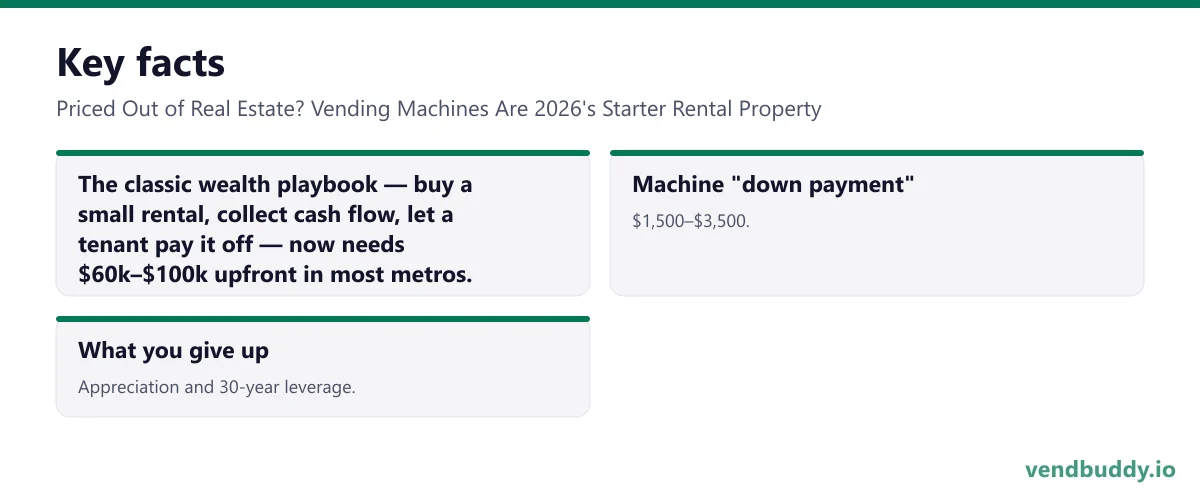
- The classic wealth playbook — buy a small rental, collect cash flow, let a tenant pay it off — now needs $60k–$100k upfront in most metros. That door has closed for most first-timers.
- The playbook itself still works. What changed is the vehicle: a placed vending machine behaves like a micro-rental — an income-producing asset at someone else’s property, paying monthly.
- Machine “down payment”: $1,500–$3,500. Typical net: $150–$400/month. First-year cash-on-cash: 50–150% vs a leveraged rental’s 6–10%.
- What you give up: appreciation and 30-year leverage. What you skip: property tax, insurance repricing, tenants, HVAC, and the $80k entry ticket.
Every generation before this one had the same starter move: scrape together a down payment on a modest rental, let the tenant pay the mortgage, and let time do the rest. At a ~$420k median home and 7%-range mortgages, that first rung now costs $60,000–$100,000 in cash before a single dollar of rent arrives — and after taxes, insurance repricing, and maintenance, many new landlords clear a few hundred dollars a month for their trouble. The rung didn’t just get expensive; on a cash-flow basis it barely pays anymore.
Part of our complete guide: best cash flow businesses.
The playbook was never about houses
Strip the real-estate playbook to its bones and it says: own an income-producing asset placed where demand already exists, collect monthly, reinvest, repeat. Nothing in that sentence requires a roof. A vending machine at a warehouse, gym, or apartment complex is the same instrument at 1/25th the ticket: your asset sits on someone else’s property, demand walks past it daily, and it pays you monthly whether or not you showed up that week.
The starter-rung math, side by side
- Starter rental, 2026: $60k–$100k down on a $300k–$420k property → $200–$500/month net if the roof, the tenant, and the insurance market all cooperate. Cash-on-cash: 6–10%. Time to recover your down payment from cash flow alone: 15–25 years.
- Starter vending machine, 2026: $1,500–$3,500 used, placed at a measured location → $150–$400/month net (the income data). Cash-on-cash: 50–150%. Time to recover the “down payment”: 6–18 months — after which the machine has effectively paid for itself and everything after is yield.
Run the rental playbook’s reinvestment loop on those numbers: machine one pays for machine two inside a year; by machine five you hold a “portfolio” producing $750–$2,000/month on less capital than half of one house down payment. That is the compounding real estate promised — arriving on a timeline you can live through. The full head-to-head with real estate’s honest advantages is in the $50k comparison, and the operators who literally sold rentals for routes explain their math in this breakdown.
Picture the machines paying you while you sleep
That’s the real promise of vending — income that doesn’t cost you your time, and a life on your own terms. VendBuddy turns this guide into a step-by-step plan so you actually build it instead of just reading about it. Start free today.
Start building free →It even fails like real estate — just cheaper
The parallels run deeper than the pitch. Location quality decides everything (a machine in a dead lobby is a vacant unit). There are bad “tenants” (a host location that closes or under-delivers on foot traffic). There is due diligence (measuring traffic before placing — the vending equivalent of running comps). The difference is the cost of being wrong: a bad rental is a $60k mistake with closing costs on both ends; a bad placement is a weekend and a hand truck — you move the machine.
What real estate still does that vending never will
Keep the comparison honest: property appreciates while machines depreciate; a 30-year fixed mortgage is the cheapest leverage a private citizen can access; and a paid-off house is shelter, which no snack machine will ever be. If you can clear the $80k entry ticket AND survive years of thin cash flow, real estate remains a phenomenal wealth vehicle. Vending is an income vehicle. The priced-out generation’s realistic sequence is income first, property later — several operators’ routes have gone on to fund exactly the down payment that started this article.
VendBuddy scores real locations near you by foot traffic and demographics — the vending version of a rental market analysis — and finds the best contact on file. Five free credits, no card.
Frequently Asked Questions
What can I invest in if I’m priced out of real estate?
Per dollar of monthly cash flow, the closest behavioral substitute for a starter rental is a small route business: vending machines ($1,500–$3,500 each, $150–$400/month net) or ATMs. REITs give real-estate exposure passively but yield 3–5%, not landlord-style cash flow.
Is a vending machine really comparable to a rental property?
As an income instrument, yes: an owned asset placed where demand exists, paying monthly, sellable later (routes trade at 1–2x annual net). As a wealth instrument, no: machines do not appreciate and cannot be financed over 30 years. Income vehicle vs wealth vehicle.
If you want a number rather than a rule of thumb, the route valuation tool takes monthly net and location mix and gives you a range. Treat it as the opening position in a negotiation, not an appraisal.
How much do I need to start a vending route instead of buying property?
One placed used machine runs $1,500–$3,500 including initial stock — roughly 3–5% of a typical 2026 down payment. Most operators start with one or two machines and reinvest the cash flow rather than writing a big check up front.
Keep going: the $50k head-to-head, all cash-flow businesses ranked, the $5k/month math, and the complete starting guide.
What is selling, which buildings say yes, and the numbers before you buy a machine. Free, confirm from your inbox, unsubscribe in one click. Refer one friend and get 25 VendBuddy credits.
Want the free 38-page Ultimate Vending Guide too? Get the guide
General information, not legal, tax or financial advice. Rules change, so check the official source. Revenue and income figures are examples, not promises. See our terms.