- Cash-on-cash: a leveraged rental typically returns 6–10% on the cash invested. A used snack machine at a decent location returns 50–150% in year one.
- Expenses: no property tax, no landlord insurance premium, no roof, no HVAC, no vacancy, no eviction. Your main cost is product — and you only buy it after the location is proving itself.
- Path to profitability: a rental is usually cash-flow-thin for years. A machine can be cash-flow-positive in its first month.
- Real estate still wins on appreciation and true passivity — vending is a business, not an investment. Most switchers keep one property and redeploy the rest.
There is a quiet trade happening among small landlords: sell the rental that nets $340 a month after the mortgage, insurance hike, and the water heater that just died — and put the equity into vending machines that net the same amount per machine, with no tenant attached. The spreadsheet behind that decision is worth seeing, because the gap is bigger than most people expect.
Part of our complete guide: best cash flow businesses.
The math that changes minds: $50,000 deployed both ways
- $50k as a rental down payment: buys roughly a $200k property. After mortgage, taxes, insurance, maintenance reserve, and normal vacancy, typical net cash flow is $300–500/month — a 7–12% cash-on-cash return, with most of the real payoff deferred to appreciation and principal paydown. Insurance repricing in 2025–26 ate a meaningful slice of that in many states.
- $50k into vending: buys 10–15 good used machines placed at vetted locations (a used snack machine runs $1,500–$3,500 — see the buyer’s guide). At the conservative end — $150–300 net per machine per month — that is $2,000–$4,000/month, a 50–100% cash-on-cash return, with the full breakdown in our $50k head-to-head comparison.
The catch, and it is a real one: the rental’s return arrives while you sleep; the route’s return requires 1–2 hours per machine per month of restocking and upkeep (the honest hours math). You are trading pure passivity for a dramatically higher yield on both your cash and your time.
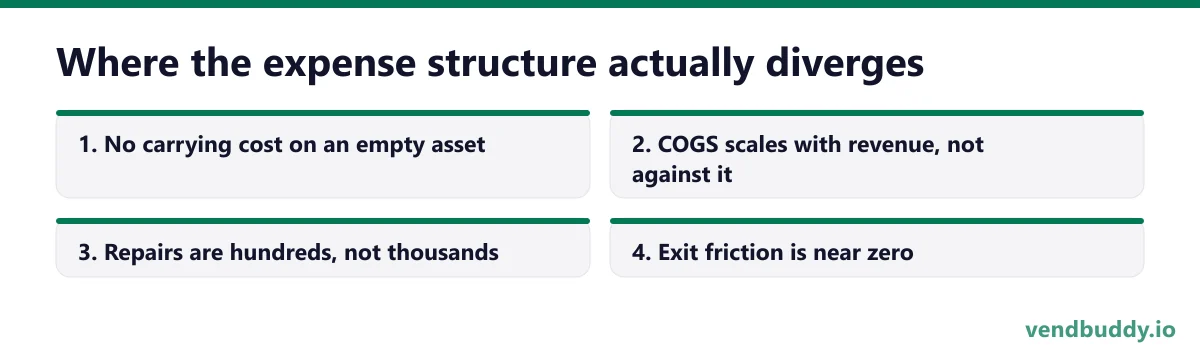
Where the expense structure actually diverges
- No carrying cost on an empty asset. A vacant unit costs you the mortgage anyway. An underperforming machine costs almost nothing while you relocate it — moving a machine is a weekend job, not a closing.
- COGS scales with revenue, not against it. Product cost (45–55% of sales) is only incurred when things sell. Property tax, insurance, and maintenance bill you whether or not rent arrives.
- Repairs are hundreds, not thousands. The worst common vending repair — a compressor — is $300–600 (repair cost guide). The worst common rental repairs start at ten times that.
- Exit friction is near zero. Machines and routes sell in weeks at 1–2x annual net (route valuation guide); a property exit costs 6–8% and a quarter of your year.
Picture the machines paying you while you sleep
That’s the real promise of vending — income that doesn’t cost you your time, and a life on your own terms. VendBuddy turns this guide into a step-by-step plan so you actually build it instead of just reading about it. Start free today.
Why the switch is accelerating in 2026
Three pressures stack: insurance and property-tax repricing compressed thin rental margins; 7%-range mortgages mean new leverage no longer flatters the math; and cashless machines quietly raised vending’s ceiling — card readers lift sales 15–35% (card reader data) while telemetry cut the labor per machine. Vending also holds up in downturns — ranked against other recession-resistant businesses here.
What real estate still does better
Credibility requires the other column: real estate appreciates (machines depreciate — useful for Section 179 deductions, useless for wealth-by-holding), supports cheap 30-year leverage, and is genuinely passive with a property manager. If you never want to touch inventory, keep the rentals. The operators who make the trade are the ones who wanted a monthly income engine, not a 20-year equity bet — the full risk comparison is in vending vs index funds vs rentals.
How operators actually make the transition
- They do not sell everything on day one. The common pattern: run 2–3 machines for 90 days while still holding the property (the 90-day location test), prove the per-machine numbers, then redeploy equity one property at a time.
- They buy machines used and routes seller-financed — a 1031-style tax shelter does not exist for machines, so keeping upfront capital small matters (seller financing guide, financing options). Both start with finding a seller, which is the slow half — the VendBuddy Marketplace buyer list is the vending equivalent of a saved MLS search: free, you set a ZIP and a radius, and it emails you when a route or a batch of used machines opens up inside it — weekly on the free list, or the day a listing goes live with the $49 one-time Priority Pass.
- They underwrite locations like they underwrote neighborhoods. The location is the asset; the machine is just the fixture. Foot traffic, dwell time, and competition decide the yield.
VendBuddy scores locations by revenue potential before you place a single machine — the vending equivalent of running comps before you buy the house.
Frequently Asked Questions
Is a vending machine a better investment than a rental property?
For monthly cash flow on invested capital, usually yes: 50–150% first-year cash-on-cash vs 6–10% for a leveraged rental. For long-term wealth via appreciation and passive holding, real estate wins. They solve different problems.
How much do I need to replace one rental’s cash flow with vending?
A rental netting $400/month is typically replaced by 2–3 well-placed machines ($4,000–$10,000 used, including initial stock) — at 1–2 hours per machine per month of servicing.
Can I sell my rental and defer taxes into vending machines?
No — 1031 exchanges only work property-to-property. But machines qualify for Section 179 first-year expensing, which offsets part of the taxable gain in the same tax year. Talk to a CPA before selling.
Related: the $50k head-to-head, vending vs laundromats vs car washes, Airbnb vs vending, ROI and payback math, and how to finance machines.
What is selling, which buildings say yes, and the numbers before you buy a machine. Free, confirm from your inbox, unsubscribe in one click. Refer one friend and get 25 VendBuddy credits.
General information, not legal, tax or financial advice. Rules change, so check the official source. Revenue and income figures are examples, not promises. See our terms.