If you have $10K–$100K and want cash flow fast, four businesses dominate the conversation: real estate, laundromats, car washes, and vending. This is the honest, numbers-first ranking on the metric that actually matters when you are building income — cash-on-cash return — plus how each one leverages financing to scale. Vending wins on capital efficiency by a wide margin; here is exactly why, and where the others are genuinely better.
Part of our complete guide: best cash flow businesses.
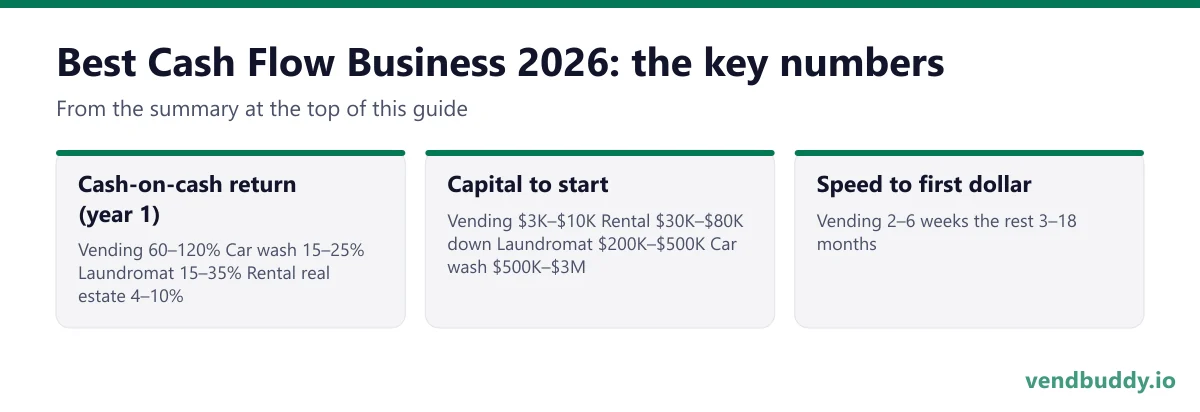
- Cash-on-cash return (year 1): Vending 60–120% · Car wash 15–25% · Laundromat 15–35% · Rental real estate 4–10%.
- Capital to start: Vending $3K–$10K · Rental $30K–$80K down · Laundromat $200K–$500K · Car wash $500K–$3M.
- Speed to first dollar: Vending 2–6 weeks · the rest 3–18 months.
- Where vending loses: No forced appreciation, no mortgage-paydown equity, and it is active income, not passive.
Why cash-on-cash return is the only fair comparison
People compare these businesses on the wrong number. “A car wash grosses $500K a year” sounds huge next to a vending machine, but it took $2M and a bank loan to build. Cash-on-cash return — annual net profit divided by the actual cash you put in — strips away the vanity and answers the real question: for every dollar you deploy, how many dollars come back this year? On that metric, the business nobody brags about at dinner parties wins decisively.
The head-to-head table
| Metric | Vending | Rental real estate | Laundromat | Car wash |
|---|---|---|---|---|
| Cash to start | $3K–$10K | $30K–$80K down | $200K–$500K | $500K–$3M |
| Cash-on-cash return (yr 1) | 60–120% | 4–10% | 15–35% | 15–25% |
| Time to first revenue | 2–6 weeks | 1–3 months | 3–6 months | 6–18 months |
| Financing to scale | Equipment loans, 0% cards, seller notes | Mortgages (best leverage) | SBA 7(a) | SBA / heavy debt |
| Appreciation / equity | None (depreciating assets) | Strong | Moderate (business value) | Moderate (real estate) |
| Downside if it fails | Move the machine | Mortgage still due | Lease + loan still due | Millions in debt |
Ranges reflect typical 2026 operator-reported and industry figures for small operators; individual results vary widely by location and management. Vending cash-on-cash assumes owner-operated placements, not passive/managed routes.
Picture the machines paying you while you sleep
That’s the real promise of vending — income that doesn’t cost you your time, and a life on your own terms. VendBuddy turns this guide into a step-by-step plan so you actually build it instead of just reading about it. Start free today.
Start building free →Why vending wins on capital efficiency
A single well-placed machine costs $3,000–$5,000 (used, cashless-equipped) and nets $150–$800/month. That is a $1,800–$9,600 annual return on a $4,000 asset — the cash-on-cash math no other option touches, because you are not buying real estate or a building lease, just a revenue-producing appliance you can relocate. Model your own placement in the free ROI & profit calculator. The catch: the return is real but earned — you find the locations, service the machines, and manage the route. That is exactly the work VendBuddy is built to systematize (find locations by ZIP, model ROI, track the pipeline).
How to leverage financing to scale faster
Cash-on-cash return is what you keep; financing is how you compound it. Real estate wins the leverage conversation long-term — a 20% down mortgage means the tenant and appreciation build equity on the bank’s money. But vending leverages differently and faster: a 0% intro-APR business card or equipment loan lets a machine pay for itself inside the promo window, and seller-financed route acquisitions (20–50% down, the rest from the route’s own cash flow) let you buy income you didn’t have to build. The full playbook is in how to finance vending machines, and you can price any route purchase with the free route valuation calculator. The pattern that beats them all: reinvest vending’s fast cash-on-cash returns into more machines, then use that stabilized income to qualify for the real-estate mortgage later. Vending funds the down payment; real estate holds the equity.
When real estate is the better call
If your goal is a 20-year, largely-passive, appreciating asset and you have $40K+ sitting idle, real estate’s leverage and tax treatment (depreciation, 1031 exchanges) are genuinely hard to beat. Vending is not a retirement vehicle — it is a cash-flow engine. See the full $50K vending vs real estate breakdown and the 3-way risk comparison.
Laundromats and car washes: great businesses, brutal entry cost
Both are proven, semi-absentee, and recession-resilient — but the entry cost is 20–300x vending’s, and the cash-on-cash return is a fraction of it because so much capital is locked in equipment and real estate. A car wash can be a $2M asset that appreciates; it is not how someone with $10K gets cash flow this quarter. Detail: laundromat vs vending unit economics.
Which should you pick?
- You have under $20K and want cash flow this quarter: vending, decisively.
- You have $40K+ idle and want a 20-year appreciating asset: rental real estate.
- You have $250K+ and want a semi-absentee anchor business: laundromat or car wash.
- The compounding play: start vending, let its 60–120% cash-on-cash returns build capital fast, then deploy that into leveraged real estate. This is the highest-return path for most people starting under $50K.
Not sure vending fits your situation? The free vending niche finder matches your time, budget, and goals to the right path — including an honest “maybe not vending” if that’s the answer.
VendBuddy finds vending-ready locations in any US ZIP with the best contact on file, models the ROI, and the Growth Coach tells you exactly how many placements to hit your income target. Free to start, 5 credits, no card.
Find your first locations free →FAQ
What business has the best cash-on-cash return?
Among the popular cash-flow businesses, owner-operated vending has the highest year-one cash-on-cash return — roughly 60–120% — because a $3,000–$5,000 machine can net $1,800–$9,600/year and requires no real estate purchase. Laundromats and car washes return 15–35% but need $200K–$3M to start; rental real estate returns 4–10% cash-on-cash but adds appreciation and equity paydown over time.
Is vending better than real estate for cash flow?
For near-term cash-on-cash return, yes — often 10x higher on the same capital, because vending needs no down payment on a building. For long-term wealth through appreciation, tax advantages, and leverage, real estate wins. The strongest strategy for most people starting under $50K is to use vending’s fast returns to build the capital that funds real estate later.
How does financing help you scale a vending business faster?
Three levers: 0% intro-APR business cards (a machine pays itself off inside the promo window), equipment loans (6–12% APR secured by the machine), and seller-financed route acquisitions (20–50% down, the balance paid from the route’s own cash flow). Because vending returns cash so quickly, financed machines often become cash-flow-positive within the first few months. See the full financing guide.
A credit line is still a debt you personally guarantee, so the honest rule is to borrow only what a signed location can repay inside the intro window. 7 Figures Funding sequences the applications for you if you would rather not apply one card at a time.
Why does vending get less attention than laundromats or real estate?
It is unglamorous and the individual numbers are small — “$400/month from a snack machine” doesn’t make a compelling YouTube thumbnail the way a $2M car wash does. But on the metric that matters for building income from limited capital — cash-on-cash return and speed to first dollar — vending quietly beats all of them.
What is selling, which buildings say yes, and the numbers before you buy a machine. Free, confirm from your inbox, unsubscribe in one click. Refer one friend and get 25 VendBuddy credits.
General information, not legal, tax or financial advice. Rules change, so check the official source. Revenue and income figures are examples, not promises. See our terms.