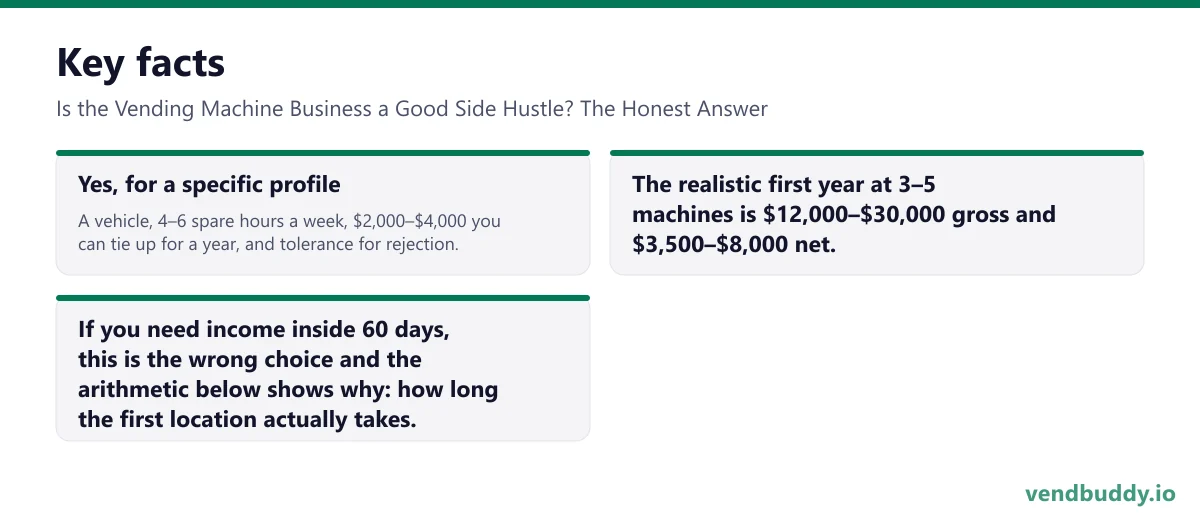
- Yes, for a specific profile: a vehicle, 4–6 spare hours a week, $2,000–$4,000 you can tie up for a year, and tolerance for rejection. Miss any one of those and it is a bad fit, not a slow start.
- The realistic first year at 3–5 machines is $12,000–$30,000 gross and $3,500–$8,000 net. That is a real side hustle and not a replacement income.
- The number one reason people quit is that landing location #1 takes weeks of rejections — not machine failure, not theft, not repairs. Almost everyone who quits does so before a machine is ever plugged in.
- What it is good at is being an asset instead of a job. It keeps paying on the weeks you do nothing, and the equipment resells. Almost no other side hustle at this budget does that.
- If you need income inside 60 days, this is the wrong choice and the arithmetic below shows why: how long the first location actually takes.
You have probably watched a video where somebody stands next to a machine and says it makes $400 a month while they sleep. The question underneath your search is not whether that is possible — it is whether it would work for you, with your budget, your hours and your patience. That is a fair question and it deserves a straight answer rather than a pitch. Here is who this genuinely suits, who it does not, and the arithmetic that settles it either way.
The honest answer in one paragraph
Vending is a good side hustle if you want an asset and a bad one if you want income. Those sound similar and they are not. A machine placed in a decent location nets $150 to $400 a month, and the working figure most operators settle on is around $330. It costs $2,000 to $4,000 all-in to get there — machine, card reader, first load of stock, and the move. So the trade you are making is: tie up three thousand dollars and two months of effort, and in exchange get roughly three hundred dollars a month that keeps arriving whether or not you did anything that week. That is a genuinely good trade if you can wait. It is a terrible one if you cannot.
Everything else in this article is just working out whether you can wait, and whether the four conditions below actually describe you.
Who it genuinely suits
Not four nice-to-haves. Four conditions, and the model breaks if any of them is missing.
If all four describe you, the honest expectation is a first year of $12,000 to $30,000 gross across three to five machines, netting $3,500 to $8,000. Full ranges and where the variance comes from are in how much vending machines actually make.
Picture the machines paying you while you sleep
That’s the real promise of vending — income that doesn’t cost you your time, and a life on your own terms. VendBuddy turns this guide into a step-by-step plan so you actually build it instead of just reading about it. Start free today.
Start building free →Who should walk away, with the arithmetic
This is the section most articles skip, so here it is with numbers attached.
If you need income within 60 days, this does not work and the math is not close. Say it is August and you need an extra $500 a month by October. A realistic timeline: two to six weeks of pitching before the first yes, often longer; one to two weeks to buy, move and stock the machine. The machine goes live somewhere around week eight. Its first month nets around $330 — and that $330 is repaying the $3,000 you spent, not paying your October bills. Cumulative net does not cross what you spent until somewhere around month nine to twelve. In the sixty-day window you asked about, vending produces roughly one payout of $330 against $3,000 gone. If the bills are due, take shifts. That is not a consolation prize, it is the correct answer to your actual question.
If you have no vehicle, the unit economics stop working. The machine has to be moved once and stocked twelve or more times a year. Truck rental at $80 to $120 a run against a machine netting $330 a month means roughly 25–35% of your net goes to logistics before you have bought a single bag of chips. One machine barely survives that. Three do not, because you cannot combine the runs efficiently without your own vehicle sitting outside.
If you cannot pitch during business hours, cut your expectations hard. Cold email and evening calls do work — there is a whole approach built around finding locations without cold calling — but they convert more slowly. Someone who can only email should budget three to four months for location one rather than six to ten weeks, and should be honest that the pipeline may never get to five machines.
If you want something genuinely hands-off, this is not it. One to two hours per machine per month sounds like nothing, and at one machine it is. At five machines with driving, sourcing, cash handling and the occasional jam, you are looking at roughly half a day a week, every week, forever. The hours-per-week breakdown puts real numbers on it, and how much time vending really takes covers what the calendar looks like at different route sizes. It is low-hours. It is not no-hours, and anyone selling it as no-hours is selling you something.
The thing that actually ends most attempts
Ask anyone who quit vending why, and you expect to hear about a broken compressor or a stolen machine. That is almost never the answer. The overwhelming majority of people who quit never place a machine at all. They budget a week for finding a location, spend six weeks getting rejected, decide the industry is saturated, and sell the machine at a loss on Facebook Marketplace.
If you are not sure where to start, most people pull a free list of the businesses near them in the before they do anything else. Five contact reveals are free and there is no card, so it costs you a search and about ten minutes.
Here is what the first location honestly looks like. You will contact somewhere between twenty and fifty venues. Most will not reply. Of the ones who do, most already have a vendor, or the decision belongs to a corporate office three states away, or the manager just does not want another thing to think about. Somewhere in there, one person says yes — and it is usually not the location you were most excited about. Median time from first pitch to signed placement runs six to ten weeks for someone working at it steadily, which the timeline breakdown covers in detail.
The second location takes about a third as long. The third is easier again, partly because you have a reference and partly because you have stopped pitching like someone who has never done this. That curve is the actual reason patience is the qualifying trait rather than capital — the business gets meaningfully easier right after the point where most people give up. It is also why most operators who fail do so in year one, and why the failure is nearly always a location-selection problem rather than an industry problem.
The honest way to test whether this suits you is to try the hard part first, before buying a machine. The free Vending Starter Guide walks the location hunt end to end — what to say, who actually decides, and how to score a venue before you commit money to it. No machine required to find out whether you can stand the rejection part.
Get the free starter guide →Against the rest of the side hustle field
Compared honestly on the five axes that actually decide whether a side hustle survives contact with your life. Vending loses several of these outright, which is the point of putting them in the same table.
| Side hustle | Cash to start | Time to first dollar | Hours/week at steady state | Asset or job? | Realistic solo ceiling |
|---|---|---|---|---|---|
| Vending (1–3 machines) | $2,000–$4,000 per machine | 6–12 weeks | 2–5 hrs | Asset — resells at 1–2x annual net | $3,000–$6,000/mo net at 10–20 machines |
| Rideshare / delivery | $0 if you own the car | Same day | Whatever you give it | Job, plus a depreciating car | Hard-capped by hours |
| Pressure washing / detailing | $2,000–$5,000 | 1–3 weeks | 10–20 hrs | Job with equipment attached | $4,000–$8,000/mo, owns your weekends |
| Reselling / flipping | $500–$2,000 | 1–2 weeks | 8–15 hrs | Inventory, not an asset | $1,000–$4,000/mo, stops when sourcing stops |
| Freelancing a skill you have | Near $0 | 2–6 weeks | As much as you sell | Job, best margins on the list | Highest here — if you have the skill |
| Content / UGC / YouTube | $0–$500 | 6–18 months, median never | 10+ hrs | Audience, mostly non-transferable | Unbounded ceiling, median outcome $0 |
| Dropshipping / print on demand | $500–$3,000 of ad budget | 2–8 weeks | 10–20 hrs | Neither — nothing to sell if it fails | Wide variance, median negative |
Read that table honestly and vending does not win it. Pressure washing pays more per dollar invested and pays faster. Freelancing an existing skill beats everything if you have one. Rideshare gets money into your account today. What vending wins on is exactly one column, and it is the asset column: it is the only entry on that list under five thousand dollars where the money turns into a physical thing that keeps producing on the weeks you are ill, on holiday, or simply cannot be bothered — and that you can sell to somebody else when you are done. The full entry-cost comparison across every model sits in side hustle startup costs ranked.
The second thing it wins on is that the hours do not scale with the money the way a service business does. Doubling a pressure-washing income means doubling the Saturdays. Doubling a vending route means adding machines to a run you are already driving. That difference does not matter in month three and it matters enormously in year three.
What a realistic first year looks like
Assume you start in January, you are working at it in the gaps around a job, and nothing unusual goes wrong.
- Months 1–2: pitching. Nothing earned, nothing spent beyond an LLC and some fuel. Most quitting happens here.
- Month 3: first yes. You spend $2,000–$4,000 all-in and the machine goes live. First partial month of revenue.
- Months 4–6: one machine, roughly $330 a month net, and you learn what actually sells at that specific site. Second location lands in this window because the pitch is much better now.
- Months 7–12: two to four machines. Cumulative net crosses what you spent on machine one somewhere around month eleven or twelve.
- End of year one: three to five machines is a good outcome, gross $12,000–$30,000, net $3,500–$8,000, and roughly four to eight hours a week going in.
That is the median good path. It is not the video. It also compounds in a way the video never shows: the machines you own at the end of year one are still earning in year two without you spending anything to acquire them again, which is why year two typically looks a great deal better than year one on the same effort. If you get far enough that servicing stops fitting into spare evenings, when a vending side hustle becomes a full-time business covers the switch.
The verdict
Vending is a good side hustle for someone patient with a car and three thousand dollars they will not miss, who wants to own something rather than be paid for hours. It is a poor one for someone who needs money soon, cannot get in front of decision-makers during the working day, or was told it was passive. If you are in the second group, the kindest thing this page can do is say so before you spend the three thousand dollars.
If you are in the first group, the entire game is location one. Everything else in this business — the machine choice, the product mix, the card reader — is a smaller decision than where the machine stands. The full start-to-first-machine walkthrough is the next thing to read, and what it actually costs to start itemizes the money.
Frequently Asked Questions
Is vending a good side hustle?
It is a good side hustle for a narrow profile and a bad one for everybody else. It suits someone with a vehicle, four to six spare hours a week, two to four thousand dollars they can tie up for a year, and enough patience to hear no twenty times while finding the first location. A solid machine nets $150 to $400 a month, so the honest expectation for a first year at three to five machines is $3,500 to $8,000 net, not a replacement income.
How much can you realistically make with a vending machine side hustle?
Per machine, $150 to $400 net a month in a decent location, with about $330 being the working figure most operators land on. Three to five machines in year one is realistically $12,000 to $30,000 gross and $3,500 to $8,000 net after product, commissions, fuel and card fees. Anyone quoting $1,000 a month from one machine is describing an outlier location, not an average one.
Why do most people quit the vending side hustle?
Because finding the first location takes far longer than they budgeted for. Most people plan for a week of phone calls and hit six to ten weeks of rejections before the first yes. Machine breakdowns and theft are real but they are not what ends most attempts — running out of patience before a machine is ever plugged in is. The people who survive that stretch tend to still be operating three years later.
Is vending a good side hustle if I have a full-time job?
Yes, and that is genuinely the best fit for it. Servicing runs about one to two hours per machine per month, so three machines fits into one evening or one weekend morning. The part that conflicts with a full-time job is not the servicing — it is the pitching, because the people who decide are reachable during business hours. If you cannot make calls or walk in between 9 and 5, this gets much harder.
How long before a vending side hustle pays for itself?
Six to twelve months from the day the machine is live, not from the day you decide to start. Add the search period in front of it: all-in cost of $2,000 to $4,000 divided by roughly $330 a month is nine to twelve months of payback, and the location hunt that precedes it usually adds another one to three months. Plan on the money being tied up for a full year.
Every figure here is an average, and averages hide the building. The revenue calculator lets you plug in the property you are actually looking at and see the range for that type.
Is vending machine business worth it as a side hustle compared to driving for a rideshare app?
They answer different questions. Rideshare pays you today and stops the moment you stop driving; vending pays nothing for two months and then keeps paying whether or not you show up that week. Per hour worked, a mature small vending route usually beats rideshare comfortably. In the first ninety days it loses badly. Pick based on whether you need cash now or an asset later.
Related: how to start a vending machine business, how much vending machines make, how long the first location takes, is vending passive income, side hustle startup costs ranked, and when a side hustle becomes a business.
What is selling, which buildings say yes, and the numbers before you buy a machine. Free, confirm from your inbox, unsubscribe in one click. Refer one friend and get 25 VendBuddy credits.
Walk-ins and cold emails find locations. A small site with your own machine photos and a request-a-machine form lets the next one find you. Around machine three to five, an AI builder drafts it in an evening. Wix is the mature site builder; Base44 also builds working tools like a quote form. Start with the AI website walkthrough or Wix vs Base44.
General information, not legal, tax or financial advice. Rules change, so check the official source. Revenue and income figures are examples, not promises. See our terms.