- Your rotation is an advantage, not an obstacle — 24-on-48-off produces about ten weekday daytime days a month. A 9-to-5 worker gets zero, and weekday daytime is the only scarce input in this business.
- Check the policy before the entity. Nearly every department has a secondary-employment rule, many require written approval, and some cover ownership as well as work.
- One hard line: you know the building stock in your district from years of driving it. That is legitimate. Trading on your official position or inspection contacts is not, and it is not a grey area.
- The absence problem has a real answer. Mandatory OT, a deployment or a court week costs you a stockout, not a customer — provided the route is one tight cluster with one backup key.
- The honest competition is your second job, not your free time. Vending pays less per hour in year one. It is the thing that keeps paying when you stop picking up shifts.
Almost every “side business for firefighters” list is written by somebody who assumes your problem is finding hours. It is not. You have more off-days than almost anyone reading this site. Your actual problems are that your days off are unpredictable in quality, that the department has a policy you have not read since academy, and that you are probably already working a second job that pays cash this week.
So this page assumes all three, and starts from the one thing your schedule genuinely gives you that a normal week does not.
The scarcest thing in this business is the thing your rotation produces
Landing a vending location requires being physically inside a business between roughly 9am and 4pm on a weekday. That is when the person who can say yes about the break room is on site. Plan on about twenty walk-ins to get one yes — a normal conversion rate, not a reflection on you.
That single requirement is why most aspiring operators stall permanently. A person with a Monday-to-Friday job cannot walk into twenty buildings without burning vacation days, so they do two, feel discouraged, and stop.
Now count yours:
| Schedule | Weekday daytime days per month | Practical verdict |
|---|---|---|
| 24 on / 48 off | Roughly 14 off-days on weekdays, of which about 7 are genuinely usable after recovery | Best in the country for this |
| 48 on / 96 off | Similar total, in longer usable blocks | Excellent — a four-day stretch runs the whole location hunt in one go |
| 4 on / 4 off, 12-hour shifts | Roughly 11 off-days on weekdays | Very good, with the caveat below about nights |
| 5-and-2 with rotating days off | 4 to 8, depending on the rotation | Good — better than a conventional week by a wide margin |
| Conventional Monday to Friday | Zero, without PTO | The reason most people never place a machine |
The honest counterweight, and anyone who has run the rotation knows it: an off-day after a bad 24 is not a working day. If you ran calls from 2am to 5am, the next morning is gone and pretending otherwise is how people conclude they failed at something they never actually attempted. Plan on using one of every two off-days for anything that requires you to be sharp and personable, and use the other for the parts that do not — restocking, ordering, driving, paperwork.
If you want the paperwork done for you instead, the starter kit has the checklist and the fill-in templates in one download. It is a one-time $27, not a subscription.
Even at that discount you have five to seven usable weekday mornings a month, which means the entire location hunt — the thing that takes an employed person four months — fits inside about five weeks.
Read the policy before you form anything
This is the part that applies to you and to essentially nobody else on this site, and it is a fifteen-minute job that prevents a genuinely bad conversation later.
Nearly every fire, police and EMS agency has a secondary-employment or outside-business policy. The shapes vary, and the things worth looking for are consistent:
- Does it require written approval, or only notification? Many require a form before you begin, and some require annual renewal.
- Does it cover ownership, or only employment? This is the one people assume their way past. Some policies address business ownership explicitly and some address only outside work for a wage. Do not guess which yours is.
- Does it restrict businesses that do business with the city or county? Common, and it is the clause most likely to matter if you ever consider placing machines in a municipal building.
- Does it restrict availability for recall or mandatory overtime? Some policies prohibit outside work that would make you unavailable. Vending is unusually easy to satisfy here, because nothing about it requires you to be anywhere at a particular hour.
- What does the collective bargaining agreement say? Sometimes more than the policy does.
In practice, an unrelated vending route is one of the easier approvals in the outside-employment category, because it involves no conflict with enforcement or response duties, no regulated products in most configurations, and no third party who could claim you were on the job. That is a reason to file the form, not a reason to skip it. An undisclosed business that surfaces two years later is a much larger conversation than a form. None of this is legal advice, and your department, your CBA and your state are the authorities.
Picture the machines paying you while you sleep
That’s the real promise of vending — income that doesn’t cost you your time, and a life on your own terms. VendBuddy turns this guide into a step-by-step plan so you actually build it instead of just reading about it. Start free today.
Start building free →The line you do not cross, stated plainly
This section exists because the temptation is genuinely there and nobody else writing about vending will name it.
If you are on a fire crew, you have been inside more commercial buildings in your district than any salesperson alive. Pre-plans, inspections, alarm calls, hydrant checks. You know which industrial park has three hundred people on nights, which apartment complex has an amenity room nobody uses, which warehouse has a vending machine that has been out of order since spring. You may also know the facility manager by name because you have stood in his office with a clipboard.
What is legitimate: the knowledge of the building stock and the geography. Knowing that the north end of your district is full of 24-hour logistics facilities is knowledge, and it is yours. So is knowing the roads, the traffic, the shift-change times and which buildings are actually occupied at 11pm.
What is not legitimate: using your official position, uniform, apparatus, inspection role or any contact you hold because of your role to solicit business. Not as a soft ask, not as a “while I am here,” not through a colleague. This is exactly the category of thing that outside-employment policies exist to prevent, it is how a routine approval becomes a disciplinary matter, and the reputational version is worse than the procedural one because it is your district and you will keep working in it.
The clean version is easy and it works: approach the building as a private citizen, on an off-day, out of uniform, through the front door, with the same script everybody else uses. You will still be better informed than every competitor. The walk-in script, with the twelve objections that come back, is here.

Five free guides cover the ground below in more detail than a blog post can — a 90-day launch plan, the location scouting checklist, the B2B pitch script with the twelve objections answered, tax deductions, and pricing. No card, delivered to your inbox in a couple of minutes.
Get the free guides →Fire, police, EMS: the differences that actually matter
Fire
The best fit of the three, and it is not close. Long predictable off-blocks, a rotation known months ahead, and a culture where side businesses are normal rather than suspicious. The 48-on-96-off departments have it best of all: a four-day off-block is enough to run an entire week of walk-ins in one stretch and then leave it alone.
The real risk is mandatory overtime and, in some regions, deployment. A wildfire assignment or a mandatory hold pattern can remove three weeks with little notice, which is the specific scenario the cluster-plus-backup-key design exists for.
The second risk is that you already have a business. A very large share of firefighters do — contracting, EMT shifts, real estate, a trade. That is worth being honest about, because two side businesses is usually one side business plus a slow guilt. If the existing one is working, this is a question about which one you want in five years, not about hours.
Police
Good fit with one persona-specific wrinkle nobody mentions: court. Subpoenas land on your off-days, they are not optional, and they arrive with little regard for what you had planned. That makes your off-days less schedulable than a firefighter and means the correct planning posture is to assume one walk-in morning a month evaporates.
The secondary-employment policy is usually more formal in police agencies than in fire, more likely to require a written application, and more likely to name prohibited categories. Read it properly rather than asking a sergeant.
The advantage is the same geographic literacy as fire, with the same hard line about position and contacts, and one addition: a lot of officers already work approved off-duty details at exactly the kind of buildings that make good vending sites — stadiums, large retail, hospitals, industrial parks. Those are buildings you have permission to be in. That is not permission to solicit while you are there.
EMS and paramedics
Same schedule advantage, with a harder honest conversation. More than fire or police, EMS staff already run a second job, frequently at a second service, and the real competitor to a vending route is that job.
The comparison is genuinely unflattering in year one. A shift at your second agency pays this week and pays a known amount. A first machine takes six to ten weeks to place, and then nets $120 to $350 a month. Per hour, in the first year, the extra shift wins.
The reason to do it anyway is the only reason that matters: the machine keeps paying on the months when you cannot pick up shifts. A second job is income that stops the day your body or your family says stop. Four machines netting $1,000 a month is roughly one shift a week you never have to take again, and it does not care whether you are sick, injured or on holiday. If the household budget needs money in the next sixty days, take the shift. If the goal is to stop needing the shift, this is the trade.
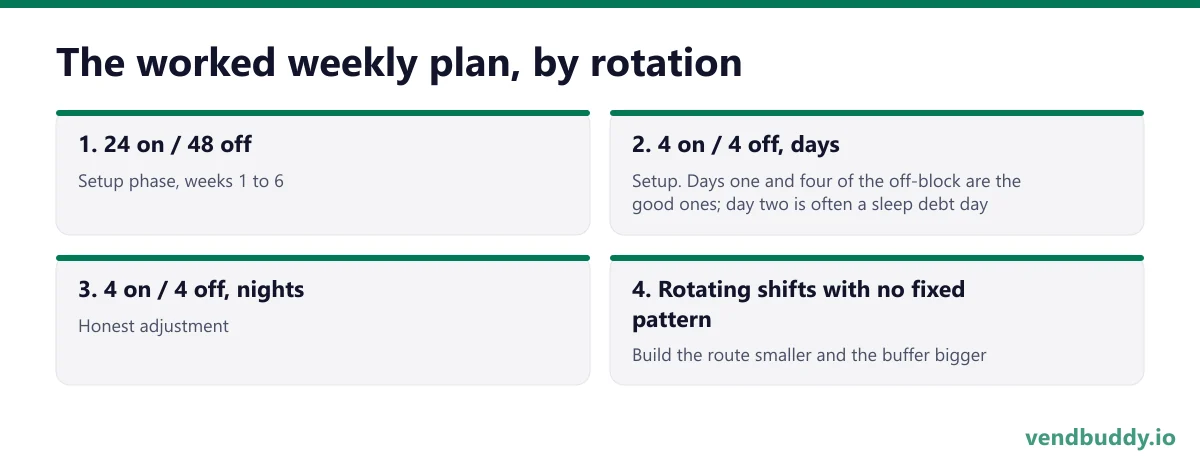
The worked weekly plan, by rotation
24 on / 48 off
Setup phase, weeks 1 to 6. Off-day one after a shift is recovery and admin: target list, emails, follow-ups, ordering. Off-day two is the working day: four to six walk-ins between 9:30am and 1pm. That is roughly seven walk-in days over six weeks, or thirty buildings, which at a normal conversion rate is one to two yeses.
Running phase. One service run of 90 minutes per machine, dropped onto whichever off-day suits. A three-machine cluster is a single morning. Ordering happens on a shift-day evening because it does not require anyone to be awake.
4 on / 4 off, days
Setup. Days one and four of the off-block are the good ones; day two is often a sleep debt day. Two walk-in mornings per block, three blocks a month, is twenty-four buildings a month. First placement in five to eight weeks.
4 on / 4 off, nights
Honest adjustment: your off-block starts with a day you cannot use. Coming off four nights, the first off-day is a write-off for anything requiring conversation. Plan two usable mornings per block from days two and three, and put restocking on day one, because a machine does not care whether you are conversational.
The compensating advantage is real: night shift means you are awake and mobile during the hours nobody else is, which makes servicing 24-hour sites — warehouses, plants, hospitals-adjacent buildings — genuinely easier for you than for a day-shift operator. The 24-hour site guide is here.
Rotating shifts with no fixed pattern
Build the route smaller and the buffer bigger. Two machines you can always service beats five you sometimes can. Set par levels high so a machine can carry two weeks, and put a card reader with telemetry on from day one so you know which machine needs the trip rather than guessing. What card readers cost and what the fees actually are is here.
The objection only you have: what happens when I get held over for three weeks
Every business has an availability question. Yours is more acute, because your unavailability is mandatory, unpredictable and occasionally measured in weeks.
The honest answer is that vending handles this better than nearly anything else you could start, and it is worth being precise about why. In a client business, three weeks of silence loses the client. In anything with a same-day promise, the promise is the product. In a route, three weeks of no fills means the machine sells out, you lose that revenue, and you send an apologetic text. The property manager is mildly inconvenienced by a machine, not by a failure that costs them anything.
But “survivable” is not “ignore it,” and the design work is small:
- One cluster. Everything within fifteen minutes, so any single person can cover the whole route in one trip.
- One backup with a key and a written fill sheet. A spouse, a crewmate, an adult kid. Agreed in advance, with product par levels written down and cash handling settled. Arrange this before the first recall, not during it. What paid help costs if you do not have a volunteer is here.
- Telemetry. A cashless reader that reports sales tells you which machine needs attention, which turns a three-machine emergency into a one-machine errand.
- High par levels going into anything you can see coming. If you know a hold or a deployment is likely, a full fill buys you two weeks instead of one.
Before you size the route at all, it is worth running the numbers on what you actually need it to produce. The Income Reality Calculator takes your capital, your real available hours and your target income and returns the machine count and the timeline that implies — which for most shift workers is the moment the plan gets smaller and more achievable at the same time.
Your rotation gives you the one thing nobody else has - weekday mornings. The waste is spending them on buildings that were never going to say yes. VendBuddy scores real venues near you by traffic, headcount and category, gives you the best contact on file for each, and models the monthly net before you walk in. Five free credits, no card.
When the honest answer is no
- If your department policy says no, or says yes with conditions you cannot meet. Find out first. This is not a rule to test.
- If you are already working two jobs and sleeping five hours. Adding a third thing to a schedule that is already producing sleep debt is not entrepreneurship, it is a slow injury. The version that works is replacing something, not stacking.
- If you need the money this month. The extra shift is faster and more certain. Build the route with money you are not counting on.
- If you are on a duty-related disability or a pension arrangement with earnings conditions. Check with your pension board or benefits office before you earn, not after. Same principle as everything else on this page: the free conversation beats the expensive surprise.
The bottom line
You are not fitting a business around a difficult schedule. You have the schedule this particular business wants, and almost nobody else does. Ten weekday off-days a month against a normal person zero is not a small edge; it is the entire bottleneck of the business, handed to you by a rotation you already work.
What you have to do in return is read the policy before you form anything, keep an absolute wall between the job and the pitch, build one tight cluster instead of a scattered route, and arrange one backup key before the first mandatory hold. Do those four things and a rotation that makes most businesses impossible makes this one straightforward.
Related reading: starting a business while working full time, healthcare and 24-hour facility vending, 24-hour site vending, is vending a good side hustle, your first $100 in vending, and hiring route help.
Frequently Asked Questions
Can a firefighter run a vending machine business?
The schedule is one of the best in the country for it, and the thing to check first is policy rather than time. Nearly every department has an outside-employment or secondary-employment rule, and many require written approval before you start, restrict businesses that contract with the city, and prohibit anything that interferes with recall availability. Some departments treat passive ownership differently from active outside work. Read your policy and your collective bargaining agreement, and file whatever your department requires before you form an entity. Nothing here is legal advice or a statement about your department.
What is the best side business for shift workers?
The one that needs weekday daytime and does not need you to be reachable on a schedule you do not control. That describes vending almost exactly. Landing a location requires being physically inside a business between roughly 9am and 4pm on a weekday, which almost nobody with a conventional job can do, and a 24-on-48-off rotation gives you roughly ten weekday off-days a month. Once machines are placed the work is a fixed weekly loop you schedule yourself, and a missed week costs a stockout rather than a customer. Businesses with clients, inboxes or same-day promises are the ones that fight a shift rotation.
Can a police officer own a business?
Most departments permit outside business ownership subject to a written secondary-employment policy, and most of those policies restrict specific categories rather than banning ownership outright. The usual restrictions involve businesses that do work for the city, anything involving alcohol or regulated products, anything that could create a conflict with enforcement duties, and any use of your position, uniform or department resources. Approval processes and renewal requirements vary by agency. Read the policy, file the paperwork, and treat the disclosure as routine rather than as something to avoid, because an undisclosed business that surfaces later is a much larger conversation.
How does a 24-on 48-off schedule work with a side business?
It works better than a conventional week for anything that needs daytime access to businesses. A 24-on-48-off rotation means two of every three days are off, and most of them land on weekdays, which produces roughly ten weekday daytime days a month against zero for a 9-to-5 worker. The realistic adjustment is that the day immediately after a busy 24 is a recovery day rather than a working one, so plan on using one of every two off-days rather than both. Restocking is schedule-agnostic and fits either off-day comfortably.
Is vending a good side business for EMS and paramedics?
It suits the schedule for the same reasons it suits fire, with one honest caveat that applies more to EMS than to anyone else: a large share of paramedics already work a second job, often at a second service, and vending competes with that rather than with free time. In the first year vending will pay less per hour than a shift at your second agency. What it does instead is build something that keeps producing when you stop picking up shifts, which is the actual trade being made. If the household budget needs the money this month, the extra shift wins. If the goal is to stop needing the extra shift, the route wins.
Do I need department approval to start a vending business?
Very likely, and it costs you nothing to find out. Most fire, police and EMS agencies require notification or written approval for outside employment or business activity, with a defined form and sometimes an annual renewal. The categories that get denied are usually conflicts with the agency, not unrelated small businesses, and an unrelated vending route is generally an easy approval where approval is required at all. The mistake to avoid is assuming that ownership without labour falls outside the policy, because some policies cover ownership explicitly and some do not.
What happens to my vending machines if I get mandatory overtime or deployed?
A stockout, and nothing worse, which is the specific reason this business fits emergency services. A missed fill means lost sales for a week and an apologetic text to the property contact. It does not mean a lost client, a broken promise or a refund. Design for it anyway: keep every machine inside one cluster you can service in a single trip, use telemetry so you know which machine actually needs the visit, and have one person with a key and a written fill routine before the first mandatory recall rather than during it.
Most operators end up on Nayax for telemetry because it is what the distributors already support. Their reader handles tap, chip and the telemetry feed in one box, and the monthly fee is the part to check against your per-machine volume before you commit the route to it.
What is selling, which buildings say yes, and the numbers before you buy a machine. Free, confirm from your inbox, unsubscribe in one click. Refer one friend and get 25 VendBuddy credits.
Walk-ins and cold emails find locations. A small site with your own machine photos and a request-a-machine form lets the next one find you. Around machine three to five, an AI builder drafts it in an evening. Wix is the mature site builder; Base44 also builds working tools like a quote form. Start with the AI website walkthrough or Wix vs Base44.
General information, not legal, tax or financial advice. Rules change, so check the official source. Revenue and income figures are examples, not promises. See our terms.