- The payback period is the answer to the age question. A machine repays itself in 8 to 16 months. “Too old” only makes sense if the payback were measured in decades.
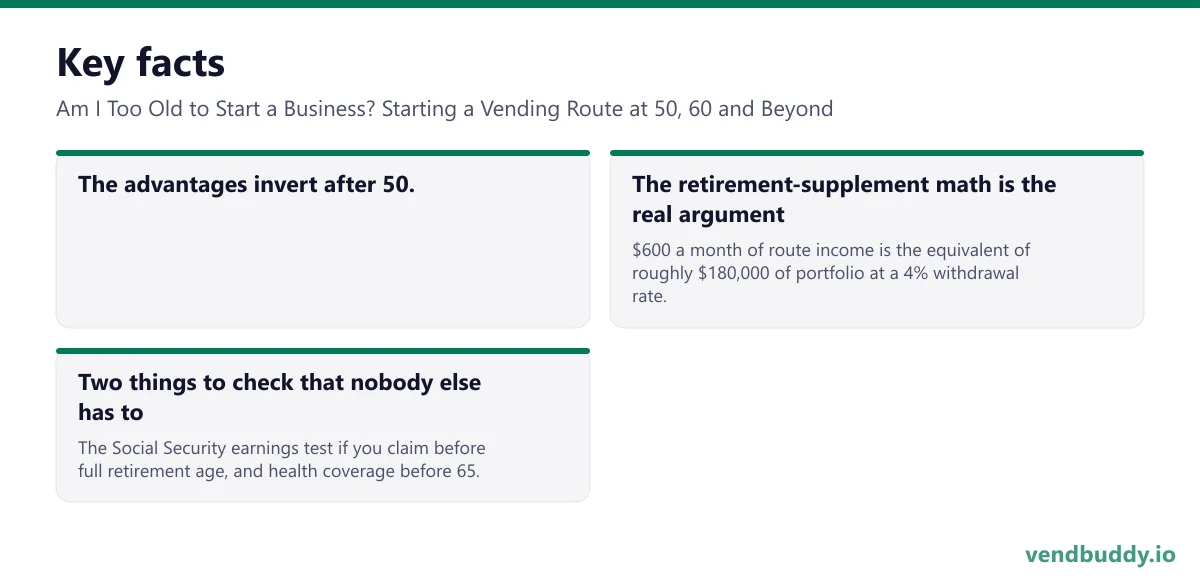
- The advantages invert after 50. Every younger reader on this site has time and no capital. You have capital and schedule control, and this is a business where those are the two binding inputs.
- The heavy part is one day and it is hireable. $150 to $400 puts a 700-pound machine on the wall. The weekly work is a loaded shopping cart.
- The retirement-supplement math is the real argument: $600 a month of route income is the equivalent of roughly $180,000 of portfolio at a 4% withdrawal rate. The route cost about $10,000.
- Two things to check that nobody else has to: the Social Security earnings test if you claim before full retirement age, and health coverage before 65. Both are planner conversations, not blog conversations.
The question people type is “am I too old to start a business.” The question underneath it is usually narrower and more reasonable: do I still have enough runway for this to be worth it, and is my body going to be a problem? Both of those have real answers, and neither of them is a poster about how sixty is the new forty.
So: the arithmetic first, the physical honesty second, and then the parts of this that are genuinely different for you than for the twenty-eight-year-old reading the same site.
The runway question, answered with arithmetic
The reason “am I too old” feels like a real objection is that most business advice is written about businesses with long payback periods. A restaurant, an agency, a software product, a brand — those are three-to-seven-year propositions where a shorter horizon genuinely changes the maths, and the advice absorbed that assumption.
Vending does not have that shape. A used machine placed in a measured building costs $2,000 to $5,000 all in and typically returns its own cost in 8 to 16 months. That is the entire commitment. At 58 you are not asking whether you will still be doing this in 2050. You are asking whether you will still be doing this next autumn.
And the second half of the arithmetic is the part that gets left out: a route is a sellable asset. Routes change hands regularly, commonly somewhere around 12 to 24 times monthly net depending on contracts, equipment age and how transferable the locations are. A business you can hand to somebody for a cheque is a fundamentally different proposition at 60 than a business that evaporates the day you stop showing up. What routes actually sell for, and what makes one saleable, is here.
So the honest version of the runway question is not about your age. It is: can you tolerate an eight-to-sixteen-month payback, and do you want the thing that exists at the end of it? Those are answerable.
The physical part, without the pep talk
This is the section most articles skip, and skipping it is how people end up in an emergency room with a machine on a hand truck at the bottom of a loading ramp.
A full-size snack or drink machine weighs roughly 600 to 800 pounds empty. Loaded, more. It is tall, top-heavy, has a centre of gravity that shifts when the door swings, and it will kill somebody on a ramp if it goes over. This is true at 30 as well. The difference after 50 is only that the consequences of getting it slightly wrong are larger and the recovery is longer.
The good news is that this is a one-time, hireable problem, not a recurring one:
- Freight with a liftgate and inside delivery when you buy from a distributor. Commonly $150 to $400 depending on distance and whether the site has a dock. This is the answer for most people and it is worth every dollar.
- A local appliance or piano mover for a used machine bought within driving distance. Two people, straps, a stair-climbing dolly, usually an hour of work.
- A smaller machine. Countertop and small-footprint units, snack-only towers and smart coolers exist specifically because not every site or operator wants 800 pounds. They earn less per site, and for a first machine that is often a reasonable trade.
What the job actually is, week to week, is much smaller than the install: carrying product totes of 20 to 40 pounds from a vehicle to a machine, and standing for 20 minutes filling coils. A folding platform cart takes most of that away. If you can push a loaded cart across a parking lot and lift a case of bottled drinks safely, you can service a route. If you cannot, the adjustment is not to quit — it is to filter locations for ground floor and door-adjacent parking, split the fill into two lighter trips, and stop buying twenty-four-count cases of water. The solo-move guide covers what is safe to do yourself and what is not, and the honest summary of it is that a lot of it is not.
Picture the machines paying you while you sleep
That’s the real promise of vending — income that doesn’t cost you your time, and a life on your own terms. VendBuddy turns this guide into a step-by-step plan so you actually build it instead of just reading about it. Start free today.
Start building free →The advantage nobody tells you about: everything inverts
Every other reader profile on this site is short of one of two things. The twenty-four-year-old has time and no capital. The parent of three has capital and no protected hours. The person with a full-time job has money coming in and zero weekday daytime.
After 50, and particularly after 55, the pattern usually flips on both axes at once, and this is a business where those are exactly the two binding inputs:
| The 25-year-old | The employed parent | You, at 55–65 | |
|---|---|---|---|
| Capital for machine one | Usually borrowed, often on a card | Available but contested | Usually available outright |
| Weekday daytime hours | None | Fragmented | Frequently controllable |
| Credibility at the walk-in | The hardest part of their pitch | Fine | Assumed before you speak |
| Local network of decision-makers | Thin | School and neighbourhood | Thirty years deep |
| Pressure to be right immediately | High | High | Low — and that is worth more than it sounds |
The third row deserves its own paragraph because it is real and slightly uncomfortable. A property manager deciding whether to let a stranger put a machine in their break room is making a judgement about reliability in about ninety seconds. A fifty-eight-year-old in a clean shirt saying “I service it every Tuesday and here is my number” gets a different reception from a twenty-three-year-old saying the same words. That is not fair and it is not a claim about competence. It is just a thing that happens, and it happens in your favour.
The fourth row is the one that actually produces placements. Thirty years in a metro means you know a facilities manager, a plant supervisor, a gym owner, a church administrator, a storage operator and somebody on an HOA board. Every one of those is a building. Most first-time operators spend eight weeks cold-walking to reach the position you start in. The map of who actually decides at each property type is here — read it and you will find you already know several of them by name.
The retirement-supplement math, done properly
The usual way this gets presented is a monthly number, which is not very illuminating. Here is the framing that actually lands for anyone who has spent the last decade thinking about a portfolio.
Three machines in a tight cluster, each netting a modest $200 a month, is $600 a month, or $7,200 a year. To generate $7,200 a year of withdrawals at the conventional 4 percent rule, you would need roughly $180,000 of invested capital.
The route required about $10,000 of equipment and product, plus one Saturday morning a week.
That comparison is not a claim that a vending route is better than an index fund, and it is not risk-adjusted — a portfolio does not require you to show up, does not have a compressor that fails, and does not depend on one property manager renewing. But it does reframe the decision correctly. You are not comparing a business to a job. You are comparing a small operating asset to the capital it would take to replicate its cash flow, and on that comparison the small operating asset looks very different than it does in a YouTube thumbnail.
Two honest adjustments before you use that number for anything. First, net means net — after product cost, commission to the property, card processing and fuel, not gross. The margin breakdown is here and it is the number most people get wrong by half. Second, run your own version rather than mine: the Income Reality Calculator takes your capital, your available hours and your target monthly income and tells you the machine count and the timeline that implies. It is deliberately unflattering.

Five free guides cover the ground below in more detail than a blog post can — a 90-day launch plan, the location scouting checklist, the B2B pitch script with the twelve objections answered, tax deductions, and pricing. No card, delivered to your inbox in a couple of minutes.
Get the free guides →Two things to check that apply to nobody else on this site
The Social Security earnings test, if you are claiming before full retirement age. Once you have reached full retirement age, benefits are generally not reduced by what you earn. Before it, an annual earnings test applies and benefits can be temporarily withheld above a limit that changes every year; for self-employment it is net earnings that count, not gross revenue, and amounts withheld are generally recalculated into later benefits rather than simply lost. The numbers move annually and the interaction with a small business is genuinely worth ten minutes with the Social Security Administration or a financial planner before you decide how hard to push in a given calendar year. Nothing here is financial advice.
Health coverage before 65. If you are leaving employment early to do this, the coverage gap between your last day and Medicare eligibility is usually the single largest number in the plan, and it is often larger than the business. Marketplace coverage, a spouse plan and COBRA are the usual three routes and they price very differently. Self-employed health insurance has its own tax treatment, which is a CPA question. Cost this before you resign anything, because it is the item that most often turns a workable plan into an unworkable one.
And one thing to check that is not persona-specific but matters more here: do not fund a first machine out of a retirement account. Taking a distribution or a loan to buy unproven equipment converts a protected, compounding asset into an experiment at the stage of life where the recovery window is shortest. A first machine is a $2,000 to $5,000 decision. If that money is not available outside your retirement accounts, the correct read is not that you should tap them — it is that you should do the location hunt first, which costs almost nothing, and revisit the purchase when a signed location makes the equipment financeable on its own merits. The low-capital routes are here.
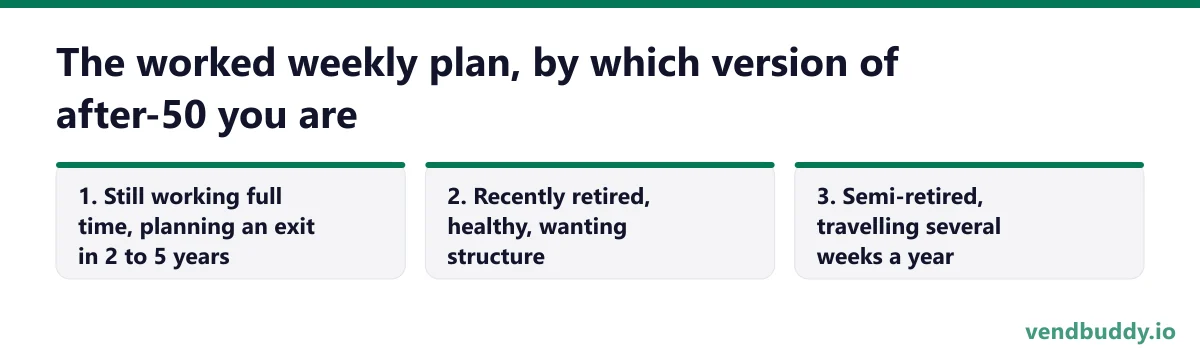
The worked weekly plan, by which version of after-50 you are
Still working full time, planning an exit in 2 to 5 years
Setup: 4 to 6 hours a week, and your constraint is the same weekday-daytime problem everyone employed has. Use PTO deliberately: two half-days of walk-ins produces more progress than six evenings of research. Running: 90 minutes a week per machine.
Target shape: four to six machines by the time you leave, netting $1,200 to $2,000 a month combined. That is not a salary replacement and it is not supposed to be. It is the piece of the retirement income plan that is not correlated with the market and that you control. If replacement genuinely is the goal, the real number is here, and it is about 28 percent higher than your salary.
Recently retired, healthy, wanting structure
Setup: 6 to 8 hours a week and a first placement in four to six weeks, which is faster than almost any other reader profile on this site can move, because you can walk into buildings on a Tuesday morning and nobody else can.
Running: one service morning a week for a three-machine cluster. The discipline that matters is keeping the cluster tight. A route that spans a county is what turns a pleasant Tuesday into a chore you resent by March.
The under-discussed benefit here is the one retirees actually report: a reason to be somewhere on a schedule, a handful of ongoing relationships with people at your locations, and a scoreboard. Several operators in this bracket describe the structure as the point and the money as the bonus. Take that seriously when you are sizing the route — three machines you enjoy beats eight you resent.
Semi-retired, travelling several weeks a year
This is a design problem, not an obstacle, and it is solvable in advance rather than in a panic. Two rules: keep every machine inside one cluster, and arrange one named person with a key and a written fill routine before your first trip, not after. A three-week absence in vending costs you a stockout and some lost sales; the same absence in a client business costs you the client. What a part-time stocker costs and how to structure it is here.
The gap between a machine that nets $150 and one that nets $600 is the building, and you can evaluate that before spending a dollar on equipment. VendBuddy scores real venues near you by traffic, headcount and category, gives you the best contact on file for each, and models the monthly net before you pitch. Five free credits, no card required.
When the honest answer is no
- If lifting 30 pounds repeatedly is not safe for you. Not “is unpleasant” — is not safe. Back, shoulder, knee, cardiac. The install is hireable; the weekly fill is not, unless you pay somebody every week, and paying somebody every week on one machine erases the margin. Be honest with yourself about this before you buy, not in month three.
- If this money has to work. A route is a supplement, not a rescue. If the plan requires $4,000 a month within a year, you are looking at eight to twelve machines, six figures of capital and a real job, and there are better vehicles for that. The honest fit assessment is here.
- If you want it to be passive. It is not. It is asynchronous, which is genuinely better for your life stage, but it involves a car, a cart and a Tuesday. If what you actually want is a return with no obligations, that product exists and it is a brokerage account.
- If you are doing it because you are bored rather than because you want it. Boredom will get you through the research and will not get you through the eleventh building saying no. That part requires actually wanting the outcome.
The bottom line
You are not too old. The question was never really about age, because the asset repays itself in under a year and can be sold at the end. What the question was actually about is whether the physical side is manageable and whether the maths is worth it, and both of those have specific answers: the heavy day is hireable for a few hundred dollars, and $600 a month of route income is the cash-flow equivalent of roughly $180,000 of portfolio.
What you should not do is treat this as a young person business you are catching up on. You are not behind. You are arriving with capital, schedule control, a thirty-year local network and a face that property managers trust on sight, which is a materially better starting position than most of the people you would be competing with for a break room.
Still deciding whether to start anything at all? The readiness quiz takes about two minutes and two of its outcomes rank something other than vending first. If the answer is already yes, the start page is the shortest path to a first location.
Related reading: moving a machine safely, what a route sells for, investing $10k for cash flow, the ROI and payback maths, starting a business while working full time, and whether vending is right for you.
Frequently Asked Questions
Am I too old to start a vending machine business?
Age is not the constraint people think it is here, because the payback period is measured in months rather than decades. A used machine placed in a measured building costs $2,000 to $5,000 all in and typically repays itself in 8 to 16 months, which means the question is not whether you have thirty years left but whether you have two. What does change after 50 is the physical plan: full-size machines weigh 600 to 800 pounds empty and moving one is genuinely a job for equipment and hired help rather than for you and a friend. Everything after the install is carrying 20 to 40 pound totes from a car to a break room, which is a shopping trip, not a labour job.
Is vending a good business for retirees?
It fits the retirement case unusually well for three structural reasons. The work is scheduled by you rather than by customers, so travel and grandchildren do not create a crisis. The income is genuinely uncorrelated with the stock market, which matters more once you are drawing down rather than accumulating. And the asset is sellable: routes commonly change hands at somewhere around 12 to 24 times monthly net, so it is not a business that dies when you stop. The honest counterweight is that it is not passive, it involves lifting, and a retiree who wants zero obligations should buy an index fund rather than a machine.
Are vending machines too heavy to handle at 60?
The machine itself is, and that is fine, because moving it is a one-time hireable job rather than a weekly one. Freight with a liftgate plus inside delivery, or a local appliance mover, typically runs $150 to $400 and puts the machine on the wall for you. The recurring physical demand is much smaller: carrying product totes of 20 to 40 pounds from a vehicle to the machine, which a folding platform cart reduces to almost nothing. The honest filter is whether you can push a loaded cart and lift a case of drinks safely. If you cannot, choose ground-floor locations with dock or door access and buy the smaller machine.
How much can a vending route add to retirement income?
A realistic first machine in an ordinary building nets $120 to $350 a month. A good site nets $500 to $1,000. Three machines in a tight cluster netting $600 a month together is $7,200 a year, and the useful way to see that number is as a portfolio equivalent: at a 4 percent withdrawal rate, generating $7,200 a year would require roughly $180,000 of invested capital. The route required about $10,000 and some Saturday mornings. That comparison is the actual argument for doing this after 50, and it is also why the location quality matters more than anything else.
Does running a business affect Social Security benefits?
If you have already reached full retirement age, benefits are generally not reduced by earnings. If you claim before full retirement age, an annual earnings test applies and benefits can be temporarily withheld above a limit that changes each year, with net earnings from self-employment counted rather than gross revenue. Withheld benefits are generally recalculated later rather than lost forever. This is a real planning consideration with numbers that move annually, and it is worth confirming with the Social Security Administration or a financial planner before you decide how much to earn in a given year rather than after.
What is the best business to start at 50 with savings?
The filter that matters at 50 is different from the one at 25. You are optimising for capital preservation and time control rather than for upside, which rules out anything that needs a long unpaid runway and anything whose value is your own labour. What survives that filter is small owned assets that produce cash quickly and can be sold: vending, laundromats, self-storage and ATMs are the usual four. Vending is the cheapest entry of the group by an order of magnitude, which is why it is the common starting point. The rule is to size the first purchase so that losing it entirely would be annoying rather than material.
Should I use retirement savings to start a vending business?
The general answer is no, and this is worth being blunt about. Taking a distribution or a loan from a retirement account to buy a first machine converts a protected, growing asset into an unproven one, and it does it at the exact stage of life where the recovery window is shortest. A first machine costs $2,000 to $5,000, which is a savings-account decision rather than a retirement-account decision. If that amount is not available outside your retirement accounts, the honest read is not that you should tap them, it is that the timing is wrong and location-hunting first costs almost nothing while you wait.
Prices move around more than any guide keeps up with. The machine finder is where we keep the current line-up, sorted by what a location that size can realistically support rather than by what looks impressive.
What is selling, which buildings say yes, and the numbers before you buy a machine. Free, confirm from your inbox, unsubscribe in one click. Refer one friend and get 25 VendBuddy credits.
Walk-ins and cold emails find locations. A small site with your own machine photos and a request-a-machine form lets the next one find you. Around machine three to five, an AI builder drafts it in an evening. Wix is the mature site builder; Base44 also builds working tools like a quote form. Start with the AI website walkthrough or Wix vs Base44.
General information, not legal, tax or financial advice. Rules change, so check the official source. Revenue and income figures are examples, not promises. See our terms.