- Your replacement number is not your salary. Take-home plus the employer health contribution, the retirement match and self-employment tax typically lands about 28 percent above take-home.
- Calculate it before you pick a model, because the number decides the customer count, and the customer count decides whether the plan is a side hustle or a second full-time job.
- Recurring beats one-off for a salary target. Accumulating customers means ten hours a week compounds; a run-rate business resets to zero every month.
- Plan on 18 months to three years on side-hustle hours. Freelancing at a rate you already command can be faster.
- The exit rule: three consecutive months above the replacement number. One good month is noise, and leaving on noise is the most common way a working business still fails.
The question is usually phrased as how do I replace my 9 to 5 salary, and the phrasing itself contains the first mistake. Your salary is not the number you have to replace. It is smaller than the number you have to replace, by a margin most people discover about four months after they resign.
Here is the honest sequence: work out the real replacement number, translate it into a customer count using an average ticket you could plausibly charge, check that count against the hours you actually have, and only then pick a model. Doing it in that order takes an afternoon and prevents the two failures that account for most of them — aiming at the wrong number, and leaving too early.
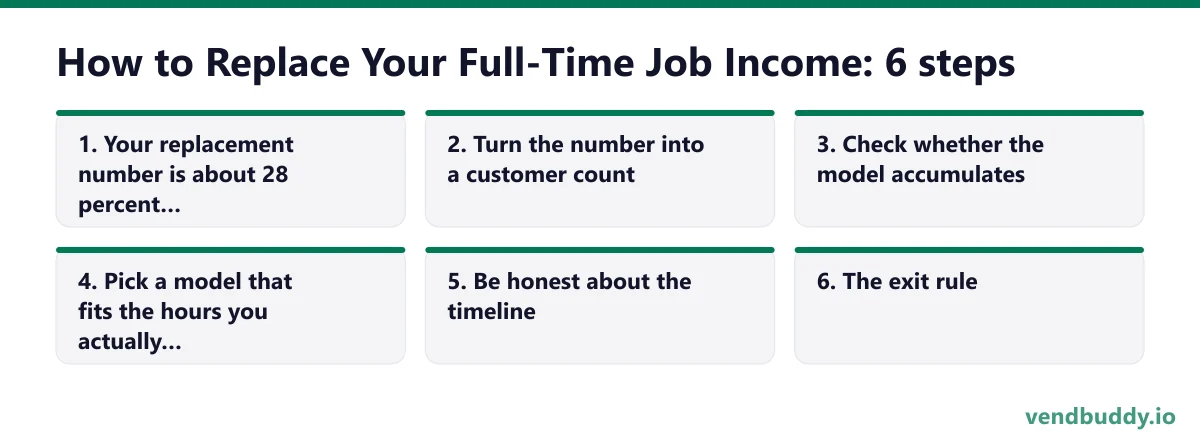
Step 1: your replacement number is about 28 percent higher than you think
A salary is not just the money. It is a bundle, and four parts of the bundle disappear the day you resign.
| What you lose | Typical size | Why it bites |
|---|---|---|
| Employer health contribution | $500–$1,400 a month for a family | The employer pays most of the premium. On the individual market you pay all of it. |
| Retirement match | 3–6% of salary | Free money that simply stops. It is compensation, not a perk. |
| Employer payroll tax | 7.65% of wages | Self-employment tax puts both halves on you. |
| Paid time off | 2–4 weeks | Self-employed, a week off is a week unpaid. It is roughly 6% of annual income. |
Add those up against take-home pay and the total commonly lands somewhere around 28 percent above what lands in your bank account today. It is a planning average and your own number will differ — if your employer covers a family plan it is higher, if you are on a spouse plan and there is no match it is much lower. Build it from your own benefits statement rather than trusting the average, because this is the one number in the whole exercise you can calculate exactly.
| Take-home now | Rough replacement number | Annual run rate it implies |
|---|---|---|
| $3,500/mo | ~$4,500/mo | ~$54,000 |
| $5,000/mo | ~$6,400/mo | ~$77,000 |
| $7,000/mo | ~$9,000/mo | ~$108,000 |
| $10,000/mo | ~$12,800/mo | ~$154,000 |
That is the target. Not the salary, not the take-home. Aiming at take-home is how people replace their income on paper and find themselves short by a grand a month in practice.
Put your replacement number into the Income Reality Calculator with your real deadline and the hours you can actually protect. It gives back the customers, meetings, conversations and outreach per day behind it across ten business models — and it says so plainly when the goal does not fit the hours. Free, no signup, no income claims.
Work out what my replacement number costs →Step 2: turn the number into a customer count
Replacement number divided by average ticket. That is the entire calculation, and it is the moment most plans get realistic.
Say your replacement number is $6,400 a month. At a $250 monthly ticket — a placed vending machine, a lawn account — that is 26 live customers. At a $160 lawn ticket it is 40. At a $2,000 freelance retainer it is three. At a $180 detailing job it is 36 jobs every single month, forever, because that model does not accumulate.
Three clients versus thirty-six jobs a month is not a difference in ambition. It is a difference in what you decided to sell, and it is decided before you do any work at all.
Picture the machines paying you while you sleep
That’s the real promise of vending — income that doesn’t cost you your time, and a life on your own terms. VendBuddy turns this guide into a step-by-step plan so you actually build it instead of just reading about it. Start free today.
Start building free →Step 3: check whether the model accumulates
This is the distinction that decides whether ten hours a week compounds or evaporates, and almost nothing written about replacing your income mentions it.
Accumulating models — routes, retainers, service contracts, subscriptions — keep paying for work you did last year. A machine placed in March pays in November. That means your monthly close requirement is the total customer count divided by the months available, so a twenty-four month plan is a genuinely gentle pace: 26 machines over 24 months is roughly one a month.
Resetting models — one-off jobs, flips, most commission sales — give you a run rate you must hit again every month. Thirty-six detailing jobs in March means thirty-six more in April. A longer deadline reduces the monthly requirement by exactly nothing, because there is nothing to build on.
For replacing a salary specifically — a recurring monthly obligation — the accumulating shape is structurally easier and considerably harder to lose. A resetting model can absolutely replace your income, but it replaces it as another job rather than as an asset, and it is worth knowing which one you are signing up for before you spend two years on it.

Five free guides cover the ground below in more detail than a blog post can — a 90-day launch plan, the location scouting checklist, the B2B pitch script with the twelve objections answered, tax deductions, and pricing. No card, delivered to your inbox in a couple of minutes.
Get the free guides →Step 4: pick a model that fits the hours you actually have
Not the hours you imagine on a Sunday. The hours that survive a bad week at work.
| Model | Shape | Time to first dollar | The real constraint |
|---|---|---|---|
| Freelancing / consulting | Recurring retainers | Weeks | You stop selling while you deliver — feast and famine |
| Vending or ATM route | Accumulating units | 1–2 months | Capital per unit, and the servicing hours grow with the income |
| Lawn care / detailing / power washing | Mixed | Days | Seasonal, weather-bound, and your hours are the product |
| Marketing agency | Recurring retainers | 1–3 months | Delivery eats the hours you need for selling |
| Commission sales | Resets monthly | Weeks | Rejection volume, and chargebacks on lapsed policies |
| Buying a small business | Cash flow on day one | Immediate | Capital, and inheriting whatever the previous owner left behind |
Rough planning shapes, not promises. The filter that matters most for anyone still employed is not on that table though: does the model need you during business hours? A business that requires you to answer a phone at 2pm on a Tuesday is incompatible with a full-time job regardless of how many evening hours you have, and that single constraint eliminates more options than capital does.
The longer comparison of income-replacement businesses ranks these on capital, time to first dollar and how well each survives being run on evenings. If you are not yet sure you should be starting anything, the readiness quiz checks the four constraints that actually decide it — capital, protected hours, risk tolerance and deadline — and one of its five results tells you to wait.
Step 5: be honest about the timeline
Planning ranges from a standing start on side-hustle hours, not promises:
- Freelancing at a rate you can already command: six to twelve months, because you are selling a proven skill rather than building an asset.
- Recurring service or route business: eighteen months to three years. You are accumulating units and the servicing load grows as you go.
- Commission sales: six to twelve months to consistency, with a high quit rate in the first ninety days.
- Buying an existing business: immediate cash flow, three to nine months to find and close, and capital as the gate.
The uncomfortable part is that these ranges assume you keep going through a stretch in the middle where the hours are real and the income is not. That stretch is where almost everyone stops, and the paycheck you still have is the only thing that makes it survivable.
Step 6: the exit rule
Three consecutive months above your replacement number, plus six months of personal expenses saved separately from the business.
Three months rather than one, because one good month is noise — a seasonal spike, a client who paid two invoices in the same window, a fluke. Three consecutive months is a pattern. And separately from the business, because the emergency fund and the working capital are two different piles; combining them means a single bad quarter takes both.
A credit line is still a debt you personally guarantee, so the honest rule is to borrow only what a signed location can repay inside the intro window. 7 Figures Funding sequences the applications for you if you would rather not apply one card at a time.
Leaving early is the most expensive mistake available in this entire subject, and it does not feel like a mistake at the time. It feels like conviction. What it actually does is convert a manageable eighteen-month build funded by a paycheck into a race against your savings, and the business does not know it is supposed to hurry.
Has anybody been able to quit their 9-5 and do their vending machine business full time?
Yes, people do it. They just do it slower than the question hopes. Run the numbers from this page: a $6,400 replacement number at about $250 net per placed machine is 26 live machines. At one new placement a month, which is a gentle pace on side-hustle hours, that is roughly two years. That fits the eighteen months to three years a route business usually takes from a standing start.
Two things decide whether the jump works. First, 26 machines is about eighty hours a month of servicing, so the route turns into a real job before it replaces your job. Second, the exit rule above: three months in a row over your number, plus six months of personal expenses set aside, before you hand in notice. Quitting at machine eight because one month looked great turns a build funded by a paycheck into a race against your savings.
The five mistakes that turn a working plan into a failed one
Aiming at take-home instead of the replacement number. The gap is about 28 percent and it shows up as a permanent shortfall four months after you resign.
Picking a model that needs you at 2pm on a Tuesday. Incompatible with employment, no matter how motivated you are.
Confusing revenue with income. Six thousand in revenue with $2,400 of costs is a $3,600 month. Model the costs before you celebrate the top line.
Forgetting the delivery load. Twenty-six vending machines is about eighty hours a month of servicing. That is not a side hustle any more, and it arrives gradually enough that nobody notices until the calendar is full.
Leaving on one good month. Covered above, and it is worth repeating because it is the one that gets people who did everything else right.
Take-home plus about 28 percent is the target. The Income Reality Calculator turns that into a customer count, a weekly activity number and a daily one, across ten business models - and tells you plainly when the goal does not fit the hours you have. Free, no signup, no income claims.
The bottom line
Replacing a full-time income is four numbers and a rule. The replacement number, which is take-home plus roughly 28 percent. The customer count, which is that number divided by your average ticket. The weekly activity behind the customer count. And the timeline, which is eighteen months to three years for most accumulating models on side-hustle hours.
The rule is three consecutive months above the replacement number before you resign. Get those four numbers on paper and follow that rule, and this stops being a leap and becomes a plan — which is the only version of it that reliably works.
Related reading: how to make $10,000 a month, the best businesses to start to leave your job, the business readiness quiz, building passive income to quit your job, should you start a business in 2026, nine signs you should be your own boss, and the 10 businesses worth starting in 2026.
Frequently Asked Questions
How do I replace my full-time job income?
Start by calculating the right number, because it is not your salary and it is not your take-home either. Take your monthly take-home pay, add the employer share of health insurance, the retirement match you stop receiving, and the self-employment tax you start paying, and the total typically lands about 28 percent above take-home. Then pick a model whose average ticket makes that number a reachable customer count, build it on ten to twenty hours a week while the job still pays you, and leave only after the business has cleared the replacement number for three consecutive months.
What can I do to replace my 9-5 salary?
Four categories work and they trade off differently. A recurring service or route business accumulates - each customer keeps paying - which makes a monthly salary target structurally easier to hit, at the cost of a slow start. Freelancing or consulting in the skill you already sell to your employer is the fastest to first dollar and the least durable, because you are still trading hours. Commission sales replaces income quickest for the right temperament and resets to zero every month. Buying an existing small business skips the build entirely and needs capital. Nothing on that list is passive, and anything sold to you as passive is a product, not a plan.
How much do I need to earn to replace my salary?
More than you earn now. Employer-sponsored health coverage, the retirement match, paid time off and the employer half of payroll tax are all real compensation that disappear the day you leave, and self-employment tax replaces the half your employer was paying. A useful planning figure is take-home plus about 28 percent, and it is worth building your own version of that number from your actual benefits statement rather than trusting the average.
How long does it take to replace a full-time income?
For a recurring business built on side-hustle hours, plan on eighteen months to three years from a standing start. Freelancing at a rate you can already command can do it in six to twelve months. Commission sales can do it in six to twelve months as well, with a much higher quit rate. The number that most reliably predicts failure is not the model chosen but the runway: people who leave at the first good month go back to work, and people who wait for three consecutive months above the replacement number mostly do not.
Should I quit my job to start a business?
Almost never at the start, and the reason is arithmetic rather than caution. The paycheck is the cheapest business funding available to you and it comes with no interest and no dilution. Every model worth building can be started on ten to twenty hours a week, which is exactly what the job leaves you. Quitting early converts a manageable eighteen-month build into a race against your savings, and races against savings are usually lost.
How much money should I have saved before quitting my job?
Six months of full personal expenses that you do not touch, held separately from anything the business needs, plus whatever the business itself needs for the same period. The emergency fund and the working capital are two different piles and combining them means one bad quarter takes both. If you can only fund one of the two, you are not ready to leave yet, and the honest move is to keep building on the side.
What is the safest way to replace my income?
Overlap them. Build the business while the job pays the bills, take the replacement number as the target rather than the salary, and require three consecutive months above it before you resign. That sequence removes almost all the risk that actually kills first businesses, which is not competition or a bad idea but running out of money in month fourteen while the thing was working.
Can a side business really replace a full-time income?
Yes, and the models that do it reliably share one trait: they accumulate. A route, a book of retainers, a set of service contracts - each customer keeps paying without being re-sold, so ten hours a week compounds into a business rather than evaporating. Models where income resets to zero every month can also replace a salary, but they replace it as a job rather than as an asset, and it is worth knowing which one you are building before you spend two years on it.
What is selling, which buildings say yes, and the numbers before you buy a machine. Free, confirm from your inbox, unsubscribe in one click. Refer one friend and get 25 VendBuddy credits.
Every operator we talk to wants fewer cold calls. The ones who get there have a Google Business Profile and a simple site a manager can check before replying. AI builders make that an evening job now. Wix is the mature site builder; Base44 also builds working tools like a quote form. Start with the AI website walkthrough or Wix vs Base44.
General information, not legal, tax or financial advice. Rules change, so check the official source. Revenue and income figures are examples, not promises. See our terms.