- $10,000 a month is an arithmetic problem, not a motivation problem. Goal divided by average ticket gives your customer count; that count run backwards through a funnel gives your week.
- The ticket decides the workload, not the goal. At $250 a month per customer you need 40 of them. At $2,000 you need five. Same target, an order of magnitude apart in effort.
- Four paths actually get there: a salary near $150k, a commission sales seat, owning something that accumulates, or real estate. Each has a different currency — time, rejection, patience, or capital.
- Recurring beats one-off for a monthly goal because it accumulates. A run-rate business resets to zero on the first of every month; a route or a retainer book does not.
- Plan on 18 months to three years from a standing start for an ownership path. Anything promising 90 days is selling something.
Ask the internet how to make $10,000 a month and you get a list of business ideas. What you almost never get is the middle step: how many customers that actually is, how many conversations it takes to get them, and what Tuesday looks like as a result. That middle step is the whole thing, and it is boring enough that nobody builds a course around it.
So here it is plainly. Your income goal divided by your average ticket is your customer count. Run that count backwards through a funnel — closes to meetings, meetings to conversations, conversations to outreach — and you land on a number you can actually schedule. Seven cold calls a day. Two site visits a week. Forty doors before one yes.
Do that sum honestly and something uncomfortable falls out: the amount of work barely depends on the goal, and almost entirely on what you sell. Ten thousand dollars a month at a $250 monthly ticket means forty live customers and something like a thousand outreach attempts to find them. The same ten thousand at a $2,000 retainer means five clients and a few hundred attempts. Choosing what you sell is a bigger lever than choosing how hard you push, and most people spend all their energy on the second one.
The Income Reality Calculator does every sum in this article on your inputs: pick a goal, a deadline, the hours you actually have and one of ten business models, and it hands back the closes, meetings, conversations and outreach per day behind it — plus a straight verdict when the goal does not fit the timeline. Free, no signup, no income claims.
See what $10,000 a month actually costs →The only math that matters
Every income goal decomposes the same way, whether you are selling insurance policies or placing vending machines:
| Step | The sum | Example at $10,000/mo |
|---|---|---|
| Customers needed | goal ÷ average ticket | $10,000 ÷ $250 = 40 |
| Meetings needed | customers ÷ meeting-to-close rate | 40 ÷ 0.35 = 114 |
| Conversations needed | meetings ÷ conversation-to-meeting rate | 114 ÷ 0.30 = 381 |
| Outreach needed | conversations ÷ outreach-to-conversation rate | 381 ÷ 0.35 = 1,089 |
| Per day | outreach ÷ months ÷ 4.33 ÷ 5 | over 12 months: about 4 a day |
Those rates are rough planning averages for a vending route and your market will differ — they exist to make the shape visible, not to predict your result. But look at the last row. Four doors a day for a year is not heroic. It is completely ordinary, and it is also the exact thing almost nobody does for twelve consecutive months, which is the actual reason most people never get near this number.
Why your average ticket matters more than your work ethic
Hold the goal at $10,000 and change nothing but the ticket:
| Average ticket | Customers at $10k/mo | Roughly what it is |
|---|---|---|
| $90 per deal | 111 every month | Reselling and flipping |
| $180 per job | 56 every month | Mobile detailing |
| $250 per month | 40 accumulated | A vending route |
| $1,500 per month | 7 accumulated | A solo marketing agency |
| $7,000 per deal | 1.4 every month | Real estate wholesaling |
The gap between the top and bottom rows is roughly eighty times the customer count for an identical income. No amount of discipline closes a gap that size. This is why the useful question is never how do I work harder, it is what could I sell where one yes is worth more.
The catch, and it is a real one: high tickets are usually gated by something other than effort. A $7,000 assignment fee needs a buyer list you do not have yet. A $2,000 retainer needs a case study. The tickets available to you on day one are the small ones, which is fine — it just means the plan has to include raising the ticket rather than only raising the volume.
Picture the machines paying you while you sleep
That’s the real promise of vending — income that doesn’t cost you your time, and a life on your own terms. VendBuddy turns this guide into a step-by-step plan so you actually build it instead of just reading about it. Start free today.
Start building free →The distinction nobody explains: stacking versus resetting
Look again at that table. Some rows say accumulated and some say every month, and that single word is worth more than every productivity tip ever written.
A recurring model accumulates. A vending machine you placed in March is still paying in November without being re-sold. A retainer client signed in year one is still on the invoice in year two. So the closes you need per month is your target customer count divided by the months you have — forty machines over twenty-four months is under two a month, which is a genuinely gentle pace.
A one-off model resets. Fifty-six detailing jobs at $180 gets you to $10,000 in March, and on the first of April you are at zero again and need fifty-six more. The timeline does not help you. A three-year deadline requires exactly the same monthly volume as a three-month one, because there is nothing to accumulate.
Neither is better in the abstract. One-off models pay faster and start cheaper; recurring models are slower to build and much harder to lose. But for a monthly income goal specifically, recurring is structurally easier, and it is the reason routes, retainers and service contracts keep showing up in every honest version of this list.
Worth reading before you sign anything: the contract walkthrough covers which terms get pushed back on and which ones you can safely give away. Commission is rarely the clause that hurts you later.

Five free guides cover the ground below in more detail than a blog post can — a 90-day launch plan, the location scouting checklist, the B2B pitch script with the twelve objections answered, tax deductions, and pricing. No card, delivered to your inbox in a couple of minutes.
Get the free guides →Path 1: get to $10,000 a month from a job
This is the path with the best odds and the worst reputation, so it goes first. Ten thousand a month is a $120,000 salary, or about $150,000 once you account for the fact that most people mean take-home. That is an unremarkable senior salary in software, sales leadership, nursing specialisms, skilled trades with a licence, logistics management and a dozen other fields.
The honest advantage: the income arrives whether or not you had a good month, someone else carries the risk, and the benefits are worth roughly 25 to 30 percent on top of the number you see. The honest cost: the ceiling is set by a market rate you do not control, the timeline is a promotion cycle rather than a decision, and the whole thing ends the day the org chart changes.
If you are within one promotion of this number, the arithmetic strongly favours going and getting it before you start anything else. Business ownership is a worse deal than a raise you can actually reach.
Path 2: a commission sales seat
The fastest legal route to $10,000 a month with no capital, and the one with the highest quit rate. At a planning average of about $600 in first-year commission per issued life policy, $10,000 a month is roughly 17 policies, and at the dial-to-close arithmetic most agencies plan around that is somewhere near 2,800 dials a month. About 140 a day.
Write that number down before you decide this is the fast path. It is fast in months and brutal in volume, and the failure mode is never the math — it is the ninetieth rejection on a Thursday afternoon in week six. People who thrive here are genuinely built differently, and the ones who do not find out expensively.
The other thing nobody mentions: commission is advanced, not earned. A policy that lapses in month seven claws the money back out of your next cheque, so a good month in March can quietly become a bad month in October. The comparison of income-replacement paths puts this next to the alternatives on exactly that axis.
Path 3: own something that accumulates
Slower to start, harder to kill. You are buying or building units that each throw off a few hundred dollars a month, and the job is to keep adding units until the pile reaches your number.
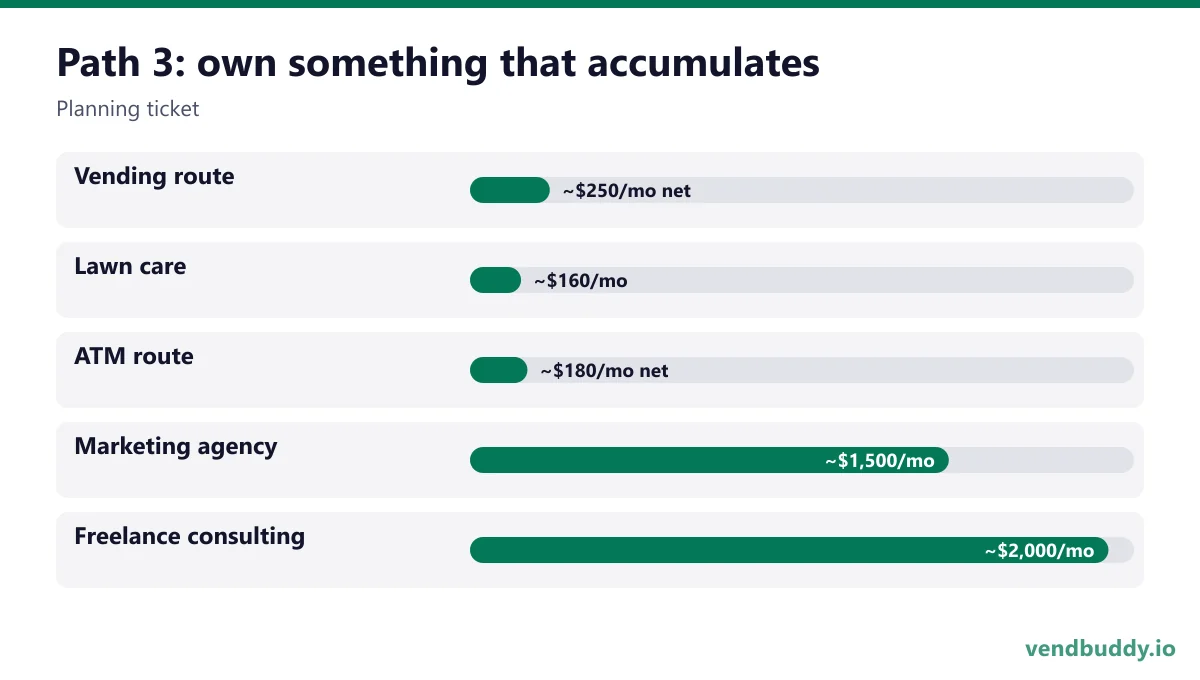
| Model | Units at $10k/mo | Planning ticket | The grind |
|---|---|---|---|
| Vending route | ~40 machines | ~$250/mo net | Restocking, the nos, and getting off the couch |
| Lawn care | ~62 accounts | ~$160/mo | Seasonal, weather-bound, decided by route density |
| ATM route | ~56 machines | ~$180/mo net | You are personally driving cash around |
| Marketing agency | ~7 retainers | ~$1,500/mo | Delivery eats the hours you need for selling |
| Freelance consulting | ~5 clients | ~$2,000/mo | Feast and famine; you stop selling while you deliver |
Rough planning averages, and your market will differ. What the table hides is the delivery load, which is the thing that actually ends most ownership plans: forty vending machines is roughly 120 hours a month of servicing and driving, which is a full-time job by itself. Seven agency retainers is about eighty hours a month of delivery before you have sold anything new. The ceiling in an ownership business is almost never sales — it is the hour you run out of.
Vending is worth a specific mention because its funnel is unusually forgiving for a beginner, and we should say plainly that we build software for vending operators so treat that as interested rather than neutral. The reason is structural rather than promotional: the conversation is ninety seconds at a counter instead of a scheduled call, roughly a third of walk-ins reach a decision-maker, and a good building says yes at a high rate. It works out to somewhere around 27 doors per placement, which is a far shorter ladder than most cold-outreach businesses. It is also physical, local, and it will not pay a bill that is due in 30 days. The first hundred dollars in vending is the honest version of the first month.
Path 4: real estate
The path with the highest ticket and the highest barrier, and the one most misrepresented online. Wholesaling headlines promise $10,000 from a single assignment, which is true, and skips the part where the funnel runs at roughly a thousand outreach attempts per closed deal and the buyer side is relationships you have not built yet.
Rentals are a genuinely durable version of the same idea — accumulating units that pay monthly — but at $200 to $400 of real cash flow per door, $10,000 a month means twenty-five to fifty doors, and that is a capital problem long before it is a work problem. Both versions are real. Neither is a starting point without either money or a network, and pretending otherwise is the single most common lie in this category.
How long it actually takes
Planning ranges from a standing start, not promises:
- Job path: one to three years, and it is mostly out of your hands. Set by promotion cycles and market rate.
- Commission sales: six to twelve months to a consistent $10,000 month, assuming you survive the first ninety days.
- Ownership, recurring: eighteen months to three years, because you are stacking units and the delivery load grows with the income.
- Real estate: two to five years unless you start with capital or a network, in which case faster.
The reason nobody publishes this table is that it is unexciting and correct. The reason you should trust it more than the ones that promise ninety days is exactly the same.
Four mistakes that show up in every failed plan
Confusing revenue with income. A $10,000 revenue month in a service business with $4,000 of costs is a $6,000 month. Every income screenshot on the internet is the top number.
Ignoring the delivery load. People model the selling and forget that the customers have to be served. This is what actually caps ownership businesses, and it appears in month eleven when the calendar has no space left in it.
Quitting the job at the first good month. One month is noise. The threshold is your replacement number — take-home plus the benefits you lose — cleared for three consecutive months. The replacement number is a specific calculation and it is about 28 percent higher than most people assume.
Optimising effort instead of ticket. The eighty-times gap in that second table is not closeable by working harder. If your plan is unpleasant, changing what you sell is usually the fix, not changing how hard you push.
The Income Reality Calculator takes your goal, your deadline, the hours you actually have and one of ten business models, and gives you the daily activity behind it - closes, meetings, conversations and outreach per day - plus an honest verdict when the goal does not fit. Free, no signup, no income claims.
The bottom line
Ten thousand a month is not a mystery and it is not a mindset. It is a customer count you can calculate in thirty seconds and a weekly activity number you can put in a calendar. The people who reach it are rarely the ones who wanted it most — they are the ones who worked out what four doors a day for a year actually meant and then did it.
Start by picking the ticket, not the hustle. Then run the funnel backwards, look at the daily number honestly, and decide whether you would still do it in month nine. That decision, made in advance and with real arithmetic in front of you, is worth more than any list of business ideas.
Related reading: how to replace your full-time job income, the best businesses to start to leave your job, the 10 businesses worth starting in 2026, recession-proof businesses ranked, should you start a business in 2026, the first $100 in vending, and how many vending machines it takes to make a living.
Frequently Asked Questions
How can I make 10k a month?
Four paths actually produce it and they are not equally available. Climbing to a $150,000 salary is the most reliable and the slowest, because it depends on a market rate you do not set. A commission sales role gets there fastest for the right temperament, at the cost of rejection volume most people underestimate. Owning something - a route, a service business, an agency - gets there through accumulated units rather than a raise, which is why it takes longer to start and keeps paying once it works. Real estate works but usually needs capital or a network first. Whichever you pick, the arithmetic is identical: goal divided by average ticket gives the customer count, and that count run backwards through a funnel gives your week.
What business makes $10,000 a month?
Any business where average ticket times customer count reaches $10,000, which is less glib than it sounds because it tells you where to look. At a $250 monthly ticket you need 40 customers; at a $2,000 monthly retainer you need five. A vending route reaches it at roughly 40 placed machines, a lawn care business at around 60 accounts, a solo agency at six or seven retainers, and a freelancer at about five clients. The ticket, not the industry, decides how hard the work is.
How long does it take to make $10,000 a month?
For recurring models the honest planning range is 18 months to three years from a standing start, because you are accumulating units rather than earning a raise. For commission sales it can be six to twelve months once you are licensed and producing, and for a job it is however long a promotion cycle takes at your employer. Anything promising 90 days is either selling a course or describing an outlier and calling it a method.
Is $10,000 a month a lot of money?
It is roughly a $120,000 annual run rate before tax, which puts a household comfortably above the US median but is not wealth. It also matters enormously whether it is gross revenue or take-home profit - a $10,000 month in a service business with $4,000 of costs is a $6,000 month, and confusing the two is the single most common mistake in every income screenshot you have ever seen.
How many sales calls a day do I need to make $10,000 a month?
Work it backwards. At a $600 commission per sale, $10,000 a month is roughly 17 sales. At a dial-to-close rate somewhere around 0.6 percent - typical planning arithmetic for cold insurance dialling - that is about 2,800 dials a month, or roughly 140 a day on a five-day week. Raise the ticket to $2,000 and the same goal needs five sales and a fraction of the dialling. This is exactly the sum the income reality calculator does for ten different models.
Can you make $10,000 a month with vending machines?
Yes, and it takes roughly 40 well-placed machines at a planning average of about $250 net per machine per month, which is a full-time route by the time you are servicing it. That is a real answer rather than an encouraging one: 40 machines means about 120 hours a month of restocking and driving, and the capital at that scale runs to six figures unless you buy used and finance. It is achievable and it is not passive.
If financing is the piece that is stuck, 7 Figures Funding works the qualification side of 0% intro business credit rather than you applying cold and collecting hard pulls. It is only worth a look if the placement is already confirmed.
What is the fastest way to make $10,000 a month?
High-ticket commission sales, if you can hold a phone through a hundred rejections a week, because it has almost no capital requirement and no delivery load. The catch is that speed and durability trade against each other: commission income resets to zero on the first of every month, while a route or a book of retainers keeps paying for work you did last year. Fast and durable are two different goals and pretending otherwise is how people end up starting over at 30 months.
Do I need to quit my job to make $10,000 a month?
Not to start, and quitting early is the most expensive mistake in this whole subject. Every model worth building can be started on ten to twenty hours a week, and the paycheck is what funds the eighteen months before the business carries you. The moment to leave is when the business has covered your replacement number - take-home plus the benefits you lose - for three consecutive months, not when it hits it once.
What is selling, which buildings say yes, and the numbers before you buy a machine. Free, confirm from your inbox, unsubscribe in one click. Refer one friend and get 25 VendBuddy credits.
General information, not legal, tax or financial advice. Rules change, so check the official source. Revenue and income figures are examples, not promises. See our terms.