- The split that works is hunter and farmer — one person owns everything up to the signature, the other owns everything after it. Both people doing the same job is the most common failure.
- Assign roles by behaviour, not personality. The hunter is whoever can be told no fifteen times and walk into building sixteen. The farmer is whoever checks a receipt against a statement unprompted.
- Two calendars solve the hardest problem in vending. Somebody has to be inside a building at 10am on a Tuesday. Between two of you, somebody usually can.
- Separate the P&L from the household budget on day one — own account, written draw rule, and an agreed walk-away number before there is anything to argue about.
- The entity choice has a real tax wrinkle for spouses. Partnership return, community-property treatment, qualified joint venture — different answers by state. Confirm with a CPA before filing, not after.
The genuine question behind “what business should we start together” is rarely which industry. It is whether doing this will make your marriage better or worse, and most articles on the subject answer with a photograph of a couple laughing at a laptop.
So here is the version that assumes you are two adults who already know that money is where couples fight: what the actual division of labour looks like, the specific failure modes that happen to couples and not to solo operators, the money architecture that keeps the business out of your kitchen, and the entity question, which has a wrinkle for spouses that it does not have for anyone else.
Why this business splits well, mechanically
Most businesses do not divide cleanly between two people. A consultancy has one relationship owner and one person doing the work, which becomes resentment. A shop has two people doing the same shift. An online business has one person who understands the funnel and one who is being kept informed.
A vending route divides at a real seam, because the business genuinely has two halves that happen at different times, need different temperaments, and hand off at a single clear moment:
| The hunter | The farmer | |
|---|---|---|
| Owns | Target list, walk-ins, follow-up, negotiation, the placement agreement | Purchasing, par levels, restocking, pricing, machine care, the books |
| When it happens | Weekday, 9am to 4pm, in bursts | Any time at all, weekly, predictable |
| What it demands | Tolerance for rejection, warmth, willingness to follow up four times | Consistency, attention to small numbers, willingness to do the same loop weekly |
| Fails when | They stop at building nine | They let a stockout run two weeks |
| Handoff point | The signed agreement. Clean, dated, and unambiguous. | |
The second structural fit is more practical and gets overlooked. The scarcest input in vending is somebody being physically inside a business between 9am and 4pm on a weekday. One person with a full-time job cannot do that without burning vacation. Between two calendars — one hybrid schedule, one shift job, one part-time role, one person between things — there is almost always a way to produce one weekday morning a week, and one weekday morning a week is enough to run the entire location hunt over eight weeks.
And the third: moving a machine is the one job in this business that genuinely wants two adults. Six to eight hundred pounds, top-heavy, on a ramp. Most solo operators pay for that, or take a risk they should not. You have a second person. What is safe to do with two people and what still needs a mover is here.
Assigning the roles, with a test instead of a guess
Couples almost always assign these wrong on the first attempt, because they use the obvious heuristic: the more outgoing person becomes the hunter. That is not the trait the job needs.
The walk-in is not a charisma exercise. It is a forty-second scripted offer, repeated at twenty buildings, most of which say no. What it requires is not sociability but rejection tolerance and follow-up discipline. Plenty of very outgoing people are terrible at it, because the ninth no genuinely stings and they go home. Plenty of quiet people are excellent, because they treat it as a process with a known conversion rate rather than as a series of personal verdicts. If that describes one of you, the introvert case for this business is worth reading before you assume anything.
Two questions that sort it properly:
- “Which of us could be told no fifteen times in a morning and walk into building sixteen without a speech about it?” That is your hunter. Not who is friendlier. Who recovers.
- “Which of us has ever checked a receipt against a bank statement without being asked?” That is your farmer. The route job is not physically demanding; it is attentively demanding. Someone has to notice that the Snickers row sold eleven and the cash is short by four dollars.
And then the third role, which causes most of the arguments when it is unassigned: the scoreboard. One named person owns the monthly numbers — gross, cost of goods, commission, fees, net, and cash on hand — and reports them at a fixed time. Without that, both of you will form independent, unequal impressions of how the business is doing, and the eventual conversation where those impressions collide is unpleasant. The bookkeeping setup that makes this a ten-minute job is here.
One thing that is genuinely fine: roles can be lopsided. A 70-30 split of effort is normal and works, as long as both people agreed to it out loud. What does not work is an unspoken assumption that it is 50-50 while one person is doing 80.
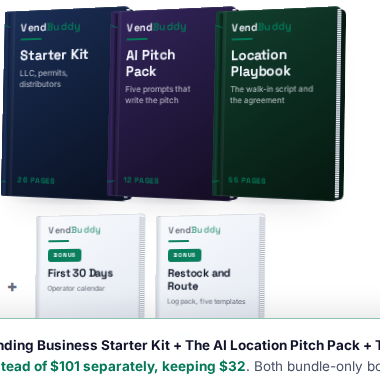
If you get to the end of this and the answer is yes, the kits are the shortcut past the blank page: a 26-page starter kit for the paperwork, a 55-page Location Playbook for the walk-in script and the agreement, and a 12-page AI Pitch Pack. Bought once, from $27, and you keep the files.
Look inside the kits →Picture the machines paying you while you sleep
That’s the real promise of vending — income that doesn’t cost you your time, and a life on your own terms. VendBuddy turns this guide into a step-by-step plan so you actually build it instead of just reading about it. Start free today.
Start building free →The four failure modes that only happen to couples
1. Both of you doing the same job. The most common one, and it looks like enthusiasm. Two adults walk into a property management office together; the manager does not know who to address, the pitch loses its shape, and one of you spends forty seconds being a spectator to your own business. Do the walk-ins alone. Debrief afterwards.
2. No decision rule. You will disagree about a commission rate, a location, a price change or whether to buy machine three. If final say has not been assigned by domain in advance, every disagreement becomes a negotiation between spouses rather than a business decision. The fix is one sentence, agreed early: the hunter has final say on location and terms, the farmer has final say on product and pricing, and anything above an agreed dollar amount is a joint decision. Pick the dollar amount now, while it is theoretical.
3. The business becomes the only conversation. This is the one that damages things quietly. A shared venture has no natural end to its working day, so it colonises dinner, the car, and the fifteen minutes before sleep. The fix is unglamorous and it works: a scheduled thirty-minute business meeting once a week, with an agenda and the numbers, and a stated rule that outside that window the route is off the table. Couples who do this describe it as the single best decision they made. Couples who do not describe month seven as tense for reasons neither of them can name.
4. One of you was recruited rather than chose. Worth being honest about, because it is common and it is fatal. If one person is enthusiastic and the other agreed to be supportive, you do not have a partnership, you have one owner and one reluctant employee who cannot be fired or paid. That configuration works fine if it is named — one owner, one occasional helper, no shared decision-making expectations. It fails badly when it is dressed up as a joint venture. Ask the question directly before you spend anything.
The money architecture that keeps this out of your kitchen
Three mechanisms. All of them are easy now and hard later.
A separate business bank account from day one, before the first purchase. Not a sub-account, not a spreadsheet tab. A real account that the machine money goes into and the machine costs come out of. This is a bookkeeping and liability practice generally, but for a couple it is primarily a psychological one: it means the route has its own balance, which can be discussed as a number rather than as a claim on the household.
A written draw rule, agreed before there is any money. The simplest version that works: nothing comes out of the business until the machine has returned its full purchase price. After that, a fixed monthly draw, reviewed twice a year, and everything above it stays in for the next machine. Write it in a note on your phone if you like — the point is that it exists before the first $400 arrives and starts feeling like it belongs to someone.
An agreed walk-away number. This is the one almost nobody does and it is the most valuable. Decide together, in advance, the maximum total amount you are prepared to lose on this before you stop: “if we are down $6,000 and the second location has not landed, we sell the machine and we are done.” That single sentence converts an open-ended anxiety into a bounded experiment, and bounded experiments do not damage marriages. It also, in practice, makes people bolder rather than more timid, because the downside is now a known number instead of an imagined one.
The other side of selling a route is that somebody is always getting out. The marketplace is where operators post routes and machines for sale, and it is free to browse.
Before you set that number, it is worth running the actual numbers rather than a feeling. The Income Reality Calculator takes your capital, the hours you genuinely have between you and the income you want, and returns the machine count and months that implies. Doing that together, once, prevents the most common couple disagreement in this business, which is two people quietly holding two different timelines.
The entity question, which is genuinely different for spouses
General information, not legal or tax advice. Confirm all of this with a CPA in your state before you file anything.
The default surprise. A multi-member LLC is generally treated as a partnership for federal tax purposes, which means a partnership return — more filing, more cost, and more complexity than a first-year vending route usually warrants. A lot of couples form a two-member LLC assuming it works like a sole proprietorship and discover the partnership return at tax time.
The two narrower paths worth asking about. In community property states, the IRS has allowed a husband-and-wife LLC to be treated as a disregarded entity in certain circumstances, which simplifies filing considerably. Separately, spouses who run an unincorporated business together and both materially participate can sometimes elect qualified joint venture treatment, which lets them file as two sole proprietors rather than as a partnership. Whether either applies depends on your state, your entity choice and your facts, and the answer changes the paperwork for every year afterwards. That makes it a fifteen-minute conversation worth having before formation.
The operating agreement, which is not optional just because you are married. A short document naming ownership percentages, who has authority to sign a placement agreement, how the business would be valued, and what happens on death, divorce or one person wanting out. Nobody enjoys writing this. It exists precisely so that if any of those things happen you are not negotiating them at the worst possible moment. It is also the document a buyer will ask for if you ever sell the route. What a route sells for and what makes one saleable is here.
The ordinary vending paperwork is the same for you as for anyone: state and local permits, sales tax registration where applicable, and proof of liability insurance before most buildings will let a machine in. The requirements by state are here and the insurance guide is here.
The worked six-week plan, with two columns
| Week | Hunter | Farmer |
|---|---|---|
| 1 | Score the ZIP. Build a 40-building target list inside a 15-minute radius of home. | Open the business account. Price machines. Read the permit requirements for your state. |
| 2 | Write the 40-second script. Rehearse it out loud until it stops sounding written. Walk into four buildings. | Agree the draw rule and the walk-away number together. Run the reality calculator. |
| 3 | Eight more walk-ins. Log every no and the reason. | Build the product plan and a first-order list. Do not order anything. |
| 4 | Eight more walk-ins plus the first follow-up round. The yes usually comes from a maybe, not a first conversation. | CPA conversation about the entity. Insurance quote. |
| 5 | Close. Agreement signed and dated. Commission and service frequency in writing. | Now buy the machine. Freight, delivery date, first fill. |
| 6 | Install day, both of you. Then hand the route over and go back to hunting for machine two. | First service run. Set par levels. Start the scoreboard. |
Total time: roughly 4 to 6 hours a week between two people during setup, and about 2 hours per machine per week afterwards. The handoff at week six is the important line. The hunter does not become a co-restocker, and the farmer does not start doing walk-ins. That is the whole point of splitting it. The single-operator version of this sequence is here if you want the compressed 30-day comparison.
The hunter half of this is mostly deciding which doors are worth walking through. VendBuddy scores real venues near you by traffic, headcount and category, gives you the best contact on file for each, and models what a machine would net there before you pitch - so the one weekday morning you can produce between two schedules goes to the right building. Five free credits, no card.
When the honest answer is no
- If money is already the recurring fight. A shared business does not resolve a money disagreement, it gives it a monthly reporting cycle. Fix the household conversation first; the route will still be available.
- If one of you is being recruited. Name it as one owner and one helper, or do not do it jointly. The dressed-up version is the one that ends badly.
- If neither of you is willing to do walk-ins. This is the fatal one and it is more common than people expect. Two farmers is a beautifully run route with no locations in it. Somebody has to knock. There is a lower-contact version of prospecting, and it is slower, not free.
- If you are hoping it will give you something to do together. It will give you something to discuss, which is not the same thing, and the discussing is mostly about restock frequency. Shared work is a fine thing to want; just want it accurately.
The bottom line
This business splits well because it genuinely has two halves with a clean seam between them, and because two calendars solve the one scheduling problem that stops most solo operators before they start. That is a real structural advantage and it is worth using deliberately rather than by drifting into whoever felt like doing what.
The risks are not business risks. They are the ordinary risks of two people sharing money without a rule, sharing a decision without a tiebreak, and sharing a subject without a boundary. All three have five-minute fixes that only work if you do them before there is anything at stake. Separate account, written draw rule, agreed walk-away number, weekly thirty-minute meeting, and one named person for the scoreboard. Do those, and the business is just a business.
Related reading: starting a business as a mom, the vending business for parents, starting a business while working full time, vending bookkeeping, your first $100 in vending, and what a route sells for.
Frequently Asked Questions
Is vending a good business for couples?
It fits couples unusually well because the work splits cleanly into two jobs that do not overlap: finding and closing locations, and running the route. Those require different temperaments and can happen on different days, which means two people can genuinely divide the business rather than both hovering over the same task. It also solves the two hardest logistical problems in vending at once. Between two calendars there is almost always someone available on a weekday morning, which is the scarcest input in the business, and the one job that genuinely needs a second adult - moving a machine - has one. The risk is not the business. It is that a shared business gives an existing money disagreement a new place to live.
How do couples split a vending business?
The split that works is hunter and farmer. One person owns everything up to the signature: building the target list, walk-ins, follow-up, negotiation and the placement agreement. The other owns everything after it: ordering, restocking, pricing, inventory and the books. A third role gets forgotten and causes most of the arguments, which is the scoreboard - one named person owns the monthly numbers and reports them. Assign roles by behaviour rather than by who seems more outgoing. The hunter is whoever can be told no fifteen times in a morning and walk into building sixteen. The farmer is whoever already checks a receipt against a statement without being asked.
Should my spouse and I form an LLC together?
It is common and generally straightforward, but the tax treatment has a wrinkle worth getting right at formation rather than at the first filing. A multi-member LLC is generally treated as a partnership for federal tax purposes and files a partnership return, which is more paperwork than most first-year vending routes need. There are narrower alternatives: in community property states the IRS has allowed a husband-and-wife LLC to be treated as a disregarded entity in some circumstances, and spouses running an unincorporated business together can sometimes elect qualified joint venture treatment. Which of those applies depends on your state and your facts, so confirm with a CPA before you file rather than after.
What is the biggest risk of starting a business with your spouse?
Money conversations losing their boundaries. A shared business creates a second, unbudgeted account that shares a household with the first one, and unless the two are separated deliberately the business becomes the subject of every kitchen conversation for a year. The three mechanical defences are a separate business bank account from day one, a written owner-draw rule agreed before there is any money to argue about, and an agreed walk-away number - the maximum total loss you will both accept before stopping. Naming the walk-away number in advance is the single most useful thing a couple can do, because it converts an open-ended risk into a bounded one.
Can both spouses work in a vending business without hiring anyone?
Yes, and for the first three to five machines that is the normal configuration. The weekly workload is about two hours per machine, so a three-machine route is roughly six hours split between two people, which is one morning each or one morning together. The thing to avoid is both people doing the same task. Two adults on the same walk-in means one of you is a spectator and the pitch gets worse, not better, because property managers respond to one clear person rather than to a pair.
How much money do a couple need to start a vending business?
The same as anyone, which is $2,000 to $5,000 all in for a first placed used machine including freight, the first product fill, a card reader and basic paperwork. What is different for a couple is not the amount but the decision process. Agree in advance how the money is classified: whether it comes from joint savings or from one person, whether it is a loan to the business or an investment, and what happens to the first profit. Those three questions are easy before there is money and unpleasant afterwards.
A credit line is still a debt you personally guarantee, so the honest rule is to borrow only what a signed location can repay inside the intro window. 7 Figures Funding sequences the applications for you if you would rather not apply one card at a time.
What happens to a jointly owned business in a divorce or if one spouse dies?
It depends on your state, your entity and your documents, which is exactly why an operating agreement matters even for a two-person business run by a married couple. A short agreement that names who owns what percentage, who has authority to sign, how the business is valued, and what happens on death, divorce or a decision by one person to exit removes the need to negotiate any of that at the worst possible moment. This is a lawyer conversation and a modest one, and the version most couples regret is the one they did not have.
What is selling, which buildings say yes, and the numbers before you buy a machine. Free, confirm from your inbox, unsubscribe in one click. Refer one friend and get 25 VendBuddy credits.
Every operator we talk to wants fewer cold calls. The ones who get there have a Google Business Profile and a simple site a manager can check before replying. AI builders make that an evening job now. Wix is the mature site builder; Base44 also builds working tools like a quote form. Start with the AI website walkthrough or Wix vs Base44.
General information, not legal, tax or financial advice. Rules change, so check the official source. Revenue and income figures are examples, not promises. See our terms.