- The question is which business, not whether. Anything requiring same-day responsiveness fights a household; anything on a weekly loop does not.
- School hours are the scarcest resource in this business — and you have them. Location hunting only happens 9am to 4pm on weekdays.
- Plan by trip count, not hours. Three machines in three directions is three outings; three machines in one cluster is one.
- Realistic pace by kids: one child, first machine in 6–8 weeks. Three children, first machine in 3 months and a second by month six.
- The kid involvement is real, not a brochure line — and there are actual labour and tax rules worth knowing before you lean on it.
Most advice written for mothers starting a business is either a pep talk or a lie about how easy it is, and both are exhausting to read when you have already done the arithmetic and know how little uninterrupted time you actually have. So this is not a pep talk. It is what the week genuinely looks like, sorted by how many children are in the house.
The honest starting point: your constraint is not ambition, energy or capability. It is predictability. You can find hours. What you cannot reliably promise anyone is a specific hour on a specific day, because a fever, a snow day or a nap that goes wrong takes precedence and always will. Which means the business has to be one that never needed that promise in the first place.
The one filter that decides everything
Ask of any business idea: if I vanish for three days, what breaks?
In a client service business, a relationship breaks. In e-commerce, an order ships late and a review suffers. In anything with a same-day promise, the promise breaks, which is the whole product. In a vending route, a machine runs low on Doritos and you fill it on Saturday instead of Thursday, and nobody — not the property manager, not the customer, not you — experiences that as a failure.
That is the difference, and it is structural rather than a matter of how organised you are. Businesses that owe other people responsiveness are hostile to a household with young children. Businesses built on an asset that produces revenue whether or not you are present are compatible with one. This is the same reason vending suits shift workers and people with unpredictable jobs; it is just more pronounced when the unpredictability lives with you.
The corollary is worth saying too, because it cuts against the usual advice: a business you can do from your phone in ten-minute gaps is usually a worse fit, not a better one. Ten-minute gaps are where notifications, inboxes and clients live, and those are exactly the businesses that leak into every part of the day. A route that takes one focused ninety-minute block on Saturday morning takes up less of your life than a phone business that takes ninety minutes spread across a week in forty-second increments.
Your actual advantage: you can be in a building at 10am on a Tuesday
Here is the thing almost nobody tells mothers considering this, and it genuinely matters.
The single hardest input in a vending business is not money, equipment or knowledge. It is weekday daytime availability. To land a location you have to physically walk into a business between about 9am and 4pm on a weekday, because that is when the person who can say yes is on site. Plan on 20 walk-ins for one yes — a normal conversion rate, not a reflection on you — which is four or five mornings of work.
A person with a conventional job cannot do that without burning vacation days, which is why so many aspiring operators stall at exactly this step. If your children are in school or part-time care, you have that window every single week. The resource everyone else is short of is the one your schedule already contains.
Two practical notes on using it. First, the useful window is narrower than the school day: 9:30am to 2:00pm, minus travel, is realistically three hours, and three or four walk-ins per outing is a good morning. Second, aim for buildings near school and near home, because the drop-off route and the route you can service weekly should be the same geography. Density is what keeps a route inside one trip, and for a parent that is not an optimisation, it is the whole feasibility question.
Two minutes of scoping beats two weeks of driving. The free Opportunity Map scores any US ZIP on population, employment and income with no account, so the buildings you spend a precious Tuesday morning on are the ones worth the trip.
Picture the machines paying you while you sleep
That’s the real promise of vending — income that doesn’t cost you your time, and a life on your own terms. VendBuddy turns this guide into a step-by-step plan so you actually build it instead of just reading about it. Start free today.
Start building free →Realistic weekly plans, by how many children are in the house
These are deliberately conservative. Every one of them is slower than the plan a course would sell you, and every one of them is achievable on a bad month.
One child, in school or full-time care
Setup phase: 4 to 6 hours a week. Two weekday mornings for walk-ins (three or four buildings each), one evening block for the target list, follow-ups and paperwork. Running: 60 to 90 minutes a week for one machine, growing to about 2 hours per machine after that.
Realistic timeline: first location in six to eight weeks, machine installed within two weeks of that, second machine around month four if the first one is earning. This is close to the standard timeline in the 30-day first-dollar sequence — slightly stretched, because the walk-ins are spread over more weeks rather than compressed into ten days.
Two children, one in school and one at home part-time
Setup phase: 3 to 5 hours a week. One reliable weekday morning of walk-ins, plus one flexible block that will sometimes not happen. Running: 90 minutes to 2 hours a week for the first machine or two.
Realistic timeline: first location in eight to twelve weeks. The variable is not effort, it is how many of the mornings survive contact with the week. Assume a third of them do not, and plan the number of walk-ins accordingly rather than assuming you will make it up.
Three or more children
Setup phase: 3 to 4 hours a week, and expect the timeline to double. Running: 2 to 3 hours a week, and the binding constraint becomes trips rather than hours.
Realistic timeline: one machine placed within three months, a second by month six. That is a real business — a decent first placement nets $150 to $400 a month, and two of them is a car payment or a grocery budget — and it is also nothing like the trajectory in a YouTube thumbnail. The reason to plan it this way is that a route of two machines you can genuinely service beats a route of five you cannot, and the failure mode with a large family is not giving up, it is over-committing in month two and then quietly missing restocks in month five.
Practical adjustment for three-plus: aim for a single cluster from the beginning. Three machines within ten minutes of each other is one Saturday morning errand. Three machines across a metro is three separate outings you will start resenting. This matters more for you than for anyone else in this business.
Infant or toddler at home full-time
The honest answer is to split the work. Walking into twenty businesses is not compatible with an unpredictable nap schedule, and pretending otherwise sets you up to feel like you failed at something that was never realistic. What is realistic during that period: build the target list, learn the economics, register the business, price machines, and read the location material properly. That is genuinely half the work and it is all doable in fifteen-minute pieces at 9pm.
Then start the walk-in phase when you have two or three predictable weekday mornings — part-time preschool, a grandparent, a swap with another parent. It is not a delay, it is a sequence. The prep work does not expire.
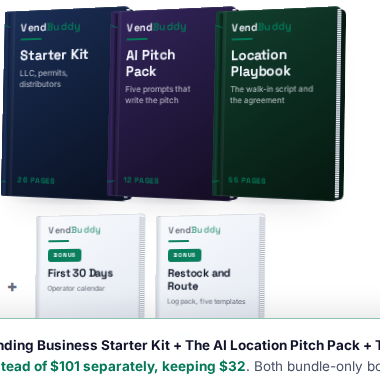
If you get to the end of this and the answer is yes, the kits are the shortcut past the blank page: a 26-page starter kit for the paperwork, a 55-page Location Playbook for the walk-in script and the agreement, and a 12-page AI Pitch Pack. Bought once, from $27, and you keep the files.
Look inside the kits →The kid-involvement part, honestly
This gets used as a marketing line constantly, so it is worth separating what is true from what is decoration.
What is genuinely true: restocking a vending machine is a real task with a visible result that a child can do properly. Loading a coil, facing the rows, checking date codes, counting a coin bag, comparing what sold against what you expected — these are not made-up jobs. A nine-year-old can face rows and count money. A thirteen-year-old can run a full fill with supervision. A sixteen-year-old can run a route.
And the lesson underneath is the unusual part. Most children never see the connection between an asset, a decision and money. Here, the decision (which building, which products, which price) is visible, the result is a number in a bag three weeks later, and the causal chain is short enough to actually follow. Operators who involve their kids consistently say this is the part that surprised them.
What is not automatic: there are rules. Federal child labour law limits hours and prohibits minors from certain equipment and tasks, states layer their own restrictions on top, and the specifics vary by age band. Employing your own child in a family business has its own carve-outs and its own payroll tax treatment, which is a real planning tool and also a real thing to get wrong. None of it is exotic — it is a fifteen-minute conversation with an accountant — but it is not something to improvise. The teenager-run version of this business has its own guide, including what a minor can and cannot sign, and it is the right read if an older child wants this to be theirs rather than yours.

What it costs, and what it realistically earns
The money is the same as it is for anybody, so this section is short and unsentimental.
To start: $2,000 to $5,000 all in for a first used machine — $1,500 to $3,000 for the machine, $150 to $500 for freight, $200 to $400 for the first product fill, and a few hundred for a licence, insurance and a card reader. Freight and the first fill are the two everybody forgets, and they are commonly $700 together. The full line-item budget is here.
What it earns: a first machine at an ordinary building commonly grosses $300 to $800 a month and nets $120 to $350 after product, commission and card fees. A genuinely good site grosses $1,500 to $3,000 and nets $500 to $1,000. The gap between those two outcomes is the building — not the machine, not the products, not how hard you work. Which is why the Tuesday mornings matter more than anything else on this page.
If the capital is the blocker rather than the schedule, the low-capital routes are here — and the honest version is that securing a location first makes the machine financeable, because equipment is its own collateral once there is a demonstrable place for it to earn.
Weekday mornings are the scarcest thing you have, and most of the location hunt is deciding which doors are worth the drive. VendBuddy scores real venues near you by traffic, headcount and category, gives you the best contact on file for each, and models what a machine would net there before you commit — so the school-hours window goes to buildings that can actually say yes. Five free credits, no card.
The bottom line
You are not short of capability and you are probably not short of hours. You are short of promised hours, which is a different problem with a different answer: pick a business that never needed you to promise anyone anything.
Vending qualifies on that test, and it happens to need the one resource your schedule already contains — the ability to walk into a building at ten in the morning on a weekday. Plan slower than the internet tells you to, keep the route in one cluster, and let the first machine prove the loop closes before you build anything on top of it.
Still deciding whether to start anything at all? The readiness quiz takes about two minutes and is willing to tell you not yet. If you already know the answer, the start page is the shortest route to a first location.
Related reading: the vending business for parents, can a teenager start a vending business, starting a business while working full time, how much time vending actually takes, your first $100 in vending, and is vending a good side hustle.
Frequently Asked Questions
Can I start a business as a mom?
Yes, and the deciding factor is which business rather than how motivated you are. The businesses that work around children are the ones that do not require you to be reachable on demand, do not have clients who call, and do not collapse if you disappear for three days because somebody has an ear infection. A vending route fits all three: the work is a fixed weekly loop you schedule yourself, and nobody is waiting on your reply. The businesses that fail mothers are the ones that promise other people same-day responsiveness.
Can I start a vending business as a stay-at-home mom?
It is one of the better fits available, for a reason that has nothing to do with the machines. The hardest input in vending is weekday daytime availability, because property managers and business owners are only reachable between about 9am and 4pm on weekdays, and almost nobody with a conventional job can be there. A stay-at-home parent can. School hours are the exact window the location hunt needs. Expect 60 to 90 minutes per machine per week once running, and 4 to 6 hours a week during the setup phase.
Can I build a vending business with 3 kids?
Yes, with a smaller route and a longer runway than the plans you will see online. With three children, plan on one machine placed in the first three months rather than three, and treat the second machine as a month-six goal. The realistic weekly budget is 3 to 5 hours: one restock trip and one admin block. What makes it work is that vending has no deadlines imposed by anyone else, so a bad week costs you a delayed restock rather than a lost customer. What breaks it is a route spread across a metro, because driving is the part that cannot be compressed.
What business can I start with a baby or toddler at home?
Something with a workload measured in weeks rather than hours, and no live customer contact. With an infant, the honest recommendation is usually to wait on the location hunt and use the time to build the target list, learn the economics and get the paperwork done, because walking into twenty businesses is not compatible with unpredictable nap schedules. With a toddler in part-time care or preschool, two or three predictable weekday mornings is enough to run the hunt over six to eight weeks.
How many hours a week does a vending business take with kids?
Two hours per machine per week is the standard planning number, and it holds for parents too, but the practical constraint is trip count rather than total hours. One machine ten minutes away is a single 60 to 90 minute errand. Three machines in three different directions is three separate outings, which is a much bigger ask than the hour count suggests. Cluster tightly and the whole route stays inside one weekly trip.
Can my kids help with a vending business?
Yes, and it is one of the few businesses where that is genuinely true rather than a nice idea. Loading product, facing rows, checking dates and counting a coin bag are real tasks a child can do properly, and older teenagers can run a full restock. There are rules worth knowing: federal child labour law restricts hours and certain equipment for minors, states add their own rules, and paying your own child through the business has specific tax treatment worth asking an accountant about. Nothing here is a workaround, but the involvement is real.
How much money do I need to start a vending business as a mom?
The same as anyone else, which is $2,000 to $5,000 all in for a first used machine including freight, the first product fill, a card reader and basic paperwork. The two costs first-timers forget are freight and the first fill, commonly $700 between them. The budget is not the part that is different for a parent. The schedule is.
What is selling, which buildings say yes, and the numbers before you buy a machine. Free, confirm from your inbox, unsubscribe in one click. Refer one friend and get 25 VendBuddy credits.
Walk-ins and cold emails find locations. A small site with your own machine photos and a request-a-machine form lets the next one find you. Around machine three to five, an AI builder drafts it in an evening. Wix is the mature site builder; Base44 also builds working tools like a quote form. Start with the AI website walkthrough or Wix vs Base44.
General information, not legal, tax or financial advice. Rules change, so check the official source. Revenue and income figures are examples, not promises. See our terms.