- Yes — with an adult in the loop. Minors cannot sign binding contracts or form an LLC solo in most states, so a parent signs placements and holds (or co-owns) the entity.
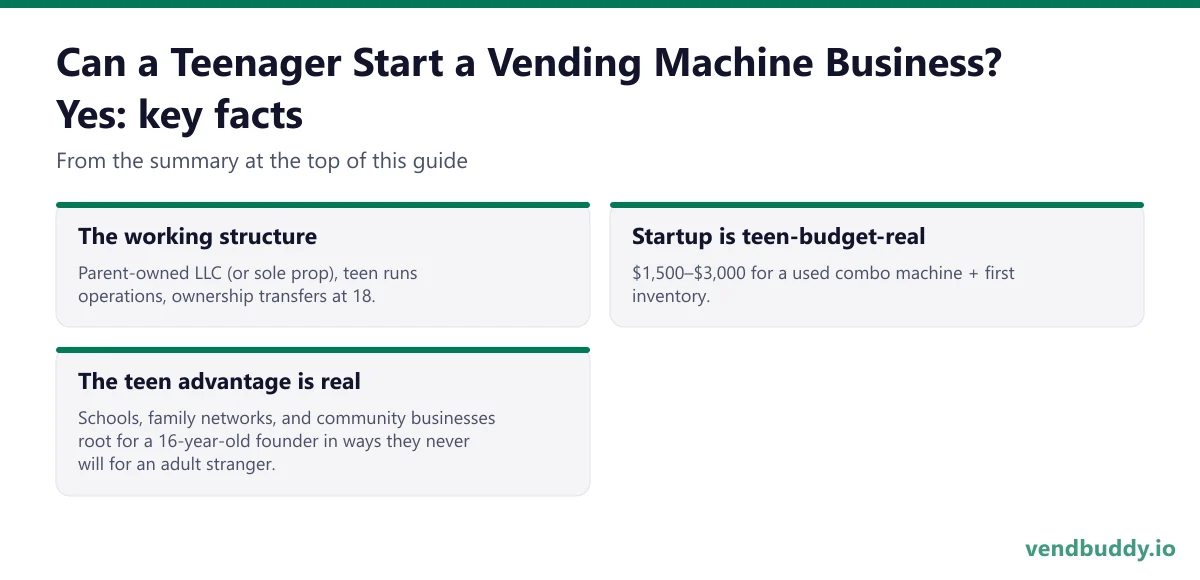
- The working structure: parent-owned LLC (or sole prop), teen runs operations, ownership transfers at 18.
- Startup is teen-budget-real: $1,500–$3,000 for a used combo machine + first inventory.
- The teen advantage is real: schools, family networks, and community businesses root for a 16-year-old founder in ways they never will for an adult stranger.
This question fills Reddit every summer, and the answers are usually half-right. The truth: age is a paperwork problem, not a capability problem. Restocking, tracking sales, pitching a location — nothing about vending requires being 18. What requires 18 is signing enforceable contracts. So the playbook is simple: borrow an adult signature, keep everything else.
Part of our complete guide: how to start a vending machine business.
The legal fine print (5 minutes, not 5 weeks)
- Contracts: agreements signed by a minor are generally voidable — which is exactly why no property manager will sign with one. A parent or guardian signs the placement agreement instead.
- Business entity: most states require LLC organizers to be 18 (some allow minor members but not organizers). Practical route: a parent forms the LLC or operates as a sole proprietor, the teen is the operator, and ownership transfers at 18. A few states allow the teen as a member with an adult organizer — check your Secretary of State.
- Taxes: the income is real and reportable. A parent-owned entity reports it; paying the teen wages from it is clean and can even be tax-smart — ask whoever does the family taxes.
- Permits: same licenses and permits as any operator, in the adult’s name.
- Bank account: business account under the entity; teen gets a debit card as an authorized user.
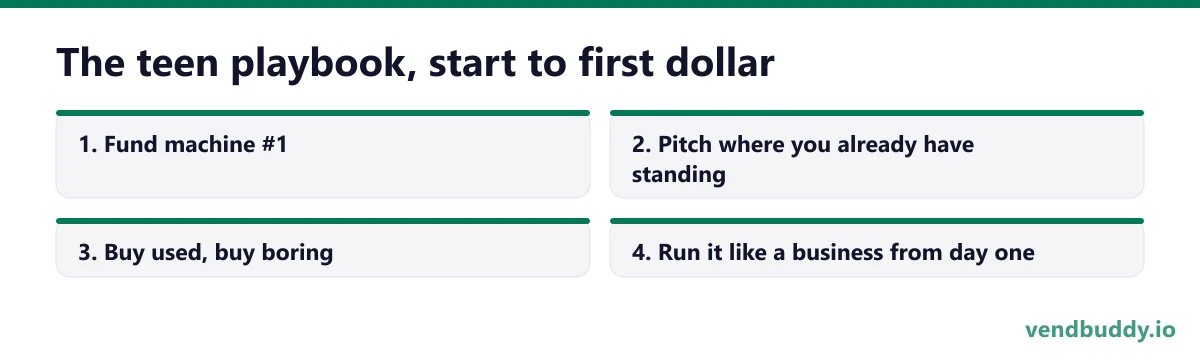
The teen playbook, start to first dollar
- Fund machine #1 ($1,500–$3,000). Summer-job savings, a family loan with real repayment terms, or a split: parent fronts the machine, teen pays it back from revenue before taking profit. That last one teaches more about business than any class.
- Pitch where you already have standing. Your school (booster clubs and athletic departments love student-run concessions), your gym, your family’s workplaces, the barbershop you have gone to for years. The pitch fundamentals are the same — but lead with who you are: a local student building a real business. Doors open.
- Buy used, buy boring. A used snack/drink combo with a card reader. No claw machines, no exotic products for machine #1.
- Run it like a business from day one. Track every dollar of sales and product cost, restock weekly, keep the machine spotless. The habit gap — not the age gap — is what kills most first routes (see why most operators fail in year one).
Picture the machines paying you while you sleep
That’s the real promise of vending — income that doesn’t cost you your time, and a life on your own terms. VendBuddy turns this guide into a step-by-step plan so you actually build it instead of just reading about it. Start free today.
What a teen route realistically earns
One decent placement grosses $400–$1,200/month; at 25–30% net margin that is $100–$350/month of profit per machine for a few hours of work a week — several times what the same hours earn at a fast-food counter, plus an asset that grows. Two or three machines by senior year is a genuinely strong college-application story and $5,000–$10,000/year of income. The full income math is in how much vending machines make.
VendBuddy maps the businesses in your ZIP worth pitching — laundromats, gyms, auto shops, offices — and scores them by vending potential. Free credits, no card, works the same whether you are 16 or 60.
Frequently Asked Questions
How old do you have to be to own a vending machine?
There is no minimum age to operate one — but signing enforceable placement contracts and forming an LLC generally require being 18. Under 18, a parent or guardian signs contracts and holds the entity while the teen runs the business.
Can a 16-year-old make money with vending machines?
Yes — a single decent placement nets $100–$350/month for a few hours of weekly work. The constraint is paperwork (adult co-signer), not capability.
What is the best first business for a teenager?
Vending ranks near the top: low startup cost ($1,500–$3,000 used), income from day one, flexible hours around school, and it teaches inventory, sales, and bookkeeping with real stakes. The failure modes are the same as for adults — weak locations and inconsistent restocking.
Related: the complete startup guide, starting with no money, buying a used machine, vending for parents (same structure, reversed), and the year-one failure modes to avoid.
What is selling, which buildings say yes, and the numbers before you buy a machine. Free, confirm from your inbox, unsubscribe in one click. Refer one friend and get 25 VendBuddy credits.
Every operator we talk to wants fewer cold calls. The ones who get there have a Google Business Profile and a simple site a manager can check before replying. AI builders make that an evening job now. Wix is the mature site builder; Base44 also builds working tools like a quote form. Start with the AI website walkthrough or Wix vs Base44.
General information, not legal, tax or financial advice. Rules change, so check the official source. Revenue and income figures are examples, not promises. See our terms.