- Yes — and better than most businesses. The selling is forty seconds, scripted and identical every time. The operating is ninety solitary minutes a week.
- The number that reframes it: the total spoken selling behind a five-machine route is under ten hours. Ever. A retail job does that in a week.
- But the first twenty conversations cannot be skipped. Written outreach works on property management companies and corporate facilities; it does not work on the small independent shop where the owner is on the floor.
- “I am shy” and “I hate sales” are different problems. If you hate persuading people to spend money, vending mostly avoids that — you are offering a free amenity, not asking for a purchase.
- Budget social battery, not hours. Two walk-in mornings a week, maximum, and nothing social afterwards. This is the plan that survives contact with an actual introvert.
The version of this question people usually ask out loud is “can I do this if I am not a people person,” and the version they mean is closer to: is there a business where I do not have to perform sociability for eight hours a day and pretend to enjoy it?
The honest answer for vending is unusually good, and it is not the usual reassurance that introverts can do anything if they push themselves. It is that the business genuinely has very little talking in it, that the talking it does have is scripted and short, and that there is one specific chunk at the beginning that you cannot avoid and should plan for deliberately instead of hoping to route around.
Start with the number, because it changes the conversation
Here is the arithmetic almost nobody does.
Landing a location takes roughly twenty walk-ins per yes. Each walk-in is a conversation of under two minutes and frequently under one, because most of them end quickly. Call it thirty to forty minutes of actual speaking per location secured, plus perhaps another twenty minutes of follow-up calls and the conversation where you sign.
So a five-machine route — the size that produces a genuinely useful second income — involves somewhere in the region of five to ten hours of spoken selling across its entire existence. Not per week. Not per month. In total, spread over a year or two.
After that, ongoing contact with a location is a text every few months, an occasional two-minute conversation with a facilities manager, and once a year a renewal that is usually a formality. The customers — the people actually buying things — never speak to you at all. The revenue-generating interaction in this business contains zero language.
| Business | Spoken selling required | Can it be scripted? |
|---|---|---|
| Insurance, real estate, phone sales | All day, every day, live | No — it is objection handling under pressure |
| Consulting, agency, coaching | Continuous client management | Partly, but relationships are the product |
| Retail or food service | Every hour you are open | Partly, and there is no end to it |
| Trades and home services | Every quote, every job, in someone home | Somewhat — but scoping is unscripted |
| Vending route | Under 10 hours, total, to build a five-machine route | Yes — the same 40 seconds every time |
That bottom row is the whole case. It is not that vending has no social requirement. It is that the requirement is finite, front-loaded, and identical every time, which is a completely different demand from a job that asks you to be warm and improvisational for forty hours a week indefinitely.
“I am shy” and “I hate sales” are not the same problem
This distinction is worth drawing carefully, because most people asking this question have conflated the two and the answers are different.
“I hate sales” usually means: I do not want to persuade somebody to give me money for something they were not going to buy. That is a moral discomfort more than a social one, and it is a completely reasonable position. Here is why it mostly does not apply to vending: you are not selling anything to the building. You are offering a machine at no cost to them, which you buy, stock, service and repair, in exchange for space they were not using. There is no price negotiation with a reluctant buyer. There is no closing technique. The building either has enough people and inconvenient food options, or it does not, and if it does not the right answer is to leave. The actual pitch is here and the thing to notice reading it is how little persuasion is in it.
“I am shy” means: initiating with a stranger costs me something real. That one is not dissolved by a reframe and it would be dishonest to pretend otherwise. Walking through a door and starting a conversation with a person who did not expect you is genuinely effortful if you are wired that way, and doing it four times in a morning is tiring in a way that does not show up on a time sheet.
What makes it survivable is that it is bounded. Twenty conversations. Four or five mornings. Then it stops, and the business becomes something else entirely. That is a very different proposition from a job where the initiating never stops, and it is why people who cannot imagine themselves in sales can often do this specific thing for six weeks.
Picture the machines paying you while you sleep
That’s the real promise of vending — income that doesn’t cost you your time, and a life on your own terms. VendBuddy turns this guide into a step-by-step plan so you actually build it instead of just reading about it. Start free today.
Start building free →Scripts beat charisma, and this is not a consolation prize
The received idea is that extroverts are better at the walk-in. In practice they frequently are not, and the reason is instructive.
The pitch is forty seconds. It works because it is clear, specific and short. The most common way it fails is over-talking — filling silence, adding detail nobody asked for, continuing to sell after the person has already said yes, and turning a simple offer into something that feels like it has a catch in it. That failure mode belongs almost entirely to people who are comfortable talking.
What actually converts is the thing a prepared person does naturally: say the same forty seconds you said at building eleven, ask the question, and then stop and let the silence sit. Introverts are usually better at the stopping.
Three things that make this concretely easier:
- Write it down and rehearse it out loud until it stops sounding written. Not memorised word for word — memorised in shape, so you always know what the next sentence is. The whole reason the walk-in is frightening is uncertainty about what happens next, and a script removes most of it.
- Pre-write the objections. There are about twelve and you will hear the same five constantly: we already have a vendor, we do not have space, I need to ask someone, we tried that and it did not work, send me something. Having a written one-sentence answer to each converts the scary part into a lookup. The rejection and objection responses are here.
- Decide in advance that a no is data. Twenty walk-ins to a yes means nineteen nos are the expected outcome, not a series of small verdicts on you. Track them in a spreadsheet with a reason column. Counting them is a surprisingly effective defence, because it turns the thing that stings into the thing you are collecting.
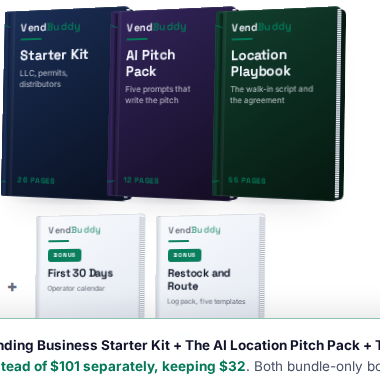
If you get to the end of this and the answer is yes, the kits are the shortcut past the blank page: a 26-page starter kit for the paperwork, a 55-page Location Playbook for the walk-in script and the agreement, and a 12-page AI Pitch Pack. Bought once, from $27, and you keep the files.
Look inside the kits →The written-first strategy, and its honest limits
This is the part most introvert-friendly business advice oversells, so here is where it genuinely works and where it does not.
Where written outreach works well: property management companies, corporate facility teams, multi-site operators, HOA boards, larger gyms and anything with a professional administrative layer. These organisations have somebody whose job includes reading email, they expect vendor contact in writing, and a well-composed message reaches a decision-maker that a walk-in would never get past the front desk to meet. For this segment, email is not a workaround. It is the better channel, and it plays directly to a strength: you can compose carefully, revise, and send it at 11pm. The cold email scripts that get replies are here.
Where it works poorly: small independent businesses. The owner of a thirty-person machine shop is on the floor, does not read a generic inbox, and will not answer an email from a stranger. That building is landed by walking in, and it is also frequently a great location. There is no email that substitutes.
The other low-contact channels, ranked honestly. Direct mail is slow and works at low volume for high-value targets. Flyers and building-notice boards occasionally produce inbound. A Google Business Profile produces genuine inbound over months rather than weeks and is worth setting up on day one precisely because it works while you sleep. The whole no-cold-calling strategy is written up here, and the honest summary is that it can produce a meaningful share of your locations and it takes longer per location.
So the workable posture is not written-instead-of-walking. It is written for the professionalised half of your target list, walk-ins for the independent half, and accept that the first location will probably come from the walking because it is faster.
The worked eight-week plan, budgeted in social battery
Every other plan on this site is budgeted in hours. This one is not, because hours are not your constraint. The rule underneath it: two walk-in mornings a week, maximum, and nothing socially demanding scheduled afterwards on those days.
| Week | Spoken (the expensive part) | Written and solitary (the cheap part) |
|---|---|---|
| 1 | None | Score the ZIP, build a 40-building target list, split it into professionalised and independent |
| 2 | Rehearse the script out loud, alone, until it is 40 seconds | Write the email sequence. Send the first 15. |
| 3 | One morning. Four buildings. Deliberately start with the ones you care least about. | 15 more emails. Log every walk-in outcome with a reason. |
| 4 | Two mornings. Eight buildings. | Follow up on every email that went unanswered. This is where replies actually come from. |
| 5 | Two mornings. Eight buildings. By now the script is automatic and the cost per building has dropped noticeably. | Second follow-up round. Set up the Google Business Profile. |
| 6 | Follow-up calls to the maybes. Usually three or four short calls. | Price machines, get an insurance quote, read the permit requirements |
| 7–8 | The closing conversation, and then it is over | Buy the machine, arrange freight, plan the first fill |
Two things about that table worth naming. Week three starts with the buildings you care least about on purpose — the first four are practice and you want to spend them where the outcome does not matter. And the total spoken column, added up, is roughly five hours of talking across eight weeks, at the end of which you own an asset that produces money without any further conversation.
If you want to know how many machines that plan needs to reach a specific income, run it rather than guessing: the Income Reality Calculator converts your capital, hours and target income into a machine count and a timeline, which is a much better way to size the social cost than imagining it.
The part nobody warns introverts about: they will like the route
Worth saying because it is the most consistent piece of feedback from operators who describe themselves this way.
A service run is ninety minutes alone. You load a cart, drive fifteen minutes, walk into a break room where nobody needs anything from you, restock a machine in a fixed sequence, count a coin bag, note what sold, and leave. Headphones the whole time. The work is physical, visible, finite, and has an obvious right answer at the end of it.
For a lot of people that is the single most restorative ninety minutes of the week, and it is the opposite of the job most of them are doing to pay for it. That is not a reason to start a business by itself. It is a reason to take seriously that the ongoing state of this business is solitary, not social, and that the six weeks of walk-ins are an entry cost rather than the shape of the thing.
Twenty walk-ins per yes is the average. It drops when the twenty are the right twenty. VendBuddy scores real venues near you by traffic, headcount and category, gives you the best contact on file for each, and models what a machine would net there - which means fewer doors, better odds, and less time being told no. Five free credits, no card.
When the honest answer is no
- If you cannot do the twenty conversations, even scripted, even spread over two months. This is the genuine floor. There is a lower-contact version of prospecting and it is slower, not free, and it still needs some. A business with literally zero outreach in it is not this one.
- If you are hoping to buy your way past it. Locating services exist and they charge $500 to $2,000 a location, and the quality is extremely uneven. The honest review of that industry is here, and the summary is that paying somebody to do the part you dislike frequently produces locations you would not have accepted.
- If what you actually want is colleagues. This is solitary work. If the real problem you are solving is isolation, a route will make it worse rather than better, and that is worth knowing before you spend $3,000.
- If the social cost is anxiety rather than preference. There is a difference between finding approach tiring and finding it genuinely distressing, and the second one deserves better support than a business plan. The route will still be here.
The bottom line
Yes, an introvert can run a vending business, and the reason is not motivational. It is that the entire spoken sales requirement of a five-machine route is under ten hours, the pitch is forty scripted seconds delivered identically every time, the customers never speak to you, and the weekly work is ninety solitary minutes with a cart.
What you cannot do is skip the first twenty conversations. They are finite, they are short, they are mostly nos, and they are over inside two months. Write the script, pre-write the objections, book two mornings a week and nothing after them, and start with the buildings you care least about.
Not sure whether to start anything at all? The readiness quiz takes two minutes, scores you on capital, protected hours, risk tolerance and deadline, and is willing to tell you not yet. If the answer is already yes, the start page is the shortest route to a first location.
Related reading: cold email scripts that get replies, finding locations without cold calling, the walk-in script and the twelve objections, starting a business while working full time, your first $100 in vending, and whether vending is right for you.
Frequently Asked Questions
Can an introvert start a vending machine business?
Yes, and it is one of the better business choices available to someone who finds sustained social performance draining. The reason is structural rather than encouraging. The selling in vending is brief, scripted and repetitive - roughly a forty-second pitch, delivered at about twenty buildings to land one location - and the operating half is genuinely solitary, a weekly ninety-minute loop with a hand truck and nobody to talk to. The total amount of spoken selling behind a five-machine route is under ten hours across its whole life. What cannot be skipped is the first twenty conversations, and no amount of email fully replaces them.
Is vending good for people who hate sales?
It depends which part of sales you hate, and the distinction matters more than people realise. If what you dislike is persuading somebody to part with money, vending mostly avoids it: you are offering a building a free amenity, at no cost and no obligation to them, that you service and stock yourself. Nobody is being talked into a purchase. If what you dislike is the act of approaching a stranger and initiating a conversation, that part is real and unavoidable in the first phase, though it is finite, scripted and over within a few weeks. Most people who say they hate sales mean the first thing, which is good news here.
Can you find vending locations without cold calling?
Partly, and it is worth being precise about how much. Written outreach genuinely works on larger and more professionalised properties - property management companies, corporate facility teams, multi-site operators - because those organisations expect to be contacted by email and have a person whose job includes reading it. It works far less well on small independent businesses, where the owner is on the floor and email goes unread. A realistic split is that a written-first strategy can produce a meaningful share of your placements but takes longer per location, and there is no version of this business with zero conversations in it.
How many conversations does it take to get a vending location?
Roughly twenty walk-ins for one yes is the working number, and each conversation is short - typically under two minutes, often under one. That means the entire spoken effort behind a first location is somewhere around thirty minutes of actual talking, spread across four or five mornings. Framed that way the barrier is usually smaller than it feels. The part that is genuinely tiring is not the total minutes but the repeated approach, which is why scheduling walk-ins in short concentrated blocks works better for most people than spreading them thinly across a month.
What is the pitch for a vending machine location?
Short enough to be memorised and delivered the same way every time. It names who you are, offers a machine at no cost to the building, states that you stock and service it, mentions the two or three things a building actually cares about - reliability, cleanliness and modern payment - and ends with a question rather than a request. The whole thing runs about forty seconds. Because it is identical at building nineteen and building one, it can be written out, rehearsed and improved, which is precisely the sort of task that suits people who prefer preparation to improvisation.
Is running a vending route lonely?
It is solitary, which is not the same thing and the difference matters. A service run is ninety minutes on your own with a cart, a route sheet and whatever you want in your headphones, and most operators describe it as the most restorative part of the week. Ongoing contact with a location is typically a short text every few months and an occasional conversation with a facilities manager. If you actively want colleagues and daily interaction, that is a real argument against this business rather than for it, and worth taking seriously before you buy anything.
What is selling, which buildings say yes, and the numbers before you buy a machine. Free, confirm from your inbox, unsubscribe in one click. Refer one friend and get 25 VendBuddy credits.
Every operator we talk to wants fewer cold calls. The ones who get there have a Google Business Profile and a simple site a manager can check before replying. AI builders make that an evening job now. Wix is the mature site builder; Base44 also builds working tools like a quote form. Start with the AI website walkthrough or Wix vs Base44.
General information, not legal, tax or financial advice. Rules change, so check the official source. Revenue and income figures are examples, not promises. See our terms.