Cold email works in vending — when it's short, specific, and structured. The operators pulling 15–25% reply rates aren't writing clever copy. They're using a 5-sentence pattern and sending it to the right person. Here are the exact templates, subject lines, and follow-up cadence.
- The 5-sentence structure that works
- Subject lines that get opened
- Template 1: Mid-size office (50–300 employees)
- Template 2: Warehouse or distribution center
- Template 3: Apartment complex (property manager)
- Template 4: Gym or fitness center
- Template 5: Medical clinic or urgent care
- The 3-touch follow-up cadence
Part of our complete guide: how to find vending machine locations.
Most vending cold emails fail for three reasons: they're too long (anything over 120 words gets skimmed and archived), too generic (no evidence the sender knows anything specific about the recipient's business), and they pitch before giving the reader a reason to care. Fix those three and your reply rate roughly triples.
The 5-sentence structure that works
Every template below follows the same skeleton. If you would rather have an AI adapt it per building than adapt it yourself twelve times, the AI Location Pitch Pack is the prompt version of this skeleton — it sits alongside the walk-in script and the placement agreement in the operator kits.
- Specific opener: Why you're emailing THEM (not generic). One detail about their business proves you're not spamming.
- One concrete observation: Break rooms, employee count, location layout, parking — something real.
- What you do, in plain English: One sentence. No jargon. No “solutions provider.”
- Zero-commitment ask: A yes/no question, not a meeting request. “Open to this?” beats “Do you have 30 minutes Thursday?”
- P.S. with proof: A credibility anchor — a similar property, a machine count, a referral.
Total length target: 80–110 words. If you're over 120, cut.
If a draft feels wordy, a tool like QuillBot can tighten the phrasing and catch grammar slips before you send. Affiliate link: VendBuddy may earn a commission at no extra cost to you.
Subject lines that get opened
Subject lines matter more than body copy. These three patterns produce the highest open rates in operator-reported data:
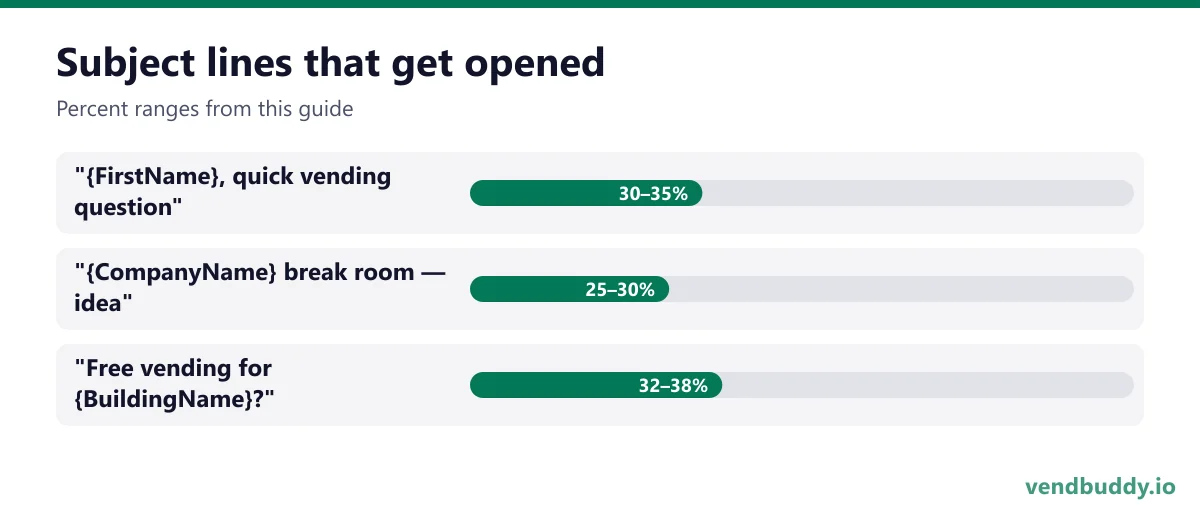
- “{FirstName}, quick vending question” — casual, personal, low-threat. Typical open rate: 30–35%.
- “{CompanyName} break room — idea” — concrete, specific, hints at value. Typical open rate: 25–30%.
- “Free vending for {BuildingName}?” — the word “free” plus the building name by landmark. Typical open rate: 32–38%.
Avoid anything that looks like a pitch in the subject (“Increase revenue with vending,” “Partnership opportunity”). Those get deleted without opens.
Picture the machines paying you while you sleep
That’s the real promise of vending — income that doesn’t cost you your time, and a life on your own terms. VendBuddy turns this guide into a step-by-step plan so you actually build it instead of just reading about it. Start free today.
Start building free →Template 1: Mid-size office (50–300 employees)
Subject: {FirstName}, quick vending question
Hi {FirstName},
Saw {CompanyName} has around {HeadcountRounded} people at {BuildingName} — that is right in the sweet spot where a well-placed beverage machine tends to get used heavily. I run a local vending route and wanted to check if your break room on {Floor} already has coverage.
We install and service the machine at zero cost to you. No contracts you cannot exit. Open to a quick look if the fit is there?
{YourName}
P.S. We currently service {NearbyCompany} down the road — happy to drop a reference if it is useful.
Template 2: Warehouse or distribution center
Subject: {CompanyName} break room — idea
Hi {FirstName},
Your {ShiftType} shift crew at {CompanyName} is a group that vending machines tend to serve really well — especially if the nearest gas station or convenience store is more than a few minutes off-site. I run a local vending route and wanted to ask whether the break area is already covered or if there is a gap.
Zero cost to you, we install and stock, and we can pay a commission on gross if that helps the case internally. Open to a quick call?
{YourName}
Template 3: Apartment complex (property manager)
Subject: Free vending for {CommunityName}?
Hi {FirstName},
I manage a small vending route and noticed {CommunityName} has {UnitCount} units with a package room and clubhouse — the kind of amenity mix where residents usually appreciate a late-night drink or snack option. No cost to the property, we handle install, stocking, and repairs, and the community gets a resident amenity without any lift.
Worth a 10-minute look?
{YourName}
P.S. Happy to share how two similar properties in {AreaName} have used this as a retention talking point with renewals.
Template 4: Gym or fitness center
Subject: {FirstName}, quick vending question
Hi {FirstName},
{GymName} is exactly the kind of gym where a small, well-stocked vending setup tends to pay for itself — protein drinks, hydration, and a few clean snacks right by the front desk or locker room. I run a local route and wanted to ask if you are open to adding one at no cost to you.
We would install a cooler-only unit (drinks only, no junk snacks) and you would earn a commission on every sale. Open to a 10-minute look?
{YourName}
Template 5: Medical clinic or urgent care
Subject: Vending for {ClinicName} waiting room?
Hi {FirstName},
Urgent care waiting rooms are one of the few places where a small vending machine — drinks and light snacks — reliably makes patients' wait easier without creating work for staff. I run a local route and wanted to ask whether {ClinicName} already has coverage or if this is something worth a look.
We handle everything end-to-end at no cost to the clinic. Open to a quick conversation?
{YourName}
The 3-touch follow-up cadence
Most replies come from follow-ups, not the first email. The cadence that works:
- Day 3: Reply to your own email. Two sentences max. “Wanted to bump this — still the right person to ask about break room amenities, or should I loop in someone else?” This alone produces a 10–15% reply rate on its own.
- Day 7: New subject line. “Last follow-up on {CompanyName} vending.” Short body: acknowledge they are busy, offer a specific piece of value (a free planogram, a short case study link), and give a clean out. “If the timing is off I will stop reaching out — just wanted to make sure you had the option.”
- Day 14: One-sentence closer. “Closing the loop on this — if it ever becomes relevant, {YourEmail} is the fastest way to reach me.” No ask. This earns replies from people who genuinely were not ready when you first emailed.
After day 14, stop. Add the contact to a 90-day re-touch list. Move on.
To fill these templates in for a specific building, the free pitch letter generator writes the first email, both follow-ups and a printed leave-behind from a short form.
Once you are sending to more than a few dozen contacts, a sending tool saves time. Smartlead sends sequences from your own inbox and stops the follow-ups when someone replies. Affiliate link: VendBuddy may earn a commission at no extra cost to you.
What to leave OUT of a cold email
- Generic benefit lists. “We offer convenience, variety, and 24/7 service.” Everybody writes this. Nobody reads it.
- Your company history. They don't care yet. They care whether you understand their business.
- Commission percentages in the first email. Mentioning commission before they have expressed interest signals desperation. Save it for the reply.
- Attachments. Nearly every corporate email filter flags unsolicited PDFs. Link to a one-page landing page instead.
- Calendly links in the first email. Ask for a yes/no first. Booking links in a first cold email convert worse than “open to this?”
Skip the research, get the right contact directly
Every template above depends on knowing who to email. The VendBuddy lead finder returns verified business email and phone for warehouses, offices, apartments, gyms, and medical clinics — so you spend your time writing emails, not hunting contacts on LinkedIn.
For the step after the reply, when someone asks you to send something over, the Placement Agreement + Proposal Kit has the proposal, the follow-up sequence and the agreement to sign.
Try the lead finder →FAQ
How many cold emails should I send per week?
15–25 first-touches per week is a sustainable pace for a single operator also doing pop-ins and restocking. Lead flow typically starts opening up at month 5–6 of consistent sending, per the BD playbook. Don't batch 200 emails in a week — you'll get flagged for spam.
If you want the playbook in one file rather than clicking through posts, the free Ultimate Vending Guide has it. It costs an email address and nothing else.
What reply rate should I expect?
A well-structured cold email with a verified business contact typically sees 10–20% reply rate across all follow-ups combined. Under 5% means your targeting or subject lines are off. Over 25% usually means you're emailing pre-warm contacts, not true cold.
Should I send from a personal or business email?
Business email from your actual domain, never a Gmail address. Personal Gmail signals “not a real operator” to corporate recipients. Your domain should match your business card and website. Warm the domain for 2–3 weeks with low-volume sending before running any outreach campaign.
Does A/B testing subject lines actually matter at this scale?
Not really — you need a few hundred sends to detect statistical difference. Use one of the three proven patterns above, stay consistent for 3 months, then evaluate. Spending time on subject-line micro-optimization at 25 sends/week is effort better spent on getting the recipient list right.
The emails above are the outreach half. The Location Playbook is what happens when one of them lands: the walk-in opener annotated line by line, variants for offices, gyms, apartments, warehouses and salons, twelve objections answered, and a plain-English placement agreement you can leave on the desk.
See what is inside →Related: how to find vending machine locations, negotiating vending placements, the vending decision-maker map, location scoring checklist, finding locations without cold calling.
What is selling, which buildings say yes, and the numbers before you buy a machine. Free, confirm from your inbox, unsubscribe in one click. Refer one friend and get 25 VendBuddy credits.
Walk-ins and cold emails find locations. A small site with your own machine photos and a request-a-machine form lets the next one find you. Around machine three to five, an AI builder drafts it in an evening. Wix is the mature site builder; Base44 also builds working tools like a quote form. Start with the AI website walkthrough or Wix vs Base44.
General information, not legal, tax or financial advice. Rules change, so check the official source. Revenue and income figures are examples, not promises. See our terms.