The reason most vending machines underperform isn't the machine, the mix, or the operator. It's the location. And the painful part is: most bad locations are predictable before you sign. This is the 10-point scoring checklist that tells you, in about 20 minutes of diligence, whether a placement will produce revenue or drain it.
Part of our complete guide: how to find vending machine locations.
New operators sign whatever they can get. Experienced operators score every placement against a fixed rubric and walk away from the ones that don't clear a threshold. The difference is usually a full year of revenue. The math in this costs breakdown gets brutal fast if you're servicing a machine that nets $120/month instead of $600.
Why scoring beats gut feel
Gut feel gets distracted by the wrong signals: nice lobby, friendly property manager, a building that looks busy at 10am on a Tuesday. None of those correlate with per-machine revenue. What correlates is a small set of structural factors that you can score in a single site visit plus 10 minutes of desk research.
Every figure here is an average, and averages hide the building. The revenue calculator lets you plug in the property you are actually looking at and see the range for that type.
The rubric below gives you a 1–5 score on each of 10 factors, for a maximum of 50. Score honestly. If you're inflating a score to justify a location you already want, you've already lost.
The 10 scoring factors
1. Captive headcount × hours on-site (1–5)
This is the single most predictive factor. A captive audience is people who cannot easily leave during their work or stay window. 200 warehouse workers stuck on a 10-hour shift produce more revenue than 2,000 people walking past an open-air mall. Score: 5 = 150+ captive people for 8+ hours. 3 = 50–150 for 4–8 hours. 1 = under 30 people or high transience.
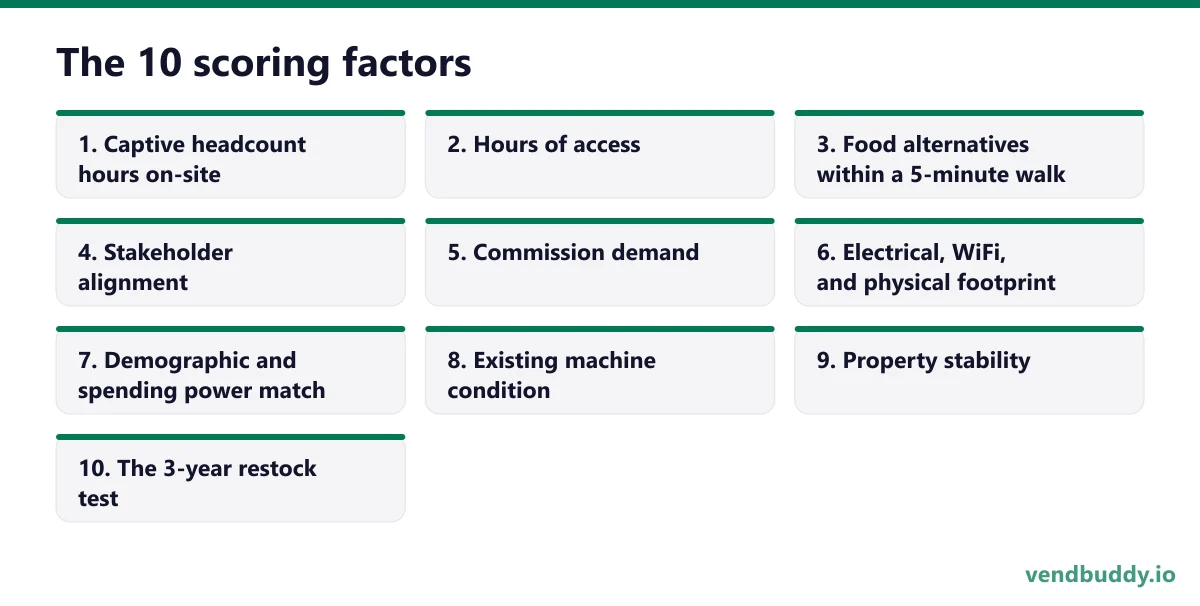
2. Hours of access (1–5)
A 24/7 machine can do 2–3x the revenue of a 9–5 machine at the same headcount because it serves second shift, off-hours, and weekend workers. Score: 5 = unrestricted 24/7. 3 = business hours plus after-hours badge access. 1 = locked outside business hours or has a host who turns the power off.
3. Food alternatives within a 5-minute walk (1–5)
Invert this one. More alternatives equals lower score. Score: 5 = no cafeteria, no micro-market, no food trucks, nearest gas station is 8+ minutes. 3 = one mediocre option. 1 = full cafeteria or a Starbucks inside the building.
4. Stakeholder alignment (1–5)
The person signing the contract needs a reason to care about the machine's success. A property manager getting a 10% commission on a $3,000/month machine is aligned. A corporate real estate director who sees vending as a compliance headache is not. Score: 5 = stakeholder earns commission or gets measurable amenity credit. 3 = neutral. 1 = signing out of obligation and hoping you disappear.
5. Commission demand (1–5)
See commission rate ranges. Score: 5 = zero commission, product credit only, or a flat placement fee. 3 = 5–10% of gross. 1 = 15%+ of gross or tiered escalators.
6. Electrical, WiFi, and physical footprint (1–5)
Bad installs kill margin quietly. Score: 5 = dedicated 20-amp circuit within 6 feet, strong WiFi or cellular signal, level concrete pad, forklift access for delivery. 3 = usable but with one compromise (weak signal, shared circuit). 1 = needs an extension cord, sits on carpet, or has to be dollied up two flights of stairs.
7. Demographic and spending power match (1–5)
Match your product mix to the people. Score: 5 = audience buys the products you stock at the prices you charge (verify with 10 minutes of observation during peak hours). 3 = partial match; you'll need to re-plan the machine. 1 = price-sensitive audience or one whose preferences you can't serve.
8. Existing machine condition (1–5)
If there is a machine already in place, it's telling you the truth about the location. Score: 5 = no existing machine, or the previous operator left due to location relocation (not performance). 3 = existing machine with obvious neglect (you're an easy upgrade). 1 = existing machine doing great with a well-established operator — you'll have to displace them to get in.
9. Property stability (1–5)
Your machine needs 24–36 months to return capital. Score: 5 = stable ownership, long-term tenant, no planned renovations or closures. 3 = some uncertainty (building for sale, renovation rumored). 1 = known closure, relocation, or ownership change within 12 months.
10. The 3-year restock test (1–5)
Stand in the spot where the machine will go and ask: “Can I see myself servicing this every 10 days for the next three years?” Score on access difficulty, drive time, parking, hostile hosts, and neighborhood safety during restock hours. Score: 5 = easy weekly visit. 1 = you already dread it.
Picture the machines paying you while you sleep
That’s the real promise of vending — income that doesn’t cost you your time, and a life on your own terms. VendBuddy turns this guide into a step-by-step plan so you actually build it instead of just reading about it. Start free today.
Start building free →The scoring rubric: what to do with your total
- 40–50 — Sign same day. These are rare. If you find one, don't haggle on commission for longer than a single back-and-forth. Lock it.
- 30–39 — Sign with conditions. Renegotiate at least one factor that scored low. Require a 3-year term with automatic renewal. Include a performance-review clause at 6 months.
- 20–29 — Route-filler only. Only sign if the location is within 1 mile of an existing high-performing placement. Never drive more than 15 minutes to a 20–29 location.
- Under 20 — Walk away. There is almost always a better placement 2 miles down the road. Use the VendBuddy location finder to see nearby higher-scoring options before you settle.
Worked example: the gym that scored 22
A 24-hour independent gym with 180 members, nice lobby, eager-to-sign owner. Here is the scored card: captive headcount 2 (members come and go, average 40 minutes on-site), access hours 5 (24/7), alternatives 2 (Starbucks across the parking lot), stakeholder alignment 4 (owner saw it as member amenity), commission 4 (owner asked for product credit only), install 4 (great electrical, weak WiFi), demographics 2 (gym members overwhelmingly buy protein shakes from the front desk, not the machine), existing 5 (no machine), stability 3 (building lease 18 months remaining), restock 3 (awkward weeknight visits). Total: 34. Would have been a “sign with conditions.” The operator walked because the demographics score (2) was a red flag. Six months later the gym put in its own protein shake cooler and would have crushed any beverage placement. Right call.
The three factors that predict 70% of outcomes
If you score only three factors and skip the other seven, score captive headcount × hours, access hours, and food alternatives nearby. These three together explain the majority of between-location revenue variance in real operator data. Everything else is refinement. Don't skip the full rubric — but if you're time-constrained on a quick in-person visit, nail these three and come back for the rest.
Pre-score locations before you visit
The VendBuddy location finder returns ranked prospects with employee count, foot traffic estimate, and the likely decision-maker title — enough to pre-score factors 1, 4, and 7 before you ever drive out. Walk in already knowing whether the site is worth the pitch.
Try the location finder →FAQ
What is the minimum score you would sign at?
30, with conditions. Below 30, the math breaks once you account for restock time, commission, and product shrinkage. The exception is a route-filler within 1 mile of an existing machine — there, 20–29 can work because your marginal servicing cost is near zero.
How long does this full scoring take per location?
About 20 minutes: 10 minutes of desk research (employee count, demographics, existing machines) plus 10 minutes on-site observing during peak hours. Operators who score discipline into their pipeline run this on every prospect before the pitch call.
What if the stakeholder refuses to answer questions you need to score?
That's a score-1 signal on stakeholder alignment and usually signals a low-effort sign-off with no follow-through on issues later. If the property manager won't spend 10 minutes explaining break room traffic patterns to you, they won't spend 10 minutes helping you troubleshoot the coin mech in month three either.
Does this work for micro-markets?
Use a modified rubric. Captive headcount × hours matters more (micro-markets need 150+ daily users to make sense), food alternatives matters less (micro-markets fill a cafeteria-style role), and install logistics matter more (refrigeration, payment kiosks, ambient shrinkage). See micro-markets vs. vending machines for the full comparison.
Stop signing placements that lose money
Pre-score every prospect before you drive out. VendBuddy surfaces captive headcount, the likely decision-maker title, and the best contact on file for ranked locations so you can filter out the bottom 70% from your desk.
Try VendBuddy free →Related: how to find vending machine locations, negotiating vending placements, commission rates, costs and profit breakdown, placement for maximum revenue.
What is selling, which buildings say yes, and the numbers before you buy a machine. Free, confirm from your inbox, unsubscribe in one click. Refer one friend and get 25 VendBuddy credits.
Walk-ins and cold emails find locations. A small site with your own machine photos and a request-a-machine form lets the next one find you. Around machine three to five, an AI builder drafts it in an evening. Wix is the mature site builder; Base44 also builds working tools like a quote form. Start with the AI website walkthrough or Wix vs Base44.
General information, not legal, tax or financial advice. Rules change, so check the official source. Revenue and income figures are examples, not promises. See our terms.