- Everywhere: business license/registration + sales-tax (seller’s) permit + EIN.
- Selling perishables: add a county/city health permit and usually a food-handler certificate.
- Strictest: California, New York, Illinois (Chicago), Massachusetts, Washington.
- Easiest: Wyoming, South Dakota, Texas, Florida, Colorado.
- There is no federal vending license — everything is state and local.
“What permits do I actually need?” is the question that stalls more first-time operators than any pricing or location problem. The honest answer is that vending is lightly regulated compared to most retail — but the pieces that do apply differ enormously by state, and getting caught without a health permit on a fresh-food machine can mean a same-day shutdown order. Here is exactly what you need, ranked by how likely you are to actually need it, plus the states where the bar is highest and lowest.
Part of our complete guide: how to start a vending machine business.
The permit floor every operator needs
Regardless of state, three things apply to almost every vending operator in the US:
- Business license or registration. Most cities and counties require you to register as operating a business, even as a sole proprietor. Fees typically run $25–$150/year. Many operators register an LLC at the same time — see our LLC setup and tax deduction guide.
- Sales-tax (seller’s) permit. You are selling tangible goods, so nearly every state requires you to register to collect and remit sales tax. A handful of states exempt certain food items below a price threshold — check your state revenue department’s vending-specific guidance, since vending often has its own line item in the tax code.
- EIN. Free from the IRS in about five minutes. You need it to open a business bank account and to file as anything other than a sole proprietor under your own Social Security number.
None of this is unique to vending — it is the same floor any small retail business clears. The part that actually varies by state, and the part that trips people up, is what comes next.
How much is a vending machine permit?
Most individual permits cost between $0 and $300, and a realistic first-year total for one machine is roughly $150 to $600 depending on the city. That is the whole answer. Permitting is not the expensive part of starting a vending business, and anyone quoting you four figures for it is either selling a service or talking about a food truck.
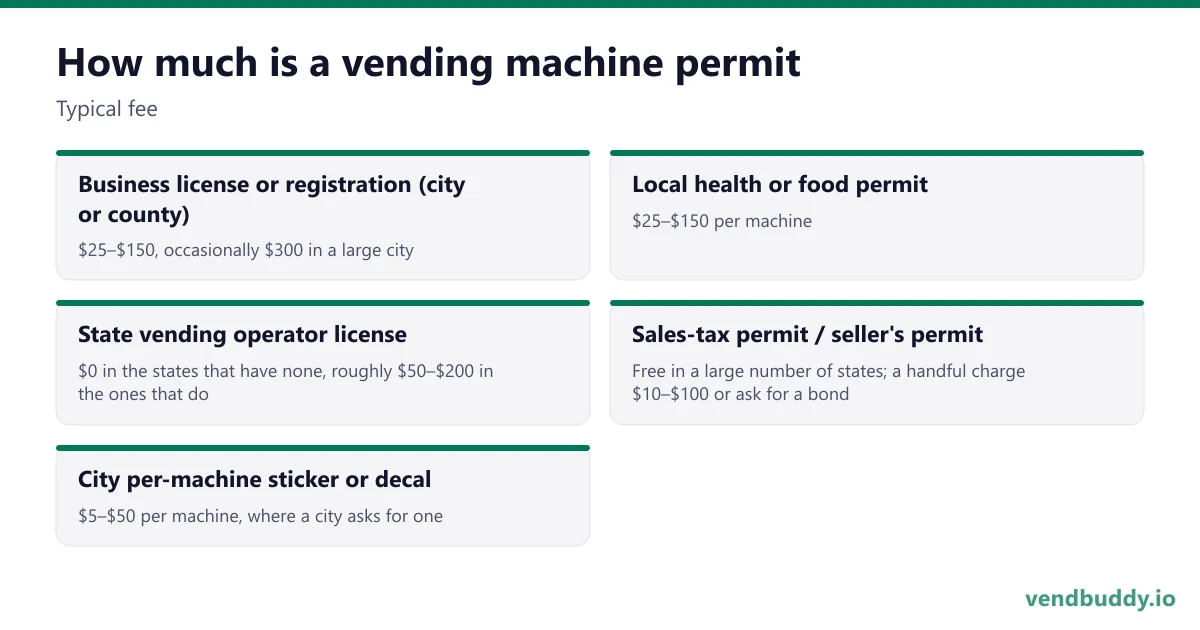
| What you are paying for | Typical fee | How often |
|---|---|---|
| Business license or registration (city or county) | $25–$150, occasionally $300 in a large city | Yearly in most places |
| Local health or food permit | $25–$150 per machine | Yearly, and usually charged per machine rather than per operator |
| State vending operator license | $0 in the states that have none, roughly $50–$200 in the ones that do | Yearly or every two years |
| Sales-tax permit / seller’s permit | Free in a large number of states; a handful charge $10–$100 or ask for a bond | One-time registration, then ongoing filing |
| City per-machine sticker or decal | $5–$50 per machine, where a city asks for one | Yearly |
The renewals are the part people miss. Your business license, the health permit and any state operator license come back every year, and the health permit and the city decal are usually priced per machine, so a five-machine route pays five health-permit fees rather than one. Budget somewhere around $50 to $200 per machine per year for the recurring side. The seller’s permit itself is normally a one-time registration in states such as Texas, Florida and Pennsylvania, though the sales-tax filing that follows it never stops.
Two things reliably cost more than the permits do. Missing a renewal, because some health departments charge a late fee that exceeds the permit, and guessing instead of calling — a five-minute call to your county health department settles the per-machine question that no national guide can answer for your address.
Picture the machines paying you while you sleep
That’s the real promise of vending — income that doesn’t cost you your time, and a life on your own terms. VendBuddy turns this guide into a step-by-step plan so you actually build it instead of just reading about it. Start free today.
Start building free →State vending operator licenses
A number of states require a specific vending or vending-operator license (sometimes per machine, sometimes per operator), while many require nothing beyond the general business and sales-tax basics. Because it varies so much, check your exact requirements in our state-by-state vending laws guide. The free permit and sales tax checker turns your state’s sales tax, permit, health and local notes into one checklist you can copy.
What you do NOT need
There is no federal vending license, no special national certification, and no industry body whose approval you must buy. Be skeptical of any program selling you a “required” vending license or certification — that is a common upsell, not a legal requirement. Nothing on that list involves a background check either, which is why a felon can start a vending machine business in most states as long as the food permit and the location agreement are in order.
Health codes for perishables
If every slot in your machine is shelf-stable — chips, candy, canned soda — most jurisdictions treat you like any other packaged-goods vendor and the health department has limited interest in you. The rules change hard the moment you add anything that needs refrigeration or has a real shelf life: sandwiches, dairy, fresh fruit, cut produce, dairy-based drinks, or hot food.
- Retail food establishment permit. Most counties classify a machine selling perishable/refrigerated food as a retail food establishment, which triggers an application, a plan review in some counties, and often an annual inspection — the same category a food truck or deli counter falls under.
- Temperature control and logging. Health departments commonly require the machine to hold cold items at or below 41°F and to have either a visible thermometer or telemetry logging. Some jurisdictions require you to keep temperature logs on file and produce them on request.
- Food-handler certification. A large share of counties require whoever stocks perishable machines to hold a basic food-handler card (ServSafe or an equivalent state-approved course). Cost is usually $10–$25 and the course takes under two hours online.
- Commissary or approved-source requirement. Perishable product generally must come from a licensed commercial kitchen or approved distributor — homemade sandwiches from your own kitchen will fail inspection almost everywhere.
- Machine-level decal or permit sticker. Several states (California and New York among them) require a visible permit decal on each machine selling food, not just a business-level license.
The practical takeaway: a snack-and-drink combo machine is a light lift almost anywhere in the country. A fresh-food micro market or smart cooler with perishables is a genuinely different regulatory category, closer to opening a small deli than stocking a vending machine. Budget the extra permit cost and the inspection cycle into your timeline before you commit to a perishable-heavy machine type — see our machine buying guide for how machine type maps to location fit.
The 5 strictest states
| State | What makes it strict |
|---|---|
| California | County-by-county health permitting under CalCode, machine decals required for food/perishable machines, some counties require plan review before your first perishable placement, and CRV (bottle deposit) compliance on beverages. |
| New York | NYC alone layers a DOHMH permit and food protection certificate requirement on top of state rules for any machine selling perishables; upstate counties vary independently. |
| Illinois (Chicago) | City-level food establishment licensing stacks on top of the state sales-tax registration, and Chicago inspects vending machines selling perishable food on a cycle similar to restaurants. |
| Massachusetts | Local boards of health administer permitting town-by-town rather than one statewide standard, so a route spanning several towns can mean several separate applications. |
| Washington | County health departments require detailed plan review for fresh-food vending and often mandate NSF-certified equipment specs before approval. |
The common thread: these are large, high-cost-of-living states where health departments are well-staffed and vending is treated as a full retail food category the moment perishables enter the machine. None of this blocks a standard snack-and-drink route — it specifically raises the bar for fresh food and micro markets.
The Vending Laws page breaks down licensing, sales-tax, and health-permit rules state by state, so you can check the exact requirements where your first machine is going instead of guessing from a top-5 list.
Want the paperwork in one place? The five free operator one-pagers include the tax-deduction sheet and the 90-day launch plan that sequences permits, EIN, and first placement.
The 5 easiest states
| State | Why it’s easier |
|---|---|
| Wyoming | No state vending-operator license, cheap and fast LLC formation ($100), and a light statewide health-code framework for packaged snacks. |
| South Dakota | No state income tax, minimal state-level vending regulation, and business registration that can be completed online in under an hour. |
| Texas | No state vending-operator license and no state income tax; most requirements are limited to the standard sales-tax permit and any city-level general business registration. |
| Florida | No state vending license and no state income tax; food-permit requirements for perishables exist but are administered efficiently through a single state agency rather than fragmented county boards. |
| Colorado | Cheap LLC filing ($50), no separate state vending license, and a straightforward online sales-tax registration process. |
Even in the easiest states, a perishable machine still needs a local health permit — “easy” here means fewer layers and lower fees for the basics, not zero rules for fresh food.
Rules change and vary by county even within one state. VendBuddy’s state-by-state laws reference and the free ROI calculator help you budget permit costs and timeline into your launch plan before you sign a location.
The pre-placement permit checklist
Work through this before your first machine goes live, and again any time you expand into a new state or add a perishable product line:
- Register your business entity (sole proprietor, LLC, or corporation) with your state.
- Apply for your EIN at IRS.gov (free, ~5 minutes).
- Register for a sales-tax (seller’s) permit with your state revenue department.
- Check your city and county for a general business license or vending-specific ordinance.
- If any machine sells perishable or refrigerated product, contact your county health department before you place the machine, not after — ask specifically about retail food establishment classification for vending.
- Get a food-handler certificate for yourself and anyone who restocks perishable machines.
- Confirm whether your state or county requires a physical decal or permit sticker on the machine itself.
- Line up general liability insurance and a Certificate of Insurance — most property owners require one before signing, regardless of what the government requires.
- Keep every permit, certificate, and COI in a shared folder your whole team can access; renewals are the most common thing operators let lapse.
What happens if you skip it
For the basics (business license, sales tax), the usual consequence is back-taxes, penalties, and interest if you get audited — painful, but rarely business-ending if caught early. Skipping the health permit on a perishable machine is a different level of risk: inspectors can and do issue same-day cease-and-desist orders on unpermitted food vending, and a property manager who finds out you were never permitted for the fresh-food machine in their lobby has grounds to terminate your placement agreement on the spot. The permit cost (often under $300/year) is trivial next to losing a location and the reputational damage of a public health violation. Treat it as a cost of entry for any perishable product line, not an optional extra.
Most first agreements are two pages, not twenty. The contracts walkthrough lays out the clauses that actually matter for the placement agreement, including the termination language operators forget about until they need it.
Frequently Asked Questions
How much is a vending machine permit?
Most individual permits cost $0 to $300, and a realistic first-year total for one machine is roughly $150 to $600 depending on the city: a business license, a sales-tax permit (free in many states), and a per-machine health permit only if you sell perishables.
Do you need a license for a vending machine?
Almost always a general business license and a sales-tax permit, not a special vending license. A minority of states add a vending operator license, and perishable food adds a health permit. There is no federal vending license.
Do I need a special license just to own a vending machine?
No federal license exists. Most operators need a general business license, a sales-tax permit, and an EIN — the same basics any small retail business needs. A specific state vending-operator license applies in some states but not most.
What triggers a health department permit for a vending machine?
Selling perishable or refrigerated product — sandwiches, dairy, fresh produce, cut fruit, hot food. Shelf-stable snacks and canned or bottled drinks rarely trigger a health permit on their own.
Which states are hardest to get permitted in?
California, New York, Illinois (especially Chicago), Massachusetts, and Washington layer county or city-level health permitting on top of state rules, particularly for perishable and fresh-food vending.
Can I operate in multiple states with one set of permits?
No. Sales-tax registration, health permits, and any state vending license are state-specific, and many are county-specific within a state. Expanding into a new state means repeating the registration and permit process there.
- Vending laws by state — the state-by-state rules behind this checklist.
- How to start a vending machine business — where permits sit in the full launch sequence.
- How to find vending locations — secure the location before you file for the permit.
What is selling, which buildings say yes, and the numbers before you buy a machine. Free, confirm from your inbox, unsubscribe in one click. Refer one friend and get 25 VendBuddy credits.
General information, not legal, tax or financial advice. Rules change, so check the official source. Revenue and income figures are examples, not promises. See our terms.