- Starting and running are different jobs. Starting is a project with an end. Running is a rhythm, and it rewards a completely different set of habits.
- You are two people: the operator who works IN the route, and the owner who works ON it. Nothing in your week forces the owner to show up, which is exactly why most routes plateau.
- A well-run week has three blocks, not one: a route day, a 45-minute admin block, and a protected growth block. Drop the third and the business stops moving.
- Three numbers monthly, per machine: net profit, revenue per visit, and commission as a share of revenue. Aggregates hide the machine that is losing you money.
- The vacation test settles it. Fail, stall, or grow — and only one of those answers means you built a business.
Almost everything written about vending is about getting in. Which machine, which location, how much it costs, whether it is worth it. Then the machine is installed, it starts selling, and the entire library goes quiet — which is unfortunate, because that is the point at which the actual business begins and the skills that got you here stop being the ones you need.
Starting is a project. It has a finish line and it rewards momentum. Running is a rhythm. It has no finish line and it rewards the least exciting virtues available: consistency, willingness to look at numbers you would rather not look at, and the discipline to keep improving the business during the months when the business is fine. This page is about that second job.
The two jobs hiding inside the word "operator"
Every route has two entirely different kinds of work in it, and one of them quietly eats the other.
| Working IN the business | Working ON the business | |
|---|---|---|
| What it looks like | Driving, restocking, collecting, fixing, cleaning | Choosing locations, setting prices, renegotiating commissions, reviewing per-machine profit, deciding what to add and what to remove |
| How it feels | Productive. Visible. Finishable. | Uncomfortable. Invisible. Never finished. |
| What it is worth per hour | Roughly what a stocker costs | The future value of every machine you own |
| What forces it into your week | Empty machines. Angry hosts. Reality. | Nothing whatsoever |
| What happens if you skip it for six months | You find out within a week | You find out in year three, when the route is the same size |
Read the last row again, because it is the whole problem. The work in the business defends itself — a machine that is empty on Friday will tell you about it. The work on the business has no such mechanism. Nothing goes wrong when you skip the monthly review. Nothing breaks when you do not renegotiate a commission for two years. The cost is entirely invisible and entirely real.
Which produces the specific failure that defines this business more than any other: the operator who is excellent at starting, places four machines in six months, and then spends the next two years being a very reliable employee of a company they happen to own. Same four machines. Same commission terms signed in year one. Same prices. Same Saturday.
Worth reading before you sign anything: the contract walkthrough covers which terms get pushed back on and which ones you can safely give away. Commission is rarely the clause that hurts you later.
Most vending operators do not own a business. They own a job that came with machines — and they are its most overqualified, worst-paid, least-supervised employee.
The fix is not motivation. It is a calendar. The owner shows up when the week has a slot with the owner’s name on it, and does not otherwise.
The weekly operating rhythm
A well-run route week has three blocks that do different jobs. Most operators run only the first one and wonder why the business is the same size it was last year.
Two rules make the rhythm hold. Do not do route work during the growth block — a jam is not an emergency, it is a Tuesday, and the machine will still be jammed in ninety minutes. And when the week collapses, protect the growth block, not the route day. That instruction feels wrong and is correct: a skipped route stop costs you a few days of sales in one machine, while a skipped growth block costs you the location you would have signed, and one of those compounds.
Picture the machines paying you while you sleep
That’s the real promise of vending — income that doesn’t cost you your time, and a life on your own terms. VendBuddy turns this guide into a step-by-step plan so you actually build it instead of just reading about it. Start free today.
Start building free →The numbers that actually matter (three, monthly, per machine)
Most operators track revenue, which is the least useful number available, and track it in aggregate, which is worse. Aggregate revenue is where a machine that is losing money goes to hide behind two machines that are not.
Run the review on a fixed date every month, ninety minutes, per machine:
- Net profit per machine. Revenue minus cost of goods, commission, card fees and any service cost, machine by machine, ranked worst to best. The ranking is the output — the total tells you how you did, the ranking tells you what to do. Where the money actually goes is broken down in the margin explainer.
- Revenue per visit. Monthly revenue divided by the number of times you serviced that machine. This is the honest measure of whether your service frequency is right, and it is the number that tells you to stop driving so much. A falling revenue-per-visit means you are visiting a machine more often than it earns the trip.
- Commission as a share of revenue. The line almost nobody revisits. It is signed once, in the excitement of a first yes, and then left alone for years despite being one of the very few costs in this business you can change with a conversation rather than a purchase. Benchmarks are in the commission rates guide.
Then the discipline that makes the review worth the ninety minutes: it ends with exactly one written action and a date. Not a list. One. A review that produces a list produces nothing, because a list is a way of deferring a decision while feeling like you made several. If a machine is bottom of the ranking twice in a row, the action is almost always to change the mix, change the price, or move it — and the diagnostic for which is a single page.
Two more numbers deserve a look each quarter rather than each month: revenue per machine against what that location type should produce, and whether any location is approaching a renewal or a 90-day review date. Both are decisions with deadlines, and deadlines that live only in your head are deadlines you will miss.
Systems and SOPs: the part that turns a job into an asset
Everything above is a rhythm you personally run. The next step is writing it down so somebody else can run it, and it is the step that separates a route with resale value from a route that evaporates the day you lose interest.
Five one-page procedures cover almost everything a route does:
- The restock run — prekit, fill to par by slot, rotate dates, record what was empty.
- Machine down — tell the host first, triage the known faults, hard 48-hour clock, close the loop in writing.
- New-location onboarding — paper before placement, test a cashless transaction on install day, short service cycle for 30 days, review date in the calendar.
- Refund and complaint — default to refunding, one published channel, 24-hour response, log the cause not just the refund.
- Monthly P&L review — per machine, three numbers, one action.
Those are summaries. The full versions, with the bullet-level detail you can copy straight into a document, are in the guide to making a route passive — along with the delegation ladder and the automation layers that make the procedures worth writing in the first place. There is no reason to build them twice, and there is no point writing an SOP for a task you have not yet tried to delete.
You can build all of this yourself in a spreadsheet over a weekend. If you would rather not, the operator kits package the same checklists and templates as a one-time download starting at $27.
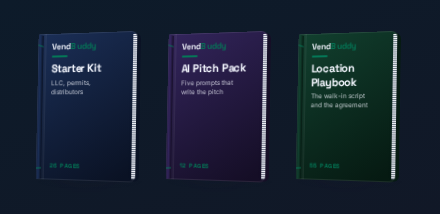
Everything above is free to read and free to do. The operator packs are the same material in fill-in-the-blank form — the 50-state distributor list, the LLC and permit checklist in unblocking order, the word-for-word walk-in script, and the placement agreement you hand a property manager. One-time purchase from $27, nothing renews.
See what is inside →Delegating, and the first hire
The hire question arrives in every operator’s head far earlier than it should, usually attached to a task they have started to hate. That is the wrong trigger. The right one is arithmetic.
Hire when two things are true at once: your own hours have become the constraint on growth rather than capital or demand, and you know your operator hourly rate — monthly net profit divided by hours actually worked. Without the second number the decision is a feeling. Most operators arrive at both somewhere between eight and fifteen machines, though route density moves that a long way in either direction.
The first hire is almost always a part-time stocker or a per-stop contractor, not anything resembling a manager, and the reason is in the delegation ladder: restocking is the highest-hour, lowest-judgment work you own, and the worst case of a mistake is a stockout rather than a lost relationship. Hiring a route driver covers the mechanics, pay structures and classification question in full, and part-time versus full-time covers which shape fits which route size.
Before you post anything, read the first-hire red flags. The one that catches most operators is not in the interview — it is that the freed hours have no destination. Buy back eight hours a month, let them dissolve into ordinary life, and you have made the business less profitable in exchange for a slightly easier Saturday. Decide what the hours are for first, in writing, and it becomes a genuinely good trade.
Cashless is table stakes now, not a strategy
This used to be a decision. In 2026 it is a floor, and treating it as an upgrade is one of the more expensive mistakes still commonly made.
A cash-only machine is not a cheaper machine. It is a machine that a meaningful share of the people standing in front of it cannot buy from, because a large fraction of customers under thirty carry no cash at all. The purchase does not get deferred to next week. It does not happen.
The second reason is operational and it matters just as much for how you run the week: a telemetry-grade reader reports sales remotely, which is what allows the route day to shrink. Without it you are servicing on a calendar and guessing; with it you service machines because they are actually empty. That single change is what moves the route day from a fixed cost of owning machines to a variable one. The 2026 reader comparison covers the options, the fee structures and the one remaining case where cash-only still makes sense, and the Nayax review goes deeper on what a monthly fee actually buys.
The vacation test, briefly
There is one question that settles whether any of the above is working, and it is worth asking yourself once a quarter rather than once a career: if you left for a month, would the business fail, stall, or grow?
Fail means the route depends entirely on your attendance — which is also what a buyer would conclude. Stall means the operating layer is built but the growth layer is still one hundred percent you, and that is where most competent operators sit. Grow means the structure is doing the work, and the honest bar is three months rather than one, because at three months something has to be decided by somebody who is not you.
The full fail-stall-grow diagnostic, and what to fix for each answer, is here.
A protected growth block is only worth defending if you know which buildings are worth walking into. VendBuddy scores real venues near you by traffic, headcount and category, gives you the best contact on file for each, and models what a machine would net there before you commit — so ninety minutes a week goes to buildings that can actually say yes. Five free credits, no card required.

The bottom line
Running a vending business well is not harder than starting one. It is just less interesting, and it fails quietly instead of loudly, which is why so few people notice they stopped doing it.
Three blocks in the week instead of one. Three numbers a month, per machine, ending in one written action. Five procedures on five pages so the route can be executed by somebody other than you. Cashless everywhere, because the alternative is turning away customers to save a fee. And one question a quarter about what would happen if you disappeared.
None of that is complicated and all of it is optional, which is exactly the problem. The operators still at four machines in year three are not less capable. They just never put the owner on the calendar.
Related reading: how to make a vending route actually passive (the SOPs, the delegation ladder and the automation stack in full), what breaks between 5 and 50 machines, the scaling playbook, where the margin goes, raising revenue on the machines you already own, and the first-hire red flags.
Frequently Asked Questions
How do you run a successful vending machine business?
By separating the two jobs the word "operator" hides. There is the work IN the business - restocking, driving, fixing, collecting - and the work ON it: choosing locations, setting prices, renegotiating commissions, reviewing per-machine profit and deciding what to add or remove. The work in the business feels productive and is largely interchangeable labor. The work on the business is what actually compounds, and it is the first thing to get squeezed out because nothing forces it into the calendar. A successful route is usually not run by a better restocker. It is run by someone who protected two hours a week for the decisions and treated the route day as the part they were trying to shrink.
How many hours a week does it take to run a vending route?
Plan on roughly two hours per machine per week early on, dropping toward thirty to forty-five minutes per machine once locations are clustered and telemetry is telling you which stops to skip. A one to three machine route settles into two to four hours a week in total, most of it driving. What changes that number is not effort, it is structure: route density, because driving is forty to sixty percent of total time, and whether you are servicing on a calendar or on actual sales data. The hours that matter most, though, are the two or three a week that are not route work at all - the admin block and the growth block - because those are what stop the business plateauing at whatever machine count your own Saturday can carry.
What systems does a vending business need?
Four, and none of them are complicated. One system of record holding stops, par levels, product costs, commission terms, service history and per-machine profit, so the business is not living in your head. A weekly rhythm that separates route work from admin from growth, so growth is not the thing that gets dropped whenever a machine jams. A monthly per-machine profit-and-loss review that produces exactly one written action. And five one-page written procedures - restock run, machine down, new-location onboarding, refund and complaint, monthly review - so the route can be executed by somebody who is not you. That last set is what converts a job into an asset, and it is covered in full in the guide to making a route passive.
What is the difference between starting and running a vending business?
Starting is a project with an end: form the entity, buy a machine, sign a location, get it installed and selling. Running is a rhythm with no end, and the skills barely overlap. Starting rewards momentum and tolerance for uncertainty. Running rewards boring consistency, a willingness to look at numbers you would rather not look at, and the discipline to keep working on the business during the weeks when the business is fine. The specific failure mode is the operator who is excellent at starting, places four machines in six months, and then spends two years servicing them without ever renegotiating a commission, adjusting a price or reviewing a per-machine profit line.
When should a vending operator hire their first employee?
When two things are true at once: your own hours have become the constraint on growth rather than demand or capital, and you know what your operator hourly rate is - monthly net profit divided by hours actually worked. Most operators reach that somewhere between eight and fifteen machines, though route density moves it a lot. The red flag is hiring to escape a task you dislike rather than to buy back hours you have a specific plan for, because a hire only pays for itself if the freed time goes into locations, pricing or acquisition. The first hire is almost always a part-time stocker or a per-stop contractor rather than anything resembling a manager.
What numbers should a vending operator check every month?
Three, per machine rather than in aggregate, because aggregate numbers hide the machine that is quietly losing money. Net profit per machine after product cost, commission and card fees - the machine ranking matters more than the total. Revenue per visit, which is the real measure of whether your service frequency and par levels are right; a falling number means you are driving too often. And commission as a percentage of revenue, which is the line operators sign once and then never look at again, despite it being one of the few costs you can renegotiate with a conversation rather than a purchase.
Do you need cashless payment on vending machines in 2026?
Yes, and it stopped being a strategic decision several years ago. A large share of customers under thirty carry no cash at all, so a cash-only machine is not a cheaper machine, it is a machine a meaningful fraction of the traffic in front of it cannot buy from. The second reason is operational rather than commercial: a telemetry-grade reader reports sales remotely, which is what lets you stop driving to machines that did not need servicing. The one remaining case for cash-only is bulk candy under a dollar a vend, where the fixed per-transaction fee is a real share of the sale.
Most operators end up on Nayax for telemetry because it is what the distributors already support. Their reader handles tap, chip and the telemetry feed in one box, and the monthly fee is the part to check against your per-machine volume before you commit the route to it. Affiliate link, so we may earn a commission at no extra cost to you.
What is selling, which buildings say yes, and the numbers before you buy a machine. Free, confirm from your inbox, unsubscribe in one click. Refer one friend and get 25 VendBuddy credits.
General information, not legal, tax or financial advice. Rules change, so check the official source. Revenue and income figures are examples, not promises. See our terms.