- To host a bitcoin ATM, you give a licensed kiosk operator about two to three square feet and a standard outlet; they run the machine and pay you, usually a flat monthly rent.
- Operators do not publish host rates. Coin ATM Radar puts typical location rent at $300 to $700 a month, about $500 on average for a retail store.
- Bitcoin Depot, once the largest operator, filed for bankruptcy in May 2026 and took about 9,700 kiosks offline; state bans and daily limits are shrinking what operators can pay.
- The FTC reports bitcoin ATM fraud losses topped $65 million in the first half of 2024, mostly from older adults, so hosts should train staff to spot a scam in progress.
- Kiosk rent usually beats a hosted vending commission on paper, but vending income is steadier because nobody is banning snack machines.
If a rep has walked into your store offering monthly rent to host a bitcoin ATM, you are being asked to rent out about four square feet and an outlet. That can be easy money for the counter by the door. In 2026 it is also a deal where the company paying you can be banned, sued or bankrupt before your contract runs out, so it pays to know what the offer is really worth before you sign.
- What it means to host a bitcoin ATM
- What operators pay hosts
- The 2026 lesson: the operator can disappear
- The rules: what lands on the operator and what lands on you
- The scam problem, and why it is your problem too
- Bitcoin ATM vs vending machine: which earns more in the same corner
- Questions to ask before you sign a host agreement
- If you would rather own the corner
Part of our complete guide: best cash flow businesses.
General information, not legal, tax or financial advice; figures are examples. Rules on crypto kiosks are changing state by state, so check with your state regulator before you sign anything.
What it means to host a bitcoin ATM
When you host, you do not own the machine and you do not run it. A kiosk company (the operator) puts its machine in your store, loads and empties the cash, handles customer support and carries the licenses. You supply the floor space and the power. In return the operator pays you, usually a flat monthly rent, sometimes with a bonus tied to how many transactions the machine does.
The space ask is small. Athena Bitcoin's host page says it needs a standard 110v outlet and roughly two square feet of floor space, that there is no cost to host, and that the machine stays Athena's property while you keep the monthly payment. Byte Federal describes the same thing as about three square feet and a standard outlet. CoinFlip says on its partner page that it has over 5,000 kiosks across 47 states and handles installation, maintenance and customer service for hosts.
The work on your side is close to zero. The risk is not.
What operators pay hosts
None of the host pages we checked publish a number. Athena says "regular monthly payments", Byte Federal says "competitive guaranteed monthly payouts and transaction bonuses based on venue location and type", and Cash2Bitcoin says payments follow "agreed-upon contract terms." CoinFlip mentions monthly rental income and revenue from transactions without a figure.
Worth reading before you sign anything: the contract walkthrough covers which terms get pushed back on and which ones you can safely give away. Commission is rarely the clause that hurts you later.
The best public guide to the going rate comes from the operator side. Coin ATM Radar, which tracks kiosks worldwide, writes in its guide to bitcoin ATM costs that the usual cost of renting a place is in the range of $300 to $700 per month, that big malls and outlets run $1,000 to $3,000, and that operators pay about $500 a month on average per retail location.
Treat that as a ceiling for a normal store, not a promise. Rent depends on your foot traffic, your neighborhood, whether there is already a kiosk down the street and, more and more, on what your state now allows.
Picture the machines paying you while you sleep
That’s the real promise of vending — income that doesn’t cost you your time, and a life on your own terms. VendBuddy turns this guide into a step-by-step plan so you actually build it instead of just reading about it. Start free today.
Start building free →The 2026 lesson: the operator can disappear
The biggest risk to a host is not the machine. It is the company behind it. In May 2026, Bitcoin Depot, which had been the largest crypto ATM operator in North America, filed for bankruptcy and took its network of about 9,700 kiosks offline, according to ICIJ. Its CEO pointed to new transaction limits and, in some places, outright restrictions or bans. The filings showed quarterly revenue down nearly 50% year on year for the three months ended March.
For the stores, that meant a dark machine overnight, and any rent still owed became a claim in a bankruptcy case.
That is the real question when you host: will this company still be paying me in 12 months? A higher rent offer from a small operator is not better if the operator cannot survive the next state law.
The rules: what lands on the operator and what lands on you
The licensing burden sits with the operator. Under federal rules, a business that exchanges cash for crypto is a money services business. FinCEN's MSB registration page says each MSB must file Form 107 within 180 days of being established and renew every two years, and that doing business without registering can carry criminal penalties of up to five years.
On top of that sit state rules, which is where hosts feel it:
- Daily limits. California caps kiosk transactions at $1,000 per customer per day, and a court upheld that cap in 2024, the state's financial regulator reported. Since July 1, 2025, kiosk operators there also need a state license. Lower limits mean fewer dollars through the machine, which means less rent the operator can afford.
- Outright bans. AARP reports that Indiana became the first state to ban crypto kiosks statewide, signed into law on March 9, 2026, and that Spokane and St. Paul voted in 2025 to ban them inside city limits. A ban ends your rent no matter what your contract says.
As a host you usually do not register or get licensed yourself, because you are not exchanging anything. But you should confirm the operator holds a license in your state. Most states list licensed money transmitters on the NMLS Consumer Access site, and it takes two minutes to look a company up.
The scam problem, and why it is your problem too
Here is the part the rep will not lead with. The Federal Trade Commission says fraud losses at bitcoin ATMs rose nearly tenfold from 2020 to 2023 and topped $65 million in the first half of 2024 alone. The median reported loss in that period was $10,000. People 60 and over were more than three times as likely as younger adults to report a loss, and more than two of every three dollars lost at these machines came from an older adult.
The pattern rarely changes. Someone gets a call from a fake bank or fake government office, is told their savings are in danger, and is sent to a kiosk with a QR code. They show up at your store, often still on the phone, and feed cash into the machine in your corner.
It gets worse at some machines. AARP reports that Iowa's attorney general sued two kiosk operators in 2025 after finding that at least 95 percent of transactions at their machines were fraudulent, costing Iowans about $20 million in under three years.
If you host, give your staff a short script: if a customer at the kiosk is on the phone being told what to do, or says the bank or the police sent them, it is fine to say "this is a common scam; can I call someone for you?" Post the operator's fraud warning where it can be seen. Do not put yourself between a customer and their money, but do not stay quiet either.
Bitcoin ATM vs vending machine: which earns more in the same corner
A store owner with a spare corner has three common options. Here they are side by side with example numbers. Your numbers will be different.
| Option | Example monthly income to the store | Your work | Main risk |
|---|---|---|---|
| Host a bitcoin ATM | Flat rent, example $300 (low end of the $300 to $700 range above) | Almost none | State ban, operator failure, scam stories tied to your store |
| Host an operator's vending machine | Commission, example 10% of $800 in sales = $80 | Almost none | A lazy operator who leaves it half-empty |
| Own a vending machine yourself | Example $800 in sales, keep what is left after product, card fees and repairs | Restocking, buying, cash, repairs | Upfront cost of the machine and your time |
On paper, kiosk rent beats a hosted vending commission. A typical vending host commission runs in the 5% to 20% range, as we break down in vending machine commission rates, and few single machines in a small store gross enough to match a $300 check. That is why kiosk reps get in the door.
The trade is durability. Nobody is passing laws to ban vending machines. A snack and drink machine does not pull scam victims into your store, and if the operator goes under, another operator will happily take the spot. Kiosk rent is bigger and shakier; vending income is smaller and steadier. Our breakdown of how much vending machines make shows what a single machine can realistically gross.
For someone choosing what to operate, not host, the gap is wider. Running crypto kiosks means federal registration, state licenses and bonds in most states, and a compliance program before the first dollar. Running vending machines means a business license, a sales tax permit and a good location. We cover the crypto kiosk side in bitcoin ATM vs regular ATM business.
Questions to ask before you sign a host agreement
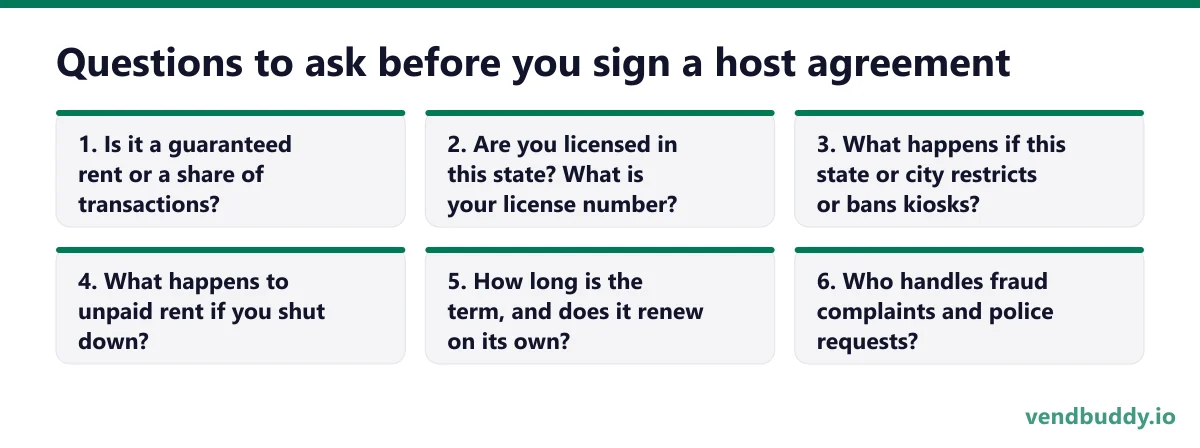
- Is it a guaranteed rent or a share of transactions? A flat number is easier to plan around. A share sounds bigger and falls fast when daily limits drop.
- Are you licensed in this state? What is your license number? Then look it up yourself.
- What happens if this state or city restricts or bans kiosks? Read the termination clause. Most let the operator pull the machine with little notice.
- What happens to unpaid rent if you shut down? Ask how often rent is paid. Monthly in advance beats quarterly in arrears.
- How long is the term, and does it renew on its own? Long auto-renewing terms with exclusivity can block you from taking a better offer.
- Who handles fraud complaints and police requests? It should be them, in writing, with a phone number your staff can call.
If you would rather own the corner
Some owners look at a kiosk offer and decide to put their own machine in that spot. If that is you, plan for card payments from day one; a machine that only takes cash leaves sales on the table.
Readers like the ones from Nayax fit most snack and drink machines and take tap-to-pay cards and phones.
If you are an operator reading this, look at the map differently. When Bitcoin Depot went dark in May, thousands of convenience stores, gas stations and smoke shops were left with an empty corner, an outlet and an owner who just lost a monthly check. That is a warm conversation for a vending machine or a cash ATM. VendBuddy pulls convenience stores, gas stations and other high-traffic businesses in any ZIP along with the owner or manager contact, so you can build that call list in an afternoon. For how vending and cash ATMs compare as a route, see vending vs ATM business.
Frequently Asked Questions
How much does a store get paid to host a bitcoin ATM?
Operators do not publish host rates, and offers vary by foot traffic and state rules. Coin ATM Radar puts the usual rent for a location at $300 to $700 a month, about $500 on average for a retail store, with malls higher. Offers in states with low daily transaction limits tend to be lower.
Do I need a license to host a bitcoin ATM in my store?
Usually not. The operator is the money services business and holds the federal registration and state licenses. As the host you provide space and power. You should still confirm the operator is licensed in your state, for example on the NMLS Consumer Access site, before you sign.
What happens if my state bans bitcoin ATMs or the operator goes out of business?
The machine goes dark and the rent stops. Most host agreements let the operator remove the kiosk if the law changes, and if the operator files for bankruptcy, any unpaid rent becomes a claim in that case. Bitcoin Depot did exactly that in May 2026, taking about 9,700 kiosks offline.
Operators who run this play usually set it up on Coinbase, because you can buy and borrow against the same balance without a credit check. Rates are variable and pledged collateral can be liquidated, and none of this is financial advice. Affiliate link, so we may earn a commission at no extra cost to you.
What is selling, which buildings say yes, and the numbers before you buy a machine. Free, confirm from your inbox, unsubscribe in one click. Refer one friend and get 25 VendBuddy credits.
General information, not legal, tax or financial advice. Rules change, so check the official source. Revenue and income figures are examples, not promises. See our terms.