- Coffee vending machine cost starts around $4,300 for a refurbished freeze-dried or fresh-brew unit and runs $4,700 to $12,000 for new bean-to-cup machines from one US dealer.
- Machines with payment hardware cost more; one seller puts them at $4,000 to $12,000 against $3,000 to $8,000 for office bean-to-cup units without payments.
- Ingredient cost per cup is the number that decides profit: about $0.15 to $0.40 for fresh ingredients, and $0.55 or more for pods.
- Paid coffee machines sell at roughly $1.50 to $4 a cup. Many offices instead pay an operator to run coffee as a free employee amenity.
- Coffee needs more care than a soda machine: daily volume, cleaning, descaling and often a water line. Price that work in before you buy.
Coffee vending machine cost has two parts: what you pay for the machine, and what every cup costs to make. The machine is the number people ask about, but the per-cup cost decides whether the business works. This guide covers both, with real dealer prices, the difference between bean-to-cup, fresh-brew, freeze-dried and pod machines, and the kind of building that justifies spending five figures on a coffee machine.
Part of our complete guide: how to find vending machine locations.
What the machine costs
Here's what one US dealer currently lists, new and refurbished (Vending Concepts):
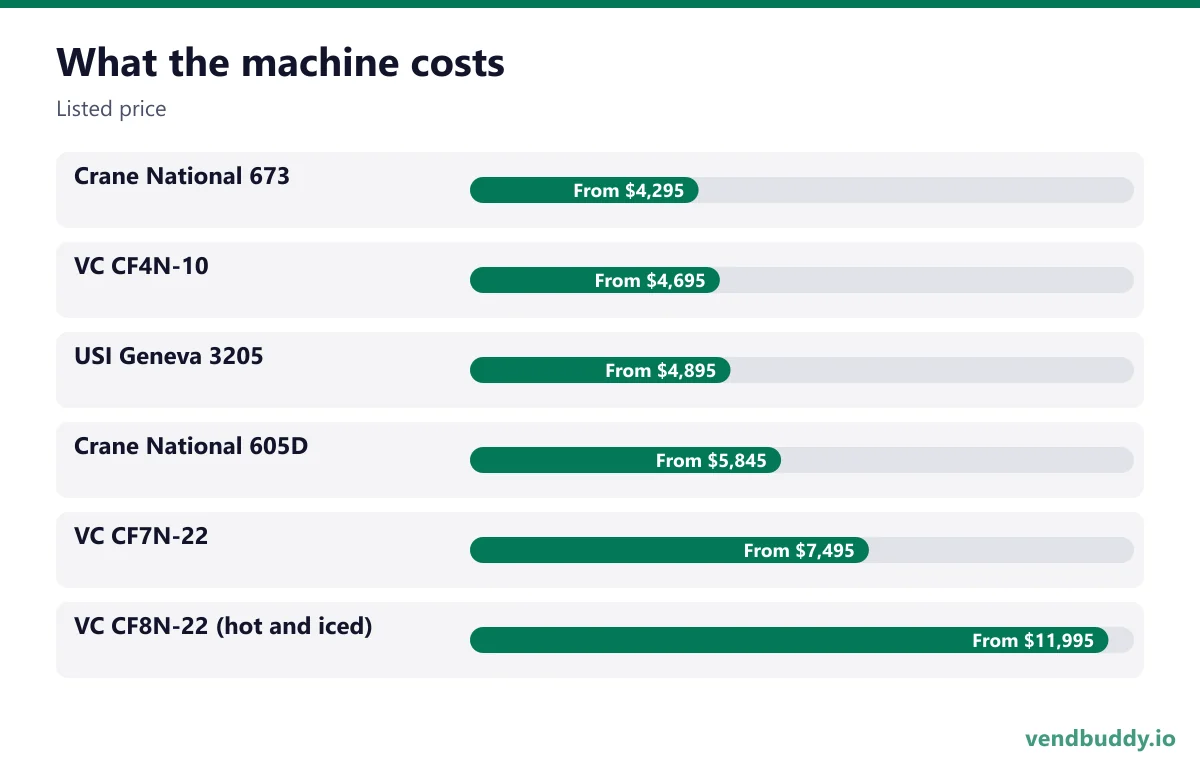
| Machine | Type | Condition | Listed price |
|---|---|---|---|
| Crane National 673 | Fresh ground | Refurbished | From $4,295 |
| VC CF4N-10 | Fresh beans, 140 x 12 oz cups | New | From $4,695 |
| USI Geneva 3205 | Freeze-dried | Refurbished | From $4,895 |
| Crane National 605D | Fresh ground, 450 x 12 oz cups | Refurbished | From $5,845 |
| VC CF7N-22 | Fresh beans | New | From $7,495 |
| VC CF8N-22 (hot and iced) | Fresh ground | New | From $11,995 |
Other sellers land in the same range. One puts office bean-to-cup machines at $3,000 to $8,000 and coffee vending machines with payment hardware at $4,000 to $12,000 (Vend Guys). Add delivery, a card reader if it isn't included, a water line or filter, cups, and the first load of ingredients.
Bean-to-cup, fresh-brew, freeze-dried or pods
- Bean-to-cup grinds whole beans for every cup. Best taste, highest machine price, lowest ingredient cost per cup at volume.
- Fresh-brew machines like the Crane National 673 and 605D brew from ground coffee. The workhorse of traditional coffee vending, and common refurbished.
- Freeze-dried machines mix instant coffee with hot water. Cheaper to run and simpler to clean, but the cup tastes like it.
- Pod brewers are cheap to buy and easy to keep clean, but each cup costs more.
Picture the machines paying you while you sleep
That’s the real promise of vending — income that doesn’t cost you your time, and a life on your own terms. VendBuddy turns this guide into a step-by-step plan so you actually build it instead of just reading about it. Start free today.
Start building free →The per-cup math
One seller puts fresh ingredient cost at $0.15 to $0.40 a cup, with retail prices of $1.50 to $4 (VMFS USA). Another dealer compares pods at $0.55 or more per cup with about $0.20 for bean-to-cup, and works out that an office pouring 200 cups a day spends about $13,000 a year more on pods (Vending Concepts). Check that number: $0.35 more per cup, times 200 cups, times 5 days, times 52 weeks is $18,200, and their $13,000 figure assumes fewer working days. Either way, at real volume the ingredient line is bigger than the machine payment.
Here's an illustrative example for a paid machine, not a promise. Sell 60 cups a day at $2.25, five days a week, and you take in about $2,900 a month. Take out ingredients and cups at $0.40 each (about $520), a 10 percent location commission (about $290) and card fees, and roughly $2,000 is left before your time, cleaning supplies and the machine payment. Sell 15 cups a day and the same machine barely covers itself. Volume decides everything, and coffee volume follows people who arrive early and stay all day.
Paid coffee vs free office coffee
Many offices don't want employees paying for coffee at all. They treat it as a perk and pay a provider to supply and maintain it. The dealer above notes most offices run coffee as a free amenity, with card payment as an option. That's a different business from vending: you bill the office monthly instead of collecting from a machine. Our office coffee service guide explains how operators price it, and whole-bean coffee in apartment buildings covers the residential version.
The same dealer's rule of thumb on size: under 25 people, a pod brewer is enough; 25 to 75, bean-to-cup pays for itself on cup cost; over 75, a premium bean-to-cup or two-group espresso machine. Treat that as a starting point and check the actual cups per day.
The work a coffee machine adds
Coffee is more hands-on than cans:
- Water. Machines doing 50 or more cups a day really want a plumbed water line. Reservoirs get refilled less often than planned, and scale builds up.
- Cleaning. Bean-to-cup machines flush after each drink but still need regular cleaning and descaling, usually quarterly.
- Freshness. Milk powder, beans and cups need rotation. A stale cup loses a regular for good.
- Service calls. Grinders and brewers fail more than soda machines. Budget for parts or a service contract.
New, refurbished or leased
Most coffee operators face the same choice they face with any machine, with one twist: coffee machines wear faster than cold-drink machines, so the condition of a used unit matters more.
- Refurbished fresh-brew machines like the Crane National 673 and 605D are the common starting point. They're proven designs, parts are available, and technicians know them. Ask what was replaced: the brewer, grinder, pumps and heating element are the parts that fail.
- New bean-to-cup machines cost more but come with a warranty and better coffee. They make sense where quality decides whether people buy, such as an office with a café two blocks away.
- Financed or leased machines spread the cost. The dealer above shows monthly payments from about $107 for a refurbished unit to about $300 for its top bean-to-cup model. Compare the total of all payments with the cash price before you sign.
Whichever you choose, ask for the machine's daily cup capacity, its power draw and whether it needs a dedicated circuit, and the cleaning schedule in writing. A machine that needs daily attention in a building you visit twice a week is the wrong machine.
Setting the price per cup
Price off the menu people already know, not off your cost. If the nearest café charges $4 for a latte, a $2.25 vending latte feels like a deal, and a $3 one may still sell. If the office already has free drip coffee in the kitchen, a paid machine has to offer something better, like espresso drinks or iced coffee, or it won't move. Start a little high and run a cheaper daily special if volume is slow; raising prices after launch is harder than cutting them.
One more check before you commit: ask the location how many people are in the building before 9 a.m. and after 5 p.m. Coffee sells in those edges of the day, and a building that empties at 4:30 has a shorter selling window than its headcount suggests.
Where a coffee machine makes sense
The best spots have people who start early and stay put: hospitals and clinics, manufacturing and warehouse shifts, car dealerships and service waiting rooms, offices without a café nearby, and large apartment or student housing lobbies. A building with a coffee shop on the ground floor is a hard sell.
If you're adding coffee to an existing route, start with a location that already buys from your other machines and asks for it. If you're still looking for that location, VendBuddy shows you which businesses near you are worth the walk-in.
Frequently Asked Questions
How much does a coffee vending machine cost?
Refurbished fresh-brew and freeze-dried machines start around $4,300 to $5,900 at one US dealer, and new bean-to-cup machines run about $4,700 to $12,000. Units with payment hardware typically cost $4,000 to $12,000.
What does a cup of coffee cost to make in a vending machine?
Roughly $0.15 to $0.40 for fresh ingredients, and $0.55 or more per cup with pods, according to sellers' published figures. Cups, lids and stir sticks add a little more.
How much do coffee vending machines charge per cup?
Paid machines typically sell coffee for about $1.50 to $4 a cup, depending on the drink and the location.
Is a coffee vending machine profitable?
It can be at real volume, because the margin per cup is wide. At 15 cups a day it barely covers the machine. Hospitals, shift-based workplaces and offices without a nearby café are the usual candidates.
Does a coffee vending machine need a water line?
Not always, but machines doing 50 or more cups a day really benefit from one. Reservoir machines need frequent refills and suffer more scale buildup.
What is selling, which buildings say yes, and the numbers before you buy a machine. Free, confirm from your inbox, unsubscribe in one click. Refer one friend and get 25 VendBuddy credits.
General information, not legal, tax or financial advice. Rules change, so check the official source. Revenue and income figures are examples, not promises. See our terms.