- Usually not worth a machine, and here is the honest reason: the children cannot be your customers and the adults are too few.
- Kids are ruled out twice over. Childcare licensing restricts food that is not centre-provided, and a snack machine at pickup is a complaint generator the director will not accept.
- The real account is the staff room, and a 60-child centre runs about 10–14 staff against a working floor of 75–100 daily captive people.
- The parent pickup line is not the answer either. Four minutes, one hand on a child, one hand on a backpack, heading for a car.
- Four exceptions are real: employer-embedded childcare, multi-site operators, church-based preschools, and centres inside an office park — in all four you are pitching the building, not the daycare.
This is the venue guide where the answer is mostly no, so here it is up front: for the overwhelming majority of operators, an independent daycare centre is not a viable placement, and the machine you would put there earns more on almost any other wall in town. The rest of this page is why, exactly which four situations flip it, and where to point the machine instead.
- Why the children are not customers, twice over
- The staff room is the only real account, and it is too small
- And the pickup line does not save it
- If you want to do it anyway, here is the honest math
- The four situations that flip it
- If you pitch one, pitch staff retention
- Where to point the machine instead
- Frequently Asked Questions
Part of our complete guide: how to find vending machine locations.
The reason the question keeps coming up is that a daycare looks like a captive-audience location. Two hundred people come through the door every day. They are there for hours. There is nothing to buy nearby. Every filter an operator normally uses says yes. It is the one venue where those filters give the wrong answer, because almost none of that traffic can transact.
Why the children are not customers, twice over
The regulatory reason. Childcare licensing is written around what children eat. States vary in the details and are consistent in the direction: food reaching children in a licensed programme is generally expected to be provided or approved by the centre, with documented allergen handling, and a great many centres run nut-free or allergy-aware policies as a matter of enrolment policy on top of whatever the state requires. A machine a child can reach is a compliance question, and the person you are asking to own that question is a director whose licence is the business. Whatever your state says specifically, the director will not guess — and you should not either. If you pursue this at all, get the answer from her licensor in writing before anything is installed. Our general rules on where machines are and are not allowed sit in can you put a vending machine anywhere legally.
The optics reason, which is the one that actually kills it. Suppose the compliance question came back clean. A snack machine visible at pickup means a four-year-old asking for a treat every single evening in front of a queue of other parents, and a share of those parents complaining to the director about it. A childcare director is measured on enrolment and on the absence of complaints. You are offering her a hundred dollars a month and a new category of complaint. She is going to say no, and she is right to.
The staff room is the only real account, and it is too small
So the account is the break room. Now do the headcount, which is the arithmetic almost nobody runs before driving out there.
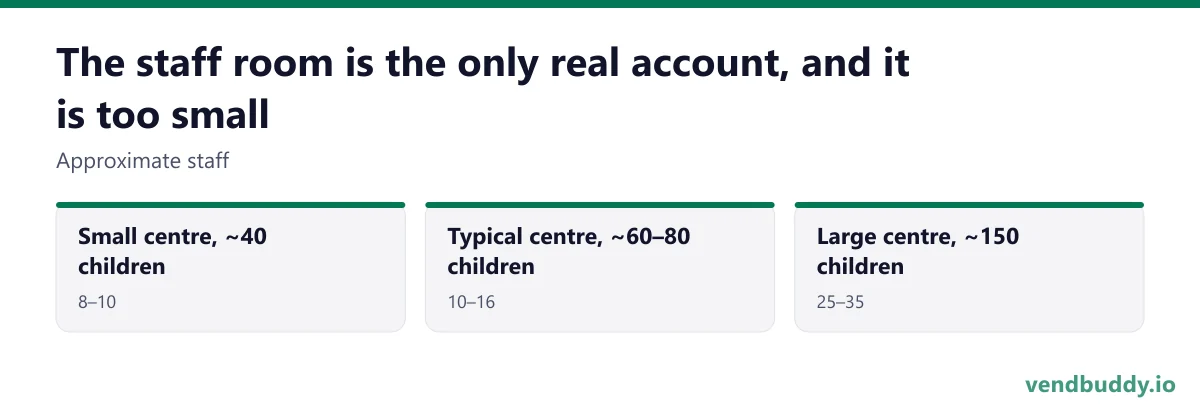
Our working floor for a standard combo machine is roughly 75 to 100 daily captive people — the full version, including capture rates by site type, is in how many people a location needs. Against that:
| Centre size | Approximate staff | Versus the 75–100 floor |
|---|---|---|
| Small centre, ~40 children | 8–10 | About a tenth of it |
| Typical centre, ~60–80 children | 10–16 | About a sixth of it |
| Large centre, ~150 children | 25–35 | Still a third of it, and they stagger breaks |
Staff-to-child ratios are set by state rule and they are tighter for infants than for preschoolers, so a centre weighted toward babies staffs up and one weighted toward four-year-olds staffs down. Either way you do not get near the floor. And the staggering matters: childcare staff take breaks in rotation, in a room with a fridge and a microwave they already use, which is the same competitive problem a break-room machine faces in a repair shop at a fraction of the headcount.
Picture the machines paying you while you sleep
That’s the real promise of vending — income that doesn’t cost you your time, and a life on your own terms. VendBuddy turns this guide into a step-by-step plan so you actually build it instead of just reading about it. Start free today.
Start building free →And the pickup line does not save it
The obvious counter is that a hundred parents come through between four and six. They do, and they are the worst captive audience in this entire series. A pickup is roughly four minutes long. The parent has a child in one hand, a lunch bag and a nap mat in the other, is talking to a teacher about the day, and is walking directly to a car. There is no dwell, no free hand and no idle moment. Compare that to the ninety minutes a parent spends sitting in a trampoline park mezzanine with nothing to do, and it is obvious which one is the placement.
If you want to do it anyway, here is the honest math
Nobody is putting a full combo in a daycare, so the realistic version is an honour box or a countertop micro unit in the break room. Twelve staff, one and a half purchases a week each, a $1.75 average:
- Gross: roughly $135 a month.
- Product cost at around half: contribution of roughly $65 a month.
- Against that: a service stop. Every stop on your route has an opportunity cost, and the capacity math behind that is in how many machines one person can service.
Sixty-five dollars is not nothing if the drive is nothing. That is the whole exception: a daycare next door to a stop you already make, on a route you already drive, with a box that costs you a couple of hundred dollars and eight minutes. As a standalone account with a dedicated drive, it loses to every other venue in this series and most of the ones in untapped locations beyond apartments.
A daycare looks like a captive-audience location by every filter an operator uses. It is the one venue where those filters give the wrong answer, because almost none of that traffic can legally transact.
The four situations that flip it
All four have the same shape: the childcare is not the account, the building is.
- Employer-embedded childcare. A centre inside a corporate campus, a hospital or a large manufacturer. You are pitching a facility with hundreds of staff and the childcare is one more room in it — the relevant playbooks are hospital and healthcare vending and 24/7 industrial sites.
- Multi-site early learning operators. A regional company running eight or twelve centres has a head office, a director of operations and a single conversation that covers every site. Twelve break rooms is a real account even though one break room is not. This is the only version where a small-site machine makes route sense, because the density comes with the deal.
- Church-based preschools. The preschool is the weekday use of a building that also runs a congregation, a fellowship hall, meetings and events. The machine serves the building all week and the preschool is incidental — that is a church account and it is covered properly in how to get vending machines into churches.
- Centres inside an office park. A daycare on the ground floor of a multi-tenant building where the lobby or shared corridor serves everyone. You are placing for the park, and the childcare traffic is a small bonus on top.
If you are qualifying small sites like this one, the playbook has the scoring pass that kills them before you drive — plus the walk-in script, the twelve objections operators really hear, and the plain-English placement agreement for the accounts that do clear the bar.
See what is inside →If you pitch one, pitch staff retention
In the exception cases above, or on a bolt-on stop you already drive past, there is one framing that works with a childcare director and it is not revenue.
“This is not about the children and it would not be anywhere they can reach. Your teachers are on staggered breaks in a room with a fridge and a microwave, and you are competing for those teachers with every other centre in the county. A cold drinks fridge in that room is a small thing you can point at in an interview. I own it, I stock it, it costs the centre nothing, and I will get you the licensing answer in writing before anything is delivered.”
Three parts of that matter. You have removed the children from the conversation in the first sentence, before she has to raise it. You have named the problem she genuinely has, which is turnover. And you have offered to carry the compliance work rather than handing it to her as homework, which at a hundred-dollar account is the only reason she would bother.
Do not offer a commission. On an account this size a revenue share is a paperwork line for her accounting worth about seven dollars a month, and offering one signals that you have not done the arithmetic. If she asks, offer product instead — a case of water a week for the staff room, which is the same house-account trade that works at hotels and costs you less.
Where to point the machine instead
If you got here searching for daycare vending, you are probably working a residential or family-services corridor, which is a good instinct with the wrong target on the end of it. Same neighbourhoods, better accounts:
- Laundromats — long dwell, adults, nothing else nearby, and frequently on the same block.
- Salons and barbershops — small sites, but real dwell time and adults with wallets out.
- Senior living — the family-services corridor account that actually has headcount.
- Trampoline parks and bowling centres — if what drew you to daycares was families, this is where the families sit still.
And if you are not sure which of the sites near you clear the bar at all, the scoring pass in the location scoring checklist is the thing to run before the drive rather than after it.
The mistake underneath the daycare question is qualifying a site by how many people walk through it rather than by how many can buy. VendBuddy scores real properties in your ZIP by category, size and captivity and hands you the best contact on file for each, so the small sites fall off your list before they cost you a morning. Free to start, no card.
Frequently Asked Questions
Can you put a vending machine in a daycare?
Physically yes, profitably almost never, and the children are not the customers under any circumstances. State childcare licensing generally requires that food reaching children be provided or approved by the centre with documented allergen handling, and a large share of centres run nut-free or allergy-aware policies that a snack machine cannot comply with. The only realistic account inside a childcare centre is the staff break room, and at a typical centre the staff headcount is far below what a machine needs to be worth the service stop.
Why do daycares not have vending machines?
Three reasons stack up, and each one alone would be close to disqualifying. Licensing rules restrict food that is not centre-provided, so an accessible machine is a compliance question the director does not want. Parent optics are worse than the compliance issue, because a snack machine near pickup produces complaints and a director is measured on not producing complaints. And the underlying headcount is tiny: a sixty-child centre runs roughly ten to fourteen staff, which is a fraction of the seventy-five to one hundred daily captive people a standard machine needs.
How many people does a location need before a vending machine is worth it?
Roughly seventy-five to one hundred daily captive people for a standard combo machine, which is the figure we use across the site. A childcare centre clears that number in children and misses it by a wide margin in people who can legally and practically buy from a machine. That single comparison is why this venue type does not work, and it is worth running before you pitch any small site rather than after you have installed at one.
If you are not sure where to start, most people pull a free list of the businesses near them in the before they do anything else. Five contact reveals are free and there is no card, so it costs you a search and about ten minutes.
Is a honor box or micro machine worth it in a daycare staff room?
Run the arithmetic before you decide. Twelve staff members, one and a half purchases each a week, a dollar seventy-five average, is about thirty-one dollars a week or roughly one hundred and thirty-five a month gross, and somewhere near half of that is product cost. That is under seventy dollars of contribution against a service stop that costs you drive time you could have spent on a real account. It can make sense as a bolt-on when the centre is already next door to a stop you make anyway, and rarely otherwise.
When is a childcare centre actually worth pitching?
Four situations. When the centre is embedded inside a corporate campus or a hospital, in which case you are really pitching the building and the childcare is a rounding error. When one company runs eight or twelve sites, in which case the prize is the head office relationship rather than any single centre. When the centre operates inside a church that also has a fellowship hall and a congregation using the building all week. And when it sits inside an office park where the machine can serve the park rather than the centre.
What is the right pitch to a childcare director?
Staff retention, not revenue. Childcare has some of the hardest staffing in the country, directors lose teachers constantly, and a stocked drinks fridge in the break room is a small perk that costs the centre nothing and gets mentioned in exit interviews. Pitch it as a benefit for her teachers, keep it out of every space children access, offer to hand her the licensing answer in writing rather than making her chase it, and do not ask for a commission on a hundred-dollar account.
Related reading: how to find vending machine locations, how many people a location needs, churches, senior living, laundromats, how to cold call locations, and the location scoring checklist.
What is selling, which buildings say yes, and the numbers before you buy a machine. Free, confirm from your inbox, unsubscribe in one click. Refer one friend and get 25 VendBuddy credits.
Want the free 38-page Ultimate Vending Guide too? Get the guide
Walk-ins and cold emails find locations. A small site with your own machine photos and a request-a-machine form lets the next one find you. Around machine three to five, an AI builder drafts it in an evening. Wix is the mature site builder; Base44 also builds working tools like a quote form. Start with the AI website walkthrough or Wix vs Base44.
General information, not legal, tax or financial advice. Rules change, so check the official source. Revenue and income figures are examples, not promises. See our terms.