- This is the one entertainment venue that already sells food. The snack bar is the objection, and pretending it is not there is why most pitches die at hello.
- Pitch the four places the counter cannot reach: the party-room corridor, the arcade floor, the league end after the kitchen closes, and the staff area.
- Skip the national brands entirely. Bowlero, Main Event and Dave and Busters buy centrally. Independents and two-to-six-location regional chains are the whole addressable market.
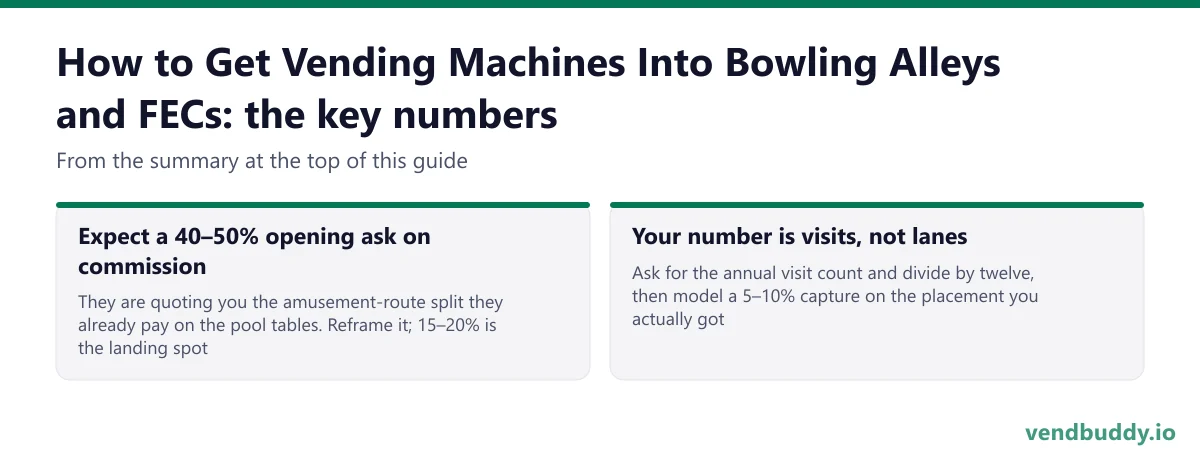
- Expect a 40–50% opening ask on commission. They are quoting you the amusement-route split they already pay on the pool tables. Reframe it; 15–20% is the landing spot.
- Your number is visits, not lanes. Ask for the annual visit count and divide by twelve, then model a 5–10% capture on the placement you actually got.
Bowling alleys and family entertainment centres sit inside the high-dwell-time venue class that almost nobody in vending works — and they are the awkward member of it. Everything else in that class, the pickleball clubs and climbing gyms and axe-throwing rooms in the experiential venue playbook, shares one trait that makes the pitch easy: there is nothing to buy inside the building. A bowling centre has a snack bar, usually a liquor licence, and a kitchen. That changes the conversation completely.
Part of our complete guide: how to find vending machine locations.
It does not kill it. It just means the version of this pitch that works is a placement argument rather than an amenity argument, and you have to know the four spots in the building the counter genuinely cannot serve before you walk in. Here they are, with who signs and what the numbers realistically look like.
Who says yes, and who cannot
Start by throwing out most of the category. Bowlero, Main Event, Dave and Busters, Round1, Chuck E. Cheese and Urban Air buy food and beverage centrally and run national vendor agreements. The GM of a Bowlero cannot approve a machine and will tell you so politely. Every hour you spend there is an hour not spent on the addressable market.
What is left is bigger than people expect: roughly the majority of US bowling centres are still independent or small regional chains, along with the whole long tail of independent FECs — the local roller rink with an arcade, the mini-golf-and-go-karts place, the indoor playground, the laser tag room in a strip centre.
- Independent bowling centre: the owner, and often the owner is behind the counter on a Tuesday afternoon. One conversation, one decision, no committee. This is the best decision-maker structure in the entire venue series.
- Two-to-six-location regional chain: the director of operations or the owner-operator, with the local GM as the person who tells you whether it is worth asking. Treat the GM as the scout, not the buyer.
- Franchised FEC: the franchisee, who is frequently an absentee owner with a GM running the floor. Ask early whether the franchise agreement has an approved-vendor list, because some do and it is cheaper to find out in week one.
The mechanics of that question — who signs versus who scouts — are the same across property types and are laid out in the decision-maker map.
What a centre owner actually cares about
Not your commission, and not the amenity. Bowling economics are unusual and understanding them is most of the pitch:
- Food and beverage is the business. Lane revenue roughly pays for the building. The margin lives at the counter and the bar. Any sentence that sounds like it moves a dollar from the counter to your machine loses, no matter how you phrase it.
- Throughput during the rush. At 6:40 on a league night there are eleven people at a counter with two staff, and the league starts at seven. The owner watches that line and knows some of it walks away. That is a problem you can solve without touching his margin, and it is the single best thing to talk about.
- Labour. Most centres cannot staff the counter past nine or ten. The kitchen closes and the building stays open. Every hour after that is unserved demand the owner has already given up on.
- The party business. Birthday parties are the highest-margin product a centre sells and the most operationally annoying. Anything that keeps a room of adults quiet and occupied for ninety minutes has value to him beyond the vend.
Picture the machines paying you while you sleep
That’s the real promise of vending — income that doesn’t cost you your time, and a life on your own terms. VendBuddy turns this guide into a step-by-step plan so you actually build it instead of just reading about it. Start free today.
Start building free →The four placements that work
This is the whole post. Get the spot right and the objection never comes up.
| Placement | Why the counter cannot serve it | Machine |
|---|---|---|
| Party-room corridor | Parents parked for 90 minutes; counter staff are mid-rush and 100 feet away | Combo, or drinks + a small snack unit |
| Arcade floor | Children are unsupervised for minutes at a time and will not queue at a counter | Drinks only, glass front |
| League end of the lanes | Kitchen closed at nine; leagues run to eleven | Combo, cashless |
| Staff back-of-house | Employees cannot buy from their own counter mid-shift, and comping it costs the owner | Small combo |
The one to lead with is the party corridor, because it is the placement the owner has already noticed a problem in. The arcade floor is the one with the highest volume once you have the account. Do not ask for the front lobby: it is thirty feet from the register and it is the same mistake operators make putting a machine in a hotel lobby instead of the guest floors.
The revenue math, honestly
Lane count tells you almost nothing. Visits per month tells you everything, and the owner knows the number because his point-of-sale reports it. Ask for it.
Then model it yourself rather than trusting a category average. A centre at 8,000 monthly visits, a machine on the arcade floor, a 5–10% capture and a $2.50 average ticket puts you at roughly $1,000–$2,000 gross a month. Halve the capture assumption for a corridor placement that people walk past rather than stand at. That range is arithmetic on figures the owner gave you, not a benchmark — the capture rate is the number that moves, and the honest way to find yours is a 90-day location test before you commit a second machine to the category.
For calibration: our experiential venue post models a busy pickleball club at around $2,400 a month for a single smart cooler. A bowling centre with comparable traffic will sit below that, and the reason is the snack bar. You are splitting demand with a counter that a pickleball club does not have.
Seasonality is sharper here than almost anywhere. League season runs roughly September through April and it is the whole year. Summer at a bowling centre is quiet enough that some owners cut hours, and a centre whose revenue is 70% leagues is effectively a nine-month account. FECs invert it: summer and school holidays are the peak, January is dead. If you can pair a bowling centre and an FEC on the same route you have smoothed both.
Every other experiential venue is easy because there is nothing to buy inside. A bowling alley has a snack bar. Pitch the four places the counter cannot reach and the objection never comes up.
The pitch
Walk in on a weekday between two and four, when the lanes are empty and the owner is doing paperwork. Not on a league night, and not on a Saturday.
“I am not asking for anything the counter sells — that is your business and I would defend it too. What I am asking about is the party rooms and the arcade. You have got parents standing in that hallway for an hour and a half on a Saturday, and your counter staff are underwater during exactly the same ninety minutes. That is the piece I would cover. Costs you nothing, and if it does not earn its wall in three months I pull it out.”
Then ask the four questions that qualify the site: what does the centre do in visits a year, what time does the kitchen close, how many birthday parties on a Saturday, and who handles the arcade equipment. That last one matters more than it sounds — see the exclusivity objection below.
Most first agreements are two pages, not twenty. The contracts walkthrough lays out the clauses that actually matter for exclusivity, including the termination language operators forget about until they need it.
The objections you will hear
“We sell all that at the counter.”
Concede it in the first four words, then move the conversation to a specific place and a specific time. “You do, and I would not go near it. I mean the party hallway at two on a Saturday.” The reason this works is that you have stopped arguing about whether he sells drinks and started talking about a hallway he already knows is unserved. What location objections actually mean covers the general shape of this move.
“What is my cut? The pool table guy gives me half.”
He is not bluffing and he is not being greedy. Amusement route operators genuinely do run fifty-fifty on pool tables, jukeboxes and cranes, and that is the only vendor split he has ever seen. Do not argue the percentage, explain the cost structure: a pool table has no cost of goods and needs servicing twice a year, and a snack machine is roughly sixty percent product cost and gets restocked weekly at your expense. Then name your number. Fifteen to twenty percent of gross is fair here, twenty-five is the ceiling, and above that the machine cannot carry the service cost. The full framing is in vending machine commission rates.
“Our amusement company handles the machines.”
Ask to read the clause. Some amusement route agreements are drafted broadly enough to cover automated equipment generally, not just games, and finding that out after install is expensive. If it does cover you, do not fight it — ask the owner to introduce you to the route operator. Food and drink is a category most amusement routes do not want and will happily let someone else carry, and you have just converted a dead account into a referral relationship with somebody who has thirty other centres.
“Kids will beat it up.”
Fair, and it is the one objection where he is describing something that actually happens. Answer with equipment rather than reassurance: an anchored machine, a laminated front rather than a thin wrap, no coin mech to jam a slug into, and cashless-first so there is no cash box worth attacking. Then tell him you will be in weekly, which is true, because an arcade-floor machine at this volume needs it.
The walk-in above, written out in full — the opener, the twelve objections operators really hear including the revenue-split one, variants for offices, gyms, apartments, warehouses and salons, and the plain-English placement agreement to leave on the counter when the conversation goes well.
See what is inside →What to put in
Arcade floor: a glass-front drink cooler, cashless-first, anchored. Drinks only. The buyer is a nine-year-old holding a game card and a parent twenty feet away, and a snack purchase competes with the pizza the family already ordered.
Party corridor: a combo, because the buyer here is a bored adult and adults buy coffee-adjacent, salty and diet. This is the one placement where the planogram should look nothing like the arcade.
Product: water and sports drinks first, energy drinks second at league-adjacent placements, and salty over sweet everywhere except the arcade floor. Skip chocolate that will sit in an unconditioned corridor in July. The general logic is in best products to stock, and the venue-by-venue version is in profit by location type.
Service reality
Weekly during league season and on the arcade floor, every other week for a corridor placement out of season. Plan service for a weekday afternoon: a Saturday visit means fighting through parties with a hand truck, and the staff will remember it.
Shrink is real and it is mostly small — children testing the flap, teenagers reaching. It is not the vandalism problem an unattended site has, because there are staff and cameras everywhere. The bigger operational annoyance is that a centre changes its hours seasonally and nobody tells you, so a machine you serviced Friday can sit through a two-week summer closure.
When to walk
Say no to: any national brand, a centre under about 3,000 visits a month, a centre whose only offered placement is the front lobby, an owner holding at forty percent, and an amusement agreement whose exclusivity clause you were not allowed to read. The last one is not a maybe. Signing over a clause you have not seen is how an operator ends up removing a machine at his own cost ninety days in.
The national brands cannot say yes and the independents are not on a list anywhere. VendBuddy scores real bowling centres, skating rinks, arcades and family entertainment venues near you by category and size, and hands you the best contact on file for each — so your morning starts with the owner-operated ones. Free to start, no card.
Frequently Asked Questions
How do you get vending machines into a bowling alley?
Go to the owner at an independent centre and to the general manager at a small chain, and do not bother with the national brands at all, because Bowlero, Main Event and Dave and Busters buy food and beverage centrally and a local machine is not a decision anyone in the building can make. Then pitch a place the snack bar does not reach. The counter already sells drinks, so asking to compete with it is the fastest no in the category. League corridors after the kitchen closes, the party-room hallway, the arcade floor and the staff area are the four placements that do not take a dollar out of the counter till.
The fastest way to test this in your own ZIP is the . Search once, see which businesses sit within a few miles, and reveal five contacts for nothing. It will not tell you who says yes, but it saves the afternoon you would spend building the list by hand.
Do bowling alleys allow vending machines when they have a snack bar?
Many do, once you have made clear you are not going after the counter. The objection is real and it is not a brush-off: food and beverage is where a bowling centre makes its margin, since lane time barely covers the building. What gets you in is a placement the counter genuinely cannot serve. The strongest of those is the window between the kitchen closing and the last league finishing, which at a lot of centres is ninety minutes of thirsty adults and a dark counter.
What commission do bowling alleys and family entertainment centres expect?
Expect the first number out of their mouth to be far higher than in any other venue class, frequently forty or fifty percent. That is not greed, it is the amusement-route split they already live with: the pool table, the jukebox and sometimes the arcade run on a fifty-fifty vendor deal. You have to reframe it rather than argue it, because the cost structure of a snack machine is nothing like a pool table. Fifteen to twenty percent of gross is a fair landing spot and twenty-five is the ceiling worth signing.
How much does a vending machine make in a family entertainment centre?
It tracks visits and dwell time rather than square footage, so ask for the annual visit count and divide by twelve. A centre doing eight thousand visits a month with a machine on the arcade floor and a realistic five to ten percent capture at a two-fifty ticket models to roughly one thousand to two thousand dollars gross a month. That band is arithmetic from figures the operator gives you, not an industry average, and the capture assumption is the part that moves. Verify it with a ninety-day test before you buy a second machine for the category.
Where should a vending machine go in a bowling alley?
The party-room corridor first, because that is where a parent is standing with nothing to do while eighteen children eat pizza, and it is the one spot the counter staff are too busy to serve during a rush. The arcade floor is second and wants drinks only. The league end of the lanes is third and only matters at centres whose kitchen closes before the last frame. Avoid the front lobby, which is thirty feet from the register and is the same mistake as putting a machine in a hotel lobby.
Does the arcade route operator have exclusivity over vending?
Sometimes, and it is the objection people forget to check for. Many centres run their arcade, pool tables and cranes through an amusement route operator on a revenue split, and some of those agreements are written broadly enough to cover coin-operated or automated equipment generally. Ask to see the clause before you order anything. If it does cover you, the move is to ask for an introduction to that route operator rather than to fight it, because a snack machine is a category they usually do not want and will happily sub out.
Related reading: how to find vending machine locations, the experiential venue playbook, trampoline parks, hotels and motels, laundromats, how to cold call locations, and commission rates.
What is selling, which buildings say yes, and the numbers before you buy a machine. Free, confirm from your inbox, unsubscribe in one click. Refer one friend and get 25 VendBuddy credits.
Want the free 38-page Ultimate Vending Guide too? Get the guide
Every operator we talk to wants fewer cold calls. The ones who get there have a Google Business Profile and a simple site a manager can check before replying. AI builders make that an evening job now. Wix is the mature site builder; Base44 also builds working tools like a quote form. Start with the AI website walkthrough or Wix vs Base44.
General information, not legal, tax or financial advice. Rules change, so check the official source. Revenue and income figures are examples, not promises. See our terms.