- Getting vending machines into hotels starts with the general manager of the single property. Not the brand, not corporate, not the front desk.
- Do not pitch the lobby. The front-desk pantry is there, the hotel keeps every cent of it, and you will lose that argument. Pitch the guest floors.
- Your number is per occupied room night, not per room. Roughly $0.10–$0.35 for a snack and drink pairing, so a 100-room property at 65% occupancy is $400–$800 a month gross.
- Extended-stay is the one to chase. Same room count, two to three times the volume, because the guest is there for eleven nights and it is 10pm.
- Commission is 10–15% at a flag, zero at an independent. Offer a staff house account first — a lot of GMs take it over a check.
Hotels look like an obvious vending location and then disappoint a lot of operators, and the reason is almost always the same: the machine went in the lobby. Thirty feet from a front desk that sells the same Coke at the same price and keeps a hundred percent of it. That placement was competing with the building it was in.
Part of our complete guide: how to find vending machine locations.
Placed correctly, hotels are a good, low-drama account type. Nobody vandalises them, the power is clean, the alcove already exists, and the GM is a single decision-maker who signs things. Here is who to talk to, what they actually care about, and the specific version of this pitch that works.
Updated October 2026 with current occupancy and industry numbers, VendBuddy’s own hotel data, a pre-signing checklist and an illustrative placement.
Why hotel vending machines work: the numbers
Hotels sell at the hours nobody else does. US hotel occupancy ran 62.3% for full-year 2025, according to CoStar (Business Travel News, reporting CoStar’s full-year 2025 data). That is the number to plug into the occupied-room-night math further down, rather than the room count on the sign. The American Hotel & Lodging Association expects hotel guest spending to reach nearly $805 billion in 2026 and direct hotel employment to reach about 2.2 million people (AHLA, 2026 State of the Industry). Those staff work nights and weekends too, and they buy from the machine.
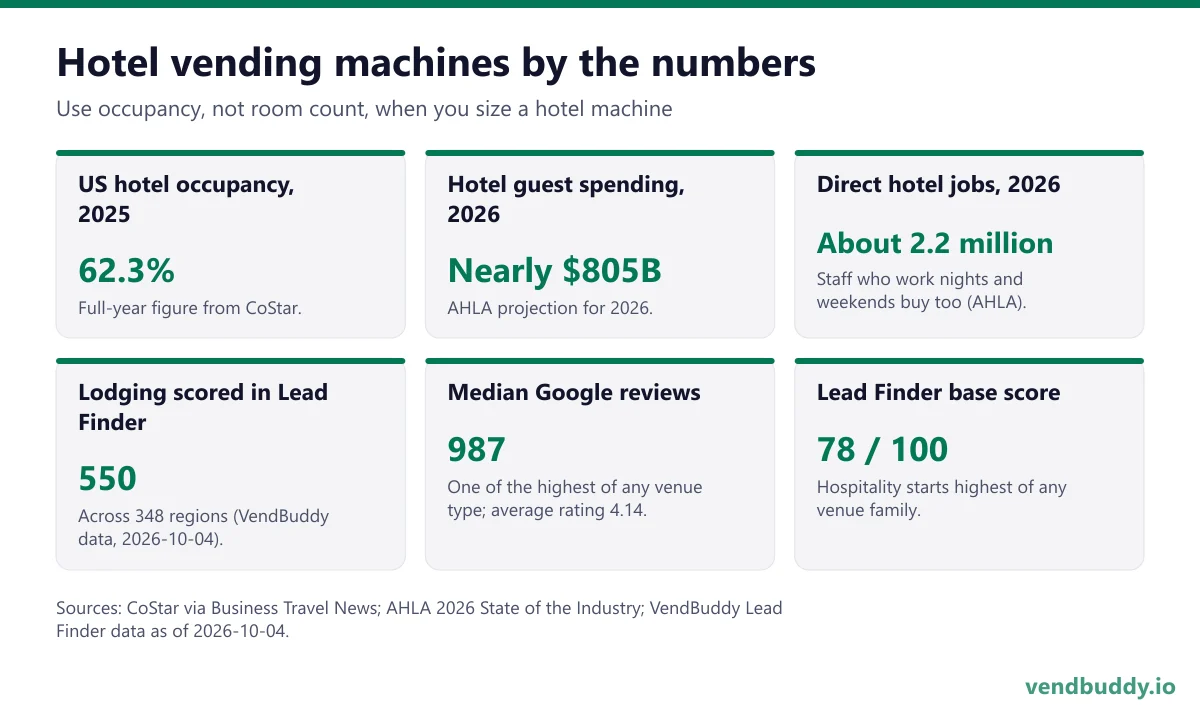
VendBuddy’s Lead Finder has scored 550 lodging properties across 348 regions. They carry a median of 987 Google reviews, one of the highest review counts of any venue type we track, and a 4.14 average rating (VendBuddy’s own Lead Finder data, 2026-10-04). High review volume is a decent stand-in for how many people pass through. Lead Finder gives the hospitality family a base score of 78 out of 100, the highest starting score of any venue family, before it adjusts for each property. On the demand side, 13 operators ran 17 hospitality searches across 13 ZIP codes since April 10, 2026, so hotels are still lightly worked compared with offices.
Who says yes
At a limited-service or select-service property — your Hampton Inns, Fairfields, Holiday Inn Expresses, La Quintas, and every independent motel — it is the general manager, and it is a one-person decision. That GM is in the building most weekdays, handles everything from the breakfast contract to the pool chemicals, and does not need permission to put a machine on the third floor.
Most first agreements are two pages, not twenty. The contracts walkthrough lays out the clauses that actually matter for the contract, including the termination language operators forget about until they need it.
At a full-service property with a restaurant and banquet space, the title you want is director of operations, and if there is a food and beverage department you will end up talking to the F&B director too, because your machine touches their category. That is a longer road with a real chance of a no, and it is not where a new operator should spend their week.
The thing that trips people up is the third structure: a property owned by an investor group and run by a third-party management company. The sign says Marriott, the operator is Aimbridge or Highgate or a regional group, and the GM may need a regional director to approve a new vendor. You find this out by asking one question early: “is this something you can sign off on, or does it go up to your regional?” Ask it in the first meeting rather than in week five. The decision-maker map covers the equivalent question for every other property type.
Picture the machines paying you while you sleep
That’s the real promise of vending — income that doesn’t cost you your time, and a life on your own terms. VendBuddy turns this guide into a step-by-step plan so you actually build it instead of just reading about it. Start free today.
Start building free →What a hotel GM actually cares about
Not your commission. Three things, in this order:
- Guest satisfaction scores. Every flagged hotel is measured on a brand survey, and “nothing to eat or drink after the desk closes the pantry” is a comment that shows up in those. A GM who is fighting a score problem is the easiest yes in this business. A GM whose scores are fine is a maybe.
- The front desk not being a shop. At a lot of small properties the night auditor is selling water and chips out of a cabinet, counting it, and reconciling it at 3am. Some GMs love the revenue and will defend it. Others quietly hate the inventory, the shrink, and the fact that a one-person overnight shift is doing retail. Find out which one you have before you say anything about the pantry.
- How it looks. A beat-up machine with a faded snack graphic on a renovated floor is a real objection and it is a fair one. Bring photos of your actual equipment, not a stock image.
The revenue math, honestly
Room count is the number people quote and occupancy is the number that pays you. Work in occupied room nights: rooms multiplied by occupancy, times thirty.
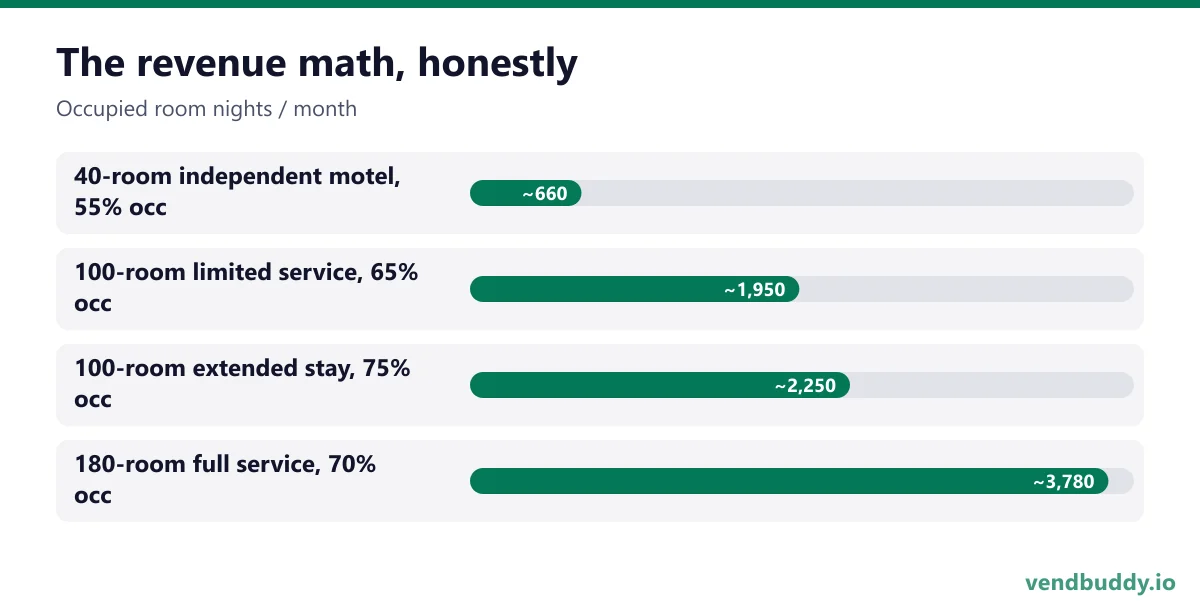
| Property | Occupied room nights / month | Realistic gross, snack + drink |
|---|---|---|
| 40-room independent motel, 55% occ | ~660 | $180–$400 |
| 100-room limited service, 65% occ | ~1,950 | $400–$800 |
| 100-room extended stay, 75% occ | ~2,250 | $900–$1,800 |
| 180-room full service, 70% occ | ~3,780 | $700–$1,400 |
Two things in that table are worth staring at. The extended-stay row is more than double the limited-service row on a similar occupied-room-night count, and the full-service row is lower per room night than limited service despite being bigger. Both have the same cause: what else is available inside the building. An extended-stay guest on night eight of a project has stopped going out for a drink at ten at night. A full-service guest has a bar and a restaurant downstairs.
So the ranking of hotel types by how much you should want them goes: extended stay, then limited service with no food nearby, then limited service near a gas station, then full service. Residence Inn, Home2, Candlewood, Extended Stay America, WoodSpring, and the long-stay independents near hospitals and construction projects are the accounts to build the route around.
Seasonality is real and it is regional. A beach or ski property will do four months of extraordinary numbers and eight months of nothing, and you cannot service it weekly year-round on that pattern. Interstate and airport properties are the flattest. Hospital-adjacent extended stay is the flattest of all, because the demand driver is somebody else’s medical schedule.
The pitch, and the sentence it turns on
You are not asking to replace the pantry. Say that out loud, early, because the GM is bracing for it.
“I am not after the pantry — you should keep that, you make full margin on it and I would too. What I am asking about is floors two through four. Your desk closes the pantry at eleven, and the guest who wants a drink at one in the morning is either knocking on the window or going without. That is the window I would cover, and it costs you nothing to find out whether it is worth anything.”
Three things that line does. It concedes the argument you were going to lose, which makes everything after it credible. It names a specific gap with a specific time on it. And it frames the ask as an experiment rather than a contract, which is how a GM who does not want a project hears it.
Then ask the four questions that tell you whether the property is worth a machine: what is the average occupancy, how many floors, is there anything to eat within walking distance, and what does the desk hear about at night. The last one is the good question, because it hands the GM the reason to say yes in his own words.
The four objections you will hear
“We sell that at the front desk.”
Agree with it immediately. Then move the conversation upstairs and into the overnight. If the GM defends the pantry hard, the property is still worth a drink-only unit on a guest floor — the pantry is a lobby product and it does not follow the guest to the fourth floor at midnight.
“Corporate has a program.”
Usually true for the breakfast supply and usually not true for vending. Ask specifically whether the brand mandates a vending vendor, because in most flags it does not. If a management company controls it, ask for the name of the regional and permission to say the property sent you. That referral is worth more than the call you just lost.
“We took ours out because guests complained it ate their money.”
This is the best objection on the list, because it means the space works and somebody else already proved it. What failed was a twenty-year-old coin mech, not demand. Say that. Then say the modern version takes tap-to-pay, refunds through the reader rather than through the front desk, and that you would rather they call you than the guest call the desk.
“What does it cost us?”
Nothing, and answer it in one sentence. You own the machine, you stock it, you insure it, you service it, and the only thing the hotel provides is the outlet. Then move straight to the commission or house-account conversation rather than letting it hang. Details on how to structure that are in the negotiation playbook.
Hotel vending fails in the lobby and works on the third floor. You are not competing with the guest, you are competing with the front desk pantry thirty feet away.
Commission norms, and the trade worth offering
Ten to fifteen percent of gross is the standard band at a franchised property. Independents frequently take zero and are pleased to have the amenity back. Anything above twenty percent at a hotel is a bad deal for you at these volumes and you should be willing to walk.
Before you offer a percentage, offer the house account: a set dollar amount of free product each month for staff, or a case of water a week for housekeeping. General managers take this trade more often than you would expect, because a monthly check is a vendor line item their accounting has to process and a case of water is a thing they can hand their team on a hot day. It is also cheaper for you at a $600-a-month account than twelve percent is.
Whatever you agree, write it down. A one-page placement agreement with the term, the commission, the service interval and a thirty-day out is enough — see vending machine contracts 101 for what belongs in it. Hotel GMs turn over roughly every eighteen to twenty-four months, and the piece of paper is what survives the handover.
The walk-in conversation above, written out in full — the opener, the twelve objections operators actually hear including the pantry one, variants for offices, gyms, apartments, warehouses and salons, and the plain-English placement agreement to leave on the GM’s desk when the meeting goes well.
See what is inside →What to put in, and where
Location: the ice-machine alcove on floors two and up. That alcove exists in almost every hotel built in the last forty years, it already has a dedicated circuit, and guests are already walking to it. If the property has five or more floors, put the combo on a middle floor and a drink-only unit two floors up rather than doubling up in one alcove.
Equipment: a glass-front cooler plus a spiral snack unit, or a single combo if the alcove is tight. Cashless is not optional — hotel guests are travelling and a meaningful share are carrying no US currency at all. Tap-to-pay, not swipe. Keep the finish plain: black or stainless passes brand standards, a bright wrap starts a conversation you do not need.
Product: water is the single biggest line at a hotel and it is not close. Then energy drinks, then the late-night salty snacks. Skip anything that melts, because the alcove is not always conditioned, and skip the candy-heavy planogram that works in a warehouse. Hotel guests buy hydration and something to eat at 11pm, in that order. The broader product logic is in best products to stock.
Service reality
Hotels are a light service account and that is most of why they are worth having. No shrink to speak of, no vandalism, staff who will call you when a coil hangs, and a loading path through a service entrance rather than a customer floor. Expect every other week at a limited-service property and weekly at a busy extended stay.
The one operational gotcha is access. Get on the property’s vendor list, get the GM to tell the front desk you are expected, and find out whether the service elevator needs a key. An operator standing in a lobby at 7am explaining who he is, to a desk agent who has never heard of him, is how a good account starts to feel like a hassle to the hotel.
If you are working a market with a lot of these, they cluster: hotel corridors near airports, interstate exits and medical districts put six or eight properties inside two miles, which is the density that makes small accounts worth servicing. The city guides for Miami and Nashville both break down where those corridors sit.
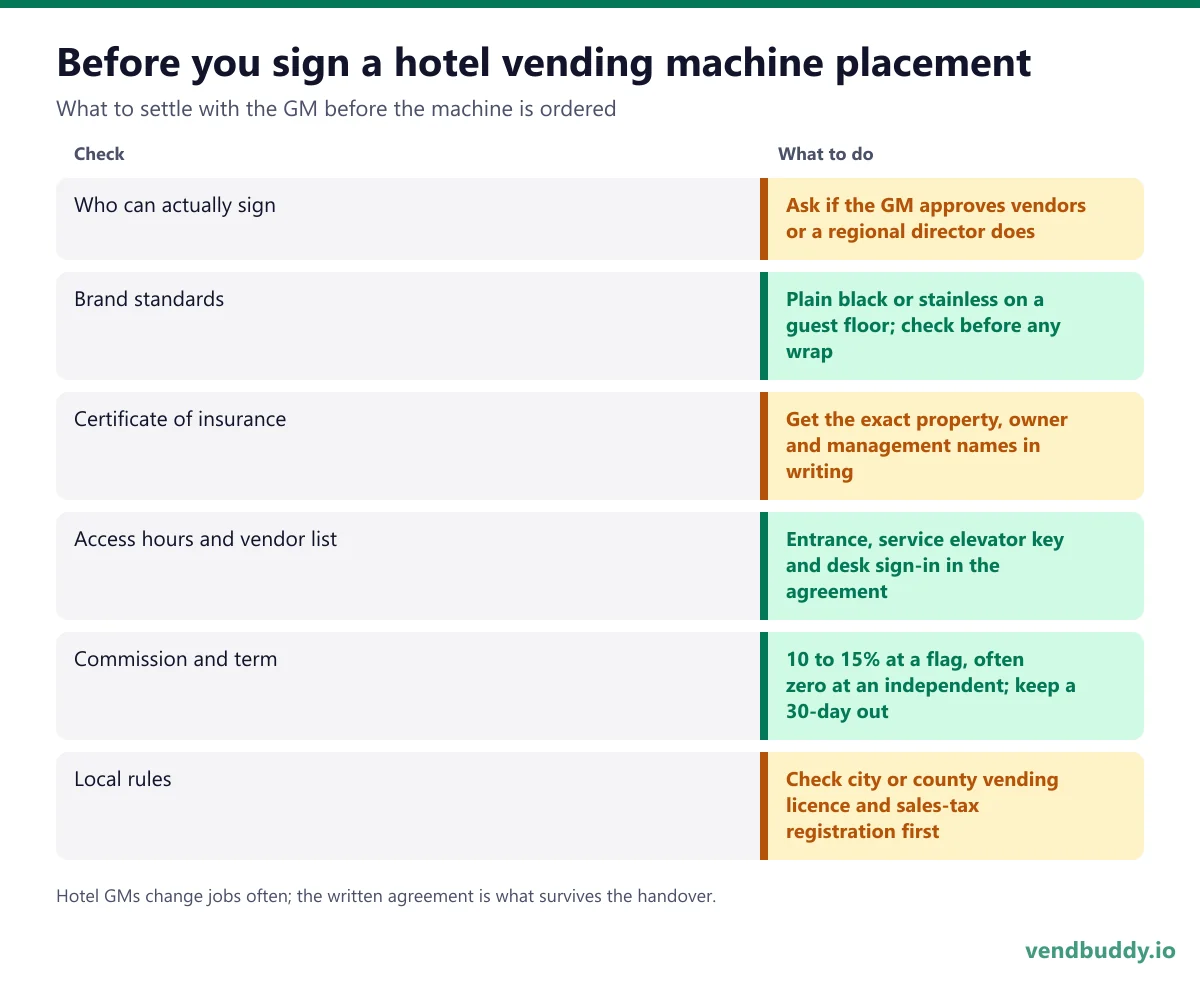
What to look out for before you sign a hotel
- Who can actually sign. Ask in the first meeting whether the GM can approve a vendor or whether it goes to a regional director at the management company. It saves you a month.
- Brand standards. Check the finish, signage and visibility rules before you order a wrap. Plain black or stainless on a guest floor passes almost everywhere.
- Certificate of insurance. Hotels and their management companies routinely ask for a COI naming the property, the owner entity and sometimes the management company as additional insured. Ask for the exact names in writing, because a wrong entity name sends the paperwork back.
- Access hours and the vendor list. Find out when you can service, which entrance you use, whether the service elevator needs a key, and whether you need to sign in at the desk. Get it in the agreement so a new GM inherits it.
- Commission and term. 10 to 15 percent at a flagged property, often zero at an independent. Avoid long terms with no exit. A 30-day out protects both sides when the GM changes.
- Local rules. Packaged snacks and drinks rarely need a food permit, but some cities and states want a vending licence, a sticker per machine or sales-tax registration. Check with your city or county before the install, not after.
Build your hotel list by ZIP and decision-maker title instead of driving past properties. Open Lead Finder filtered to hotels to see scored properties with the best contact on file. If you are weighing a smart cooler for a lobby or a premium property, read the best AI vending machine for hotels first.
Illustrative example: one extended-stay property
This example is illustrative. It shows how the math in this guide works; it is not a real operator’s result.
An operator pitches a 100-room extended-stay property near a hospital. The GM confirms the desk closes the pantry at 11 pm and that night-shift guests ask for drinks. At 75% occupancy that is about 2,250 occupied room nights a month, which the table above puts at $900 to $1,800 a month gross for a snack and drink pair. The operator places a combo on the third floor by the ice machine and a drink-only unit two floors up, offers a staff house account instead of a percentage, sends the COI with the owner entity named, and writes a 90-day review into the agreement. The plan uses the low end of the range; anything above it is a bonus.
When a hotel is not worth it
Say no to: properties under forty rooms with a convenience store in the parking lot, seasonal resorts you cannot service in the off months, full-service hotels with a 24-hour restaurant, and anything where the GM wants twenty-five percent. The last one is not a negotiation, it is a signal that somebody has told them vending is a revenue centre, and the machine will underperform the expectation you just agreed to.
Not every hotel is worth a machine and occupancy is not on the sign. VendBuddy scores real properties in your area by category, size and captivity, and gives you the decision-maker title for each one, so your list starts with the extended-stay and no-food-nearby properties instead of whatever you drove past. Free to start, no card.
Frequently Asked Questions
How do you get vending machines into hotels?
You go to the general manager of the individual property, not to the brand and not to the front desk. At limited-service and select-service hotels the GM controls the guest floors and can say yes in one conversation. Lead with the guest-floor placement rather than the lobby, because the lobby is where the front-desk pantry lives and the pantry is the thing the hotel already makes full margin on. Ask what happens between eleven at night and six in the morning, which is the window the pantry does not cover and the window your machine owns.
How much does a hotel vending machine make per month?
Plan on roughly ten to thirty-five cents of vend sales per occupied room night for a snack and drink pairing on the guest floors. A hundred-room limited-service property running sixty-five percent occupancy is about sixty-five occupied rooms a night, which works out to somewhere between four hundred and eight hundred dollars a month gross for the pair. Extended-stay properties run two to three times that on the same room count because guests are in the building for a week rather than a night.
What commission do hotels expect on vending machines?
Ten to fifteen percent of gross is the common band at a franchised limited-service property, and zero is normal at an independent motel that simply wants the amenity back. A number of properties would rather have a house account than a check: a set dollar amount of free product a month for staff, or free water for the housekeeping crew. That trade is frequently cheaper for you than a commission and it is worth offering before the percentage conversation starts.
Where should a vending machine go in a hotel?
Second floor and up, next to the ice machine, in the alcove guests already walk to. The lobby underperforms it by a wide margin in most properties because a guest standing in the lobby is thirty feet from the front desk pantry and will buy there instead. If a property has more than four floors, the alcove nearest the elevator on the middle floors outsells the top and bottom, and a second drink-only unit on a high floor is usually the better second machine rather than a second combo.
Do hotel brand standards stop you from placing a vending machine?
Rarely for the machine itself and frequently for the wrap. Most flags care about the finish, the signage and whether the unit is visible from the lobby rather than about who owns it, so a plain black or stainless glass-front on a guest floor passes almost everywhere. Ask the GM to check the current brand standard before you order a wrap, because a branded machine that has to be re-skinned after install is a cost you carry.
Are motels worth it for vending operators?
Independent motels are a mixed bag and the deciding factor is not room count, it is whether there is a convenience store within walking distance. A forty-room interstate motel with nothing else at the exit can outperform a hundred-room suburban hotel next to a gas station. Check the surroundings before you check the room count, and expect cash to still be a real share of transactions at properties whose guests are paying for the room in cash.
Do hotels ask for insurance from vending operators?
Yes, almost always. Expect a request for a certificate of insurance that names the property, the owner entity and sometimes the management company as additional insured, usually on a general liability policy. Ask for the exact legal names in writing before you request the certificate, because a wrong entity name is the most common reason the paperwork comes back.
You can build all of this yourself in a spreadsheet over a weekend. If you would rather not, the operator kits package the same checklists and templates as a one-time download starting at $27.
What occupancy should I assume for a hotel vending machine?
Use the occupancy figure from the property itself if the GM will share it. If not, US hotel occupancy ran 62.3 percent for full-year 2025 according to CoStar, and extended-stay properties usually run higher. Multiply rooms by occupancy by thirty to get occupied room nights, then use roughly ten to thirty-five cents of vend sales per occupied room night for a snack and drink pair.
Related reading: how to find vending machine locations, senior living communities, laundromats, car dealerships, how to cold call locations, and the property-side version of this page at vending machines for hotels.
What is selling, which buildings say yes, and the numbers before you buy a machine. Free, confirm from your inbox, unsubscribe in one click. Refer one friend and get 25 VendBuddy credits.
Want the free 38-page Ultimate Vending Guide too? Get the guide
Every operator we talk to wants fewer cold calls. The ones who get there have a Google Business Profile and a simple site a manager can check before replying. AI builders make that an evening job now. Wix is the mature site builder; Base44 also builds working tools like a quote form. Start with the AI website walkthrough or Wix vs Base44.
General information, not legal, tax or financial advice. Rules change, so check the official source. Revenue and income figures are examples, not promises. See our terms.