- Vending machines in senior living communities are bought by staff, not residents. That single fact decides where the machine goes and what is in it.
- The overnight shift is the account. Aides working 11pm to 7am have no open kitchen, no cafeteria, and nothing within driving distance.
- Executive director approves, environmental services places. Dining services may see you as competition — handle that before it becomes a no.
- Hot beverages punch above their weight here in a way they do not in an office or a gym. Plan the planogram around a 2am shift, not a lunch break.
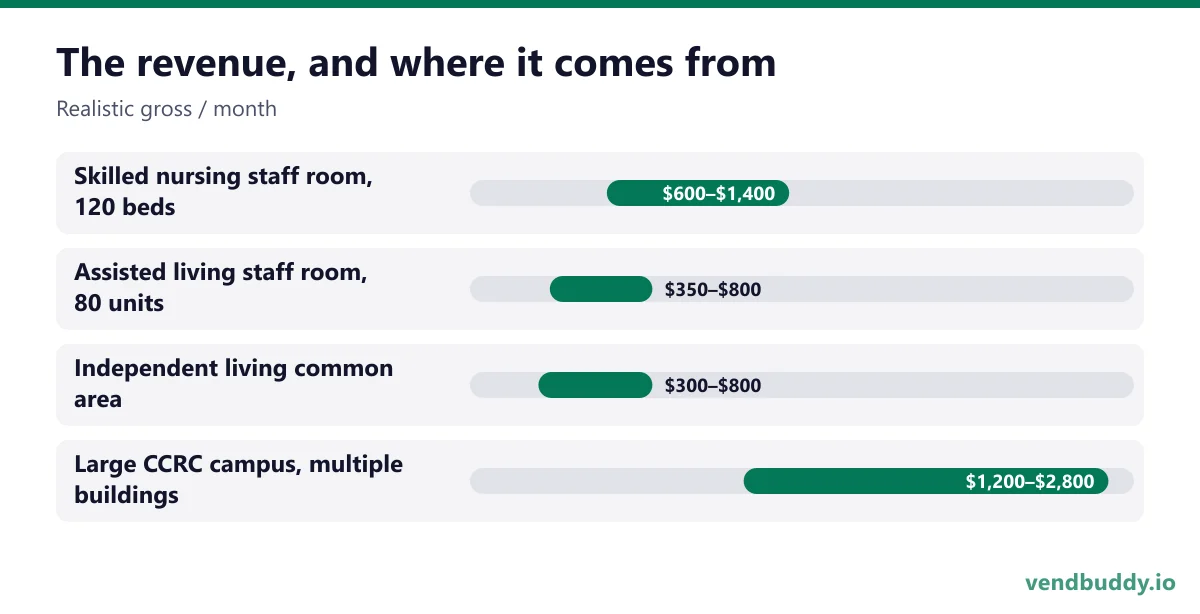
- $600–$1,400 a month at a 120-bed skilled nursing staff room. Independent living common areas run $300–$800 and behave more like apartments.
Most operators who look at a senior living community see a few hundred residents and start doing headcount arithmetic. That arithmetic is wrong, and it is wrong in a way that gets a proposal rejected in the first meeting: in assisted living, memory care and skilled nursing, the residents are not your customers. Their food is provided, frequently prescribed, and in some settings clinically supervised.
Part of our complete guide: how to find vending machine locations.
The customers are the people in scrubs. A hundred-and-twenty-bed facility runs three shifts, seven days a week, and the eleven-to-seven aides are working a nine or twelve-hour shift in a building with a locked kitchen and nothing open within ten minutes of the parking lot. That is one of the most genuinely captive audiences in vending, and almost nobody is pitching it properly.
Know which building you are standing in
“Senior living” covers four very different operations, and treating them as one thing is the fastest way to sound like you have never been in one.
- Independent living. Apartments for seniors who live independently, with optional dining. Residents have their own money, come and go, have visitors, and genuinely do buy from machines. This is the one venue in the category where a resident-facing placement is a real business. Behaves much like an apartment community — see the apartment pitch template for the parallel.
- Assisted living. Residents need help with daily activities. Meals are provided, dietary restrictions are common, and resident purchasing is limited. Staff room is the placement.
- Memory care. Secured units for dementia residents. No resident-facing food machines, ever, for reasons that are clinical rather than commercial. Staff areas only.
- Skilled nursing. Medical facility under state health licensure, three shifts, the highest staff density in the category and the strongest staff-room numbers. Also the most regulation.
Many campuses are two or three of these at once, which means one conversation can produce two or three placements in separate buildings. Ask the executive director what levels of care are on the campus in your first meeting — it is the question that shows you know the difference.
Who approves and who places
Three titles matter and they do different jobs:
- Executive director. Runs the community, approves vendors, signs. The yes.
- Director of environmental services, plant operations or maintenance. Owns the physical building. Tells you which wall, which circuit, and what infection-control protocol applies to the surface you are putting in a staff room. Nothing gets installed without him.
- Dining services director. Not an approver, and a potential blocker. Your machine touches his category, and if he is not consulted he can turn a yes into a review. A two-minute conversation acknowledging that you are not touching resident dining, and asking what he does not want in the machine, is usually all it takes.
Corporate-owned chains add a layer. The large operators run regional directors of operations and sometimes a national procurement function, which means an executive director at a chain community may be able to approve you or may need a regional sign-off. Ask directly in the first meeting whether it is her call. The decision-maker map covers the same question across every property type.
Roleplay a property manager and get scored. Pick who you are calling — office property manager, apartment community manager, gym owner, warehouse ops lead, school administrator, hospital facilities director, dealership GM — then pick how hard they are, up to Gatekeeper mode where a receptionist screens you and you have to earn the transfer. Talk it through out loud. At the end you get a score out of 100, whether the meeting was actually booked, three things that worked, three that cost you, and three better questions written word for word for the next real call. In the VendBuddy app for paid subscribers.
Picture the machines paying you while you sleep
That’s the real promise of vending — income that doesn’t cost you your time, and a life on your own terms. VendBuddy turns this guide into a step-by-step plan so you actually build it instead of just reading about it. Start free today.
Start building free →The revenue, and where it comes from
| Placement | What drives it | Realistic gross / month |
|---|---|---|
| Skilled nursing staff room, 120 beds | Three shifts, 60–100 staff, no open kitchen overnight | $600–$1,400 |
| Assisted living staff room, 80 units | Two to three shifts, 30–50 staff | $350–$800 |
| Independent living common area | Residents plus visitors, daytime | $300–$800 |
| Large CCRC campus, multiple buildings | Staff rooms plus an IL common area | $1,200–$2,800 |
Look at where the volume sits inside a day. In a staff room, the overnight block from roughly ten at night to five in the morning is commonly a third to nearly half of total sales, which is a distribution you will not see in any office, gym or hotel. It is also why the product mix has to be built for a shift rather than for a lunch break.
The second thing worth knowing: turnover in this sector is high, which cuts both ways. New staff every month means a constant supply of people discovering the machine, and it also means the person who told you where to put it may be gone in six months. Keep the executive director as your relationship rather than the aide who was friendly on install day.
Build the planogram for a night shift
This venue rewards a planogram that looks wrong everywhere else:
- Hot beverage does real numbers here. A coffee unit in a staff room at two in the morning has no competitor inside the building and no open drive-through nearby. In most venues hot drinks are a marginal add; here they can be a meaningful share. The category logic is in the coffee service model.
- Frozen and food, if you can service it. Ice cream and microwaveable meals do genuinely well with overnight staff who did not bring dinner. Higher spoilage risk and a shorter service interval, so only take this on at a site you already visit weekly.
- Energy drinks, heavily. Night shift is the energy drink’s natural habitat and this is the venue that proves it.
- Cashless, but not cashless-only. Staff pay by phone. Independent living residents genuinely still use cash and some will not use a card at a machine at all. If you place in an IL common area, run a working bill validator.
In assisted living the residents are not your customers. The eleven-to-seven aide with a locked kitchen and nothing open for ten miles is. Build the machine for her shift.
The pitch that gets a second meeting
Lead with the night shift. It is a specific, real, unglamorous problem that the executive director already knows about and no vendor has ever mentioned to her.
“I want to ask about your staff break room rather than anything resident-facing — I know dining covers the residents. What do your eleven-to-sevens do about food? Because at most buildings this size the answer is they bring it or they go without, and the ones who forget end up buying out of a machine at the hospital on the way in. I would put a drink and snack unit in the break room, and a coffee unit if there is room. Costs the community nothing, and I would look at whether the activity fund or the employee fund should get a piece of it.”
Three things happen in that paragraph. You disqualify the resident areas yourself, which immediately separates you from every operator who has walked in proposing a candy machine in a memory care hallway. You name a staffing pain point in a sector where staff retention is the executive director’s hardest problem. And you introduce the fund idea before the commission conversation starts, which is the framing this venue responds to.
Bring the retention angle out explicitly if the meeting goes well. Senior living operators spend real money on staff appreciation because turnover is expensive, and “your night aides get something the day shift does not” is a lever nobody expects a vending operator to pull.
Senior living is a multi-title building — executive director, environmental services, dining — and each one needs a different first sentence. The AI Pitch Pack is five copy-paste prompts that research a specific community and draft the walk-in pitch, the cold email and the follow-ups in about five minutes, with guardrails that stop the model inventing revenue claims.
See what is inside →The regulatory part, handled properly
Skilled nursing facilities are licensed medical facilities and they get surveyed. That does not make vending complicated, but it does mean a few things you should know before you are asked:
- State food-service rules vary and can cover labelling, storage temperature and who may handle food in resident-accessible areas. Machines in staff-only break rooms are simpler than machines in resident corridors almost everywhere, which is another reason the staff room is the right target.
- Infection control affects surfaces and cleaning. Expect to be asked how the machine is cleaned and how often. Have an answer, and follow it.
- Ask what the surveyor has said. This one question — “has your state surveyor ever had anything to say about vending here?” — makes you sound like somebody who has worked in this sector, and it surfaces any real constraint immediately.
- Carry the insurance and show it unprompted. Certificates of liability get asked for here more reliably than in any other venue on this list. The insurance guide covers what coverage a placement actually needs.
None of this is a reason to avoid the category. It is a reason to walk in already knowing it, because the executive director is used to vendors who do not.
Commission, and the fund alternative
Ten to fifteen percent is standard at a corporate community. Independents and non-profits frequently take zero. But the offer that lands unusually well in this sector is a designated contribution: a fixed percentage or dollar amount paid to the resident activity fund or the employee appreciation fund rather than into the operating account.
That is not a gimmick. Activity funds and staff funds are real line items that executive directors care about and are constantly short on, and a vendor who funds one is a vendor who is difficult to replace at renewal. It is the same mechanic that works with churches, and it works for the same reason. Commission rates by venue type has the wider comparison.
Get a written agreement with a term, a service interval, an insurance clause and a thirty-day out. This is a sector where executive directors turn over regularly and the incoming one will want to see the paper. Vending machine contracts 101 covers the clauses.
Finding them
Senior living clusters around hospitals and in retirement-heavy metros, and the campuses are large enough that a single site can hold two or three machines in separate buildings. Sun Belt markets carry the highest density by a wide margin — the city guides for Tampa and Phoenix both show where those corridors run.
These are also stable, long-term accounts. Buildings do not move, the demand driver is a licensed bed count rather than a lease, and a well-serviced staff room stays yours for years. If hospital and healthcare vending is on your list, this is the adjacent category to work at the same time — the buildings sit near each other and the decision-maker structure rhymes.
Most people working on the decision-maker problem start by pulling the list rather than driving the map. The ranks the businesses around your ZIP by type and headcount, and the first five contact reveals are free.
Senior living campuses are big, stable and clustered around hospitals. VendBuddy scores real facilities in your ZIP by category, size and captivity and gives you the decision-maker title for each, so you can build a healthcare-adjacent loop rather than guessing which building runs three shifts. Free to start, no card.
Frequently Asked Questions
How do you get vending machines into senior living communities?
Go to the executive director for approval and the director of environmental services or plant operations for placement, and pitch the staff break room rather than the resident areas. The buyer in assisted living and skilled nursing is overwhelmingly the staff, because certified nursing assistants work overnight shifts in a building with no open kitchen at two in the morning. Independent living is the exception, where residents genuinely do buy, but even there the staff room is usually the stronger of the two placements.
Who buys from vending machines in a nursing home?
Staff, not residents, in assisted living, memory care and skilled nursing. Residents in those settings have meals, snacks and beverages provided by dining services, frequently have prescribed dietary restrictions, and in memory care are not left to make unsupervised food purchases at all. Meanwhile the building runs three shifts, and the overnight aides have no cafeteria, no nearby open restaurant and a nine or twelve-hour shift. That is the demand.
How much does a vending machine make in a senior living facility?
A staff break room at a hundred-and-twenty-bed skilled nursing facility running three shifts realistically grosses six hundred to fourteen hundred dollars a month, and an independent living common area runs three hundred to eight hundred. The overnight shift is a disproportionate share of it, and hot beverages perform far better here than in almost any other venue because a two-in-the-morning coffee has no alternative inside the building.
What commission do senior living communities expect?
Ten to fifteen percent at a corporate-owned community, and frequently zero at an independent or non-profit one. A common alternative that operators should offer early is a donation to the resident activity fund or the employee appreciation fund instead of a commission cheque, which many executive directors prefer because it lands somewhere they can point at rather than in a general ledger.
Are there regulations on vending machines in nursing homes?
There are, and they vary by state and by licence type. Skilled nursing facilities operate under state health department food-service rules that can cover storage, labelling and who is permitted to handle food in resident areas, and infection-control protocols affect where a machine may sit and how it must be cleaned. This is a real reason machines end up in staff-only areas rather than resident corridors, and the right move is to ask the executive director what the state surveyor has said rather than to guess.
Can you put candy vending machines in memory care areas?
No, and you should not propose it. Memory care residents may have swallowing difficulties, prescribed diets or diabetes, and unsupervised access to food is a clinical and liability problem rather than a preference. Proposing a snack machine in a memory care corridor signals to the executive director that you do not understand the building, which is expensive at exactly the moment you are trying to establish that you do.
Related reading: how to find vending machine locations, hospital and healthcare vending, colleges and universities, churches, hotels and motels, and the decision-maker map.
What is selling, which buildings say yes, and the numbers before you buy a machine. Free, confirm from your inbox, unsubscribe in one click. Refer one friend and get 25 VendBuddy credits.
Want the free 38-page Ultimate Vending Guide too? Get the guide
Walk-ins and cold emails find locations. A small site with your own machine photos and a request-a-machine form lets the next one find you. Around machine three to five, an AI builder drafts it in an evening. Wix is the mature site builder; Base44 also builds working tools like a quote form. Start with the AI website walkthrough or Wix vs Base44.
General information, not legal, tax or financial advice. Rules change, so check the official source. Revenue and income figures are examples, not promises. See our terms.