- Getting vending machines into colleges usually means not getting the campus. Beverage exclusivity and a purchasing department own that, and the answer is a contract cycle rather than a call.
- The open doors are off-campus. Private student housing, Greek houses, small private and community colleges, and campus-adjacent buildings under separate management.
- Pouring rights usually cover beverages on university property. Ask what the agreement actually says — snacks and privately owned housing are frequently outside it.
- Budget for eight or nine months, not twelve. An academic-year account should be planned at roughly 70% of its in-session run rate.
- Institutional commission runs 15–30%. Private student housing runs 0–10%. That gap is most of the reason to start off campus.
A university looks like the best vending location in any town. Thousands of people, walking everywhere, awake at two in the morning, no cars, no alternatives. Every operator who has driven past a campus has thought about it.
Part of our complete guide: how to find vending machine locations.
And then almost none of them get in, for a reason that has nothing to do with their pitch: the beverages on that campus were sold years ago, in a single exclusive agreement worth more than your entire route, and the vending is awarded by a purchasing department through a bid process. That is the honest headline. The useful part of this post is everything that sits around that wall, because a surprising amount of it is open.
What you are actually up against
Three structures, stacked:
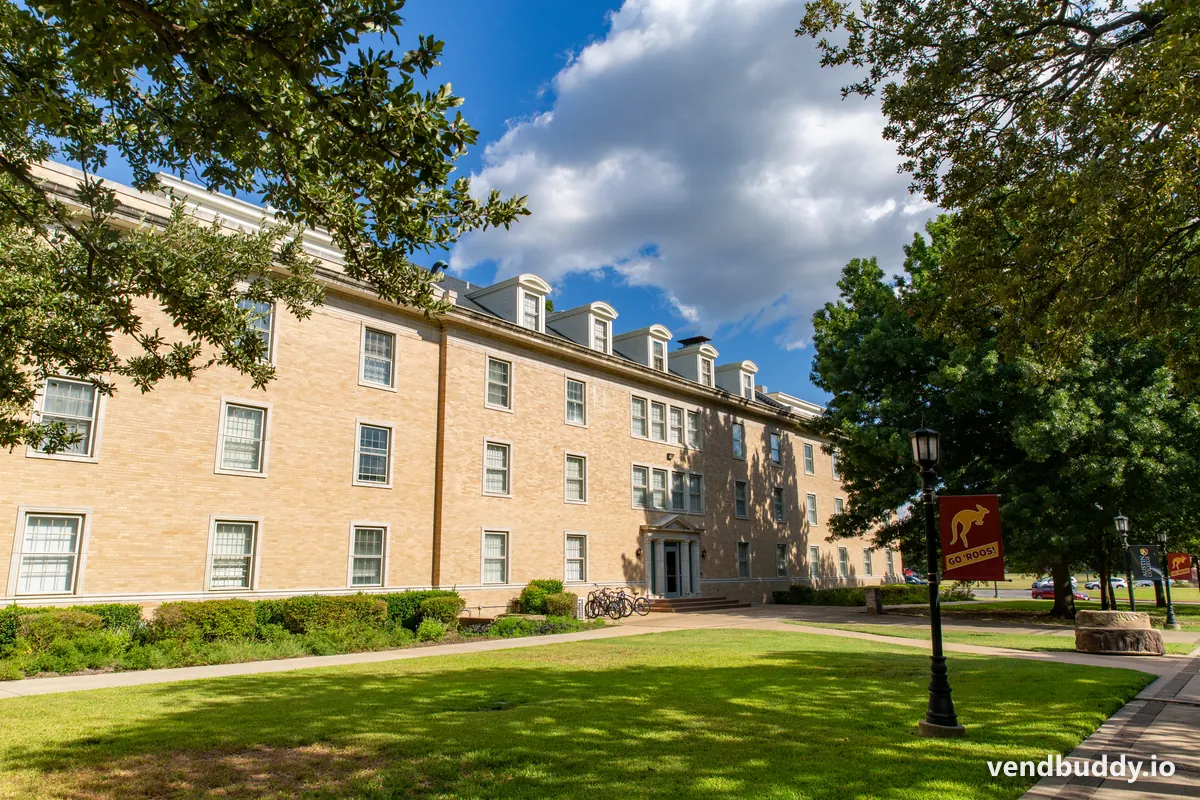
- Pouring rights. An exclusive beverage agreement with one company, typically five to ten years, paid for with a substantial annual sum plus scholarship and athletics money. It grants exclusivity over beverage sales on campus. This is why an enthusiastic facilities manager can still tell you no on a drink machine.
- The dining contract. Most campuses outsource food service to a national contractor. Where the contractor also holds vending, your conversation is with a company, not a college.
- Purchasing. Public institutions must competitively bid contracts above a threshold. That means an award, a request for proposal, insurance requirements, references, and frequently a performance bond. It is a real process and it runs on a calendar rather than on your timeline.
Two things are worth knowing about that wall, because they are where the openings are. Pouring rights agreements are typically written around beverages, not snacks, and they typically cover university-owned property, not everything with the university’s name near it. Ask what the agreement actually says. A surprising number of facilities staff have never read it and assume it covers more than it does.
The five doors that are actually open
- Off-campus private student housing. The best entry point in the entire category and the one most operators miss. Purpose-built student apartment complexes near campus are owned by real estate companies, run by a property manager, and are not university property. Four hundred to eight hundred beds, no exclusivity, no purchasing department, and a community manager who behaves exactly like any other apartment PM. The pitch is the apartment pitch — the apartment pitch template is the right script, not this one.
- Fraternity and sorority houses. Privately owned by a house corporation or an alumni board, with a house manager or steward who handles supplies. Small — thirty to sixty residents — but zero competition, no process, and a house that says yes will tell the house next door. Best worked in early autumn when the house officers have just turned over and are looking for things to fix.
- Community colleges. Frequently no pouring rights agreement at all, a much smaller purchasing threshold, and a business manager or director of auxiliary services who can make a decision. Commuter-heavy, which means daytime volume and a real lunch rush. This is the most reachable institutional account in the category.
- Small private colleges. Under two thousand students, often no exclusive beverage deal, and a business office rather than a procurement department. Ask for the director of auxiliary services or the vice president for finance and administration.
- Campus-adjacent buildings under separate management. Research parks, university-affiliated clinics, athletic training facilities run by a separate authority, and privately operated conference centres. These sit near a campus and frequently sit outside its agreements. Ask who owns the building rather than assuming the university does.
Notice what those five have in common: none of them require you to beat a beverage company. If you are a small operator, that is the entire strategy.
Roleplay a property manager and get scored. Pick who you are calling — office property manager, apartment community manager, gym owner, warehouse ops lead, school administrator, hospital facilities director, dealership GM — then pick how hard they are, up to Gatekeeper mode where a receptionist screens you and you have to earn the transfer. Talk it through out loud. At the end you get a score out of 100, whether the meeting was actually booked, three things that worked, three that cost you, and three better questions written word for word for the next real call. In the VendBuddy app for paid subscribers.
Picture the machines paying you while you sleep
That’s the real promise of vending — income that doesn’t cost you your time, and a life on your own terms. VendBuddy turns this guide into a step-by-step plan so you actually build it instead of just reading about it. Start free today.
Start building free →The numbers, and the four-month hole
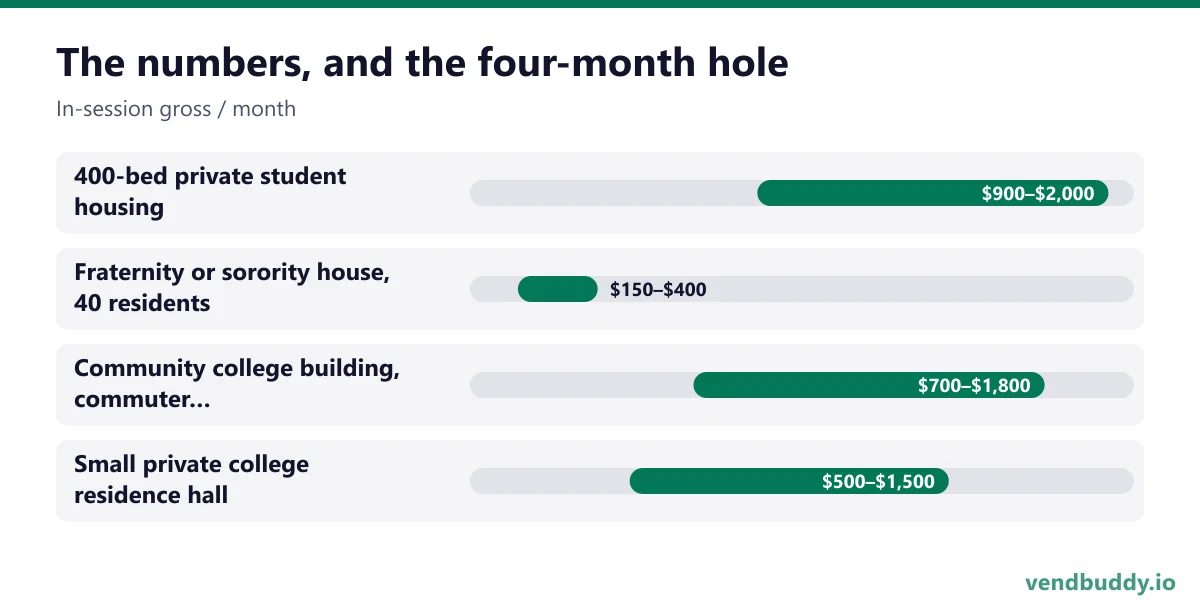
| Placement | In-session gross / month | Annualised, allowing for breaks |
|---|---|---|
| 400-bed private student housing | $900–$2,000 | $700–$1,500 |
| Fraternity or sorority house, 40 residents | $150–$400 | $110–$290 |
| Community college building, commuter campus | $700–$1,800 | $550–$1,400 |
| Small private college residence hall | $500–$1,500 | $370–$1,100 |
The right-hand column is the one that matters and it is the one operators forget. A campus account produces roughly eight to nine months of revenue: it empties out for winter break, empties again for spring break, and goes largely quiet from May to August. Summer sessions, athletic camps and conference bookings fill some of that at some institutions and none of it at others, so ask what the building does in July before you sign anything.
Two practical consequences. First, plan cash flow around the annualised number, not the September one, because the September number will make you buy a machine you cannot pay for in June. Second, and more usefully: pair a campus account with a counter-seasonal one. A warehouse, a hospital or a senior living staff room runs flat all year and does not care what month it is. An operator whose route is all student housing has a genuinely hard summer.
Product mix skews young and cheap: energy drinks are enormous, large-format water sells hard, and price sensitivity is real. Late-night volume is a bigger share than anywhere except a hospital, which means capacity matters — a machine that sells out on a Thursday night and is not serviced until Monday lost three days. Best products to stock covers the general logic; the campus version of it is simply more energy, more water, more capacity.
You are not going to outbid a beverage company for a campus. Go around it: the student apartments across the street are owned by a REIT and have never heard of pouring rights.
The question that decides everything
Whoever you reach, on campus or adjacent to it, ask this before you pitch anything:
“Before I take up your time — does the campus have an exclusive beverage agreement, and does this building fall under it? I ask because it would save us both a conversation, and because a lot of those agreements cover drinks on university property and not much else.”
That question does three jobs. It disqualifies a dead lead in twenty seconds instead of six weeks. It tells the person on the other end that you know how their sector works, which is not the impression a vending call usually leaves. And it frequently produces an answer neither of you expected, because the person answering has not thought about the boundary of the agreement before and may realise mid-sentence that the building you are asking about sits outside it.
If the answer is that purchasing handles it, ask when the current agreement expires and how to get on the vendor list. Then actually get on the list. That is a two-year play rather than a two-week one, and it is a legitimate one for an operator who is building something durable. The equivalent framing for a slow institutional sale is in the negotiation playbook.
Campus-adjacent buildings all need a different first email — a housing REIT’s community manager, a fraternity house corporation, a community college business office. The AI Pitch Pack is five copy-paste prompts that research a specific venue and draft the pitch, the cold email and the follow-ups in about five minutes, with guardrails that stop the model inventing revenue claims.
See what is inside →The campus card problem
On university-owned property, students pay with the campus card. Meal-plan dollars, flex dollars, whatever the institution calls them — that card is the wallet, and a machine that cannot take it gets used a fraction as much and generates complaints that land on the person who let you in.
Integrating with a campus card system means working through the institution’s card office and the platform they run, and it is not something you bolt on casually. This is a real, unglamorous barrier and it is one more reason the off-campus route is the sensible one for a small operator: private student housing has no card system, so a normal tap-to-pay reader is all you need. The card reader comparison covers what to fit when you are outside a campus system.
Most operators end up on Nayax for card readers because it is what the distributors already support. Their reader handles tap, chip and the telemetry feed in one box, and the monthly fee is the part to check against your per-machine volume before you commit the route to it. Affiliate link, so we may earn a commission at no extra cost to you.
The three objections
“We have an exclusive agreement.”
Usually true and usually narrower than the speaker thinks. Ask whether it covers snacks and whether it covers this specific building. If it covers both, thank them and go across the street to the student apartments.
“Purchasing handles that.”
Take the process seriously rather than treating it as a brush-off. Get on the vendor list, note the expiry date, and check back on a calendar rather than on a feeling. Institutional contracts do turn over, and the operators who win them are the ones who were registered before the bid opened.
“Does it take the student card?”
If the honest answer is no, say so immediately and pivot to a building where the card is irrelevant. Getting a machine installed somewhere it cannot take the local currency is a slow, embarrassing failure.
A note on Greek houses, because nobody writes about them
Fraternity and sorority houses are small, privately owned, and structurally the easiest institutional-adjacent placement there is. The house corporation owns the building, a house manager or steward handles supplies, and the officer group turns over every spring. They are also socially networked in a way almost no other venue is: a house that likes its machine will mention it, and one campus can produce six placements from one conversation in September.
The trade-offs are real. Forty residents is a small account, the houses empty completely over the summer, and wear and tear is higher than average. Treat them like fill-in stops that happen to cluster inside four blocks, service them every two to three weeks, and do not put your newest equipment in one.
Commission and paper
Institutional vending has the highest commission expectations of any venue type — fifteen to thirty percent, sometimes with an annual guaranteed minimum written in. That is what a captive campus with an exclusive award costs, and if you win one, model it carefully before you sign a guarantee you have to pay in a bad year.
Off campus is a completely different world. Private student housing behaves like an apartment community: zero to ten percent, a community manager who signs a one-page agreement, and no bond. That difference in commission is most of the argument for starting there. Commission rates by venue type lays out the full comparison.
Whichever side you land on, get the seasonality in writing. A clause that adjusts your service interval during academic breaks protects you from being contractually obliged to visit an empty building weekly in July.
Finding the ones worth working
Big state-school towns concentrate the off-campus housing that makes this category work: the four-hundred-bed complexes tend to sit in a ring within a mile of campus, along with the Greek houses. Austin and Columbus are both textbook examples of that geography — the city guides for Austin and Columbus show how the student-housing ring sits relative to everything else worth servicing.
And pair it. The single best piece of route advice for anyone building on campus-adjacent accounts is to hold at least one flat, year-round anchor — a senior living staff room, a warehouse, or a hospital-adjacent building — so that June does not hurt.
The campus is spoken for. The four-hundred-bed complexes around it are not. VendBuddy scores real properties in your ZIP by category, size and captivity and gives you the decision-maker title for each, so you can work the ring instead of the buildings you cannot have. Free to start, no card.
Frequently Asked Questions
How do you get vending machines into colleges and universities?
On a large campus you generally do not get the main buildings, because beverage rights are sold as an exclusive multi-year contract and campus vending is bid through the purchasing department. The doors that are actually open are off-campus private student housing, fraternity and sorority houses, small private colleges and community colleges without an exclusive agreement, and campus-adjacent buildings under separate management. Start there, and treat the university itself as a procurement process rather than a sales call.
What is a pouring rights contract and why does it block vending?
A pouring rights agreement is an exclusive deal between a university and a single beverage company, typically running five to ten years and worth a significant annual payment to the institution. It grants that company exclusivity over beverage sales on campus, which is why a university that likes your proposal will still say no to a drink machine. The important detail for an operator is that these agreements usually cover beverages specifically, not snacks, and they usually cover university-owned property rather than privately owned student housing nearby.
How much does a vending machine make at a college?
A four-hundred-bed private student housing complex realistically grosses seven hundred to eighteen hundred dollars a month, and a building at a small college runs five hundred to fifteen hundred while classes are in session. The number that matters more than the monthly figure is that you get eight or nine months of it rather than twelve, so an academic-year account should be planned at roughly seventy percent of what the in-session months suggest.
Do vending machines at colleges need to take the student ID card?
On university-owned property, effectively yes, because campus card systems are how students actually pay and a machine that cannot take the card gets ignored and complained about. That capability is a real technical requirement and a genuine barrier for a small operator. In privately owned student housing there is no such requirement and a normal tap-to-pay reader is fine, which is one more reason off-campus housing is the better entry point.
What commission do colleges pay on vending machines?
Institutional vending carries the highest commission expectations in the business, commonly fifteen to thirty percent of gross and sometimes with a guaranteed annual minimum written into the contract. That is the price of a captive campus with an exclusive award. Privately owned student housing behaves like an apartment community instead, with zero to ten percent being the normal band, which materially changes the economics in favour of the off-campus route.
How do you bid on a university vending contract?
Register as a vendor with the institution or, for a public university, with the state procurement portal, then watch for the request for proposal when the current agreement approaches expiry. The proposal will ask for commission rates, equipment specifications, service levels, insurance, references and frequently a performance bond. This is a genuine path for an established operator with several years of accounts behind them, and it is not a realistic first placement for someone with two machines.
Related reading: how to find vending machine locations, K–12 school vending contracts, the apartment pitch template, senior living communities, churches, and the negotiation playbook.
What is selling, which buildings say yes, and the numbers before you buy a machine. Free, confirm from your inbox, unsubscribe in one click. Refer one friend and get 25 VendBuddy credits.
Want the free 38-page Ultimate Vending Guide too? Get the guide
Walk-ins and cold emails find locations. A small site with your own machine photos and a request-a-machine form lets the next one find you. Around machine three to five, an AI builder drafts it in an evening. Wix is the mature site builder; Base44 also builds working tools like a quote form. Start with the AI website walkthrough or Wix vs Base44.
General information, not legal, tax or financial advice. Rules change, so check the official source. Revenue and income figures are examples, not promises. See our terms.