- Getting vending machines into churches is entirely a qualification problem. Sunday-only congregations are not locations. Weekday operations are.
- Look for the weekday activity: a preschool or school, a gym or family life centre, sports leagues, recovery meetings, a food pantry, a real staff. That is the demand.
- The administrator or facilities manager is your contact, not the pastor. Then a board or committee. Four to twelve weeks is normal, not a stall.
- Pay the commission to a named ministry. Youth fund, missions, scholarships. It answers the mission objection before anyone raises it and it is what gets a vote through.
- $300–$1,200 a month at a church that runs all week. Under $200 at one that does not. Same building, completely different account.
Churches get recommended as vending locations constantly and the recommendation is almost always wrong, because the person making it is looking at attendance. A congregation of eight hundred sounds like a location. If those eight hundred people are in the building for three hours on a Sunday morning and the doors are locked the rest of the week, that is roughly the traffic of a small barbershop, delivered in one burst, once every seven days.
Part of our complete guide: how to find vending machine locations.
What makes a church a real account has nothing to do with how many people attend. It is whether the building is used Monday through Saturday. Get that filter right and this is a good, stable, low-hassle category with an unusually loyal relationship attached. Get it wrong and you will install a machine that grosses a hundred and forty dollars a month and takes two years to admit to yourself about.
Qualify the building, not the congregation
Walk the parking lot on a Wednesday at two in the afternoon. That single observation tells you more than any conversation will. Here is what you are looking for:
- A weekday preschool, daycare or K–12 school. The single strongest signal. Staff, parents at drop-off and pick-up, and a building that runs on a school schedule five days a week. Many churches operate one and it is frequently the largest thing happening in the building.
- A gym or family life centre. Basketball leagues, pickleball, volunteer fitness classes, scouts, youth nights. Evening and weekend traffic that is thirsty by definition, and often the best single placement in the building.
- Recovery and support groups. Widely overlooked. Twelve-step meetings, grief groups and similar programmes run in church halls five or six evenings a week in most towns, twenty to sixty people at a time, and coffee is already part of the culture of those rooms.
- A food pantry or clothing ministry. Volunteers on site for hours, several days a week.
- Actual weekday staff. A large church may employ fifteen to forty people full-time — pastoral, administrative, facilities, music, childcare. That is an office break room that happens to be inside a church.
- Sunday attendance and nothing else. Not a location. Say so politely and move on.
Denomination matters less than programming. A five-hundred-seat church with a preschool and a gym beats a two-thousand-seat church with neither, every time.
Who decides, and why it takes a while
Not the pastor. The pastor may be enthusiastic and will still hand you to somebody else, because in most congregations the building and the budget are not his job.
- Church business administrator or executive pastor. The title to ask for at any church large enough to have one. Runs the operational and financial side, and is frequently able to decide or to carry the decision to the committee for you.
- Facilities or building manager. Knows the room, the circuit, and the calendar of what happens in the building. In smaller churches this may be a part-time or volunteer role held by a retired member who is in the building constantly and knows more about it than anyone.
- Board of trustees, elders, deacons, or church council. The approving body in most smaller congregations. Meets monthly. This is why a church timeline is four to twelve weeks, and why a follow-up two weeks after the meeting is not pushy, it is necessary.
The single most useful question you can ask in the first conversation is: “how does something like this get decided here?” Churches vary enormously in governance and the person you are speaking to will explain it happily. Asking is what stops you following up with the wrong person for six weeks. The decision-maker map covers the same question across every other property type.
Picture the machines paying you while you sleep
That’s the real promise of vending — income that doesn’t cost you your time, and a life on your own terms. VendBuddy turns this guide into a step-by-step plan so you actually build it instead of just reading about it. Start free today.
Start building free →What churches actually produce
| Church | What drives it | Realistic gross / month |
|---|---|---|
| Sunday-only congregation | One three-hour window a week | $60–$180 |
| Mid-size church with weekday staff and groups | Staff, evening meetings, midweek services | $200–$500 |
| Church with a preschool or school | Five-day staff and parent traffic | $400–$900 |
| Large church with a family life centre | Leagues, gym, school, full-time staff | $600–$1,200 |
Two seasonal notes that matter for planning. Churches with schools have the same academic-year dip a college does, though a milder one because the staff and the evening programming continue. And attendance patterns are genuinely seasonal in most congregations — higher in autumn and around major holidays, softer in summer. Neither is severe enough to make the category unworkable, but a church should not be the account you are counting on in July.
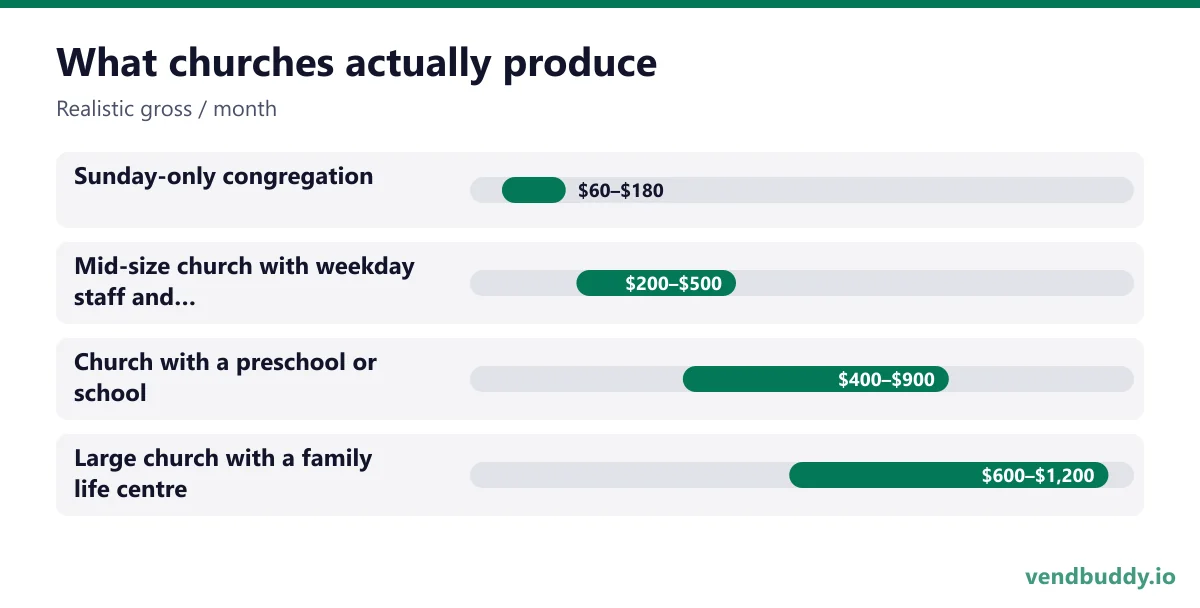
Attendance is not traffic. A church with a preschool and a gym beats a church four times its size that opens for three hours on a Sunday. Walk the parking lot on a Wednesday.
The pitch: commission to a named ministry
This is the part that makes the category work, and it is not a trick. A church committee evaluating a vending machine is weighing a small amount of money against a slightly commercial feel in a building that is not meant to feel commercial. A generic commission cheque into the operating account does not move that scale much. A commission designated to a specific ministry does, because it changes what the machine is for.
“Here is how I would set it up. I own the machine, I stock it, I service it, and the church pays nothing. Twenty percent of what it takes goes to the church — but I would rather it went somewhere specific than into the general fund. Youth budget, missions, the scholarship fund, whatever you want it designated to. That way when somebody asks why there is a machine in the hall, the answer is that it pays for the mission trip.”
What that does: it hands the administrator a sentence to say in the committee meeting, which is the actual product you are selling at this stage. Committees do not approve proposals, they approve proposals somebody in the room is willing to argue for, and “it pays for the mission trip” is an argument. It also pre-empts the objection about the building feeling commercial, without you having to raise it.
Fifteen to twenty percent is the right band here. It is above what a repair shop or a hotel gets and below institutional rates, and the extra points buy you a durable relationship in a venue where nobody is going to re-bid you next year. Commission rates by venue type puts that in context.
A church is a committee sale, which means the person you talk to has to repeat your pitch in a room you are not in. The Location Playbook is the whole conversation written down — the opener annotated line by line, twelve objections answered, and a plain-English placement agreement short enough that a board of trustees will actually read it before voting.
See what is inside →The four objections, and the real one
“We would rather the youth group run it as a fundraiser.”
The most common and the most sincere. Do not argue with it. Point out what the fundraiser version actually involves — somebody buying the product, hauling it, filling the machine, counting the money, and fixing it when a coil hangs — and that in practice that becomes one volunteer parent driving to a warehouse club twice a month until they quietly stop. Then offer the same money to the same ministry with none of that. If they still want to run it themselves, wish them well; a meaningful number of those come back in a year.
“It feels too commercial.”
Legitimate, and answerable with placement and product. Not in the sanctuary wing. In the fellowship hall, the gym lobby, the preschool corridor or the staff area — rooms that are already functional rather than devotional. A plain unwrapped machine with no external branding also matters more here than almost anywhere else.
“We put out coffee and donuts free on Sunday.”
Fine, and irrelevant, because Sunday morning is not what you are selling to. You are selling to Tuesday afternoon at the preschool and Thursday night at the gym. Say that.
“We do not want candy where the children are.”
Common where a preschool or school shares the building, and the right response is to have already proposed a better-for-you planogram before it comes up. Arrive with the healthier mix as your default and this objection never gets raised. The healthy vending guide covers what actually sells in that format rather than what looks good on a proposal.
Equipment, placement and payment
Where: the family life centre or gym lobby is usually the strongest single placement, followed by the fellowship hall and the preschool corridor. If the church has a weekday school, the staff break room is a second machine rather than a competing one.
What: a drink cooler plus a snack unit if the traffic supports both, or a single combo. Plain finish. Churches care about how the machine looks in a way that is closer to a salon than to a warehouse, so bring photographs of the actual unit rather than a catalogue image.
Payment: tap-to-pay, and it matters more here than the average operator expects. Cash has largely disappeared from churches — giving moved to apps years ago and most people arrive with a phone and nothing else. A coin-operated machine in a church hall will underperform badly for reasons that have nothing to do with the location.
Service: every two to three weeks at most churches, and time it around the building’s actual schedule rather than yours. Wednesday morning is usually ideal: the staff is in, nothing is running, and the facilities manager has time to talk to you. Avoid Sunday entirely.
Why these accounts last
Churches do not re-bid vendors. Nobody is running a procurement review, no regional manager is going to swap you out for a national operator, and the building is not going to be sold to a REIT. A church that has a good experience with a machine keeps it, frequently for years, and the facilities manager who let you in will still be there in five years more often than a hotel GM or a property manager will.
They also connect. Church administrators in a town know each other, denominational associations meet, and a facilities manager who likes his vendor is a genuinely willing reference. If you have landed one, ask — this is a category where asking for an introduction is a normal thing to do rather than an imposition.
They cluster geographically too, along with the schools, daycares and community buildings that make up the same civic layer of a town. The city guides for Nashville and Charlotte both show how dense that layer gets in a Southern metro, where the family-life-centre model is most common.
Put it on one page
A short written agreement matters here despite the informality, and for an unusual reason: church staff and committees turn over, and the person who agreed to this may be gone before the machine needs replacing. One page covering the term, the designated commission and where it goes, the service interval, insurance, and a thirty-day out either way is enough. Keep it short — a ten-page contract in front of a volunteer board is how a straightforward yes turns into “let us have someone look at this.” Vending machine contracts 101 covers what belongs on it.
Attendance is not traffic, and you cannot tell from the road which churches run a preschool, a gym and five nights of programming. VendBuddy scores real properties in your ZIP by category, size and captivity and gives you the decision-maker title for each, so you qualify before you drive. Free to start, no card.
Frequently Asked Questions
How do you get vending machines into churches?
Find the church business administrator or facilities manager rather than the pastor, and expect the decision to go to a board, trustee or finance committee before it is final. The more important filter comes first: only pitch churches with real weekday activity. A congregation that uses its building for three hours on a Sunday is not a vending location no matter how large it is, while a church running a preschool, a gym, recovery meetings and a weekday staff is a genuine account.
If you are not sure where to start, most people pull a free list of the businesses near them in the before they do anything else. Five contact reveals are free and there is no card, so it costs you a search and about ten minutes.
Do vending machines make money in churches?
Only in the ones that operate all week. A church with a family life centre, a weekday preschool or school, sports leagues and evening recovery groups realistically grosses three hundred to twelve hundred dollars a month. A Sunday-only congregation grosses under two hundred and is not worth the service stop. The building is the same size in both cases, which is why headcount on a Sunday is a misleading number to plan against.
Who approves a vending machine at a church?
It depends on how the church is governed, which is worth asking about directly. Larger congregations have a business administrator or executive pastor who can decide, sometimes with a finance committee ratifying it. Smaller ones run through a board of trustees, elders, deacons or a church council that may meet monthly, which makes a four-to-twelve-week timeline normal rather than a bad sign. The facilities or building manager is nearly always involved in where the machine physically goes.
What is the best way to pitch a church on vending?
Offer the commission as a designated contribution to a named ministry rather than as general revenue. Funding the youth group, the missions budget or the scholarship fund converts the machine from a commercial intrusion into something with a purpose the committee can explain to the congregation, and it answers the mission-alignment objection before anyone raises it. It is also frequently the difference between a proposal that sits on an agenda and one that gets voted through.
What should go in a church vending machine?
Cold drinks first, and a snack mix weighted toward better-for-you options rather than a candy wall. Many churches will ask for healthier selections outright, particularly where children are in the building on weekdays, and arriving with that already proposed saves an awkward conversation. Fit a tap-to-pay reader, because almost nobody carries cash to church any more and a coin-operated machine in this venue will sit mostly unused.
Will a church want to run the vending machine itself?
Often, and it is usually framed as a youth group fundraiser. That is a reasonable instinct and it is also a chore that quietly becomes one volunteer parent driving to a warehouse club twice a month. The response that works is not to argue but to point out that a commission paid to the youth fund produces money for the same ministry with none of the buying, hauling, restocking or repairs, and to offer a ninety-day trial so the comparison is real rather than theoretical.
Related reading: how to find vending machine locations, colleges and universities, senior living communities, salons and barbershops, K–12 school vending contracts, and untapped locations beyond apartments.
What is selling, which buildings say yes, and the numbers before you buy a machine. Free, confirm from your inbox, unsubscribe in one click. Refer one friend and get 25 VendBuddy credits.
Want the free 38-page Ultimate Vending Guide too? Get the guide
Every operator we talk to wants fewer cold calls. The ones who get there have a Google Business Profile and a simple site a manager can check before replying. AI builders make that an evening job now. Wix is the mature site builder; Base44 also builds working tools like a quote form. Start with the AI website walkthrough or Wix vs Base44.
General information, not legal, tax or financial advice. Rules change, so check the official source. Revenue and income figures are examples, not promises. See our terms.