- Getting vending machines into salons and barbershops is easy to pitch and easy to overestimate. No gatekeeper, low commission, small numbers.
- Barbershops beat salons badly. Walk-ins create a queue; appointments do not. A Saturday wait is the entire business case.
- Do not propose a full-size machine. A counter cooler, a compact drink unit, or a toy machine in a kids-cuts shop. Size the equipment to the room.
- The real objection is aesthetic, not financial. Bring photographs of your actual equipment or you lose on that point before the numbers.
- $150–$450 a month in a busy shop. Fill-in stops on a dense corridor, serviced every two to three weeks. Never an anchor account.
Salons and barbershops are the easiest cold walk-in in vending and one of the easiest places to talk yourself into a bad placement. The owner is right there, there is no receptionist screening you, no corporate approval, and the conversation takes four minutes. That accessibility is real and it is worth something. The revenue is smaller than the accessibility suggests.
Part of our complete guide: how to find vending machine locations.
Placed correctly, in the right kind of shop, on a corridor you were already driving, these are fine little accounts that almost never cause trouble. Placed wrong — a full-size combo in a quiet appointment-based salon — they are a machine you will eventually pull at your own cost. Here is how to tell the difference before you buy anything.
Barbershops and salons are not the same venue
They get grouped together on every location list and they behave completely differently, for one reason: the appointment book.
A barbershop runs substantially on walk-ins. That creates a waiting area with actual people in it, a queue that reaches forty or fifty minutes on a Friday afternoon and Saturday morning, and a customer who has committed to sitting there. Some of the busiest neighbourhood shops turn over eighty to a hundred and twenty cuts on a Saturday. That is a captive audience with time on its hands, which is the entire thing vending sells to.
A salon runs on scheduled appointments. The client arrives at 2:15 and is in a chair at 2:20. There is a waiting area but it is frequently empty, and at anything above mid-market the shop is already handing out complimentary water, coffee or a glass of wine as part of what the client is paying for. A paid machine in that room is not an amenity, it is a downgrade, and the owner will say so.
The practical rule: if the shop takes walk-ins and has a wait, it is a candidate. If it runs on appointments and offers a free drink, it is not. Colour-and-cut salons, chain cut shops with a queue app, and traditional barbershops are all on the yes side. High-end salons and single-operator studio suites are on the no side, and that is fine — there are plenty of the first kind.
Who decides, and the booth-rent wrinkle
The owner, and the owner is on the floor. That is the good news, and it makes this the most straightforward decision-maker situation on any venue list. Walk in mid-morning on a Tuesday or Wednesday, when nobody is waiting, ask who owns the shop, and you will usually be talking to them inside a minute.
The wrinkle is booth rental. Most barbershops and a large share of salons are structured as booth rent: the owner leases chairs to independent stylists or barbers who run their own books. The owner still controls the lease and the common area, so he can still say yes — but the people who work there are effectively small business owners, and a machine that annoys them will get complained about. Two minutes spent saying hello to the barbers, and offering them free product, is worth more here than it is anywhere else. In a booth-rent shop the chair holders are your real constituency.
Chains change the answer. Great Clips, Sport Clips, Supercuts and the franchise cut shops are individually owned franchises, which means the franchisee decides — usually someone with three to eight locations who is not on site. That is a phone call rather than a walk-in, and it is worth making, because one yes covers six shops. The decision-maker map has the equivalent structure for other multi-site categories.
Picture the machines paying you while you sleep
That’s the real promise of vending — income that doesn’t cost you your time, and a life on your own terms. VendBuddy turns this guide into a step-by-step plan so you actually build it instead of just reading about it. Start free today.
Start building free →The numbers, without the optimism
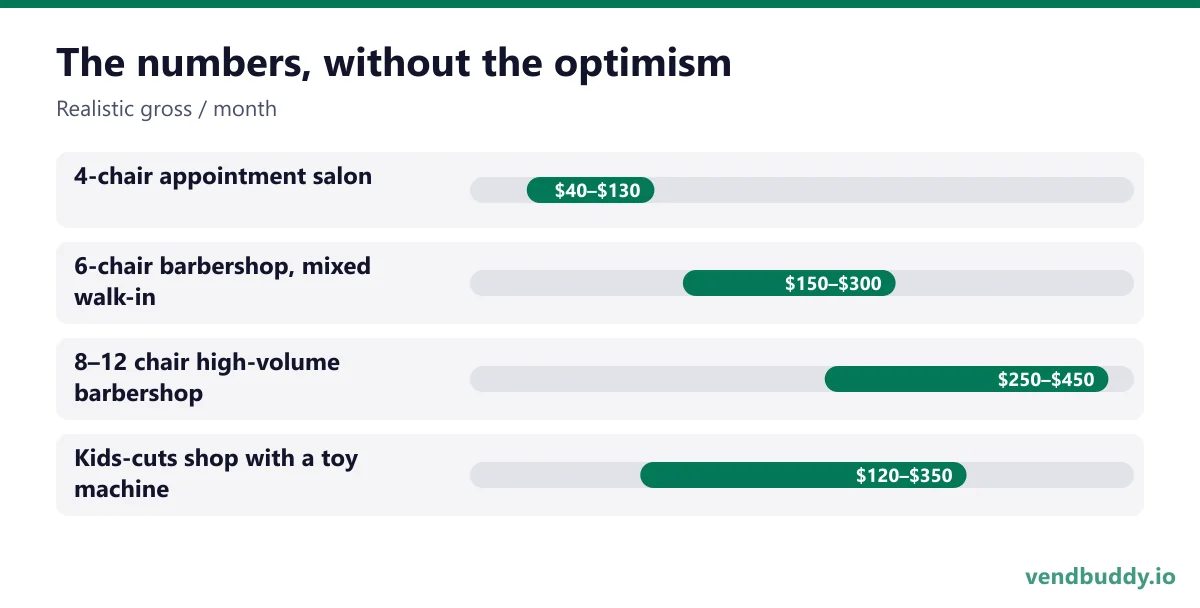
| Shop | What drives it | Realistic gross / month |
|---|---|---|
| 4-chair appointment salon | No wait, complimentary drinks | $40–$130 |
| 6-chair barbershop, mixed walk-in | Short waits weekdays, real queue Saturday | $150–$300 |
| 8–12 chair high-volume barbershop | 40–60 minute waits Friday and Saturday | $250–$450 |
| Kids-cuts shop with a toy machine | Parent settling a restless child | $120–$350 |
Nothing in that table pays for a weekly stop. That is the honest headline and it is not a reason to skip the category — it is a reason to be clear about what the category is for. A salon or barbershop belongs on your route because it sits on a strip you already service, between a laundromat and an auto repair shop, and it takes eight minutes including the drive. Serviced every two to three weeks, at zero commission, with a small machine you bought used, a $250-a-month shop is a genuinely decent little asset.
Where the money hides in this category is route density. Neighbourhood commercial strips concentrate exactly the businesses that make good fill-in stops: barbershops, nail salons, laundromats, tyre shops, small repair garages, corner gyms. One corridor can carry six or eight of them. That is a service loop worth eighteen hundred a month that never requires a single hard conversation, and it is a completely different proposition from one salon thirty minutes away. The wider version of this argument is in untapped vending locations beyond apartments.
Size the equipment to the room
The single most common mistake here is proposing a machine that does not fit the room, physically or visually. A shop is a designed space that the owner spent money on. A full-size snack and drink combo in a twelve-hundred-square-foot barbershop is enormous, and putting one against the mirror wall is not going to happen.
- Counter cooler. A small glass-front unit that sits on or beside the reception counter. Drinks only, eight to twelve facings. Fits almost every shop, looks retail rather than institutional, and is the default proposal.
- Compact drink machine. A narrow six-to-eight-selection unit for shops with a real waiting area and a spare wall. Bigger revenue, needs about two and a half feet of wall and a nearby outlet.
- Bulk candy head. A single or triple-head candy or gumball stand near the till. Almost no revenue and almost no cost, and it works in shops where nothing else fits. Real detail in the bulk vending guide.
- Claw or toy machine. In shops that cut a lot of children this genuinely outperforms drinks, because the buyer is a parent trying to stop a six-year-old squirming through a haircut and the price point is impulse. Claw machine placement economics covers what these actually earn.
Whatever you propose, bring photographs of the exact unit. Not a catalogue render, not a stock image — a phone photo of the machine you would install, in a room, plugged in and stocked. The aesthetic objection is the real one in this category and a photograph answers it in two seconds where a paragraph will not.
If the shop takes walk-ins and has a wait, it is a vending location. If it runs on appointments and hands out free drinks, it is not. Same chair count, opposite answer.
The walk-in, word for word
Short, because the owner is holding clippers and there is a client in the chair.
“Sorry to interrupt — are you the owner? I run a small vending route on this strip. I am not talking about one of those big machines, it would look terrible in here. I mean a small drink cooler about this size” — hold your hands apart — “that sits by the counter. Here is a photo of exactly what it looks like. You do not pay for it, I stock it, and your barbers drink out of it free. Your Saturday queue is why I stopped in. Want me to leave a photo and come back Tuesday?”
Four moves in that: interrupt honestly, kill the size objection before he raises it, show the photo, and name the specific reason you stopped at this shop rather than the next one. Then leave. A shop owner mid-cut cannot make a decision, and pressing for one in front of a client is how you become the vending guy nobody wants back.
Come back Tuesday morning, when the shop is empty and the owner is on his phone. That is the conversation where the yes happens. The general structure of this approach is in the cold pitch script that works.
The walk-in above is one of a set. The Location Playbook has the salon and barbershop variant written out in full alongside the office, gym, apartment and warehouse versions, twelve objections answered including the how-will-it-look one, and a plain-English placement agreement short enough that a shop owner will actually read it.
See what is inside →The three objections
“It will look bad in here.”
The real one. Answer with the photo, not with words. If the shop is genuinely high-design and nothing you own fits it, say so and leave — a machine that the owner resents looking at every day comes out in four months and you paid to move it twice.
“We give clients a bottle of water already.”
Usually a real no for the client-facing side, and sometimes a yes for the staff side. Ask who buys that water and who carries it in from the car. Some owners will happily let you stock the fridge they are currently filling themselves, at cost or on a small monthly, in exchange for a paid machine the clients can use for anything else.
“There is no room.”
Frequently true and frequently answerable by going smaller. Counter cooler, or a bulk head, or nothing. Do not try to argue a room bigger than it is.
What to offer instead of commission
At these volumes a percentage is not worth either party’s attention. Fifteen percent of a $220 machine is thirty-three dollars, and handing a shop owner thirty-three dollars a month creates an expectation, a conversation and a payment you both have to track.
Offer product instead. Free drinks for the owner and the chair holders, restocked every visit, is the deal that closes this category and it costs you roughly ten dollars of product a month. In a booth-rent shop it also buys you the goodwill of the barbers, who are the people who will either tell customers the machine is there or quietly resent it. If you want to see how this venue compares against the rest of the map, commission rates by venue type has the full table.
Still put it on paper. One page, thirty-day out both ways, who services it and how often. Shops change hands and the paper is what survives it.
Where these shops sit
Neighbourhood retail strips, strip-mall anchors, and the commercial spines of dense residential areas — the same geography that holds the laundromats and small repair shops. In big markets these corridors are easy to identify and easy to work in one loop; the city guides for Atlanta and Charlotte both map where the dense small-business strips run.
Work the strip, not the shop. That is the whole strategy for this venue type, and it is the difference between a category that is a waste of a Saturday and one that quietly adds fifteen hundred a month to a route you were already driving.
One barbershop is not a route. Six small stops on the same corridor is. VendBuddy scores real businesses in your ZIP by category, size and foot traffic and gives you the best contact on file for each, so you can build a dense loop instead of chasing single small shops across town. Free to start, no card.
Frequently Asked Questions
How do you get vending machines into salons and barbershops?
Walk in on a weekday morning and ask for the owner, because in this category the owner is usually cutting hair ten feet from the door and there is no gatekeeper at all. Pitch a small cooler rather than a full-size machine, and lead with how it looks rather than with what it earns, because the objection you are about to hear is about the room and not about the money. Barbershops with a Saturday wait convert far more often than appointment-based salons do.
How much does a vending machine make in a barbershop?
A busy eight-chair barbershop with real walk-in wait times realistically grosses two hundred to four hundred and fifty dollars a month from a small drink cooler, and a quiet four-chair shop does under a hundred and fifty. Appointment-based salons sit at the bottom of that range or below it, because a client who arrives at a scheduled time and is seated immediately never becomes a captive buyer. This is a fill-in venue and it should be planned as one.
What kind of vending machine fits in a hair salon?
A small glass-front counter cooler, a compact six-to-eight-selection drink unit, or a bulk candy head near the till. A full-size snack and drink combo does not fit either the floor plan or the aesthetic of most shops, and proposing one is the fastest way to a no. In shops that cut a lot of children, a small claw or toy machine frequently outperforms drinks entirely, because the buyer is a parent settling a restless six-year-old rather than a waiting adult.
Do salons and barbershops pay vending commission?
Usually nothing, and asking for a commission conversation in a shop grossing three hundred dollars a month wastes the goodwill you need. What owners want instead is product: free drinks for the barbers, or a stocked cooler the shop can offer clients without buying and hauling it themselves. That trade costs you far less than a percentage and it is the thing the owner was quietly already paying for out of pocket.
Why do salons say no to vending machines?
Because of how it looks, and that objection is legitimate rather than an excuse. A shop that has spent money on its interior is not putting a scuffed beige snack machine against the feature wall, and an operator who arrives without photographs of the actual equipment loses on that point before the numbers are discussed. The second common reason is that higher-end salons already offer complimentary drinks, which makes a paid machine a downgrade to the client experience.
Are barbershops better than salons for vending machines?
Substantially, and the reason is the appointment book. Barbershops run heavily on walk-ins, which produces a real waiting area with a real queue on Fridays and Saturdays, and a person waiting forty minutes buys something. Salons run on scheduled appointments, seat clients quickly, and frequently hand out complimentary beverages as part of a premium service. Same square footage, same chair count, completely different capture rate.
Related reading: how to find vending machine locations, laundromats, auto repair shops, churches, untapped locations beyond apartments, and the cold pitch script that works.
What is selling, which buildings say yes, and the numbers before you buy a machine. Free, confirm from your inbox, unsubscribe in one click. Refer one friend and get 25 VendBuddy credits.
Want the free 38-page Ultimate Vending Guide too? Get the guide
Walk-ins and cold emails find locations. A small site with your own machine photos and a request-a-machine form lets the next one find you. Around machine three to five, an AI builder drafts it in an evening. Wix is the mature site builder; Base44 also builds working tools like a quote form. Start with the AI website walkthrough or Wix vs Base44.
General information, not legal, tax or financial advice. Rules change, so check the official source. Revenue and income figures are examples, not promises. See our terms.