- Getting vending machines into laundromats runs into one wall: the owner is already in the coin-op business and often owns the machine himself.
- Real numbers are modest. $200–$700 a month gross in a busy store. Treat laundromats as fill-in stops between anchor accounts, never as the anchor.
- Commission is higher here than anywhere. 20–25% is normal because floor space in a laundromat is revenue. Some owners want flat rent instead.
- Coins still matter. This is one of the last venues where customers arrive holding quarters. Take both.
- Unattended overnight stores need steel, not glass. Bolt it down and ask what the cameras actually record.
Laundromats show up on every list of vending locations, usually with an optimistic dollar figure attached, and operators who chase them without knowing the economics end up with a stop that grosses three hundred dollars and pays a quarter of it back in commission. That does not mean they are bad. It means they are a specific kind of account with a specific job on a route.
- Why laundromat vending machines work: the numbers
- Who owns it, and why that is harder than it sounds
- The objection you will hear at almost every store
- The real numbers
- Commission, and why it is higher here
- Equipment, payment and security
- How to make laundromats work on a route
- What to look out for before you sign a laundromat
Part of our complete guide: how to find vending machine locations.
The dwell time is genuinely excellent — nobody else in vending gets a captive audience for ninety minutes — and the good ones are steady, unglamorous and easy to service. Here is who to talk to, what the numbers actually are, and the two openings that get you past the objection every laundromat owner has ready.
Updated October 2026 with industry and VendBuddy data, a pre-signing checklist and an illustrative corridor plan.
Why laundromat vending machines work: the numbers
The market is bigger than most operators think, and spread thin. The Coin Laundry Association counts about 29,500 coin laundries in the United States, generating nearly $5 billion in gross revenue a year (CLA, Industry Overview). Almost every one of them has the same thing a vending machine wants: people who cannot leave for an hour because their clothes are in a machine.
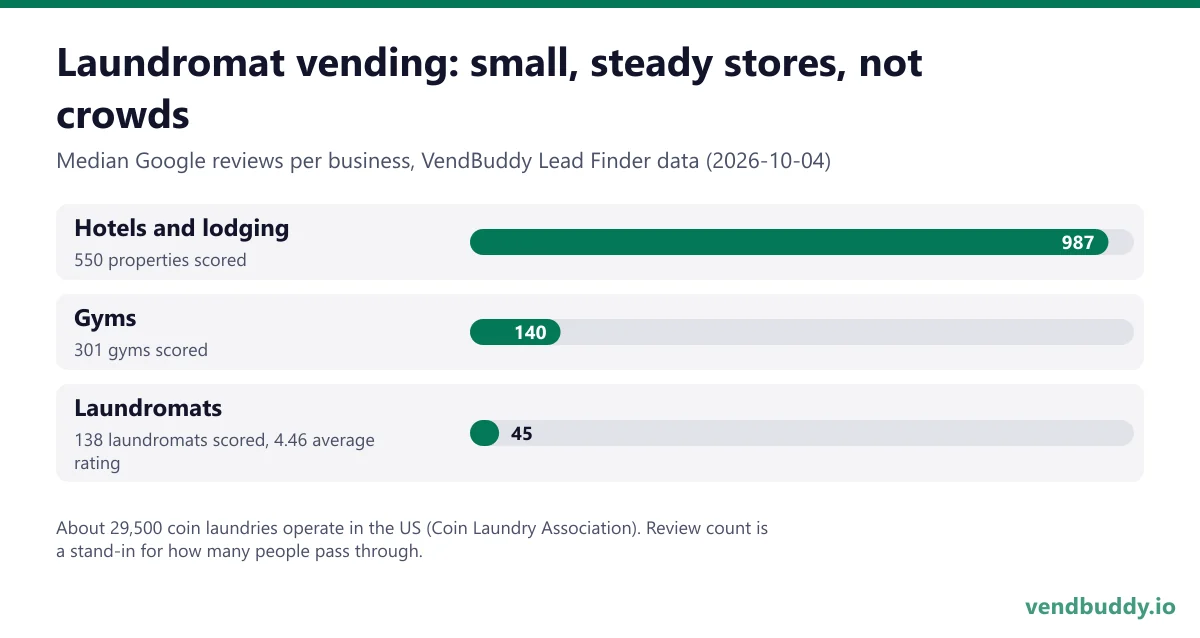
VendBuddy’s Lead Finder has scored 138 laundromats across 119 regions. They carry a median of 45 Google reviews and a 4.46 average rating (VendBuddy’s own Lead Finder data, 2026-10-04). Compare that 45 with a median of 987 for hotels and 140 for gyms, and you can see the honest story in one number: laundromats are small, steady stores, not crowds. Lead Finder starts the wait-time family that laundromats belong to at a base score of 62 out of 100. Few operators are chasing them: 8 operators ran 14 laundromat searches across 8 ZIP codes since April 10, 2026.
Who owns it, and why that is harder than it sounds
The person behind the counter cannot say yes. Attendants in laundromats are hourly, frequently part-time, and have no purchasing authority whatsoever — and they will take your card, mean to pass it on, and not. That is not a brush-off, it is what happens to a business card in an apron pocket.
The owner is usually one of three profiles:
- The one-to-three-store operator. The most common and the best target. Often a second-generation owner or someone who bought the store as an income asset. On site at odd hours, hands-on, and makes decisions in one conversation. Get his mobile number from the attendant.
- The absentee investor. Bought the store as cash flow, has an attendant and a service company, and visits weekly. Reachable by the number on the door. Slower but not difficult, and this owner has the least emotional attachment to running his own vending — which makes him the easiest yes on the list.
- The multi-store chain. Six to thirty stores with a manager layer and sometimes a distributor relationship. Worth pursuing precisely because it is one conversation for a lot of placements, but expect a real commission negotiation and a longer timeline.
The practical move is to walk in around ten on a weekday, when the store is at its emptiest, ask the attendant when the owner is normally in, and come back at that hour. That two-visit rhythm closes far more laundromats than leaving a card ever has.
Picture the machines paying you while you sleep
That’s the real promise of vending — income that doesn’t cost you your time, and a life on your own terms. VendBuddy turns this guide into a step-by-step plan so you actually build it instead of just reading about it. Start free today.
Start building free →The objection you will hear at almost every store
“I have my own machine.”
And he does, usually. A laundromat owner is already running a coin-operated business. He already buys single-load detergent and dryer sheets by the case for his own soap vending, he already has a relationship with a warehouse club, and a snack machine he owns keeps a hundred percent of the gross instead of the seventy-five percent he would keep under your commission. On paper he is right, and pretending otherwise makes you sound like you have not thought about it.
There are exactly two openings, and both of them are honest:
The first is the drive. Owning a machine means somebody buys the product, hauls it, fills the machine, pulls the money, counts it, tracks what sold out, and fixes the coil when it hangs. For an owner with three stores and a day job, that is a Sunday afternoon every fortnight. Ask him what he pays himself for that Sunday. A quarter of the gross to never think about it again is a trade a lot of owners take once someone puts it in those terms.
The second is the equipment. His machine is probably an old coin-only unit he bought used, and it is losing every sale from a customer who has no quarters left after loading two washers. A modern unit with a tap reader captures those. If you can get a straight answer on what his machine grosses, you can frequently show him that yours would gross forty percent more before commission — and forty percent more times seventy-five percent is a bigger number than what he has now.
“Honestly, if you are happy filling it yourself, keep it — you are keeping the whole margin and I would too. The only reason I would swap is that mine takes tap, and half your customers have spent their last quarter on the dryer by the time they get hungry. If you want, tell me what yours does in a month and I will tell you straight whether it is worth changing. If it is not, I will say so.”
That offer to disqualify yourself is the whole play, and it is the same move that works everywhere else in this business. The seven objections and what each one really means breaks down why it lands.
The real numbers
Laundromats are a capture-rate venue, not a headcount venue. The arithmetic is: daily customers, times the share who buy, times the ticket.
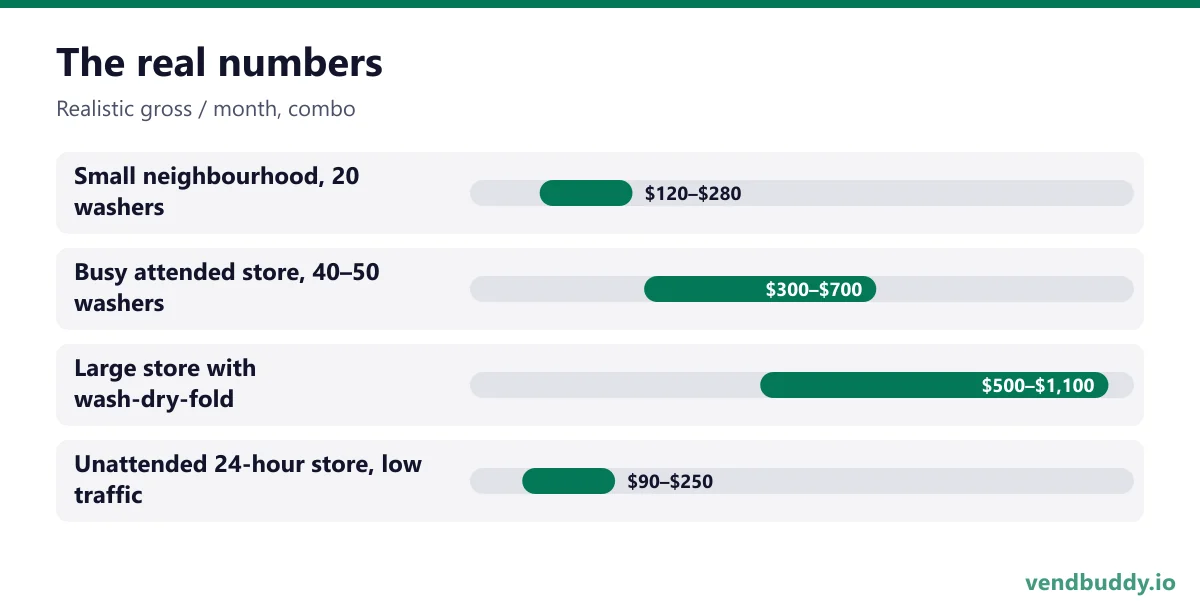
| Store | Customers / day | Realistic gross / month, combo |
|---|---|---|
| Small neighbourhood, 20 washers | 40–70 | $120–$280 |
| Busy attended store, 40–50 washers | 100–150 | $300–$700 |
| Large store with wash-dry-fold | 150–250 | $500–$1,100 |
| Unattended 24-hour store, low traffic | 30–60 | $90–$250 |
Capture rate runs roughly eight to fifteen percent of customers, and the ticket is low — a drink or a bag of chips, not a meal. That combination is why the site’s profit-by-location-type breakdown puts laundromats near the bottom of the venue table, and the honest framing is that a laundromat is a fill-in stop. It belongs on a route because it is four minutes from an anchor account you were already driving to, not because it justifies its own trip.
Two levers move the number more than anything else. Wash-dry-fold volume means staff on site all day, who buy every day, on top of the walk-in customers. And a store with no convenience store within two blocks converts at the top of that band rather than the bottom. Check both before you commit equipment.
A laundromat is a fill-in stop, not an anchor. It earns a place on your route because it is four minutes from a real account, not because it pays for its own trip.
Commission, and why it is higher here
Twenty to twenty-five percent of gross is the normal band, and thirty exists. That is well above what a hotel or a repair shop expects, and the reason is structural rather than greedy: in a laundromat, every square foot of floor is occupied by a machine that earns money. The eight square feet you want are eight square feet that could hold a washer, and the owner does that maths instinctively.
Some owners prefer flat rent — fifty to a hundred a month regardless of sales. Take that deal only in a store you have already measured, because flat rent on an unmeasured store is how you end up paying seventy dollars a month for the privilege of a two-hundred-dollar account. If you have no data, offer percentage for the first ninety days and revisit. A ninety-day trial framing is easy for an owner to accept and it protects you from exactly this. The 90-day location test is the structure for it.
One thing worth offering instead of a higher percentage: take over the soap vending. Single-load detergent, dryer sheets and stain sticks are a category the owner is currently buying, hauling and stocking himself for thin money. Offering to run that alongside your snack and drink units removes a chore and makes you harder to replace. Owners who let you do this rarely go back.
The two-visit approach above, the disqualify-yourself line, and the version of it for an owner who already has a machine — all written out. The Location Playbook is the walk-in conversation annotated line by line, twelve objections answered, and a plain-English placement agreement you can leave on the counter.
See what is inside →Equipment, payment and security
Steel, not glass. A glass-front cooler in an attended store closing at nine is fine. In an unattended twenty-four-hour store it is an advertisement. Bottle-drop drink machines and closed-front spiral snack units are the right call in anything unattended, and both should be bolted or strapped to the floor. Ask the owner directly whether the cameras record or just display, because a lot of laundromat camera systems are deterrents rather than evidence.
Take coins. This is the venue where that sentence is still true. Customers arrive with rolls of quarters for the washers, and coin volume in a laundromat can be a third or more of transactions — far higher than an office, a hotel or a gym. Run a working validator and coin mech alongside a tap reader rather than going cashless-only.
Match the store’s payment system. A growing share of laundromats run on a proprietary card or app for the washers. You will not be able to accept that card, but you should know it is there, because in those stores customers may genuinely have no coins and no cash, and your tap reader becomes the entire payment path.
Product: cold drinks first, salty snacks second, and single-serve laundry products if you have taken over that category. Skip anything that melts — the dryer wall of a laundromat runs hot enough to ruin chocolate for half the year. The general logic is in best products to stock.
How to make laundromats work on a route
Cluster them. Laundromats sit in dense, lower-income and rental-heavy commercial strips, which means a single corridor can hold four or five stores inside two miles, along with the salons, barbershops and repair shops that fill the same strip. Working one corridor and picking up six small stops on it is a completely different economic proposition from driving thirty minutes to one laundromat. The city guides for Chicago and Philadelphia both show where those corridors sit in a big market.
Service every two to three weeks rather than weekly. At three hundred a month, a weekly stop costs more in drive time and labour than the margin it collects, and the whole point of a fill-in account is that it is cheap to keep.
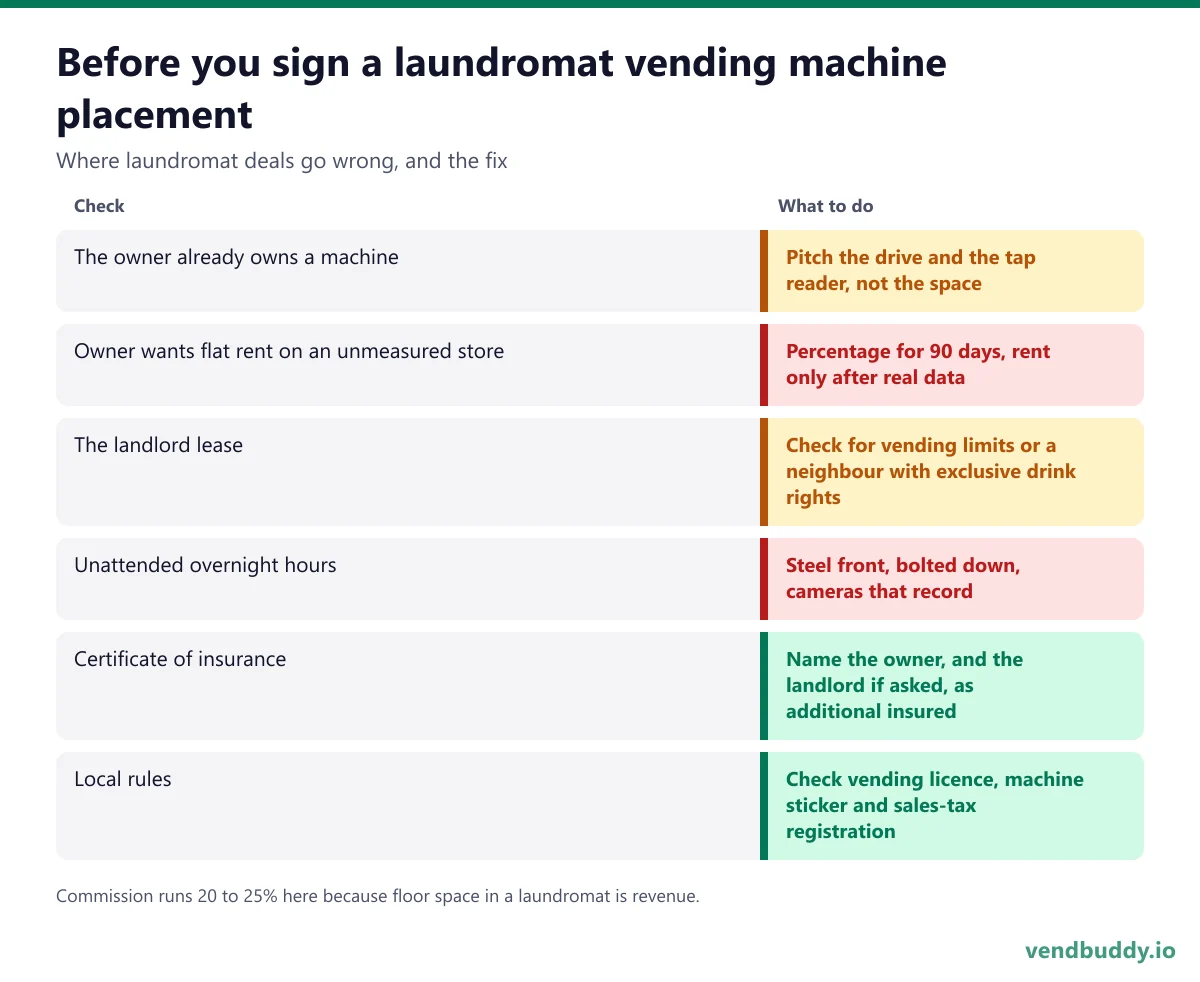
What to look out for before you sign a laundromat
- The owner’s own machine. Ask what is already in the store and who owns it. If the owner owns a working machine, your pitch is the drive and the tap reader, not the space.
- Flat rent on an unmeasured store. Offer a percentage for the first 90 days and talk about rent only once you have real sales data.
- The landlord’s lease. Laundromats usually rent their unit. Some leases restrict additional vending or give a neighbouring tenant exclusive rights to sell drinks. Ask the owner to check before you deliver a machine.
- Unattended hours. A store that is unattended overnight needs steel-front equipment bolted down, and a straight answer on whether the cameras record.
- Certificate of insurance. Expect a request for a COI naming the owner, and sometimes the landlord, as additional insured. It is cheap to carry and it removes a reason to say no.
- Local rules. Packaged snacks and drinks rarely need a food permit, but some cities require a vending licence or a per-machine sticker, and your state may require sales-tax registration. Check before the install.
Laundromats pay when they cluster. Open Lead Finder filtered to laundromats to map the stores in one corridor with the best contact on file, then add the salons, repair shops and other small stops on the same strip. If you are looking at it from the owner’s side, laundromat vending and ATM add-on income covers what an owner keeps when they run their own machines.
Illustrative example: a five-stop laundromat corridor
This example is illustrative. It shows how the numbers in this guide fit together; it is not a real operator’s result.
An operator already services an office building on a commercial strip. Within two miles are four laundromats. One is a busy attended store with 45 washers and no convenience store nearby; the owner’s own coin-only machine is half empty. The operator offers a tap-and-coin combo at 20 percent for 90 days, plus taking over the single-load detergent shelf. Using the busy-store row above ($300 to $700 a month gross), the operator plans on the low end, services every two weeks on the same day as the office, and only pitches the next laundromat on the strip once the first one has 90 days of data.
When to walk away
Skip the store if the owner wants thirty percent on a low-traffic site, if the machine has to go where you cannot see it from the counter in an unattended store, or if there is a convenience store sharing the parking lot. And skip it entirely if it is your first placement. A first machine needs to teach you what a working location feels like, and a laundromat at $250 a month will teach you the wrong lesson about this business.
Laundromats only pay when they cluster with the other small stops around them. VendBuddy scores real businesses in your ZIP by category, traffic and captivity and gives you the best contact on file for each, so you can build one dense corridor instead of chasing single sites across town. Free to start, no card.
Frequently Asked Questions
How do you get vending machines into laundromats?
Find the owner rather than the attendant, because the attendant has no authority and will take a card that never gets passed on. Most laundromats are owned by someone with one to three stores who is on site at unpredictable hours, so the reliable route is the phone number on the door or the LLC on the business licence taped near the change machine. Walk in mid-morning on a weekday when the store is quiet, ask the attendant when the owner is usually in, and come back then.
How much does a vending machine make in a laundromat?
Two hundred to seven hundred dollars a month gross for a snack and drink pairing in a busy store, and under two hundred in a quiet one. The mechanism is capture rate rather than headcount: a well-run forty-machine store sees roughly a hundred to a hundred and fifty customers a day, they are captive for sixty to ninety minutes, and somewhere between eight and fifteen percent of them buy something. That is a genuinely modest number and laundromats should be planned as fill-in stops rather than anchor accounts.
What commission do laundromats expect on vending machines?
More than most venues, because floor space in a laundromat is literally revenue. Twenty to twenty-five percent of gross is common and thirty is not unheard of, and some owners would rather charge flat rent of fifty to a hundred dollars a month than take a percentage. Know that going in and price the placement accordingly, because a two-hundred-dollar-a-month machine paying twenty-five percent plus product cost is not a stop worth driving to.
Worth noting on product spend: the route spend is the smaller half of this. The bigger line is the rent or mortgage payment, which normally earns nothing. Per its card page the Bilt card earns up to 1.25X on that payment with no transaction fee, and the no-fee Blue tier earns 1X on everything else. Referral link, and it only works if you clear the balance every month. Affiliate link, so we may earn a commission at no extra cost to you.
What is the biggest obstacle to placing vending machines in laundromats?
That the owner already owns a machine. Laundromat owners are in the coin-operated business by definition, they already buy soap and single-load detergent for their own vending, and a snack machine they own keeps a hundred percent of the margin instead of seventy-five. The two openings that work are stores where the owner is tired of driving to the warehouse club, and stores where the existing machine is broken, empty or twenty years old.
Do laundromat vending machines still need to take coins?
Yes, and this is one of the last venues where that is genuinely true. Laundromat customers arrive with quarters because the washers need them, so coin volume here is far higher than in an office or a hotel. The exception is stores running a card system such as a proprietary laundry card, where you want your reader to accept the same taps the customers are already using. Take both wherever you can and do not assume cashless-only is safe here the way it is elsewhere.
Are laundromats safe locations for vending machines?
It depends entirely on whether the store is attended and what its overnight hours are. An attended store closing at nine is a normal, low-risk placement. An unattended twenty-four-hour store is a different proposition: glass-front coolers are a target, the machine will be alone with the public at three in the morning, and you should assume a break-in attempt eventually. Place steel-front equipment, bolt it to the floor, and ask the owner what the camera coverage actually records before you commit.
How many laundromats are there in the US?
The Coin Laundry Association counts about 29,500 coin laundries in the United States, generating nearly five billion dollars in gross revenue a year. Most are small, owner-run stores, which is why the owner is usually the one person who can say yes.
Can a laundromat lease stop you from placing a vending machine?
Sometimes. Most laundromats rent their unit, and a lease can restrict extra vending or give another tenant in the same plaza the exclusive right to sell drinks or snacks. Ask the owner to check the lease before you deliver anything, and get the answer in writing if the plaza has a convenience store.
Related reading: how to find vending machine locations, hair salons and barbershops, auto repair shops, hotels and motels, profit by location type, and laundromat ownership vs vending unit economics if you are weighing buying one instead.
What is selling, which buildings say yes, and the numbers before you buy a machine. Free, confirm from your inbox, unsubscribe in one click. Refer one friend and get 25 VendBuddy credits.
Want the free 38-page Ultimate Vending Guide too? Get the guide
Walk-ins and cold emails find locations. A small site with your own machine photos and a request-a-machine form lets the next one find you. Around machine three to five, an AI builder drafts it in an evening. Wix is the mature site builder; Base44 also builds working tools like a quote form. Start with the AI website walkthrough or Wix vs Base44.
General information, not legal, tax or financial advice. Rules change, so check the official source. Revenue and income figures are examples, not promises. See our terms.