- Almost none of these are decisions. They are the sentences a busy person says to make a stranger leave, and they are all answerable.
- One pattern for all seven: acknowledge what they said, empathize with what is underneath it, bridge to a smaller ask.
- “We already have a machine” is an opening, not a wall. Most buildings with a machine are quietly unhappy with it.
- “We tried one before” is the best news on this list. It means the space works and somebody else already proved it.
- Only one thing on this page is a real no — an in-term exclusive, a lease prohibition, or genuinely no power. Everything else softens.
You will hear roughly seven sentences for the rest of your career in this business. Learn what each one actually means and the job stops feeling like rejection and starts feeling like routing.
Part of our complete guide: how to find vending machine locations.
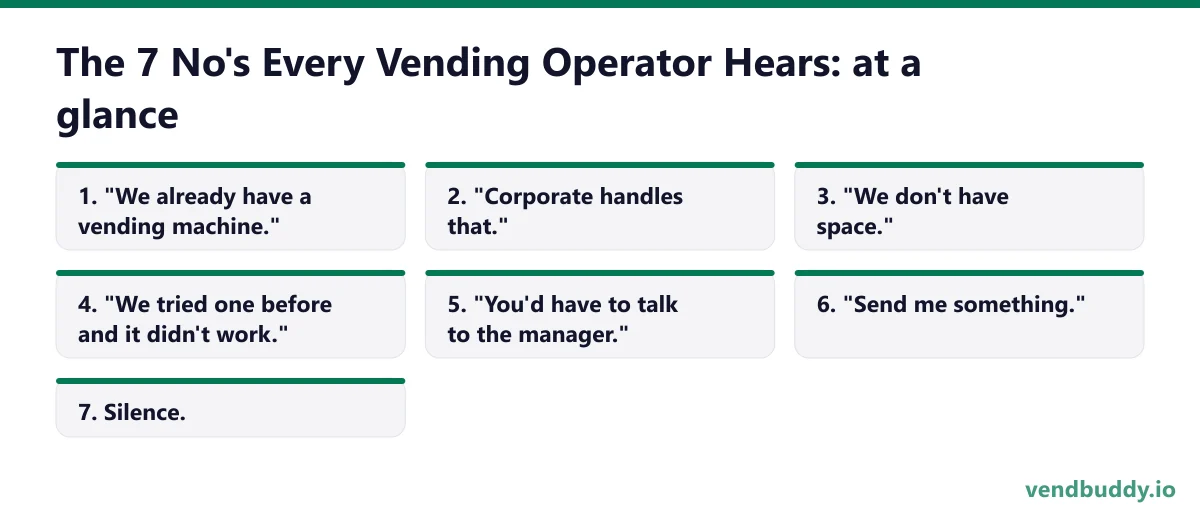
The pattern below is the same for all seven, and it is the house pattern for every difficult conversation on this site: acknowledge → empathize → bridge. Acknowledge what they said so they know you heard it. Empathize with the reason underneath it. Bridge to something smaller and easier to agree to than what you originally wanted.
It works because these are reflexes, not verdicts. A reflex survives an argument — arguing confirms you are the thing to be got rid of. It rarely survives being agreed with and then narrowed.
1. “We already have a vending machine.”
What it usually means: we have a machine, we are not thrilled about it, and I do not want a project. Almost nobody says this because their current vendor is excellent. The single most common complaint in vending is a machine that sits empty for a fortnight or eats a dollar and nobody comes.
Acknowledge: “Makes sense — most buildings this size do.”
Empathize: “Honestly, half the ones I walk past are half empty and nobody wants to be the person who has to chase the vendor about it.”
Bridge: “I am not asking you to swap anything. Can I leave you what our restock schedule and response time look like, and check back in about six weeks? If yours is running fine, tear it up.”
Then actually check back. Incumbents create their own openings on a schedule — the full version of this play, including how to time it and what to do when the incumbent has a contract, is taking over an existing vendor contract.
2. “Corporate handles that.”
What it usually means: one of two things, and they need different responses. Either there is a genuine national agreement you will not displace this year, or — more often — the person in front of you does not want to be the one who decides and corporate is a convenient wall.
Acknowledge: “Understood, a lot of the multi-site places I deal with are set up that way.”
Empathize: “And I imagine it is not your favourite part of the week chasing head office about a snack machine.”
Bridge: “Two quick things and I will get out of your way. Who is the right person at corporate — and would you mind if I said this site sent me?”
That second question is the whole play. A named person plus a named building converts a cold corporate approach into a warm referral, and giving you the name costs the site manager nothing at all. Which title to ask for at each type of business is mapped in the decision-maker map.
Picture the machines paying you while you sleep
That’s the real promise of vending — income that doesn’t cost you your time, and a life on your own terms. VendBuddy turns this guide into a step-by-step plan so you actually build it instead of just reading about it. Start free today.
Start building free →3. “We don’t have space.”
What it usually means: I am picturing a full-size machine in the middle of my lobby. Almost nobody has done the measurement; they have done a mental image. Occasionally it is literally true, and you will know within one question.
Acknowledge: “Fair — the big ones are a monster, they are about six feet by three.”
Empathize: “And the last thing you need is furniture you have to work around.”
Bridge: “Would you mind if I put my head in the break room for thirty seconds? If there is not a wall that works, I will tell you so myself and stop bothering you.”
Volunteering to disqualify yourself is disarming, and it gets you into the room. Once you are in the room, you are having a different conversation. Countertop and slim-profile units solve a lot of buildings that a full-size machine cannot, and knowing which one fits which building is half of the location scoring checklist.
4. “We tried one before and it didn’t work.”
What it usually means: the best news on this list. The space has already been tested, somebody thought it was worth doing, and the failure was almost always service rather than demand. Machines fail in buildings for a short list of reasons: it sat empty, it broke and nobody came, the prices were wrong for the crowd, or the mix was wrong for the crowd.
Acknowledge: “What happened with it?” — and then say nothing for as long as it takes. This is the one objection where the whole answer is the prize.
Empathize: “That is the usual story, and it is the reason half the buildings I walk into say no straight away.”
Bridge: answer the specific failure with a specific commitment. If it sat empty: “Mine is restocked on a fixed day and I will tell you which day, in writing.” If it broke: “Here is my number, and here is what happens when it goes down.” A building that has been burned wants reliability, not enthusiasm, and general promises to be better are exactly what the last vendor made.
"We tried one before" is the best news you will hear all week. It means the space works and somebody else already paid to prove it. What failed was service, not demand.
5. “You’d have to talk to the manager.”
What it usually means: you are talking to a gatekeeper who has been told not to make decisions, and who is now deciding whether you are worth passing along. That is the actual test in front of you, and it is a test you pass by being easy rather than by being persistent.
Acknowledge: “Of course — I would rather not waste your manager’s time either.”
Empathize: “You probably get people through that door all day.”
Bridge: “Two things that would help. What is the name, and when are they usually around? I will come back then rather than making you take a message.”
Asking when to come back rather than asking to be put through reframes you from an interruption into an appointment. Take the name, write it down in front of them, come back at the named time and use the name. That sequence gets past most gatekeepers, and the ones it does not are covered in the cold pitch script that works.
6. “Send me something.”
What it usually means: a polite exit — but a polite exit that hands you permission to follow up, which is worth considerably more than the conversation you just lost. The mistake is treating it as a brush-off and sending a generic brochure, or worse, sending nothing.
Acknowledge: “Happy to.”
Empathize: “It is easier to look at than to talk about in a hallway.”
Bridge: “What is the best address for it? I will keep it to one page — what I would put in, what it costs you, which is nothing — and I will check back the week of the fourteenth.”
Three rules for what you send. One page. It names their building specifically. It ends with a date you will check back, and then you check back on that date. That is touch two of a five-touch cadence, and most placements close somewhere in touches three to five — the written versions are in cold email scripts for vending contracts, and the full cadence is week four of the 30-day sales practice plan.
7. Silence.
What it usually means: the hardest one, because there is nothing to acknowledge. You emailed, you called, you left the one-pager, and nothing came back. Operators read this as rejection. It is almost always the least personal outcome on the list — you are a low-priority item in somebody’s inbox on a week where something on fire outranked you.
Acknowledge and empathize in the same line: “I know a snack machine is nowhere near the top of your list this month.”
Bridge — and this is the highest-converting message in the whole cadence: “Should I check back after the new year, or should I leave this one alone?”
It works because it is the only message that costs them something to ignore. It is easy to not reply to a request. It is oddly hard to not reply to somebody politely offering to stop contacting you. A meaningful share of the yeses in this business arrive in response to that exact sentence, several weeks after the operator had privately written the building off.
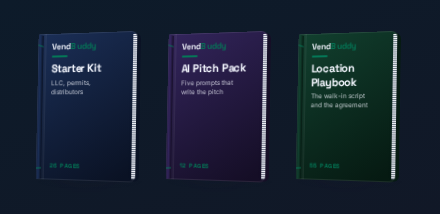
Everything above is free to read and free to do. The operator packs are the same material in fill-in-the-blank form — the 50-state distributor list, the LLC and permit checklist in unblocking order, the word-for-word walk-in script, and the placement agreement you hand a property manager. One-time purchase from $27, nothing renews.
See what is inside →The one that actually is a no
Not everything on this page softens, and pretending otherwise wastes your week. A real no has a fact behind it rather than a feeling:
- An in-term exclusive contract with another vendor. Ask when it ends, put the date in your calendar, and go.
- A lease or landlord prohibition on the tenant placing equipment. The tenant genuinely cannot say yes; the building owner might, which is a different conversation with a different person.
- No power and no floor in a building with no alternative space. Occasionally this is simply true.
In all three, the correct move is identical: thank them, ask the one question that gives you a future date, and leave in a way that makes you welcome back. Operators who argue with facts get remembered as the pushy one, which closes the building permanently rather than for a year. If a conversation has genuinely gone sideways, the recovery playbook for when a property manager says no is how you get it back.
The scoreboard that keeps you sane
Count objections rather than rejections. Fifteen no’s in a week is not fifteen failures; it is fifteen buildings correctly categorized, most of them into a follow-up list rather than a bin. The arithmetic of how many buildings you have to work through per placement is in the 100-door math, and the reason it is worth the effort at all — that every dollar in this business is downstream of one of these conversations — is sales skills are the cheapest vending machine you will ever buy. If you are still at the very start of this, the ground floor is how to start a vending machine business.
Half the objections on this page are a building telling you it was never a fit. VendBuddy scores real businesses in your ZIP by headcount, category and captivity and gives you the best contact on file for each, so more of your conversations start in buildings that have a reason to say yes. Free to start, no card.
Frequently Asked Questions
What do you say when a business already has a vending machine?
Acknowledge it rather than arguing with it, then find out whether the incumbent is actually serving them. Most buildings that already have a machine are not happy with it, because the most common complaint in vending is a machine that sits empty or takes money without vending. The move is not to ask them to switch today. It is to leave a service standard and a way to reach you, and to check back in six to eight weeks, because incumbents create their own openings on a schedule.
How do you get past corporate handles that in vending sales?
Treat it as a routing problem rather than a rejection. Sometimes it is literally true and there is a national contract you cannot displace this year. Often it means the person in front of you does not want to be the one who decides. Either way the next question is the same one: who at corporate, and would they mind if you mentioned this site specifically. A named person and a named building turns a cold corporate approach into a warm one, and the site manager giving you that name costs them nothing.
What does it mean when a location says send me something?
Usually it is a polite exit, but it is a polite exit that hands you permission to follow up, which is worth more than the conversation you just lost. The mistake is sending a generic brochure. Send one page that names their building, says what you would install and what it costs them, and ends with a specific date you will check back. Then actually check back on that date. A large share of placements that close come from touches three to five, and this objection is how touch two gets its opening.
How do you handle we tried a vending machine before?
This is the most promising objection you will hear, because it means the space works and somebody else proved it. What failed was almost always service rather than demand, and the failure is specific: it sat empty, or it broke and nobody came. Ask what went wrong, listen to the whole answer, then answer that specific failure with a specific commitment rather than a general promise to be better. A building that has been burned is looking for reliability, not enthusiasm.
When is a no from a vending location actually a no?
When there is a physical or contractual constraint you cannot change: an in-term exclusive contract with another vendor, a landlord prohibition in the lease, or a genuine lack of power and floor space in a building with no other option. Those are facts rather than reflexes, and the right response is to thank them, ask when the contract ends or when the fit-out changes, put a date in the calendar, and leave. Everything else on the list is a reflex, and reflexes soften.
Most first agreements are two pages, not twenty. The contracts walkthrough lays out the clauses that actually matter for the contract, including the termination language operators forget about until they need it.
Related reading: the 30-day sales practice plan, why sales skill is the cheapest machine you can buy, the cold pitch script that works, the essentials to land vending locations, the decision-maker map, and taking over an existing vendor contract.
What is selling, which buildings say yes, and the numbers before you buy a machine. Free, confirm from your inbox, unsubscribe in one click. Refer one friend and get 25 VendBuddy credits.
Walk-ins and cold emails find locations. A small site with your own machine photos and a request-a-machine form lets the next one find you. Around machine three to five, an AI builder drafts it in an evening. Wix is the mature site builder; Base44 also builds working tools like a quote form. Start with the AI website walkthrough or Wix vs Base44.
General information, not legal, tax or financial advice. Rules change, so check the official source. Revenue and income figures are examples, not promises. See our terms.