- 100 doors → 20 conversations → 5 live opportunities → 1 to 2 signed. Plan at one placement per 65 doors.
- Fifteen doors a week is ten machines a year. 650 doors, 46 working weeks, 14.1 a week. Round up.
- That is about six and a half hours a week — three and a half walking, ninety minutes in conversations, an hour scouting, twenty minutes on follow-ups.
- Track four numbers: doors, real conversations, follow-ups due, and agreements signed year to date.
- A hundred dry doors happens to one operator in five. It is what a one-in-65 process does. It means nothing about you.
Here is a message we get some version of every week: I think I have run out of locations in my area. Three machines, nine months at this, and there is nothing left around me. So we asked the obvious follow-up — how many buildings have you actually walked into? He counted. Thirty-one. Across nine months. In a county with something like four hundred qualifying buildings inside a fifteen-minute drive.
He had not run out of locations. He had run out of doors, which is a completely different problem with a completely different fix. And nobody spots it in themselves, because thirty-one rejections feel like a market verdict. They are not. They are a sample size too small to tell you anything at all.
This is the arithmetic that turns I hope I get a yes into a schedule. It is the least glamorous thing on this site and the single most valuable, because prospecting is the only part of vending where effort converts to outcome at a rate you can actually calculate.
The ladder: 100 doors, 20 conversations, 5 opportunities, 1 to 2 signed
Every placement you will ever get comes down the same four steps. Round numbers, because the shape is the useful part:
| Stage | Out of 100 doors | Conversion from the stage above |
|---|---|---|
| Doors | 100 | — |
| Real conversations | ~20 | 1 in 5 |
| Live opportunities | ~5 | 1 in 4 |
| Signed agreements | 1 to 2 | 1 to 2 in 5 |
Those stages need hard definitions or the tracking is worthless.
- A door is one attempt at one building. You walked in, or you called, or you sent a written pitch to a named person. It counts whether or not anyone spoke to you. The receptionist saying he is not in, try Tuesday is a door. It cost you eight minutes and it goes on the tally.
- A real conversation is a two-way exchange with someone who either decides or knows who decides. They asked you a question. You learned a name. Roughly one door in five gets here; the other four die at the front desk, at the voicemail, or at we are all set, thanks.
- A live opportunity is a conversation that produced a next step with a date attached. They took the one-pager and told you when they would look at it, they asked what the commission would be, they walked you to the break room. About one in four real conversations gets this far.
- A signed agreement is paper. One or two out of every five live opportunities. Not three, not four. Most of the ones that die at this stage die from silence rather than from a no.
Multiply it through and a hundred doors buys you between one and two placements. Call it one placement per 65 doors as a planning midpoint.
Why the brutal number is good news
Because it converts a mood into a rate. If a placement costs 65 doors, a single no costs you one sixty-fifth of a placement. A no moves you 1.5% closer to a yes and it cost you eight minutes. Read as a verdict on your pitch, that is crushing. Read as a denominator, it is Tuesday.
Operators who know their denominator do not quit at door thirty-one. They cannot. The arithmetic tells them plainly that door thirty-one is inside the normal range of nothing happening yet.
Picture the machines paying you while you sleep
That’s the real promise of vending — income that doesn’t cost you your time, and a life on your own terms. VendBuddy turns this guide into a step-by-step plan so you actually build it instead of just reading about it. Start free today.
Start building free →Working it backward from ten machines
Say the goal is ten placed machines twelve months from now. The whole plan fits on one line.
| Step | Arithmetic |
|---|---|
| Placements wanted | 10 |
| Doors per placement | 65 |
| Doors needed | 650 |
| Working weeks (six off for holidays, illness, and the weeks life wins) | 46 |
| Doors per week | 650 ÷ 46 = 14.1 |
| The number | 15 doors a week |
Fifteen doors a week is ten machines a year. Not fifteen a day. Not a personality transplant. Fifteen buildings, once a week, for a year.
Now price it in hours, because that is the part people skip and then resent. Budget fifteen minutes per door including the drive between them, so fifteen doors is about three and a half hours. Your three real conversations that week run twenty to forty minutes each, call it ninety minutes. Add one hour to scout and rank next week’s buildings and thirty minutes to work your follow-up list. Roughly six and a half hours a week of business development, on top of servicing whatever machines you already have.
Six and a half hours is real, and it is completely doable around a job — which is exactly why this business works for people who have one. What kills the plan is never the total. It is that nothing in your week forces those hours to happen. So put them somewhere specific.
A week you can actually run
Three patterns, depending on the shape of your day job. Pick the one that matches your life rather than the one that sounds most disciplined.
Two more slots, non-negotiable and short:
- Sunday, thirty minutes — the scouting block. Add ten new buildings to your ranked list and write down which fifteen you are hitting this week and in what order. Doing this on Sunday is what stops Tuesday morning becoming a decision instead of an execution.
- Wednesday, twenty minutes — the follow-up block. Every touch due this week, sent. It is the cheapest twenty minutes in the entire business.
One rule holds the whole thing together: when the week collapses, protect the door blocks and let the route slip. That feels wrong and it is correct. A machine you service on Sunday instead of Friday costs you two days of sales in one unit. A door block you skip costs you the building you would have signed, and only one of those compounds.
The four numbers
You will be tempted to build a spreadsheet with fourteen columns. Do not. During the build phase there are four numbers, they fit on an index card, and anything else you track is a way of feeling busy on a week you did not knock.
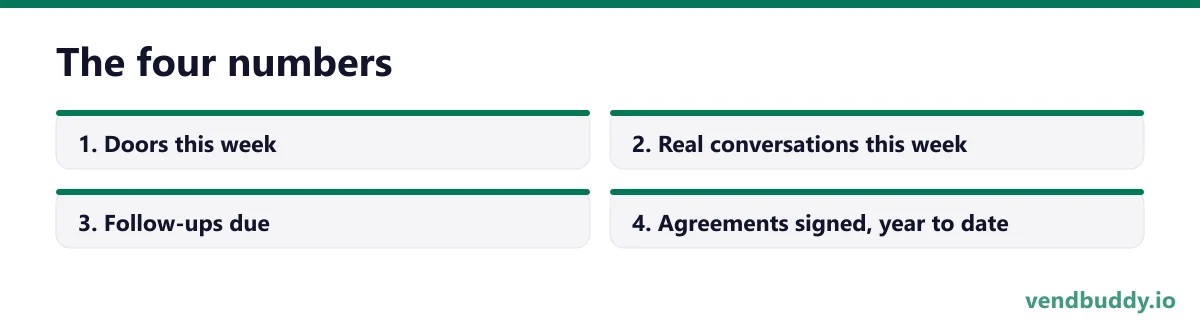
- Doors this week. A tally. Target fifteen. The only number fully inside your control, which makes it the only one worth judging yourself on.
- Real conversations this week. Target three. If doors are hitting and conversations are not, your problem is upstream of your pitch.
- Follow-ups due. A dated list of names. Not follow-ups made — follow-ups due. This is the only forward-looking number of the four and the one operators skip, which is why so many are working a pipeline that leaks out the back.
- Agreements signed, year to date. One cumulative number. It moves ten or twelve times a year. Looking at it weekly is how people talk themselves into quitting; look at it monthly.
Here is what eight real-feeling weeks look like on that card.
| Week | Doors | Conversations | Follow-ups due | Signed YTD |
|---|---|---|---|---|
| 1 | 15 | 4 | 2 | 0 |
| 2 | 16 | 2 | 5 | 0 |
| 3 | 9 | 1 | 6 | 0 |
| 4 | 15 | 3 | 7 | 1 |
| 5 | 14 | 4 | 6 | 1 |
| 6 | 0 | 0 | 9 | 1 |
| 7 | 17 | 5 | 8 | 1 |
| 8 | 15 | 2 | 6 | 3 |
Look at week three, a bad week, and week six, a zero. Neither one broke anything, because the other six weeks held the average near fourteen. Now look at week eight: two signings landed in the same week and neither came from a door knocked in week eight. They came from follow-ups placed in weeks two and four.
That is the actual mechanism. Most placements are won on the third touch, after the operator who out-talked you gave up. The follow-up column is where the yeses live, and it costs twenty minutes on a Wednesday.
Slumps are a feature of the arithmetic
If your true rate is one placement per 65 doors, the odds of knocking a hundred straight doors with nothing to show for it are about one in five. That is simply what a one-in-65 process does across a hundred trials. Run this long enough and you will personally live through a hundred-door dry stretch, probably more than once, and it will mean nothing about your ability.
The temptation in the middle of it is to change everything: new script, new pitch, new property type, new attitude. Changing everything at once guarantees you learn nothing, because now you cannot tell which change did what. The rule during a slump is the same one that governs machine slots: change one thing, keep the volume constant, give it thirty doors. Slowing the doors down while you tinker throws away the only variable you control in order to fiddle with the one you can barely measure.
Streaks work the same way in reverse. Two yeses in one week does not mean you cracked it — it means one-in-65 clustered, the way random things cluster. The operators who blow up after a hot streak are the ones who took it as permission to stop knocking.
Volume or standards? Read the leak
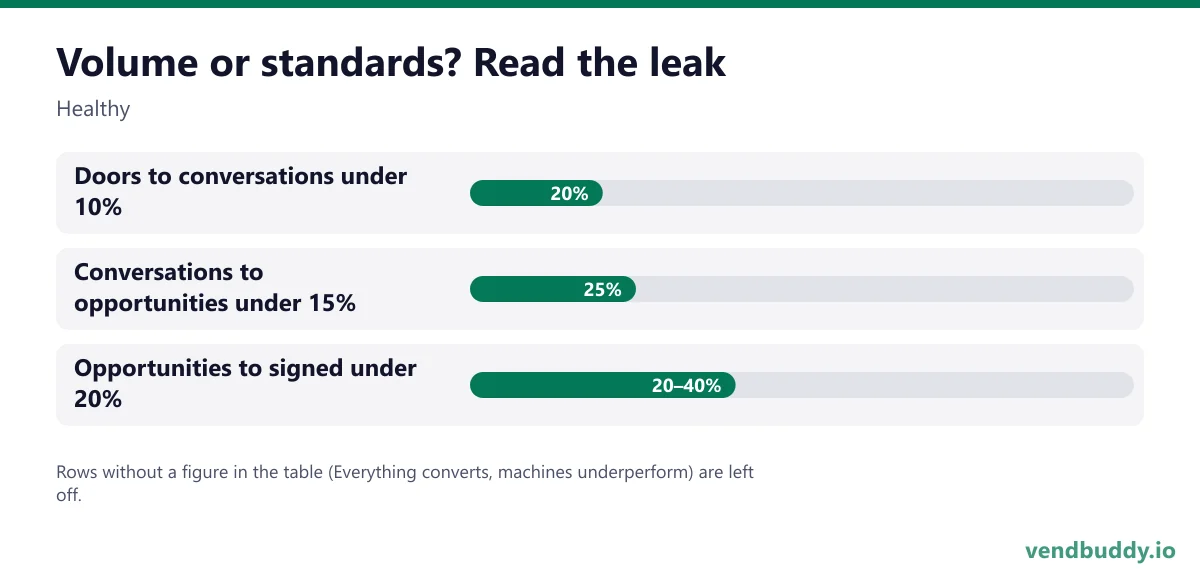
At some point the honest question becomes: do I need more doors, or better doors? The funnel tells you, if you check where it is leaking rather than guessing.
| Symptom | Healthy | What it actually means |
|---|---|---|
| Doors to conversations under 10% | 20% | A list problem or a timing problem, and no amount of script polishing moves it. Usually you are walking into buildings whose decision-maker sits in another state, or arriving at 2 p.m. on a Friday. Filter for 50-plus people on site, no convenient food alternative, and a decision-maker who works in the building. That third filter alone will roughly double this number. |
| Conversations to opportunities under 15% | 25% | This one is you. You are pitching when you should be asking. A conversation converts when they do most of the talking, which happens when you lead with questions about their break room, their complaints and their last vendor rather than with your machine’s features. |
| Opportunities to signed under 20% | 20–40% | You are not closing because you are not putting a date and a piece of paper on the table. The ask is small and specific: I will email you a one-page agreement today, and if it looks right I can have a machine in by the fourteenth. A live opportunity with no date attached is a polite no that has not finished happening yet. |
| Everything converts, machines underperform | — | The expensive one. You fixed a volume problem by lowering the bar — you said yes to a forty-person office with a gas station across the road because you were tired of hearing no. Raise standards: run the parking-lot count before you spend a door on a building, not after they say yes. |
The governing rule: raise volume when your pipeline is empty, raise standards when your route average is falling, and never both in the same month, because then you will not know which one worked.
The constraint nobody warns you about
Ten placements in twelve months is only good news if they sit inside a radius you can service. A yes forty minutes outside your cluster costs you that drive twice, on every visit, for as long as you own the machine — which is the whole argument in route density versus machine count.
So the discipline is slightly harder than get fifteen doors. It is: get fifteen doors inside the radius. When the radius genuinely runs dry — and at four hundred qualifying buildings in an average county it almost never does before machine twenty — you open one new cluster deliberately and fill in around it.
Fifteen doors is three and a half hours of walking. Building the list of fifteen buildings worth walking into is the other hour, every single week, and it is the one people quietly stop doing. VendBuddy scores real businesses in your ZIP by headcount, category and captivity and hands you the best contact on file for each, so Sunday night is ten minutes instead of an evening with a notebook. Free to start, no card.
What ten machines actually pays
Worth saying plainly before you spend a year on this, because the number is good but it is not the number on YouTube.
- Ten machines at average placements, serviced by you: roughly $2,000 to $3,500 a month net, at twelve to eighteen hours a week.
- Ten machines at strong placements: roughly $4,000 to $7,000 a month net, at about the same hours.
What separates those two lines is which buildings you knocked on, and that is decided by the list you build on Sunday. Everyone in this business who is still here in year three did roughly the same volume of doors. The ones doing well did them at better buildings — which is what counting buyers instead of bodies is for, and what the ten-minute drive-by filters for before you spend a morning.
Fifteen a week. Inside the radius. Write down four numbers. That is the roadmap to ten machines, and there is not a second one.
What happens after ten is a different set of questions — storage, a vehicle, a hire, and eventually whether you buy routes instead of knocking for them. Those are staged out, with a gate at each level, in the 0 to 100+ machine roadmap. And the argument for why the fifteen holds through month four, when the door blocks quietly become optional, is outwork the average.
Frequently Asked Questions
How many locations do you need to contact to start a vending machine business?
Plan on roughly 65 buildings contacted per placement you land. The working ladder is 100 doors producing about 20 real conversations, those producing about 5 live opportunities, and those producing 1 to 2 signed agreements. So one machine placed costs somewhere between 50 and 100 attempts, and ten placements in a year costs about 650. That number sounds brutal for ninety seconds and then it becomes the most useful thing you own, because it converts a mood into a rate.
How many vending locations should I contact per week?
Fifteen. Ten placements at 65 doors each is 650 doors, and 650 spread across 46 working weeks (six weeks off for holidays and the weeks life wins) is 14.1 per week. Fifteen doors a week is ten machines a year. That is about three and a half hours of walking, plus ninety minutes of real conversations, one hour of scouting and twenty minutes of follow-up: roughly six and a half hours a week of business development on top of servicing whatever you already have.
How many rejections is normal before landing a vending location?
Fifteen to twenty real conversations before a first placement is a normal first location, which is somewhere between 75 and 100 doors. If your true rate is one placement per 65 doors, the odds of knocking a hundred straight doors with nothing to show for it are roughly one in five. A dry stretch that long is a property of the arithmetic, not a verdict on your pitch, and every operator who lasts three years lives through at least one.
If you are not sure where to start, most people pull a free list of the businesses near them in the before they do anything else. Five contact reveals are free and there is no card, so it costs you a search and about ten minutes.
What should I track when prospecting vending locations?
Four numbers and nothing else during the build phase. Doors this week (target 15). Real conversations this week (target 3). Follow-ups DUE, which is a dated list of names rather than a count of follow-ups made. And agreements signed year to date, read monthly rather than weekly. Anything beyond those four is a way of feeling busy on a week you did not knock.
Do I need more locations to contact, or better ones?
Read the leak instead of guessing. Doors to conversations under 10 percent when it should be 20 is a list or timing problem, not a script problem. Conversations to opportunities under 15 percent when it should be 25 is you pitching where you should be asking. Opportunities to signed under 20 percent means you are not putting a date and a piece of paper on the table. And if everything converts but the machines underperform, you fixed a volume problem by lowering your standards. Raise volume when the pipeline is empty, raise standards when the route average falls, and never both in the same month.
How much does a vending route of ten machines actually make?
Ten machines at average placements, serviced by you, run roughly $2,000 to $3,500 a month net at twelve to eighteen hours a week. Ten machines at strong placements run roughly $4,000 to $7,000 net at about the same hours. The difference is not effort and it is not the machines. It is which buildings you knocked on, which is decided by the list you build on Sunday.
Related reading: the ten-minute drive-by, a body count is not a buyer count, how to find vending locations, how long it takes to get your first location, how to close a vending machine location, and the location scoring checklist. Not sure this business is the right shape for your life yet? The two-minute readiness quiz is a more honest starting point than another article.
What is selling, which buildings say yes, and the numbers before you buy a machine. Free, confirm from your inbox, unsubscribe in one click. Refer one friend and get 25 VendBuddy credits.
Every operator we talk to wants fewer cold calls. The ones who get there have a Google Business Profile and a simple site a manager can check before replying. AI builders make that an evening job now. Wix is the mature site builder; Base44 also builds working tools like a quote form. Start with the AI website walkthrough or Wix vs Base44.
General information, not legal, tax or financial advice. Rules change, so check the official source. Revenue and income figures are examples, not promises. See our terms.