- The average operator quits around thirty doors. At one placement per 65 building contacts, thirty is not a market verdict. It is not a sample.
- You cannot control a yes. You control the denominator. Output is rate times attempts, and attempts is the only term you set yourself.
- Variance dies at volume. At 20 contacts the spread around your average is ~180% of it. At 650 it is ~31%. Same rate, different certainty.
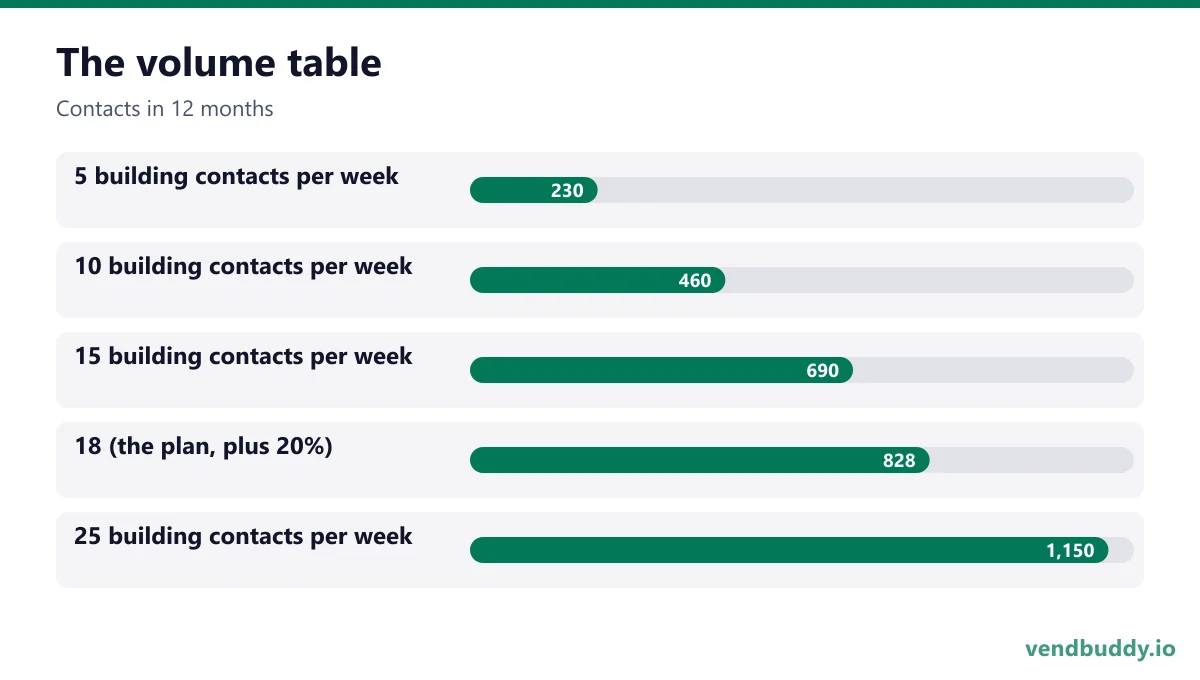
- The volume table: 10 contacts a week is ~7 placements a year, 15 is ~10.6, 25 is ~17.7. Choose a row and defend it for a year.
- Quitting is the only failure mode volume cannot fix. Every other one gets repaired by the next fifty attempts.
A message we get some version of every week: three machines, nine months in, and the area is tapped out. Asked how many buildings he had actually walked into, he counted. Thirty-one. In a county with roughly four hundred qualifying buildings inside a fifteen-minute drive.
Part of our complete guide: how to find vending machine locations.
He had not run out of locations. He had run out of doors, and those are completely different problems with completely different fixes. Nobody catches this in themselves, because thirty-one rejections feel like a market verdict. They are not a verdict. At the rates this business actually runs at, they are not even a sample.
The settling mechanism
Most people do not want to work hard, and that is not an insult — it is the default setting of an organism that evolved to conserve energy. So most people settle. They take the status quo, because the status quo has known risks and the alternative has imagined ones, and imagined risks always look bigger. They benchmark against the people physically near them rather than against what is achievable, which makes ordinary effort feel sufficient. And when the early nos arrive on schedule, they read them as information about themselves.
That third one is the only one that is a straightforward arithmetic error, and it is the one this post is about. Because the fix is not a better attitude. It is a number.
You cannot control a yes. You control the denominator.
Here is what the funnel actually does, published in full as the 100-door math: 100 buildings contacted produces about 20 real conversations, about 5 live opportunities, and 1 to 2 signed agreements. Call it one placement per 65 contacts as a planning midpoint.
Read that as output equals rate times attempts. The rate is your list quality and your pitch combined, and it improves slowly and indirectly. The attempts term is entirely yours. No property manager, no competitor, no economy and no market gets a vote on how many buildings you walked into last week.
Which means a no costs you one sixty-fifth of a placement and about eight minutes. It moved you 1.5% closer. That is the entire reframe, and it is worth more than any script.
You cannot control a single yes. You fully control the denominator. That is the whole business, and almost nobody plays it that way.
Picture the machines paying you while you sleep
That’s the real promise of vending — income that doesn’t cost you your time, and a life on your own terms. VendBuddy turns this guide into a step-by-step plan so you actually build it instead of just reading about it. Start free today.
Start building free →The volume table
Twelve months, 46 working weeks (six off for holidays, illness and the weeks life wins), one placement per 65 contacts. Pick a row.
| Building contacts per week | Contacts in 12 months | Placements at 1 per 65 | Weekly business-development time |
|---|---|---|---|
| 5 | 230 | ~3.5 | ~2 hrs |
| 10 | 460 | ~7 | ~4.5 hrs |
| 15 | 690 | ~10.6 | ~6.5 hrs |
| 18 (the plan, plus 20%) | 828 | ~12.7 | ~7.5 hrs |
| 25 | 1,150 | ~17.7 | ~10 hrs |
Two things about that table. First, the gap between the fifteen row and the ten row is three and a half machines a year, for two hours a week. Second, nothing in the table is heroic. Fifteen buildings a week is not fifteen a day and it is not a personality transplant. It is three and a half hours of walking, ninety minutes of conversations, an hour of scouting on Sunday and twenty minutes of follow-up on Wednesday.
What each of those machine counts is worth in money depends entirely on which buildings you chose — the same machine nets under $150 a month in a quiet building and $500 to $1,000 in a busy one. The dollar version of this table, with the assumptions stated, is the $100,000 route, gross versus net.
Variance dies at volume
This is the part that makes the thesis defensible rather than merely inspiring. Hold the conversion rate fixed at one placement per 65 contacts and look at what happens to certainty as attempts rise.
| Building contacts | Expected placements | Spread around that average | Chance of ending with zero |
|---|---|---|---|
| 20 (about six weeks of half-effort) | 0.3 | ~180% of the average | ~73% |
| 65 (one placement’s worth) | 1 | ~99% | ~37% |
| 100 | 1.5 | ~80% | ~21% |
| 200 | 3.1 | ~57% | ~4.5% |
| 650 (one year at fifteen a week) | 10 | ~31% | ~1 in 24,000 |
| 1,300 (two years) | 20 | ~22% | vanishingly small |
Read the first row and the fifth row next to each other, because that comparison is the entire argument. Twenty contacts produces nothing at all about three times out of four. It is a coin flip with a weighted coin, and whatever it tells you is noise. Six hundred and fifty contacts, at the exact same skill level, lands within about a third of its average and essentially never produces zero.
Nothing changed except the denominator. Same operator, same pitch, same market. That is what people are gesturing at when they say “make it impossible to lose” — and stated precisely, it is true. Stated loosely, it is a lie, so let us be precise about it.
What volume guarantees, stated honestly
Volume guarantees funnel progress at your own observed rate, and it guarantees that your results converge on that rate instead of on luck. It does not guarantee income. Nobody can promise you a dollar figure and anybody who does is selling you something.
Three specific things volume does not do, said plainly:
- It does not choose your buildings. Dollars are decided by placement quality, and the spread there is roughly twenty-fold. Volume buys you more chances at good buildings; it does not stop you from saying yes to bad ones because you were tired of hearing no.
- It does not fix a broken rate. If doors-to-conversations is running under 10% when it should be near 20%, that is a list or timing problem and more doors just makes it more expensive. The leak-reading table is in the 100-door math.
- It does not remove ordinary business risk. Machines break, anchor tenants move out, a location changes management. Volume makes those survivable, not impossible.
The governing rule for the two levers: raise volume when your pipeline is empty, raise standards when your route average is falling, and never both in the same month — because then you will not know which one worked.
Quitting is the only failure mode volume cannot fix
Go down the list of things that go wrong in this business and notice how many of them get repaired by the next fifty attempts. A weak pitch improves with reps. A bad building gets replaced. A mispriced machine gets repriced. An underperforming location gets rescued or pulled. A dry stretch ends because dry stretches are finite.
Every single one of those repairs requires you to still be contacting buildings. None of them is available to somebody who stopped. That is the asymmetry: quitting is the one failure that closes off every other fix.
Which reframes the discipline. The goal is not to be excellent. It is to be present in month four, when the novelty is gone, the first machine is fine but not exciting, and the door blocks on your calendar have quietly become optional. Everything in the 100-door system — four numbers on an index card, a fifteen-a-week target instead of a heroic one, a follow-up block that costs twenty minutes — exists to get you through that specific week.
Quitting is the only failure mode volume cannot fix. Every other one gets repaired by the next fifty attempts, and none of those repairs are available to somebody who stopped.
The don’t-quit compounding case
Year one at fifteen contacts a week is about ten placements. Year two is not another ten from a standing start — it is ten more on top of a route that is already producing, a follow-up list that is two years deep, referral conversations that only exist because you have been visible in the same buildings, and a materially better sense of which buildings are worth the walk. The rate improves because the list improves.
That is the whole case for not quitting, and it does not require you to be exceptional. It requires you to be unexceptional for longer than the people who were better at it. If you want the version of this argument aimed at ambition rather than at vending specifically, it is why the top 1% is a volume tier, not a talent tier. If you want to see where the stages lead, the map is the 0 to 100+ machine roadmap.
Fifteen buildings is three and a half hours of walking. Building the list of fifteen buildings actually worth walking into is the other hour every week, and it is the first thing people quietly stop doing. VendBuddy scores real businesses in your ZIP by headcount, category and captivity and hands you the best contact on file for each, so Sunday night is ten minutes instead of an evening with a notebook. Free to start, no card.
Frequently Asked Questions
How do you succeed in the vending machine business?
By contacting more buildings than the person who quit, and by being fussy about which buildings. Those are the only two levers that reliably move the outcome. The funnel is roughly one placement per 65 building contacts, so fifteen contacts a week across a working year is about ten placements. The average person who fails does not fail at the pitch. They stop contacting buildings somewhere in the thirties, which is far too small a sample to have tested anything, and then conclude the market is saturated.
The fastest way to test this in your own ZIP is the . Search once, see which businesses sit within a few miles, and reveal five contacts for nothing. It will not tell you who says yes, but it saves the afternoon you would spend building the list by hand.
Why do most vending operators quit?
Because a statistically normal run of nos reads as a personal verdict. If your true rate is one placement per 65 contacts, roughly one operator in five will hit a hundred straight contacts with nothing to show for it. That is simply what a one-in-65 process does across a hundred trials, and it says nothing at all about the operator. Without the denominator in front of them, most people interpret it as evidence and stop. With the denominator, it is just an unremarkable stretch inside a normal range.
How many locations should I contact per week for vending?
Fifteen is the number that turns into roughly ten machines a year, and it is about six and a half hours of business development including drive time, three real conversations, an hour of scouting and twenty minutes of follow-up. Ten a week gets you to about seven placements a year. Twenty-five gets you to about eighteen. The useful move for most people is not doubling the number, it is adding twenty percent to it and never stopping.
Can you guarantee success in vending if you do not quit?
No, and it would be irresponsible to say otherwise. What the arithmetic supports is narrower: at a stable conversion rate, the probability of producing zero placements collapses as your number of attempts rises, and the variation around your average shrinks as the square root of attempts. So volume makes your results converge on your true rate rather than on luck. It does not promise a dollar figure, because dollars depend on placement quality, and it does not remove the risk of a badly chosen location or an equipment failure.
What is the one mistake that actually ends a vending business?
Stopping. Almost every other failure mode has a fix that volume reaches eventually: a weak pitch improves with reps, a bad building gets replaced, a mispriced machine gets repriced, an underperforming location gets pulled. None of those fixes are available to somebody who is no longer contacting buildings. Quitting is the only failure mode that volume cannot repair, which is why it deserves more attention than the pitch does.
Does doing 20 percent more actually matter?
Over one week, no. Over a year it is the whole difference. Eighteen contacts a week instead of fifteen is 138 extra contacts across 46 working weeks, which is about two additional placements a year at a one-in-65 rate, from roughly ninety extra minutes a week. Then it compounds, because the following year starts from a larger base and a longer follow-up list. Twenty percent is the right size specifically because it survives a bad week, and a 300 percent push does not.
Related reading: the 100-door math (the schedule and the four numbers), the top 1% is a volume tier, the 0 to 100+ machine roadmap, the $100,000 route, why most operators fail in year one, and how long it takes to get your first location. Not sure this business fits your life yet? The two-minute readiness quiz is a more honest starting point than another article.
What is selling, which buildings say yes, and the numbers before you buy a machine. Free, confirm from your inbox, unsubscribe in one click. Refer one friend and get 25 VendBuddy credits.
Every operator we talk to wants fewer cold calls. The ones who get there have a Google Business Profile and a simple site a manager can check before replying. AI builders make that an evening job now. Wix is the mature site builder; Base44 also builds working tools like a quote form. Start with the AI website walkthrough or Wix vs Base44.
General information, not legal, tax or financial advice. Rules change, so check the official source. Revenue and income figures are examples, not promises. See our terms.