- "Six figures" is two different businesses. $100k in revenue and $100k in profit are separated by a factor of three or four, because net runs about 25–30% of gross.
- $100k GROSS is roughly 8 to 17 machines, depending on whether your fleet averages $1,000 or $500 a month each.
- $100k NET is roughly 12 to 21 machines at strong placements, or 24 to 42 at average ones.
- Timeline, via the 100-door math: fifteen building contacts a week is about ten placements a year. So gross-six-figures is a 1 to 2 year build; net-six-figures is 3 to 4 unless you buy a route.
- Three things break on the way: restock hours, the vehicle, and the first hire — in that order, and each is a decision rather than an emergency if you see it coming.
Search “6 figure vending machine business” and you will find people quoting a number without telling you which number it is. That omission is not accidental — it is the entire trick. A route grossing $100,000 and a route netting $100,000 are separated by a factor of three or four in machine count, roughly two years of building, and one entire set of operational problems. Here is both versions, with the arithmetic shown.
Part of our complete guide: how much do vending machines make.
First: revenue is not profit, and the gap is enormous
On a normally-run machine, net profit lands at 25 to 30 percent of gross revenue once you subtract product cost (roughly 40 to 50 percent of sales), the location commission, card processing, insurance, software, fuel and the repair fund. The full waterfall on a single machine is in the profit margin breakdown, and it is the number most new operators get wrong by half.
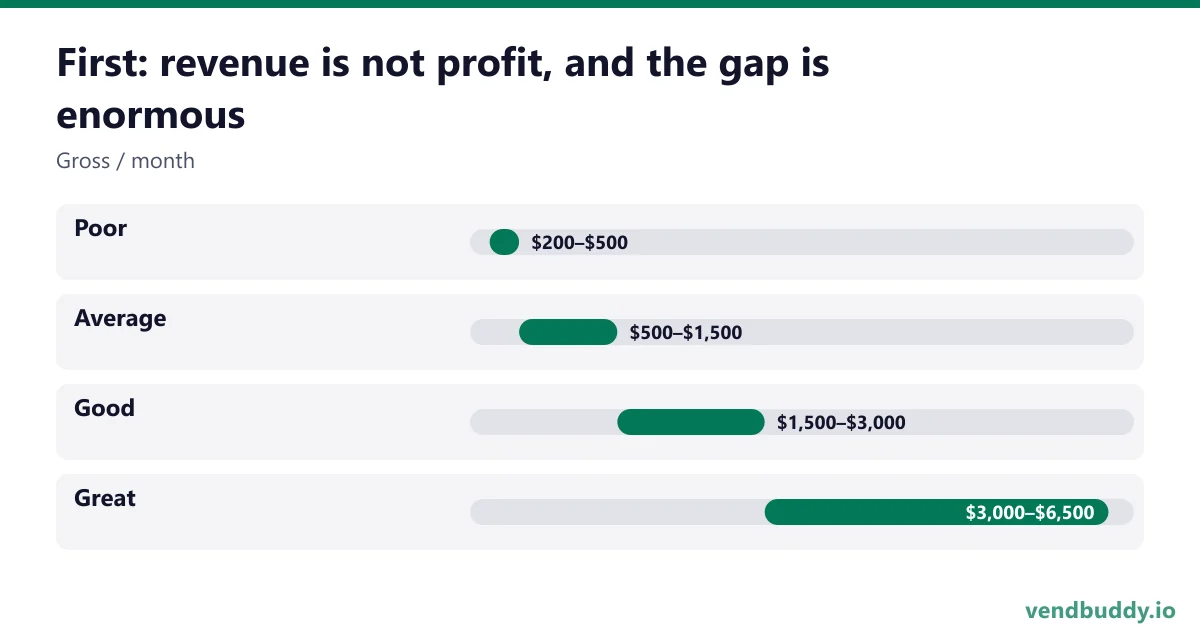
So before any machine count makes sense, here is the site’s published per-machine picture by placement tier. Every count later in this post is derived from this table:
| Placement tier | Daily visitors | Gross / month | Net / month |
|---|---|---|---|
| Poor | under 30 | $200–$500 | $50–$150 |
| Average | 50–100 | $500–$1,500 | $150–$500 |
| Good | 100–200 | $1,500–$3,000 | $500–$1,000 |
| Great | 200+ | $3,000–$6,500 | $1,000–$2,500 |
Same cabinet, same product, same operator, roughly a twenty-fold spread. That spread is why the honest answer to “how many machines” is always a range, and why the range is decided before you buy anything. The venue-by-venue detail is in how much vending machines actually make.
$100,000 in revenue: what that is in machines
$100,000 a year is $8,333 a month in gross revenue across the whole fleet. Divide by your fleet average — not by your best machine, by the average including the disappointing ones:
| Fleet average gross / machine / month | Machines needed for $100k/yr gross | What that fleet looks like |
|---|---|---|
| $500 (bottom of the average tier) | ~17 | Mostly small offices and quiet buildings. Common for a route built by saying yes to whoever said yes. |
| $800 | ~10 to 11 | A realistic blended average for a route with a few good placements carrying some weak ones. |
| $1,200 | ~7 | A curated route. Every building was qualified before a machine went in. |
| $2,000 (good tier throughout) | ~4 to 5 | Rare and deliberate. This is what ruthless placement standards buy you. |
The honest planning range is 8 to 17 machines, and where you land inside it is a placement-quality question, not a hustle question. Note what the top row costs you: seventeen machines instead of seven means roughly ten extra restock stops a week forever, for the same revenue.
Picture the machines paying you while you sleep
That’s the real promise of vending — income that doesn’t cost you your time, and a life on your own terms. VendBuddy turns this guide into a step-by-step plan so you actually build it instead of just reading about it. Start free today.
Start building free →$100,000 in profit: what THAT is in machines
Now the number people actually mean when they say they want a six-figure business. $100,000 in net profit is $8,333 a month after everything. Using the net column from the tier table:
| Placement quality | Net / machine / month | Machines needed for $100k/yr net |
|---|---|---|
| Average placements | $200–$350 | 24 to 42 |
| Strong placements | $400–$700 | 12 to 21 |
| Great placements | $1,000–$2,500 | 4 to 8 (and vanishingly rare as a whole fleet) |
Call the working planning figure roughly 15 machines at strong placements, or 30 to 40 at average ones. Those are arithmetic ranges on published per-machine numbers, not a forecast of anybody’s results — your rate is your rate, and you will not know it until you have run a few machines for six months. The broader machine-count-by-income-target table lives in how many vending machines it takes to make a living.
A route grossing $100,000 and a route netting $100,000 are separated by a factor of three, roughly two years, and one entire set of operational problems. Ask which number somebody means.
The timeline, from the door math rather than from vibes
You do not get to machines by wanting them. You get to machines by contacting buildings, and the 100-door math prices that exactly: 100 buildings contacted produces about 20 real conversations, about 5 live opportunities, and 1 to 2 signed agreements. Call it one placement per 65 contacts as a planning midpoint.
| Building contacts per week | Contacts per year (46 working weeks) | Placements per year at 1 per 65 | Years to ~15 machines | Years to ~35 machines |
|---|---|---|---|---|
| 10 | 460 | ~7 | ~2.1 | ~5 |
| 15 | 690 | ~10.6 | ~1.4 | ~3.3 |
| 25 | 1,150 | ~17.7 | ~0.85 | ~2 |
Fifteen contacts a week is about six and a half hours of business development, including the drive time, the three real conversations that come out of it, an hour of scouting on Sunday and twenty minutes of follow-up on Wednesday. That fits around a job, which is exactly why this business suits people who have one.
Two honest caveats on that table. It assumes you keep every machine you place, and in reality you will pull one or two duds. And it assumes the pace holds through the boring middle, which is the actual difficulty — the case for that is in outwork the average.
What breaks on the way
Three things, in a fairly predictable order. None of them is an emergency if you see it coming, and all three are emergencies if you do not.
Every count on this page collapses when your placements are good and balloons when they are not. Seventeen mediocre machines and seven good ones gross the same and cost wildly different amounts of your life. VendBuddy scores real businesses in your ZIP by headcount, category and captivity and hands you the best contact on file for each, so the buildings you spend a morning on are the ones worth it. Free to start, no card.
Which number should you actually aim at?
Neither, at first. Aim at the placement standard, and let the count fall out of it. An operator chasing a machine count says yes to a forty-person office with a gas station across the road because they were tired of hearing no, and then spends three years servicing a machine that nets $90 a month. An operator chasing a placement standard walks past that building and ends up at the same revenue with half the stops.
When the route does cross into real money, the next question is structural rather than numerical: what a genuinely large vending operation looks like is in the $1M operation blueprint, and the stage-by-stage version of the whole climb is the 0 to 100+ machine roadmap.
Frequently Asked Questions
How many vending machines do you need to make 6 figures?
It depends entirely on whether you mean six figures of revenue or six figures of profit, and the two answers are not close. At $100,000 a year in gross revenue you need about $8,300 a month across the fleet, which is roughly 8 to 17 machines depending on whether your fleet averages $1,000 or $500 a month each. At $100,000 a year in net profit you need $8,300 a month after product, commission, card fees and operating costs, which is roughly 12 to 21 machines at strong placements or 24 to 42 at average ones. Those are arithmetic ranges on published per-machine numbers, not a forecast of your results.
You can run the per-machine math on your own numbers in the revenue calculator instead of borrowing ours. It asks for property type and headcount, which is where nearly all of the difference comes from.
Is a 6 figure vending machine business realistic?
Six figures of revenue is a normal outcome for a disciplined operator over two to four years, and it is roughly what a well-placed 10 to 17 machine route grosses. Six figures of take-home profit is a genuinely different business: it typically means somewhere between 15 and 40 machines depending on placement quality, plus the operational build-out that comes with them. Both are achievable. Neither is guaranteed, and the variable that decides which one you get is placement quality rather than machine count.
What is the difference between vending revenue and vending profit?
Revenue is everything the machines take in. Profit is what is left after product cost, which runs roughly 40 to 50 percent of sales, the location commission, card processing, insurance, software, fuel and repairs. Across a normally-run machine, net profit lands around 25 to 30 percent of gross revenue. So a route grossing $100,000 a year is typically netting somewhere in the region of $25,000 to $30,000, which is why the distinction is not pedantic. It is a factor of three or four.
How long does it take to build a $100,000 vending route?
Use the funnel arithmetic rather than a guess. At one placement per roughly 65 building contacts, fifteen contacts a week across 46 working weeks produces about ten placements a year. So a 10 to 17 machine route grossing six figures is realistically a one to two year build at that pace, and a 25 to 40 machine route netting six figures is a three to four year build unless you accelerate it by buying an existing route. Slower is normal. Faster usually means either more weekly contacts or an acquisition.
How much does a vending machine gross per month?
By location tier: a poor placement under 30 daily visitors grosses $200 to $500, an average placement at 50 to 100 daily visitors grosses $500 to $1,500, a good placement at 100 to 200 grosses $1,500 to $3,000, and a great placement above 200 grosses $3,000 to $6,500. Net profit is roughly 25 to 35 percent of those figures. The identical machine spans that entire range, which is why placement quality decides your machine count far more than your purchasing does.
What breaks first when a vending route gets to six figures?
Three things, in a fairly predictable order. Restock hours go first, because service time runs roughly 30 to 60 minutes per machine per week and stops fitting around a job somewhere in the teens. The vehicle goes second, when a car with the seats down stops being able to carry a full day of product. The third is the hire, which is the one operators postpone longest and regret postponing. Each of those has its own decision guide on this site, and each is a decision rather than an emergency if you see it coming.
Related reading: how many vending machines it takes to make a living, the gross versus net margin breakdown, how much vending machines make by location tier, the 100-door math, and the real math behind a 10-machine route. Not sure where you are starting from? The two-minute readiness quiz is a more honest starting point than another article.
What is selling, which buildings say yes, and the numbers before you buy a machine. Free, confirm from your inbox, unsubscribe in one click. Refer one friend and get 25 VendBuddy credits.
Every operator we talk to wants fewer cold calls. The ones who get there have a Google Business Profile and a simple site a manager can check before replying. AI builders make that an evening job now. Wix is the mature site builder; Base44 also builds working tools like a quote form. Start with the AI website walkthrough or Wix vs Base44.
General information, not legal, tax or financial advice. Rules change, so check the official source. Revenue and income figures are examples, not promises. See our terms.