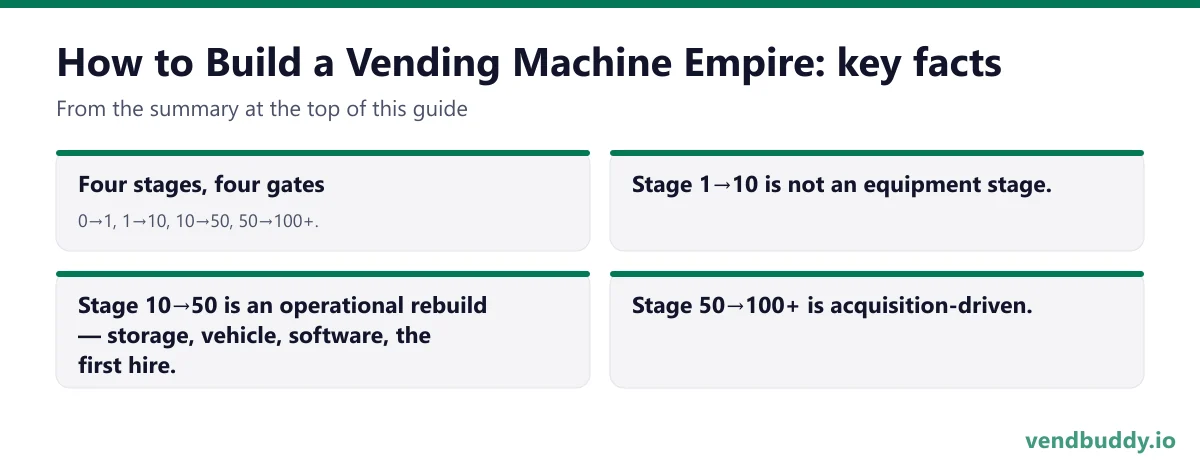
- Four stages, four gates: 0→1, 1→10, 10→50, 50→100+. The gates are what must be TRUE before you are allowed to move up.
- Stage 1→10 is not an equipment stage. It is a habit stage: fifteen building contacts a week is about ten placements a year at the published funnel rate.
- Stage 10→50 is an operational rebuild — storage, vehicle, software, the first hire. Every one of those has its own deep-dive guide, linked at the stage.
- Stage 50→100+ is acquisition-driven. You cannot knock your way there while also servicing the route.
- Skipping a gate is the #1 stall. Adding machines to hide an underperforming one is how a growing route becomes a shrinking business.
“Empire” sounds like a growth curve. It is not. It is a stack of four completely different jobs with a hard gate between each one, and almost everybody who stalls stalls because they carried the previous job’s habits into the next stage. This is the roadmap: what each stage actually is, what must be true before you are allowed to leave it, and which existing guide covers the transition in depth.
Part of our complete guide: scale a vending machine business.
One thing to settle before the map. The word for this business is not empire, it is denominator. Machines do not arrive because you want them; they arrive because you contacted buildings, at roughly one placement per 65 contacts. Every stage below is downstream of that number, and no amount of ambition substitutes for it.
Stage 0 → 1: prove the placement, not the machine
The whole job here is to learn that a building you personally qualified produces the revenue you personally predicted. Not to own equipment. A machine bought before a location is a storage problem with a payment plan, which is why buy the machine or find the location first exists and answers the way it does.
The step-by-step for this stage is how to start a vending machine business, and the ordered pre-machine checklist is the startup checklist.
- Machine one has run 90 days and settled into a steady state.
- You know its net, not its gross, and you can name every line between the two.
- You have a repeatable way to find the next building, not a story about how you found the first one.
Stage 1 → 10: this is a habit stage, not an equipment stage
Nothing about machines gets harder between one and ten. What changes is that the business now depends on a weekly activity that nothing in your life forces you to do. Fifteen building contacts a week, across 46 working weeks, is roughly ten placements a year — about six and a half hours a week of business development including drive time, conversations, Sunday scouting and a twenty-minute Wednesday follow-up block.
Two guides carry this stage: the 100-door math for the arithmetic and the weekly schedule, and outwork the average for the part that actually decides it, which is month four. If you are doing this around a job, the scheduling patterns are in starting a business while working full time.
- The contact habit has survived a bad month without stopping. This is the real gate; everything else is bookkeeping.
- Your machines are clustered, not scattered. Density is a profitability decision, not a logistics one.
- Nothing on the route is a known dud you are tolerating. Rescue it or pull it before you add.
Adding a machine to hide an underperforming one is how a growing route quietly becomes a shrinking business. Fix the stage you are in before you buy the next one.
Picture the machines paying you while you sleep
That’s the real promise of vending — income that doesn’t cost you your time, and a life on your own terms. VendBuddy turns this guide into a step-by-step plan so you actually build it instead of just reading about it. Start free today.
Start building free →Stage 10 → 50: the operational rebuild
This is where most stalls happen, and it is not because the operator ran out of buildings. It is because the systems that worked at five machines break under the load of fifteen, and the ones that work at fifteen break at thirty-five. Four things get rebuilt, roughly in this order:
For the full operational treatment of this middle stretch — the specific inflection points at 5, 15, 25 and 50 machines and what to build before you need it — the deep dive is scaling from 5 to 50 machines. The broader playbook is the pillar, how to scale a vending machine business. This page is the map; those two are the terrain.
Money-wise, this is also the stage where the six-figure conversation becomes real, and where it is worth being precise about which six figures you mean: the $100,000 route, gross versus net.
- Somebody other than you can run a route day from a written system, without calling you.
- Books are real: monthly P&L, per-machine numbers, sales tax handled.
- You can survive a bad month of cash flow without touching the product budget.
- And the honest one: you actually want the next job, because it is management, not vending.
Stage 50 → 100+: you are running a company now
Two things change and both are structural. First, growth switches from knocking to buying, because the arithmetic leaves no alternative: a 100-machine fleet represents something like 6,500 building contacts, which is years of knocking you cannot do while also running the operation. So deal flow becomes a discipline — retiring operators and route deals for where the well-priced ones actually come from, and how to buy a vending route for the checklist that stops you buying somebody else’s problems.
Second, your margin compresses, because your own unpaid labour leaves the cost line and drivers, a lease and a fleet enter it. That trade — margin for capacity — plus the full anatomy of an operation at this size is in what a $1M vending business actually looks like.
The gate rule, which is the only rule here
You are allowed to move up a stage when the gate conditions are true. Not when you are impatient, not when a machine is cheap, and specifically not when the current stage is going badly. Adding machines to hide an underperforming one is the single most reliable way to turn a growing route into a shrinking business, because it buries the diagnostic signal under new revenue and you find out eighteen months later.
The corollary is more forgiving than it sounds: parking at a stage is a legitimate outcome. Plenty of operators run eight to twelve excellent machines forever and take a clean few thousand a month for twelve to eighteen hours a week. That is not a failed empire. It is somebody who read their own gate honestly and decided the next job was not the one they wanted.
Stage two, three and four all consume the same fuel: qualified buildings inside your radius, with someone to call at each. That list is the thing operators quietly stop building first, and the stall always shows up two stages later. VendBuddy scores real businesses in your ZIP by headcount, category and captivity and hands you the contact on each. Free to start, no card.
Frequently Asked Questions
How do you build a vending machine empire?
In four stages with a gate between each one, and the gates matter more than the stages. Stage one is a single proven placement. Stage two is ten machines, built by a weekly building-contact habit rather than by buying equipment. Stage three is roughly ten to fifty machines, which is an operational rebuild: storage, a vehicle, software and usually a hire. Stage four is fifty and beyond, where growth is acquisition-driven and the owner stops running a route and starts running a company. Skipping a gate is the single most common way operators stall.
How many vending machines is a lot?
Ten machines is a genuine side business, fifteen to twenty-five is the ceiling for one person servicing them without help, and fifty is where it becomes a company with employees. Above one hundred you are an operator-manager whose week contains almost no restocking. Most people who say they want an empire actually want the economics of stage three, which is reachable in two to four years, without the payroll and lease commitments of stage four.
What should be true before I add my next vending machine?
Three things. The machines you already have are performing at or near their tier, because adding a machine to hide a bad one is how routes get quietly unprofitable. Your service time still fits the week you actually have, not the week you imagine. And the new placement is inside your existing service radius, because a yes forty minutes outside the cluster costs you that drive twice on every visit for as long as you own the machine. If any of the three is false, fix it before you add.
Can one person run 50 vending machines?
Not sustainably on a weekly service cycle. Service runs roughly 30 to 60 minutes per machine per week including drive time, so fifty machines is 25 to 50 hours a week of pure route work before any admin, purchasing or prospecting. The realistic solo ceiling is 15 to 25 machines with good route density and telemetry. Beyond that you are choosing between a part-time helper, a full driver, or capping the route deliberately, and capping deliberately is a perfectly respectable answer.
Most people working on prospecting start by pulling the list rather than driving the map. The ranks the businesses around your ZIP by type and headcount, and the first five contact reveals are free.
Is it better to have more machines or better locations?
Better locations, by a wide margin, and the arithmetic is not subtle. The same machine can net under $150 a month in a quiet building and $500 to $1,000 in a busy one. Seventeen weak placements and seven strong ones produce similar revenue, but the seventeen cost you roughly ten extra service stops every week for the rest of the time you own them. Raise volume when your pipeline is empty and raise standards when your route average is falling, and never both in the same month.
How long does it take to scale a vending route?
Use the funnel rather than a guess. At one placement per roughly 65 building contacts, fifteen contacts a week across 46 working weeks produces about ten placements a year. That makes ten machines a roughly one year build, the twenty-five to forty machine range a three to four year build, and anything above fifty an acquisition question rather than a knocking question. Those are planning figures at a published conversion rate, not a promise about your results.
Related reading: the 100-door math, outwork the average, the $100,000 route, the $1M operation blueprint, why the top 1% is a volume tier, and scaling from 5 to 50 machines. Want the arithmetic on your own target? The Income Reality Calculator turns a goal and a deadline into the daily activity behind it. Free, no signup, no income claims.
What is selling, which buildings say yes, and the numbers before you buy a machine. Free, confirm from your inbox, unsubscribe in one click. Refer one friend and get 25 VendBuddy credits.
Walk-ins and cold emails find locations. A small site with your own machine photos and a request-a-machine form lets the next one find you. Around machine three to five, an AI builder drafts it in an evening. Wix is the mature site builder; Base44 also builds working tools like a quote form. Start with the AI website walkthrough or Wix vs Base44.
General information, not legal, tax or financial advice. Rules change, so check the official source. Revenue and income figures are examples, not promises. See our terms.