- A generation of route owners is aging out. A large share of independent operators are in their sixties and seventies, with no successor and no idea what the route is worth.
- The good routes never get listed. They change hands because somebody asked at the right moment — which makes origination, not searching, the actual skill.
- Be the person who asked. Three people always hear first: your distributor rep, your card-reader rep, and whoever runs the state association. Ask twice a year, in these words: who is winding down?
- Expect seller financing, because the seller usually wants monthly money and a clean exit rather than a lump sum — and a seller carrying paper has a direct reason to hand the accounts over properly.
- Valuation discipline still applies: 12–24× monthly net with documentation, 4–8× without. The documentation is what you are actually pricing.
Walk into a distributor counter in any mid-sized market on a weekday morning and look at who is picking up product. Then do the arithmetic on the room. A large share of the independent vending operators in this country are in their sixties and seventies. Many of them built a route over twenty or thirty years, never wrote a location agreement down, have no children who want it, and have never had the business valued by anyone.
Those routes are going to change hands over the next several years. Almost none of them will be listed anywhere.
That is the whole opportunity, and it is not a secret so much as a thing nobody bothers to act on. Every guide to buying a route tells you how to value one and what to check — and both of those are downstream problems. The upstream problem, the one that actually decides whether you ever get a good deal, is how a route surfaces at all when it was never for sale.
The wave, and why it does not reach the listing sites
Two forces are pointed at the same outcome. The operator base is old, and the exits are unplanned.
An operator who has run twelve machines since 1998 does not wake up one Tuesday and decide to run a sale process. What happens is slower and quieter: a knee goes, or a spouse gets sick, or a third account cancels and it stops being worth the drive. They shed machines rather than sell a business. The equipment ends up on Marketplace one unit at a time at $1,500 a piece, and the actual asset — twenty years of relationships with buildings that will keep buying snacks forever — simply evaporates.
That is the failure mode this whole page exists to interrupt. When a route does get sold properly it is usually because somebody happened to be standing there at the moment the operator started thinking about it. Listing sites see the routes whose owners went looking for a broker, which is a self-selecting minority and generally the priced-for-retail end of the market.
The best vending routes in your city are not for sale. They are owned by someone in their late sixties who has not decided yet - and the person who ends up with them is simply the person who asked.
Be the person who asked
The mechanism is embarrassingly unsophisticated, which is exactly why it is available. Three people in your market hear about a winding-down operator before anyone else does, and none of them is a broker.
Five years of being that person will buy you better routes at better prices than any amount of refreshing listing sites, and the reason is simple arbitrage: you are the only bidder. A route that never went to market never had a competing offer, which is worth more to your purchase price than any negotiating tactic.
What to say when a name comes back
Do not open with an offer. You are talking to somebody who has spent decades on this and has probably never been asked about it respectfully. Open with the two questions that get them talking — how long have you been running it, and what would you want to happen to the accounts — and let the second one sit. Operators who built something over twenty years care, often intensely, about the buildings not being let down by whoever comes next. That is not sentiment getting in the way of a deal. It is the thing that makes you the preferred buyer over a bigger regional operator with more cash, and it is available to you for the price of caring about it visibly.
Picture the machines paying you while you sleep
That’s the real promise of vending — income that doesn’t cost you your time, and a life on your own terms. VendBuddy turns this guide into a step-by-step plan so you actually build it instead of just reading about it. Start free today.
Start building free →Why seller financing dominates these deals
If you have only ever read about buying a business through a bank-loan lens, this will look like a concession the seller is making. It usually is not. It is the structure the seller wants, and understanding why is most of the negotiation.
A retiring operator wants two things: for the thing to be over, and for money to keep arriving monthly. A lump sum delivers the first and actively works against the second — it is a large taxable event in one year, followed by nothing. Payments spread over three years deliver both, and the tax treatment is frequently better. So the seller carries paper because the seller prefers paper.
Three consequences follow, and they are all in your favour:
- The terms often beat a bank. No underwriting, no equipment appraisal, no two years of business tax returns for a business you do not own yet, and no personal guarantee beyond the asset itself. Banks are poorly set up to lend against a pile of used vending machines and a folder of location agreements; the person who has been operating them for twenty years is not.
- The down payment is negotiable in a way a bank’s is not. Typical structures land around 20 to 40 percent down with the balance amortised over two to five years, secured by the machines and the assigned contracts. Where in that band you land is mostly a function of how confident the seller is in you, which is why the conversation above matters commercially and not just socially.
- It protects the handover, which is the part that actually kills these deals. A seller who has been paid in full has no remaining reason to spend a Thursday introducing you to a facilities manager. A seller carrying 70% of the price only gets paid if the route keeps performing — so they will make the introductions, explain the quirks of the building with the loading dock, and take your call in month four when a coil starts hanging.
Two clauses are worth insisting on. Tie a portion of the balance to revenue retention over the first six to twelve months, so accounts that walk immediately after closing adjust the price rather than landing entirely on you. And require an in-person introduction, account by account, before keys change hands — most deals that go wrong go wrong after the money moves, when a location discovers its operator changed by finding a stranger at the machine. Have a lawyer paper it. This is the one part of a vending deal where a few hundred dollars of review is unambiguously worth it.
Valuation discipline still applies
An unlisted route is not automatically a good deal. It is an uncontested deal, which is different, and the discipline does not relax because you found it first.
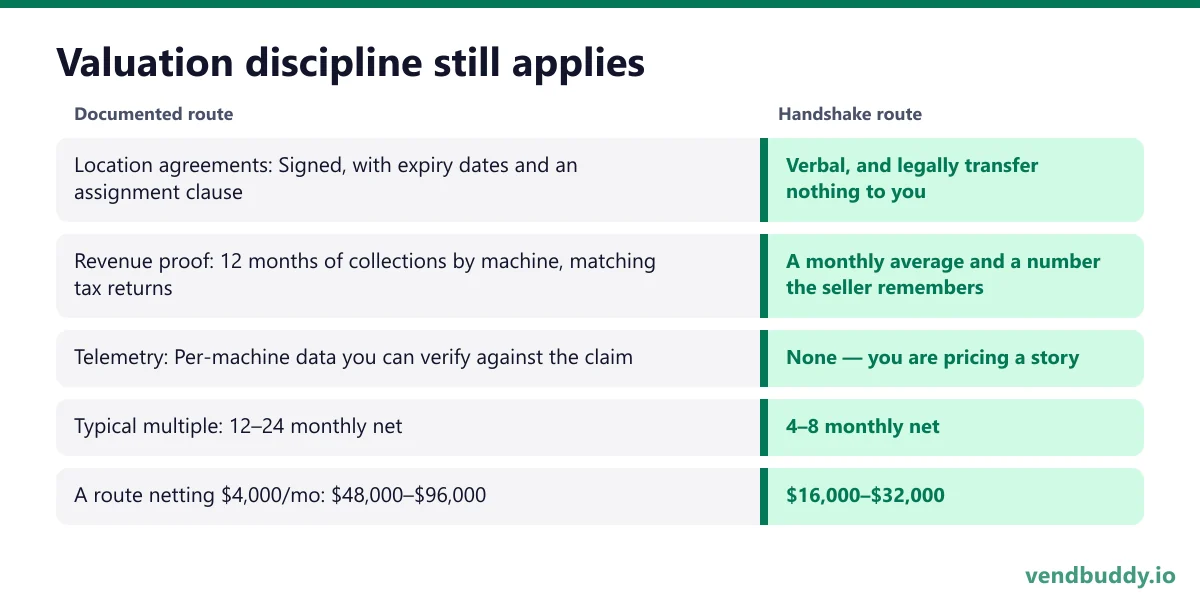
The band is 12 to 24 times monthly net profit. Where a specific route lands inside it is decided almost entirely by paperwork:
| Documented route | Handshake route | |
|---|---|---|
| Location agreements | Signed, with expiry dates and an assignment clause | Verbal, and legally transfer nothing to you |
| Revenue proof | 12 months of collections by machine, matching tax returns | A monthly average and a number the seller remembers |
| Telemetry | Per-machine data you can verify against the claim | None — you are pricing a story |
| Typical multiple | 12–24× monthly net | 4–8× monthly net |
| A route netting $4,000/mo | $48,000–$96,000 | $16,000–$32,000 |
Three checks before money moves, all of which are cheap and all of which are routinely skipped. Ask for twelve months of collections by machine, not a monthly average — an average hides the three stops that are dying. Visit at least two locations unannounced, because a machine that has been stocked for your visit tells you nothing. And ask how old the equipment is: a route priced on revenue can conceal a fleet of compressors all due in the same eighteen months. The full checklist is in the route due-diligence guide, the number itself comes out of the free route valuation calculator, and reading the seller-side guide is worth an hour precisely because it tells you what a well-prepared seller will have done — and therefore what its absence means.
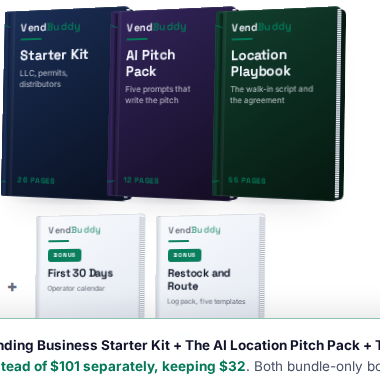
If you get to the end of this and the answer is yes, the kits are the shortcut past the blank page: a 26-page starter kit for the paperwork, a 55-page Location Playbook for the walk-in script and the agreement, and a 12-page AI Pitch Pack. Bought once, from $27, and you keep the files.
Look inside the kits →The other half: what this means if you are the one winding down
This page has been written from the buyer’s chair, but the same facts read differently from the other side, and the asymmetry is worth naming honestly.
If you are the operator in your late sixties with twelve machines and no plan, the sentence that matters is the one in the table above: documentation does not improve your route, it roughly doubles what your route is worth. Operators who get the top of the range decided to sell about a year in advance. Twelve to nine months out, clean the books and build a per-machine profit statement. Nine to six, re-paper every handshake location onto a written agreement with an assignment clause, and cut or rescue anything netting under about $250 a month, because one weak account invites a buyer to price the whole route off your worst machine. Six to three, get telemetry on everything. Then hand over in the right order.
Worth reading before you sign anything: the contract walkthrough covers which terms get pushed back on and which ones you can safely give away. Commission is rarely the clause that hurts you later.
The thing nobody says out loud: the year of tidying is worth more per hour than any year you spent servicing the route.
The VendBuddy Marketplace lists vending routes, individual machines and hand-raised locations. If you are buying, joining the buyer list is how you see listings - we email you when one lands inside your radius, and there is no commission and no markup. VendBuddy does not hold the money: both sides use a licensed escrow company, and the marketplace page walks you through what to ask for first. Sellers get one optional tip ask after they mark a listing sold, and that is the whole of it. If you are winding down, listing is free and takes two minutes. It will not replace the three phone calls above, and it is not meant to: this is where the routes that DID decide to sell show up.
Not sure whether buying a route or starting fresh is the right entry for you? The two-minute readiness quiz routes on that question honestly. Related reading: route due diligence, step by step, how to sell a vending machine business, what a machine actually nets, and what belongs in an assignable location agreement.
Frequently Asked Questions
Can you buy a vending machine route from a retiring operator?
Yes, and it is the most common way a good route changes hands - it is just rarely advertised. A large share of independent operators in the US are in their sixties and seventies, many built a route over twenty or thirty years, never wrote anything down, have no successor in the family, and have no idea what the route is worth. Those routes will change hands over the next several years and most of them will never appear on a listing site. They move because somebody asked at the right moment, which means origination, not searching, is the actual skill.
How do I find vending routes for sale that are not listed anywhere?
Get known to the three people who always hear first, then ask them twice a year in plain words: who is winding down? Your distributor rep sees an account stop ordering product. Your card reader or telemetry rep sees devices go dark. And whoever runs the state or regional vending association hears it directly, because that is where operators go to complain about being tired. Each call is free, takes ten minutes, and the answer is often a name and a phone number. Five years of being the person who asked will buy you better routes at better prices than any amount of refreshing listing sites.
What is a vending route worth?
A route trades at roughly 12 to 24 times monthly net profit, and where it lands inside that band is decided almost entirely by documentation. A route netting $4,000 a month with signed assignable location agreements, telemetry and clean tax returns trades at the top of the range - about $48,000 to $96,000. The same route, same machines, same revenue, with verbal agreements and a spreadsheet, trades at four to eight times, or roughly $16,000 to $32,000. Nothing about the machines changed. What a buyer pays for is certainty that the revenue survives the handover.
Why is seller financing so common when buying a vending route?
Because it matches what the seller actually wants, which is usually not a lump sum. A retiring operator wants the thing to be over and wants money arriving monthly - often for tax reasons as much as income ones. Seller financing gives them both, and the terms frequently beat a bank because there is no underwriting, no equipment appraisal and no personal guarantee beyond the asset itself. It also aligns the handover: a seller carrying paper only gets paid if the route keeps performing, so they have a direct financial reason to introduce you properly to every account instead of disappearing with the cheque.
How should a seller-financed vending route deal be structured?
Typically 20 to 40 percent down with the balance amortised over two to five years, and the machines and contracts pledged as security so the seller can take the route back on default. Two clauses matter more than the rate. First, tie a portion of the balance to revenue retention over the first six to twelve months, so accounts lost immediately after closing adjust the price rather than becoming your problem alone. Second, require the seller to introduce you in person, account by account, before keys change hands. Have a lawyer paper it - this is the one part of a vending deal where a few hundred dollars of legal review is unambiguously worth it.
What should I check before buying a retiring operator route?
Ask for twelve months of collections by machine rather than a monthly average, because an average hides the three stops that are dying. Establish which location agreements are in writing, when they expire, and whether they are assignable at all - a verbal placement transfers nothing. Visit at least two locations unannounced. Confirm the machines are owned outright and none are financed. And find out how old the equipment is: a route priced on revenue can hide a fleet of compressors all due at once.
If financing is the piece that is stuck, 7 Figures Funding works the qualification side of 0% intro business credit rather than you applying cold and collecting hard pulls. It is only worth a look if the placement is already confirmed.
Is buying a vending route better than starting from scratch?
It is a different trade rather than a better one. Buying skips the hardest part of this business, which is getting buildings to say yes, and you get cash flow from month one instead of month six. What you take on is somebody else standards - their pricing, their planograms, their relationships, and any account that was only ever loyal to them personally. A route bought well at 12 to 24 times monthly net pays for itself in one to two years, which is comparable to a placed new machine, with the risk moved from will-anyone-say-yes to did-I-verify-these-numbers.
What is selling, which buildings say yes, and the numbers before you buy a machine. Free, confirm from your inbox, unsubscribe in one click. Refer one friend and get 25 VendBuddy credits.
Walk-ins and cold emails find locations. A small site with your own machine photos and a request-a-machine form lets the next one find you. Around machine three to five, an AI builder drafts it in an evening. Wix is the mature site builder; Base44 also builds working tools like a quote form. Start with the AI website walkthrough or Wix vs Base44.
General information, not legal, tax or financial advice. Rules change, so check the official source. Revenue and income figures are examples, not promises. See our terms.