- The complaint is usually true. Most individual vending machines are not making meaningful money, and the people saying so are not wrong about their own machine.
- The cause is almost never the machine. $600 gross nets about $220 a month. $300 gross nets about $85 — because fuel, insurance and software do not shrink when the machine underperforms.
- Capture rate is the hidden variable. A captive audience converts at 5–12%. Pass-through traffic converts at 1–3%. That gap is four to ten times, and it is invisible from the parking lot.
- The profitable minority did one thing differently: they secured the building before they bought the box, so the machine was sized to the room instead of the room being found for the machine.
- Walk away when the deal only works at the top of the range, when locations come bundled with the equipment, or when payback runs past about 18 months at conservative revenue.
Type the question into any forum and the top reply is some version of the same thing: they don’t make money. Someone bought a machine, put it somewhere, drove out to it every other Saturday for a year, and cleared enough to cover the fuel. That person is not lying and they are not bad at this. Their machine genuinely does not make money.
What is worth arguing with is the conclusion they draw from it, because it is nearly always the wrong one. They conclude that vending does not work. The actual finding is narrower and far more useful: that building did not work, and the machine had no say in it.
This page is the pessimistic case made properly — the arithmetic of why most machines fail, what the ones that work are doing differently, and the specific points at which the correct move is to walk away. If you want the optimistic version with the same numbers, it is how much vending machines actually make. If you want the version about the marketing around this business rather than the economics, that is the vending machine lie. And if the disappointment you are actually testing is the “passive income” claim rather than the revenue claim, how many hours a week a vending machine business really takes puts an honest number on it.
1. Why most machines genuinely do not make money
Start with the arithmetic, because everything else on this page is downstream of it.
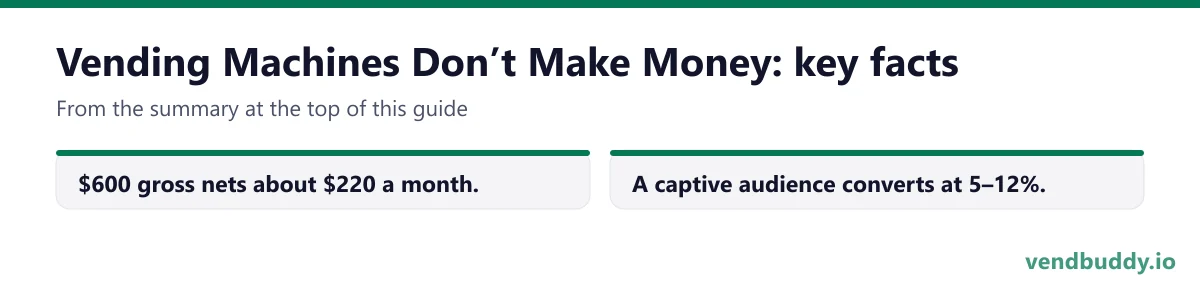
A machine at a decent placement — a real building, real daily traffic, no coffee shop forty feet away — grosses somewhere between $300 and $800 a month. Take the middle of that, $600, and subtract in order:
- Product costs roughly half of what you sell. That is the shape of the industry and it does not move much. Minus $300. You are at $300.
- Card processing runs about 5% of everything through the reader. On $600, call it minus $30. You are at $270.
- Fuel, a bill validator that eventually needs replacing, liability insurance, whatever software you run. Budget $50 a month. You are at $220.
- Commission to the building. At most small locations, zero. Some want a cut, and that comes off the $220. When to agree to one is a contract question.
About $220 a month net. Roughly $2,600 a year from one box. Against an all-in placement of about $2,700 — a used combo at $1,500 to $3,000, a card reader at $300 to $500, and a first fill — that is just over twelve months to get your money back. Fine. Unremarkable. A business.
Most operators end up on Nayax for card readers because it is what the distributors already support. Their reader handles tap, chip and the telemetry feed in one box, and the monthly fee is the part to check against your per-machine volume before you commit the route to it.
Now move one variable
Here is the part that explains every disappointed operator you have ever read.
| The machine that works | The machine that does not | |
|---|---|---|
| Monthly gross | $800 — a building at the top of the range | $300 — a building that looked fine from the car |
| Product cost | Minus $400 | Minus $150 |
| Card fees at ~5% | Minus $40 | Minus $15 |
| Fuel, insurance, software | Minus $50 | Minus $50 — identical, because fixed costs do not shrink |
| Monthly net | About $310 | About $85 |
| All-in placement cost | $1,900 on a private-party machine | $2,700 bought retail before the location existed |
| Payback | About 6 months | About 32 months |
| What your time earned | Roughly $52/hr at two hours a fortnight | Roughly $14/hr — before you charge yourself for the drive |
Notice which line did the damage. It was not the product cost, which scaled down with revenue. It was the $50 of fixed overhead, which did not. A machine that underperforms keeps its full insurance premium, its full software fee and its full tank of fuel. Underperformance is not proportional. It is subsidised, by you.
Same machine, same product, same operator - six months to payback in one building and thirty-two in another. The machine never had a vote. The room decided everything.
How the bad machine gets born
Almost always the same way, and it is worth naming because it is preventable and free to prevent.
Somebody buys the machine first. It arrives, and it sits in a garage. An unplaced machine does not sit there neutrally — it negotiates against you. Every week it sits there your standards drop a little, and somewhere around week seven you sign a twelve-person office with a break room nobody uses, because you need this to be over.
That is the whole mechanism. The operator did not misjudge the building; they were no longer in a position to judge it. The reverse order costs nothing: a location without a machine is a business that has not been funded yet, and you can convert it into a placed machine in about a week with a phone and a card. You cannot convert an unplaced machine into a good location on any timeline you control.
2. What the profitable minority does differently
Three things, and none of them is equipment.
They multiply three numbers, not one
Vending revenue is how many people pass the machine, what share of them buy, and what they spend. New operators fixate on the first number, which is the one everybody overestimates and the one that matters least.
The number that separates locations is the middle one. A genuinely captive audience — people who cannot easily leave and have nowhere else to go — converts at something like 5 to 12 percent. Casual pass-through traffic converts at 1 to 3 percent. That is a four-to-ten-times gap, it is worth more than any product decision you will ever make, and you cannot see it from the parking lot unless you know to look.
Four structural things decide where a building lands:
They recount the building
The single most valuable habit in this business, and it takes ten minutes. A body count is not a buyer count.
Consider a nursing home with 500 residents against a 150-unit apartment highrise. On paper the nursing home is more than three times the building. In practice it is the smaller one, and it is not close. Walk it and recount: a large share of those residents do not move freely through the halls, many do not carry a card, and diets are often managed — sometimes medically, sometimes by the facility — which means a machine full of chips and soda is working directly against the people whose job it is to manage them. Strip that out and your customer base is the staff. Forty-odd people on shift, some of whom brought lunch.
Now the highrise. A hundred and fifty households crossing the lobby twice a day, every one of them an adult with a card and nobody’s permission to ask for. Then add the thing the nursing home does not have: eleven at night, somebody wants something, the nearest store is closed or a drive, and they are forty feet from your machine in a building they would have to put shoes on to leave.
The question is never how many people are in there. It is how many pass the machine with the ability and the freedom to buy. Run that recount on every building before it goes anywhere near your list, and a surprising number of impressive-looking locations disqualify themselves in a paragraph.
They know margin is narrow and gross is everything
Across property types, net margin lands in a fairly narrow band — about 35% of gross where you pay no commission, dropping toward 25% once a location takes a share. That range moves far less than gross does.
Which produces the conclusion that should reorder how you spend your week: the difference between a $30,000-a-year route and a $120,000-a-year route is not four times the machines. It is the same number of machines in better buildings. Every hour spent optimising a planogram in a bad room is an hour not spent finding a good one. The location playbook is where that hour goes.
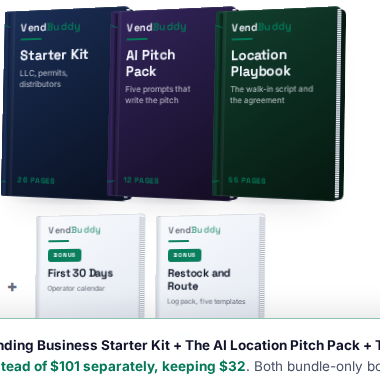
If you get to the end of this and the answer is yes, the kits are the shortcut past the blank page: a 26-page starter kit for the paperwork, a 55-page Location Playbook for the walk-in script and the agreement, and a 12-page AI Pitch Pack. Bought once, from $27, and you keep the files.
Look inside the kits →Picture the machines paying you while you sleep
That’s the real promise of vending — income that doesn’t cost you your time, and a life on your own terms. VendBuddy turns this guide into a step-by-step plan so you actually build it instead of just reading about it. Start free today.
Start building free →3. When to walk away
The counterpart to knowing what good looks like. These are the points at which the correct move is to stop, and each one is cheap to check before money moves.
- The deal only works at the top of the range. If the machine is profitable at $800 gross and underwater at $500, you are not evaluating a placement, you are placing a bet. Run the numbers at the bottom of the range and see whether you still want it.
- Locations come bundled with the equipment. This is the loudest warning sound in the industry. Locations are the scarce half of a vending business and they are free to obtain if you do the work. Nobody who has genuinely secured good buildings gives them away to move a cabinet at retail price — so when somebody bundles the free half with the expensive half, they are charging you for the free half.
- There is a cafeteria, a lobby coffee shop, or a gas station across the lot. You are not competing with other vending machines. You are competing with the nearest alternative, and a cheaper alternative inside a five-minute walk caps your prices permanently.
- Nobody will put the placement in writing. A handshake location is fine right up until the facilities director changes, and then it is a machine you have to move at your own cost. It also craters what the route is worth if you ever sell it.
- Payback runs past about 18 months at conservative revenue. Not at optimistic revenue. Not at the number the seller quoted. Run the payback framework at the low end and treat the answer as the real one.
- You are buying because the machine is already in your garage. The tell is that you are arguing yourself into it rather than out of it. That is the unplaced machine negotiating, and the correct response is to sell the machine, not to accept the building.
Walking away is not a failure state. Every building you decline is a couple of thousand dollars and thirty months of servicing you did not spend, and the operator who says no to six rooms and yes to the seventh is materially ahead of the one who said yes to the first.
So do they make money or not
Both, and the split is not random.
Vending is a good business for somebody who wants to own a small cash-flowing asset, will do unglamorous outreach for months before it pays, and is willing to know their numbers cold. It is a bad business for somebody who needs money in thirty days, wants to be hands-off from the start, or will not have the conversations. The upside is modest and durable rather than large and fast: one good machine is $200 to $300 a month you did not have, and five of them start to feel like a real second income. That is a perfectly good shape. It just is not the one in the video.
The people saying vending machines do not make money are describing a real machine in a real building, and they are right about it. They are simply describing the wrong half of the business. The box was never the variable.
The entire difference between the two columns on this page is which room the machine ended up in. VendBuddy scores real venues near you on traffic, headcount, category and what is already serving them, gives you the best contact on file at each one, and models what a machine would actually net there before you spend anything. Five free credits, no card required.
Not sure whether the shape fits you at all? The two-minute readiness quiz is built to talk people out of this as often as into it. If it fits, start with how to find locations and the full cost and profit breakdown, and price the machine last in the Machine Finder.
Frequently Asked Questions
Do vending machines actually make money?
Some do and most of the ones people complain about do not, and the difference is almost entirely the building rather than the machine. A machine at a decent placement grosses roughly $300 to $800 a month. Product takes about half of that, card processing takes about 5 percent of everything through the reader, and fuel, insurance, software and a repair reserve take another $50 or so. At $600 gross that is about $220 a month net. At $300 gross the same machine nets about $85, because the fixed costs do not shrink when the machine underperforms. Same equipment, same product, same operator - the location did all of it.
Why do most vending machines not make money?
Because they were placed in rooms that cannot support them, usually by an operator who bought the machine first and then went looking for somewhere to put it. An unplaced machine sitting in a garage negotiates against you: every week it sits there your standards drop, and eventually you accept a twelve-person office because you need the situation to be over. That is how a machine ends up in a building with low traffic, a coffee shop forty feet away and no after-hours access. The machine is fine. The room was never going to work.
How much does a vending machine make per month realistically?
The honest middle is about $220 a month net on roughly $600 gross, which is around $2,600 a year from one box. The good version - a private-party machine bought at $1,200 and placed in a building grossing $800 - nets about $310 a month and pays for itself in roughly six months. The bad version nets about $85 and takes over thirty months to pay back, at which point you are working for about $14 an hour once you charge yourself for the drive. All three of those are the same machine.
What is a good capture rate for a vending machine?
A genuinely captive audience - people who cannot easily leave and have nowhere else to buy - converts at roughly 5 to 12 percent of the people who pass the machine. Casual pass-through traffic converts at 1 to 3 percent. That gap is four to ten times, it is the single biggest driver of whether a machine makes money, and it is invisible from the parking lot. The word that does the work is stuck: two hundred warehouse workers on a ten-hour shift outproduce two thousand people walking through an open-air shopping centre.
How do I know if a vending location is worth it before I place a machine?
Recount the building rather than reading the sign out front. A body count is not a buyer count. A nursing home with 500 residents is usually a 40-person location once you subtract the residents who do not move freely, do not carry a card or have managed diets - your customers are the staff on shift. Then check four things: captive headcount multiplied by hours on site, whether the space is reachable after hours, what food alternatives sit within five minutes, and how long a person is stuck in the room with nothing to do. Model the specific building before you buy anything for it.
When should I walk away from a vending machine deal?
Walk when the numbers only work at the top of the range, when the seller bundles locations with the equipment, when the building has a cafeteria or a lobby coffee shop, when nobody will put the placement in writing, or when the payback runs past about 18 months at conservative revenue. The bundled-locations one is the loudest signal in this industry: locations are the scarce half of a vending business and they are free to obtain if you do the work, so anyone giving them away with a machine at retail price is charging you for the free half.
Is vending a bad business?
It is a narrow business, which is different. It is a good fit for someone who wants a small cash-flowing asset, will do unglamorous outreach for months before it pays, and is willing to know their numbers cold. It is a bad fit for someone who needs money inside thirty days, wants to be hands-off from the start, or will not have the conversations. The upside is modest and durable rather than large and fast: one good machine is $200 to $300 a month you did not have before, and five of them start to feel like a real second income.
What is selling, which buildings say yes, and the numbers before you buy a machine. Free, confirm from your inbox, unsubscribe in one click. Refer one friend and get 25 VendBuddy credits.
General information, not legal, tax or financial advice. Rules change, so check the official source. Revenue and income figures are examples, not promises. See our terms.