- The top 1% is a volume tier, not a talent tier. Almost everyone who fails stops doing the customer-producing activity before it has produced a fair sample.
- The settling mechanism has three parts: status quo bias, comparing yourself to the people around you instead of to what is possible, and reading a statistically normal run of nos as a verdict.
- Vending is the honest test case because the funnel is countable: 100 buildings → ~20 real conversations → ~5 live opportunities → 1 to 2 signed.
- The do-20%-more rule: 18 buildings a week instead of 15 is about two extra placements a year, for roughly ninety extra minutes a week.
- What volume guarantees is funnel progress, not income. Dollars depend on which buildings. Volume decides how many chances you get at the good ones.
Ask how somebody got into the top one percent of anything and you will usually get a talent answer, because talent is the flattering explanation and it is also the one that lets the listener off the hook. The uncomfortable version, the one you can act on this week, is that the top of most activities is a survivorship tier. It is the group still doing the boring repetitive thing at month nine, after everybody who was better at it stopped.
Part of our complete guide: how to start a vending machine business.
That is not a motivational claim. In a business with a countable funnel you can watch it happen in the numbers, and vending happens to be one of the few small businesses where the numbers are genuinely countable. This post is about what that arithmetic says, and what it asks of you.
The top 1% is a volume tier
Take any activity where output is roughly rate multiplied by attempts. Sales calls. Applications. Buildings walked into. The rate term is your skill and your list quality combined, and it moves slowly — you can improve it, but not this month, and not by deciding to. The attempts term moves the instant you decide it does.
So when two operators end the year with wildly different results, the honest post-mortem almost never finds a talent gap that explains the size of it. It finds one person who made 460 attempts and one who made 31, and both of them believed they had tested the market.
The thirty-one number is real. We hear some version of it every week: an operator with three machines, nine months in, certain that his area is tapped out. Asked how many buildings he had actually walked into, he counted thirty-one. In a county with roughly four hundred qualifying buildings inside a fifteen-minute drive. He had not run out of locations. He had run out of doors, which is a completely different problem with a completely different fix — and the reason nobody spots it in themselves is that thirty-one rejections feel like a market verdict when they are simply too small a sample to mean anything.
The settling mechanism, in three parts
Settling is not laziness. It is three ordinary cognitive defaults doing exactly what they evolved to do.
Picture the machines paying you while you sleep
That’s the real promise of vending — income that doesn’t cost you your time, and a life on your own terms. VendBuddy turns this guide into a step-by-step plan so you actually build it instead of just reading about it. Start free today.
Start building free →Why vending is the honest test case
Most businesses have a fuzzy funnel. You cannot say what one more unit of effort buys, so effort and outcome float free of each other and you are left arguing from vibes. Vending has an unusually legible one, and we published the whole thing as the 100-door math:
| Stage | Out of 100 buildings contacted | Conversion from the stage above |
|---|---|---|
| Doors (one attempt at one building) | 100 | — |
| Real conversations | ~20 | 1 in 5 |
| Live opportunities | ~5 | 1 in 4 |
| Signed agreements | 1 to 2 | 1 to 2 in 5 |
Call it one placement per 65 doors as a planning midpoint. That single number does something no amount of mindset content can: it converts a mood into a rate. A no now costs you one sixty-fifth of a placement and about eight minutes. It moves you 1.5% closer to a yes. Read as a verdict, crushing. Read as a denominator, unremarkable.
The top one percent is not a talent tier. It is the group still doing the boring repetitive thing at month nine, after everybody who was better at it stopped.
The do-20%-more rule
Here is where the ambition advice usually goes wrong. Somebody tells you to work three times harder than everyone else, you try it for eleven days, and then you stop entirely — which leaves you behind where you would have been with a smaller, permanent change.
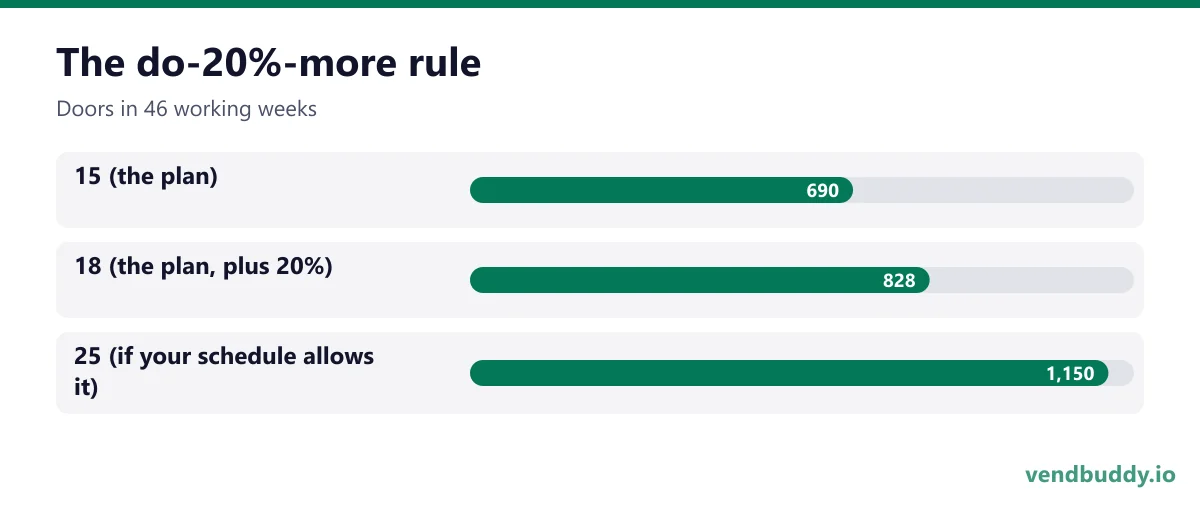
Twenty percent is the number because twenty percent survives contact with a real week. If the plan is fifteen buildings a week, do eighteen. Run the arithmetic on the difference:
| Weekly doors | Doors in 46 working weeks | Placements at 1 per 65 | Extra business-development time |
|---|---|---|---|
| 15 (the plan) | 690 | ~10.6 | — |
| 18 (the plan, plus 20%) | 828 | ~12.7 | ~45 to 90 min/week |
| 25 (if your schedule allows it) | 1,150 | ~17.7 | ~3 to 4 hrs/week |
Two extra placements a year for ninety minutes a week. Then it compounds, because year two starts from a bigger base and a longer follow-up list. Nobody watching from outside will be able to point at the moment it separated, which is precisely why it works.
What volume actually guarantees
Be careful here, because this is where the internet lies to you. Volume does not guarantee income. Nobody can promise you a dollar figure, and anybody who does is selling something.
What volume guarantees is narrower and considerably more useful:
- Funnel progress at your own rate. Not at the rate in a video. At yours, measured on your own list, in your own market. Once you have a few hundred attempts behind you, that rate is a fact rather than a hope.
- The removal of luck as an explanation. At twenty attempts, luck dominates and you learn nothing. At six hundred, the result converges on your true rate the way a coin converges on heads — which means the number you see is actually about you and your list, and can therefore be improved deliberately.
- Optionality. More conversations means more chances to say no to a bad building. Operators with a thin pipeline take whatever says yes, and that decision is what sets their income ceiling, not their work ethic.
What volume does not do is fix which buildings you chose. Dollars are decided by placement quality, and the spread there is brutal: the same machine can net under $150 a month in a quiet building and $500 to $1,000 in a busy one. That is the argument for counting buyers rather than bodies before you spend a morning on a building. Volume decides how many chances you get at the good ones. It does not choose for you.
Eighteen buildings is about four hours of walking. Building the list of eighteen buildings actually worth walking into is the other hour, every week, and it is the one people quietly stop doing first. VendBuddy scores real businesses in your ZIP by headcount, category and captivity and hands you the best contact on file for each, so Sunday night is ten minutes instead of an evening with a notebook. Free to start, no card.
Where the separation actually happens: month four
Not month one. Month one everybody is enthusiastic. The separation happens in month four, when the novelty is gone, the first machine is doing fine but not exciting, and the door blocks on your calendar have become optional.
Everything above is designed for that specific week. The four numbers on an index card exist so that a bad week is visibly a bad week rather than a referendum. The 20 percent rule is small enough to survive a bad week. The 65-door denominator exists so that a run of nos in month four reads as arithmetic instead of as an answer.
If you want the honest, unglamorous version of this argument with the tables to back it, that is outwork the average. If you want to see where the volume leads, the money version is the $100,000 route, gross versus net and the roadmap version is the 0 to 100+ machine stage-gate map. And if you are doing this around a job, the schedule that makes it fit is in starting a business while working full time.
Frequently Asked Questions
How do you get into the top 1 percent of entrepreneurs?
By sustaining volume past the point where almost everyone else stops. The top of any activity is not primarily a talent tier, it is a survivorship tier: most people who start a business stop doing the one repetitive activity that produces customers long before that activity has produced a fair sample. In a business with a measurable funnel, such as vending, you can watch this happen in the numbers. If one placement costs roughly 65 building contacts, an operator who quits at 31 contacts has not tested the market at all, and an operator who does 120 percent of what the average person does compounds that difference every single year.
Is entrepreneurial success talent or hard work?
It is mostly which of the two you can actually control. Talent is real and it is not distributed evenly, but it is also fixed on any timescale that matters this year. Volume is not fixed. In an activity where the conversion rate is roughly stable, output equals rate times attempts, and attempts is the only term on the right-hand side you set yourself. That is why the practical advice is almost always about attempts rather than about ability.
Why do most people settle for average results in business?
Because average is the default and defaults are sticky. Three things do most of the work: status quo bias, which makes the current state feel safer than it is; comparison to the people around you rather than to what is actually achievable, which makes ordinary effort feel sufficient; and small-sample discouragement, where a run of nos that is statistically normal reads as a verdict on you. The third one is the most fixable, because it is an arithmetic error rather than a character trait.
What is the 20 percent more rule?
Do 20 percent more of the one activity that produces customers than the person you are competing with. It is deliberately small, because a 20 percent increase is sustainable and a 300 percent increase is not. In vending terms, if the plan says fifteen buildings a week, do eighteen. Across 46 working weeks that is 138 extra contacts, which at a one-in-65 planning rate is about two additional placements a year, every year, from a change that costs roughly ninety minutes a week.
Why is vending a good business for testing this?
Because the work-to-outcome conversion is unusually measurable. Most businesses have a fuzzy funnel where you cannot say what one more unit of effort buys. Vending has a countable one: buildings contacted, real conversations, live opportunities, signed agreements. Each stage has a stable-ish ratio, so you can convert a mood into a rate and check your own arithmetic against it every week. That does not make the business easy. It makes it honest.
Does more volume guarantee you will make money?
No, and anyone promising that is selling something. Volume guarantees funnel progress at whatever conversion rate you personally run, and it removes small-sample luck as an explanation for your results. It does not guarantee a dollar figure, because dollars depend on which buildings you walked into, which is a separate discipline entirely. The honest claim is narrower and more useful: volume makes the process converge on its own average, and it is the only variable you fully control.
Related reading: how to succeed in vending by outworking the average, the 100-door math, the 0 to 100+ machine roadmap, the $100,000 route, and what a $1M vending operation actually looks like. Want the arithmetic on your own target instead of ours? The Income Reality Calculator turns a goal and a deadline into the daily activity behind it. Free, no signup, no income claims.
What is selling, which buildings say yes, and the numbers before you buy a machine. Free, confirm from your inbox, unsubscribe in one click. Refer one friend and get 25 VendBuddy credits.
General information, not legal, tax or financial advice. Rules change, so check the official source. Revenue and income figures are examples, not promises. See our terms.