- A 500-resident nursing home is usually a 40-buyer location. A 150-unit apartment highrise is usually a 300-buyer one.
- The question is never how many people are in there. It is how many pass the machine with the ability and the freedom to buy.
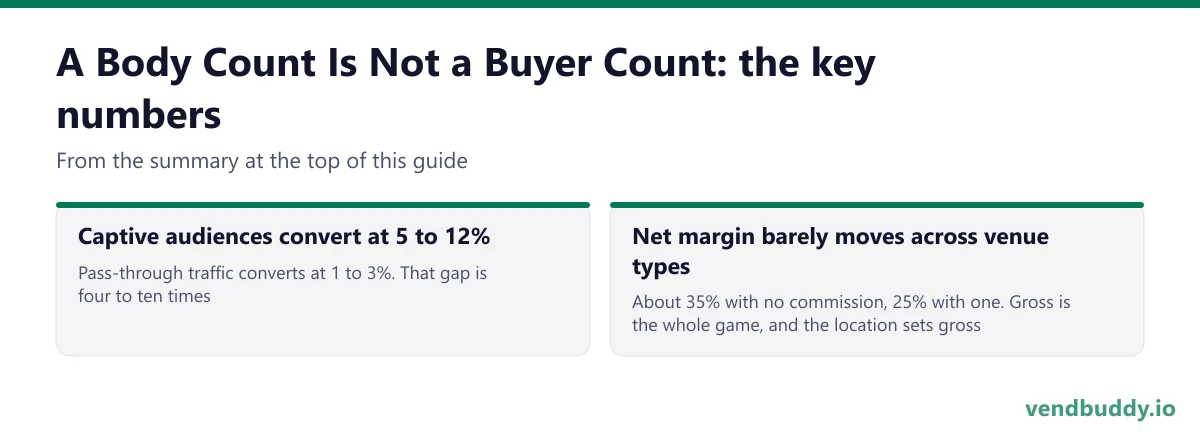
- Captive audiences convert at 5 to 12%. Pass-through traffic converts at 1 to 3%. That gap is four to ten times.
- Net margin barely moves across venue types — about 35% with no commission, 25% with one. Gross is the whole game, and the location sets gross.
- Recount before a building goes on your list, not ninety days after you install a machine in it.
Two buildings. A nursing home with 500 residents, and a 150-unit apartment highrise. On paper the nursing home is more than three times the building. In practice it is the smaller one, and it is not close. If you understand why, you understand the only thing that actually decides what a vending machine earns.
- The number on the sign is not the number that buys
- The head-to-head: 500 residents versus 150 units
- The recount, applied to the categories that fool people
- What capture rate does to the same machine
- Why this matters more than anything you do to the machine
- You can get the building right and still lose half the revenue inside it
- Frequently Asked Questions
The number on the sign is not the number that buys
Vending revenue is three numbers multiplied: how many people pass the machine, what share of them buy, and what they spend. Foot traffic is the obvious one and the least interesting, because everybody overestimates it. Capture rate is where locations separate, and capture rate is decided by something you cannot see from the lot: whether the people walking past are able and free to buy.
A genuinely captive audience — people who cannot easily leave and have nowhere else to go — converts at something like 5 to 12 percent per day. Casual pass-through traffic converts at 1 to 3 percent. That is a four-to-ten-times gap sitting behind two headcounts that look identical on a spreadsheet.
The head-to-head: 500 residents versus 150 units
Walk the nursing home and recount. A large share of those 500 residents do not move freely through the halls. Many do not carry a wallet, let alone a card. Diets are managed, sometimes medically and sometimes by the facility, which means a machine full of chips and soda is actively working against the people whose job it is to manage them.
Strip that out and your customer base is the staff: forty-odd people on shift, some of whom brought lunch. So the 500-person location is a 40-person location with purchasing constraints attached. It might still be a fine placement. It is not the placement the sign out front implied.
Now the highrise. A hundred and fifty households crossing the lobby twice a day — call it 250 to 320 adult trips — every one of them an adult with a card and nobody’s permission to ask for. Then add the thing the nursing home does not have: eleven at night, somebody wants something, the nearest store is closed or a drive, and they are forty feet from your machine in a building they would have to put shoes on to leave.
| 500-resident nursing home | 150-unit apartment highrise | |
|---|---|---|
| Headcount on the sign | 500 residents plus staff | 150 units |
| Who can physically reach the machine | Ambulatory residents plus staff | Every resident, every day, twice |
| Who carries money | Staff, some residents | Effectively all of them |
| Who is permitted to buy freely | Staff. Resident diets are frequently managed | Everyone. Nobody asks permission |
| Recounted buyer base | ~40 on shift | ~250 to 320 adult trips a day |
| Hours of access | Usually staffed round the clock, restricted floors | 24/7, unrestricted, and 11 p.m. is the good hour |
| Honest verdict | A 40-person staff location. Price it as one. | The bigger building, by a distance. |
The question is never how many people are in there. It is how many pass the machine with the ability and the freedom to buy.
Picture the machines paying you while you sleep
That’s the real promise of vending — income that doesn’t cost you your time, and a life on your own terms. VendBuddy turns this guide into a step-by-step plan so you actually build it instead of just reading about it. Start free today.
Start building free →The recount, applied to the categories that fool people
Run this on every building before it goes anywhere near your list. It reorders things fast.
- A school with 900 students is not a 900-person location. The students are in class, many districts restrict what can be sold during the school day, and July and August are near zero — so annualise before you get excited. Your reliable buyers are the front office, the staff lounge, and whoever is there for practice at four.
- A hospital floor is not the patients. It is the visitors sitting six hours with nothing to do, and the night nurses at 2 a.m. That is also why hospitals produce the highest revenue per machine of any category: the captive effect is extreme, and the insurance certificates and vendor registration that make them hard to get into are exactly why those accounts almost never come loose.
- A 250-person corporate office is a hybrid-schedule question. A pre-2020 150-person office running three days a week has the economics of a 60-person office. Call centres are the standout in this category precisely because the workers are desk-bound with scheduled breaks and no outside food access.
- A laundromat is the most consistently overestimated location in this business. Operators see foot traffic and assume it converts, but customers start a load and leave, and average ticket sits near $1.50. Filler stop, rarely a first target.
- A warehouse with 200 workers across three shifts is three buildings. Multiple shifts multiply transactions without multiplying headcount, and the overnight crew has nothing else open to them. This is the most underpriced category in vending and it is not close.
The general form: headcount, minus the people who cannot physically get to the machine, minus the people who cannot pay, minus the people whose purchases somebody else controls, times the number of times a day they pass it. Do that arithmetic on the page, out loud, before you spend a door on the building — and if you have not filtered the list that far yet, the ten-minute drive-by is the cheap way to find out.
What capture rate does to the same machine
Two worked examples, both real shapes, to show what the recount is worth in dollars.
The plant is the ceiling, not the expectation. Your first placement is most likely a mid-size office, an apartment building, a gym, or a small medical practice, and those gross $300 to $800 a month. That is proof, it is a data feed, and it makes the fifth and tenth conversation easier — because you can say I run one at a building like yours and mean it. The full range is in how much vending machines actually make.
Why this matters more than anything you do to the machine
Here is the number that should reframe how you spend your time. Across property types, net margin lands in a narrow band: about 35 percent of gross where you pay no commission, dropping toward 25 percent once a location takes a share. That range moves far less than gross does.
Gross is the whole game, and the location sets gross. The difference between a $30,000-a-year route and a $120,000-a-year route is not four times the machines. It is the same number of machines in better buildings. Which is why product mix, planogram tweaks and pricing — all real, all worth doing, all covered in the product margin guide — are optimizing the last twenty percent of an outcome the address already decided.
You can get the building right and still lose half the revenue inside it
Every door, stairwell, elevator ride and detour between a person’s natural path and your machine costs you sales, and the cost is not small. Nobody buys from a vending machine because they planned to that morning. They buy because it was there when the thought arrived. Move it thirty feet off the path and the thought never arrives.
So an ordinary machine on the walking line beats a better machine in a room just off it. Being seen is the feature. The test takes three minutes: stand where people actually walk — the door they come in, the route to the elevator, the path from the time clock to the floor — and count what sits between that line and the proposed spot. Zero is what you want. Two or more and you discount your revenue estimate rather than argue with it.
Every figure here is an average, and averages hide the building. The revenue calculator lets you plug in the property you are actually looking at and see the range for that type.
Then the part operators forget: the spot is negotiable, and the moment to negotiate it is the conversation, not install day. A yes attached to you can put it in the basement alcove is not a yes to the basement alcove. It is a yes with an opening offer on location. Ask for the upgrade while they are already agreeing with you: would beside the mailboxes work? Same footprint, and it will actually get used. Managers agree more often than operators expect, because to them it is ten feet and to you it is whether the machine pays. More of that conversation is in negotiating the placement.
The recount is only cheap when you already know which buildings are worth recounting. VendBuddy scores real businesses in your ZIP on the things that actually predict buyer count — headcount on site, category, how captive the audience is, and what food sits within five minutes — then hands you the best contact on file for each. Free to start, no card.
Frequently Asked Questions
What are the best locations for vending machines?
The ones with the highest buyer count, which is frequently not the ones with the highest headcount. Warehouses, plants and distribution centres with multiple shifts, hospitals, apartment buildings over about 200 units, genuinely in-office corporate sites of 250-plus, and gyms all tend to score well because their occupants are captive, carry money, and have nowhere convenient to go. A 500-resident nursing home and a 150-unit apartment building look three times apart on paper and land the other way around in practice.
How many people does a vending machine need to be profitable?
Roughly 50 recounted buyers on site is the usual floor, and that word recounted is doing the work. Fifty people who are physically present, carry a wallet or a card, and can reach the machine without asking anyone is a very different number from fifty names on a company website. Genuinely captive audiences convert at something like 5 to 12 percent per day; casual pass-through traffic converts at 1 to 3 percent, which is a four-to-ten-times gap and it is invisible from the parking lot unless you know to look for it.
Is a nursing home a good vending machine location?
Usually as a staff location rather than a resident location, and it should be priced that way. A large share of residents do not move freely through the halls, many do not carry a wallet, and diets are frequently managed either medically or by the facility. Strip that out and your customer base is the staff on shift, which at a 500-resident facility might be forty-odd people. It can still be a fine placement. It is not the placement the sign out front implied.
Are schools good vending machine locations?
A 900-student school is not a 900-person location. Students are in class for most of the day, many districts restrict what can be sold during school hours, and revenue goes to near zero in July and August, so annualise before you get excited. The reliable buyers are the front office, the staff lounge and whoever is there for practice at four. Dorm-adjacent machines with 24-hour access at a college are the good version of this category.
How do you estimate vending machine revenue at a location?
Buyers times capture rate times average ticket times days. Count the door for fifteen minutes at three different times on a normal weekday, count the lot at 10 a.m. and 2 p.m., then recount for who can actually buy. A 50-buyer site that is not fully captive at 8 percent capture and $2.25 a vend is about four vends a day, roughly $190 a month. A 200-worker plant with no food within eleven minutes at 25 percent capture and $2.75 is about 50 vends a day, roughly $4,000 a month. Same operator, same machine, twenty times the revenue.
Related reading: the ten-minute drive-by, the 100-door math, how many people a vending machine needs, the best vending machine locations, the location scoring checklist, and how much vending machines make.
What is selling, which buildings say yes, and the numbers before you buy a machine. Free, confirm from your inbox, unsubscribe in one click. Refer one friend and get 25 VendBuddy credits.
Walk-ins and cold emails find locations. A small site with your own machine photos and a request-a-machine form lets the next one find you. Around machine three to five, an AI builder drafts it in an evening. Wix is the mature site builder; Base44 also builds working tools like a quote form. Start with the AI website walkthrough or Wix vs Base44.
General information, not legal, tax or financial advice. Rules change, so check the official source. Revenue and income figures are examples, not promises. See our terms.