- Desk research is free, the parking-lot count costs 45 minutes. The ten-minute drive-by is the missing filter in between.
- Four questions, from the lobby: is there a machine and what state is it in, is there a spot on the walking line with an outlet, does it feel busy, and can you tell who to ask?
- Five or six in a morning while you are already out on the route.
- Ranks eleven to twenty are where lists die. They sit unverified, so you either never visit them or you walk in cold.
- A neglected machine on site is a green flag, not a red one. Somebody already won the hard argument.
You have twenty ranked buildings. You will run the full 45-minute parking-lot count on the top ten, because 45 minutes apiece is what that costs and ten is what a person will actually do. So what happens to eleven through twenty?
They sit. And because they sit unverified, one of two things happens: you never visit them at all, or you eventually walk in cold on a building you know nothing about — which is the version of prospecting that feels like asking a stranger for a favor. That is where most location lists quietly go stale, and it is a tooling problem rather than a discipline problem.
The fix is a cheaper instrument between the desk and the parking lot. Ten minutes, one pass, no counting.
Scouting is three passes, not one
Most people treat scouting a location as a single activity and then feel bad about not doing enough of it. It is actually three instruments with three different price tags, and the whole skill is spending the expensive one only where it is earned.
| Pass | Cost | What it settles | How many buildings |
|---|---|---|---|
| 1. Desk research | Free, one evening | Size, category, parking, loading access, rough headcount, whether the decision is even made locally | 50 to 60 candidates down to 20 |
| 2. The ten-minute drive-by | 10 minutes each | Whether a building is worth 45 minutes | The 20 — five or six per morning |
| 3. The parking-lot count | 45 minutes each | An actual revenue estimate you can pitch against | The 8 to 10 that survived |
Pass one and pass three are well covered — the location scoring checklist handles the desk criteria and the rubric. This post is about pass two, because it is the one nobody does and it is the reason half your list never gets visited.
The four questions
Park. Walk to the entrance like you belong there. You are not pitching, you are not counting, and you are not going to speak to anyone unless someone speaks to you first. Look for four things.
You are not scouting to find a yes. You are scouting to find out which buildings deserve forty-five minutes of your Saturday.
Picture the machines paying you while you sleep
That’s the real promise of vending — income that doesn’t cost you your time, and a life on your own terms. VendBuddy turns this guide into a step-by-step plan so you actually build it instead of just reading about it. Start free today.
Start building free →What to write down before you drive away
Four answers, one line each, in the car before you pull out. Doing it later means doing it from memory, and memory rounds everything toward whichever building the manager was friendliest at.
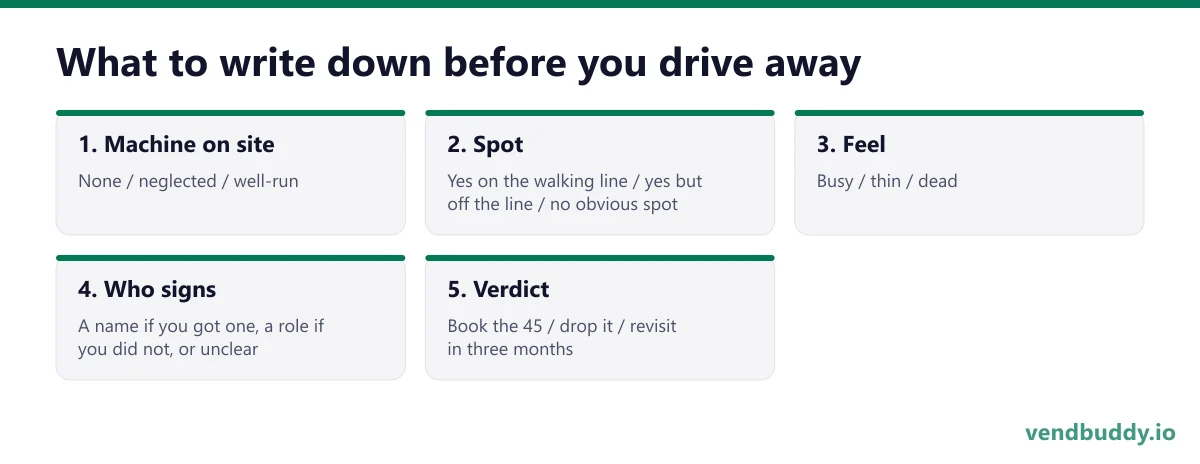
- Machine on site: none / neglected / well-run. Plus a photo if it is neglected.
- Spot: yes on the walking line / yes but off the line / no obvious spot. Note where the outlet is.
- Feel: busy / thin / dead. One sentence of why.
- Who signs: a name if you got one, a role if you did not, or unclear.
- Verdict: book the 45 / drop it / revisit in three months.
Then the ruthless part. A building that produced two soft answers and no obvious spot does not go into maybe. It comes off the list, because a list of twenty maybes is the same as no list at all. Finding more buildings is cheap. Carrying dead ones is what makes prospecting feel hopeless.
Five buildings in a morning
The drive-by is designed to be piggybacked, not scheduled. You are already out servicing machines; the buildings you are curious about are already in the same cluster, because they had better be. So the pattern that actually happens is this one:
- Sunday night, mark five buildings from ranks eleven to twenty that sit within a mile of your Tuesday route.
- Tuesday, service the route as normal.
- Between stops, do the five drive-bys. Ten minutes each plus the drive is roughly ninety minutes added to a morning you were spending anyway.
- By lunchtime you have two buildings promoted to the 45-minute count, two dropped, and one to revisit when the renovation finishes.
Compare that to the alternative, which is that ranks eleven to twenty sit on a list for four months while you tell yourself the area is tapped out. It is not tapped out. It is unverified, and those are very different problems — which is the whole argument of the 100-door math.
What the drive-by buys you in the conversation
There is a second payoff that has nothing to do with filtering. When you eventually walk in, you are no longer a stranger asking for a favor. You are someone who has looked at their building and has a specific proposal about a specific spot.
That changes the opening line from do you take vending machines? — which invites a no from anyone who wants their afternoon back — to something closer to I have been past a few times and noticed the machine by the time clock has been out for a while. One of those is a request. The other is an observation, and observations get answered.
It also makes the closing conversation shorter, because the two things a manager will ask — where would it go, and does it need anything from us — already have answers you worked out from the lobby.
When to skip the drive-by entirely
Two cases. If the building is already in your top three and you were going to run the full count this week anyway, go straight to the count — the drive-by is a filter, and there is nothing left to filter. And if the building is a badged facility you physically cannot enter without an appointment (most hospitals, some plants, secured distribution centres), the drive-by degrades to a parking-lot look and a phone call, which is fine. Those categories are worth the extra friction; the venue rankings explain why the barrier to entry is exactly what makes them durable once you are in.
A drive-by is only cheap if the building was worth driving to. VendBuddy pulls and scores real businesses in your ZIP by headcount, category and how captive the audience is, and hands you the best contact on file for each one — so the twenty names on your list were filtered before you burned a tank of gas on them. Free to start, no card.
Frequently Asked Questions
How do you scout vending machine locations?
In three passes of increasing cost. Desk research (satellite view, street view, a business database filtered by employee count) is free and gets you 50 to 60 candidates. The ten-minute drive-by is the middle filter: park, walk to the entrance, and answer four questions. The 45-minute parking-lot count is the expensive instrument you spend only on buildings that survived the drive-by. Skipping the middle step is why most prospect lists go stale below rank ten.
What do you look for when scouting a vending location?
Four things, in ten minutes, from the lobby. Is there already a machine and what condition is it in? Is there a spot on the walking line with an outlet near it? Does the place feel busy, or does it feel like a building that emptied out in 2020 and never refilled? And can you tell, from where you are standing, who you would ask? Four answers resolve most uncertain buildings into either worth the full 45 minutes or cross it off.
How long does it take to scout a vending location?
Ten minutes for the drive-by and about 45 minutes for the full parking-lot count, which is three fifteen-minute door counts at three different times on a normal weekday. The drive-by exists precisely because 45 minutes is a real cost and nobody will spend it twenty times. Five or six drive-bys fit into one morning while you are already out on the route.
Is a neglected vending machine already on site a good sign or a bad one?
A well-maintained, well-stocked machine from an established operator is close to disqualifying: you would have to displace somebody doing the job well. A neglected machine is the opposite signal and one of the best openings in this business, because the objection you normally spend a week fighting has already been answered by somebody else. The building said yes to vending once. The current operator is simply not showing up.
How many buildings should be on my prospect list?
Twenty ranked buildings, rebuilt every month. An operator with one prospect is not doing outreach, they are doing hope: when that building says no, the week is over and the next building has to be found from scratch while the disappointment is still fresh. An operator with twenty ranked buildings hears the identical no and is standing in front of number five before lunch. Half an hour a month keeps the list live.
Related reading: the 100-door math, a body count is not a buyer count, the location scoring checklist, how to find vending locations, the best vending machine locations, and how to close a location once you are inside.
What is selling, which buildings say yes, and the numbers before you buy a machine. Free, confirm from your inbox, unsubscribe in one click. Refer one friend and get 25 VendBuddy credits.
Every operator we talk to wants fewer cold calls. The ones who get there have a Google Business Profile and a simple site a manager can check before replying. AI builders make that an evening job now. Wix is the mature site builder; Base44 also builds working tools like a quote form. Start with the AI website walkthrough or Wix vs Base44.
General information, not legal, tax or financial advice. Rules change, so check the official source. Revenue and income figures are examples, not promises. See our terms.