- $1M in revenue is about $83,000 a month across the fleet. At a $500 fleet average that is ~165 machines; at $800, ~105; at $1,200, ~70.
- Margin compresses at scale. Owner-operated machines net 25–30% of gross. With drivers, a warehouse and a fleet on the books, low-to-mid teens is normal — so $1M revenue is often a $120k–$200k profit business.
- The org chart is small: the owner as manager, two to four route drivers, a bookkeeper. A driver covers roughly 8–12 machines a day.
- Growth above ~50 machines is bought, not knocked. A 165-machine fleet is about 10,000 building contacts. At 15 a week that is 15+ years.
- This post is the operation, not the story. The timeline version lives in the $0 to $1M journey post — linked below.
Most writing about seven-figure vending is a story: someone started here, did this, and thirty months later crossed a milestone. Stories are useful and we have one — but a story does not tell you what the thing you are trying to build actually is. This post is the blueprint instead: the machine count, the org chart, the buildings, the vehicles, and the shape of the P&L once payroll is in it.
Part of our complete guide: scale a vending machine business.
If you want the timeline — the phases, the capital deployed at each one, the transitions that unlocked scale and the three patterns that stall operators — that is a separate post and it already exists: from $0 to $1M in vending revenue, what the real operator timeline looks like. Read that one for the sequence. Read this one for the anatomy.
The machine count, three ways
$1,000,000 in annual revenue is $83,333 a month in gross across the entire fleet. The only variable that matters is your fleet average, and the fleet average is not your best machine — it is every machine including the four you have been meaning to pull.
| Fleet average gross / machine / month | Traditional machines for $1M/yr | What produces that average |
|---|---|---|
| $500 | ~165 | A large mixed fleet with a long tail of mediocre placements. Very common, and the version most large routes actually are. |
| $800 | ~105 | A well-run fleet where duds get pulled rather than tolerated. |
| $1,200 | ~70 | Genuinely curated. Every building was qualified before a machine went in and the standard never slipped during a growth push. |
Then there is the format lever, which is the one that actually separates modern operations from 1990s ones. A micro market or a bank of smart coolers in a large facility can gross several times what a single snack cabinet does in the same building, because the assortment is bigger, the ticket is higher and the purchase friction is lower. So a $1M operation in 2026 is frequently fewer traditional machines plus a handful of markets rather than a bigger pile of cabinets. The comparison is in micro markets versus vending machines and smart cooler versus micro market.
The org chart is smaller than you expect
This is the part that surprises people who have not seen one. A $1M vending business is not a company with departments. It is typically five to seven people.
- Two to four route drivers. A driver services roughly 8 to 12 machines in a full day depending on density and how much of the fleet has telemetry. On a weekly-or-better cycle, a 150-machine fleet is broadly a three-driver operation once you allow for drive time, warehouse loading, and the days somebody is out. The hiring bar, the pay band and the red flags are in hiring a vending route driver.
- The owner, as a manager. Not on a route. This is the hard part and it is a job change rather than a promotion — the week becomes location acquisition, pricing and product decisions, hiring, and reading the numbers. Owners who cannot make that switch cap out somewhere in the 40s and blame the market.
- A bookkeeper, part-time. Cash-heavy business, multi-vehicle, payroll, sales tax in some states. This stops being optional well before $1M.
- A tech, usually outsourced. Mobile vending techs at a per-visit rate are cheaper than a salaried one until the fleet is very large.
Picture the machines paying you while you sleep
That’s the real promise of vending — income that doesn’t cost you your time, and a life on your own terms. VendBuddy turns this guide into a step-by-step plan so you actually build it instead of just reading about it. Start free today.
Start building free →Warehouse and fleet
The warehouse trigger is not machine count, it is purchasing: the moment you buy at wholesale case quantities to protect margin, you need somewhere to put pallets and somewhere to stage pre-picked loads so drivers are not shopping in the morning. At this scale that is typically 1,500 to 4,000 square feet with pallet racking, cold storage, a loading area and a locked cash room. The earlier decision, including the honest case for staying in a garage longer than feels professional, is in when you actually need a vending warehouse, and the full build-out is in multi-route vending logistics.
Fleet follows the same logic. One van per driver, or a van plus a box truck if you are moving machines regularly. The cost-per-mile arithmetic and the point where a second vehicle pays for itself are in vending route vehicle math.
A 165-machine fleet is roughly ten thousand building contacts. At fifteen a week that is over fifteen years. This is why every large vending business is partly a buyer.
Why growth at this scale is bought, not knocked
Do the arithmetic and the strategy chooses itself. The 100-door math prices a placement at roughly 65 building contacts. So:
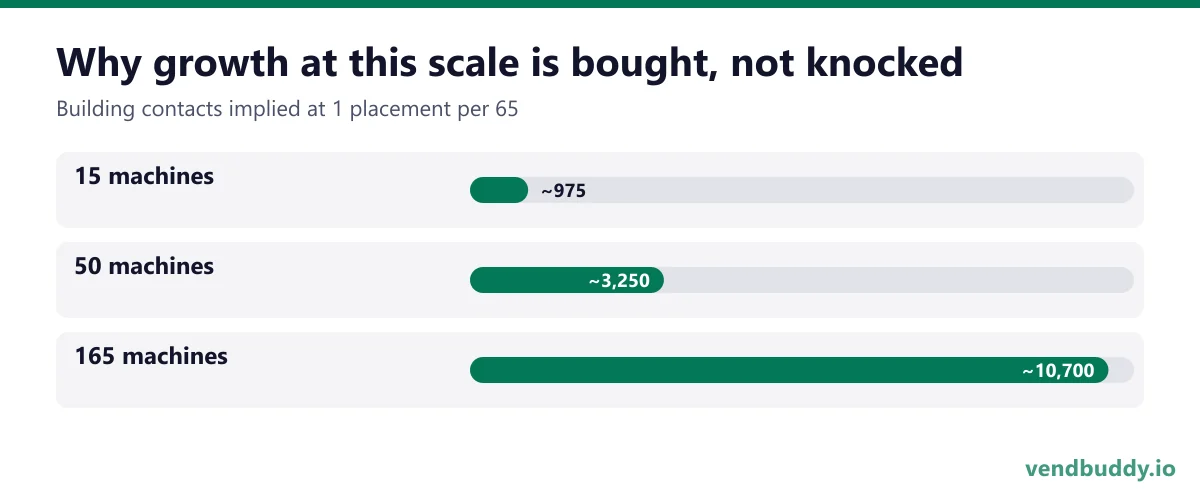
| Fleet size | Building contacts implied at 1 placement per 65 | Years to knock it at 15 a week | Years at 40 a week |
|---|---|---|---|
| 15 machines | ~975 | ~1.4 | ~0.5 |
| 50 machines | ~3,250 | ~4.7 | ~1.8 |
| 165 machines | ~10,700 | ~15.5 | ~5.8 |
Nobody knocks their way to 165 machines inside a decade while also servicing them. What actually happens is that organic placement builds the first 30 to 50, the operation becomes creditworthy and operationally capable of absorbing more, and then growth switches to acquisition. You buy somebody else’s fifteen years of doors.
Two consequences follow, and they are the real content of this section:
- Deal flow becomes a discipline. The best-priced routes are not listed on a marketplace; they belong to operators in their sixties with no succession plan. How that conversation actually starts, and why it is a relationship rather than a listing, is in retiring operators and route deals.
- Due diligence stops being optional. A route is priced off net, typically around 2x to 3x annual net, and every one of those numbers can be dressed up. Contracts that do not transfer, machines at end of life, a single anchor location that is about to leave, telemetry that does not match the deposits. The full checklist is in how to buy a vending route, and the price conversation is in route acquisition price negotiation.
The P&L shape: margin compresses, and that is the trade
Here is the honest part that nobody puts in a thumbnail. A solo operator’s 25 to 30 percent net margin is partly an accounting illusion: their own labour is not in the cost line. Put drivers, a warehouse lease, a fleet, commercial insurance and route software on the books and that margin compresses, commonly into the low-to-mid teens.
Which means a $1M-revenue vending operation is frequently a $120,000 to $200,000 profit business — a real business, a good one, and considerably less than the number the revenue implies. That is arithmetic on typical margin bands, not a projection of any particular operation, and the actual figure swings hard on route density and driver productivity.
Notice what the owner bought with that compressed margin: capacity, and their weekday mornings. A 15-machine owner-operated route can out-earn a 60-machine badly-run one on take-home while costing more hours. Scale is a choice about what kind of job you want, not automatically a better outcome. The stage-by-stage version of that choice is the 0 to 100+ machine roadmap, and the earlier money version is the $100,000 route, gross versus net.
Every operation at this scale still needs organic placement running underneath the deals, because bought routes come with churn and because the next acquisition is priced better when you are not desperate. VendBuddy scores real businesses across your metro by headcount, category and captivity and hands you the best contact on file for each, so a driver-led operation still adds locations every month. Free to start, no card.
Frequently Asked Questions
How many vending machines does it take to make $1 million a year?
Roughly 70 to 170 traditional machines, and the spread is entirely about fleet average rather than about the operator. $1,000,000 a year is about $83,000 a month in gross revenue. At a fleet average of $500 per machine per month that is around 165 machines; at $800 it is around 105; at $1,200, which requires a genuinely curated route, it is around 70. Operations that mix in micro markets and smart coolers hit the same revenue with materially fewer traditional cabinets, because a single micro market can gross what several machines do.
What does a $1 million vending business actually look like?
Usually one owner-manager, two to four route drivers, a leased warehouse in the 1,500 to 4,000 square foot range with racking and cold storage, two or more vans or a van plus a box truck, route management software with telemetry on most of the fleet, and a bookkeeper. The owner is no longer restocking. Their week is location acquisition, pricing and product decisions, hiring and firing, and the numbers. That transition, from operator to manager, is the actual difficulty at this scale.
What is the profit margin on a large vending operation?
Lower than a solo route, and that surprises people. An owner-operated machine nets around 25 to 30 percent of gross because the operator is unpaid labour. Once route drivers, a warehouse lease, fleet costs, insurance and software are real line items, net margins commonly compress into the low-to-mid teens. A $1M revenue operation is therefore often a $120,000 to $200,000 profit business, and the owner has traded margin for capacity and for not driving the route themselves.
Is it faster to buy vending routes or build them?
At this scale it is almost always faster to buy, and the arithmetic is not close. If one placement costs roughly 65 building contacts, a 165-machine fleet represents somewhere near 10,000 contacts. At fifteen contacts a week that is over fifteen years, and even at forty a week it is close to six. Acquiring an established 20 to 40 machine route transfers those placements in a single transaction. That is why growth above roughly 50 machines is usually acquisition-driven, and why due diligence stops being optional.
How many employees does a $1 million vending business need?
Typically two to four route drivers plus the owner, though it depends heavily on route density and machine mix. A driver can service roughly 8 to 12 machines in a full day, so a 150-machine fleet on a weekly-or-better service cycle is broadly a three-driver operation once you account for drive time, warehouse loading and the days somebody is out. Micro markets change that arithmetic because they are serviced less like a machine and more like a small shop.
Do you need a warehouse for a large vending route?
Yes, well before $1M. The trigger is usually buying at wholesale case quantities and staging pre-picked loads so drivers are not shopping in the morning. Typical footprints run 1,500 to 4,000 square feet with pallet racking, a walk-in or reach-in cooler, a loading area and a locked cash room. The step before that, and the honest answer about how long a garage still works, is covered in our warehouse timing guide.
Related reading: the $0 to $1M operator timeline (the story version of this page), scaling from 5 to 50 machines, multi-route vending logistics, how to buy a vending route, and hiring a route driver. Nowhere near this yet? Start with the two-minute readiness quiz instead.
What is selling, which buildings say yes, and the numbers before you buy a machine. Free, confirm from your inbox, unsubscribe in one click. Refer one friend and get 25 VendBuddy credits.
Every operator we talk to wants fewer cold calls. The ones who get there have a Google Business Profile and a simple site a manager can check before replying. AI builders make that an evening job now. Wix is the mature site builder; Base44 also builds working tools like a quote form. Start with the AI website walkthrough or Wix vs Base44.
General information, not legal, tax or financial advice. Rules change, so check the official source. Revenue and income figures are examples, not promises. See our terms.