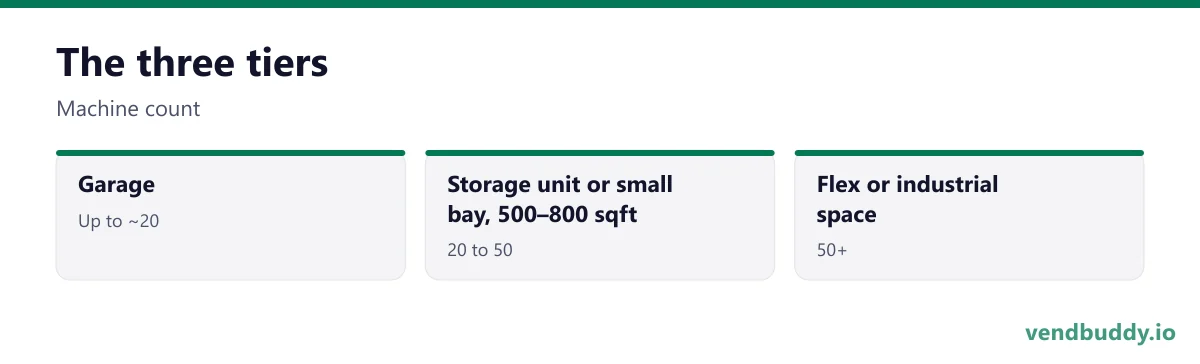
- Garage to ~20 machines. Storage unit or small bay, 20 to 50. Flex or industrial space past 50.
- The trigger is an event, not a number: untracked inventory, needing to stage two route loads, or somebody who is not you needing access.
- Case math: ~1 to 1.5 cases per machine per cycle plus a third for buffer. Ten machines is 13 to 20 cases; thirty is 40 to 60.
- $150–$400 a month for 500 to 800 sqft. Under 2.5% of gross on a $35,000-a-month route.
- Build one tier ahead. The stockroom you need at twenty-five gets built at twelve, or you spend a year one tier behind.
Nobody rents storage because they ran out of space. They rent it because they lost an afternoon looking for a case of something they were sure they had, or because they hired somebody and then realized that person would be letting themselves into the family garage at seven in the morning. Space is what shows up on the invoice. Access and visibility are what actually forced the decision.
So this is the yes-or-not-yet post: the three tiers, what triggers a move between them, the case arithmetic that tells you which tier you are in, and the costs. The build-out itself — shelving spec, hand truck, layout, the full bill of materials — is in the vending warehouse setup checklist, and you should not read it until this post says you have earned it.
The three tiers
| Tier | Machine count | Cost | What moves you off it |
|---|---|---|---|
| Garage | Up to ~20 | $200–$350 once, for shelving and a hand truck | You cannot stage two route loads at once, or somebody who is not you needs access |
| Storage unit or small bay, 500–800 sqft | 20 to 50 | $150–$400/month | You need a receiving area, pallet deliveries, or a labeled staging zone per driver |
| Flex or industrial space | 50+ | Under 2.5% of gross at $35,000/month | Nothing, for a long time. This is where the operation stops being a route. |
Two things to notice. The first tier is free and covers most operators for their entire first two years. And the jump between tiers is triggered by an event in the right-hand column, not by the number in the second — the machine count is a proxy, and like every proxy it is wrong for somebody.
The case math, so you can tell which tier you are actually in
Space requirements in vending are not about machines, they are about cases sitting still. Here is the arithmetic that turns a machine count into shelf feet.
Nobody rents vending storage because they ran out of space. They rent it because somebody who is not them needs to get in at seven in the morning.
Picture the machines paying you while you sleep
That’s the real promise of vending — income that doesn’t cost you your time, and a life on your own terms. VendBuddy turns this guide into a step-by-step plan so you actually build it instead of just reading about it. Start free today.
Start building free →The garage tier, done properly
Up to about twenty machines this is the correct answer and paying rent instead is a straightforward waste. Four things make a garage work, and they total a couple of hundred dollars once.
- Wire shelving, categorized. Three or four heavy-duty sections, one per category, and you label the shelves rather than the boxes. Labeled boxes get moved. Labeled shelves stay put and the system survives somebody else touching it.
- A hand truck. Sixty to a hundred and fifty dollars, and it is the difference between loading in ten minutes and loading in thirty.
- A written count rather than a remembered one. A notes app with quantities prevents the universal failure of buying a third case of something while stocking out on the thing that actually sells.
- Date rotation, every time. Oldest to the front on the shelf and in the machine. Product that leaves inventory without producing revenue runs 1 to 3 percent of gross on an established route — on $10,000 a month that is $1,200 to $3,600 a year, and rotation is the free half of the fix.
The three events that mean it is time to rent
- You are carrying $2,000 to $3,000 of inventory and losing track of it. The tell is buying something you already had, twice in a quarter. At that value, untracked shrink and duplicate ordering cost more per month than a storage unit does.
- You need to stage more than one route load at a time. Once the route splits across two days or two people, staging area stops being a nicety.
- Somebody who is not you needs to pick and pack without you present. This is the real one. A part-time stocker cannot work from your garage at seven in the morning while you are asleep upstairs, and asking them to is how a good hire quietly becomes a scheduling problem. If a driver is on your horizon, the space decision is already made and it comes first.
When that third trigger arrives, the first unit does not have to come from a national self-storage chain. Neighbor is a marketplace for renting other people’s unused garages, bays, and warehouse corners nearby, and the monthly rate often lands well under the $150 to $400 a chain charges for the same 500 to 800 square feet — a cheaper way to take the space one tier ahead without signing a commercial lease. Affiliate link — we may earn a commission if you rent through it, at no extra cost to you.
Notice that none of the three is I have N machines. The count correlates, it does not cause.
Build one tier ahead
The governing principle for all of this: the tracking system you need at fifteen machines gets built at five, and the stockroom you need at twenty-five gets built at twelve. Operators who scale painfully are always one tier behind — setting up the books after eight months of untracked revenue, renting space the week after the hire started, buying shelving the day the floor became impassable.
One tier ahead is not the same as three. Renting 800 square feet at eight machines is the opposite error and it shows up as a fixed cost against a route that has not earned one. The rule is one tier, deliberately, before the pain arrives — and the honest test of whether you are early is whether you can name the specific event the space is about to solve.
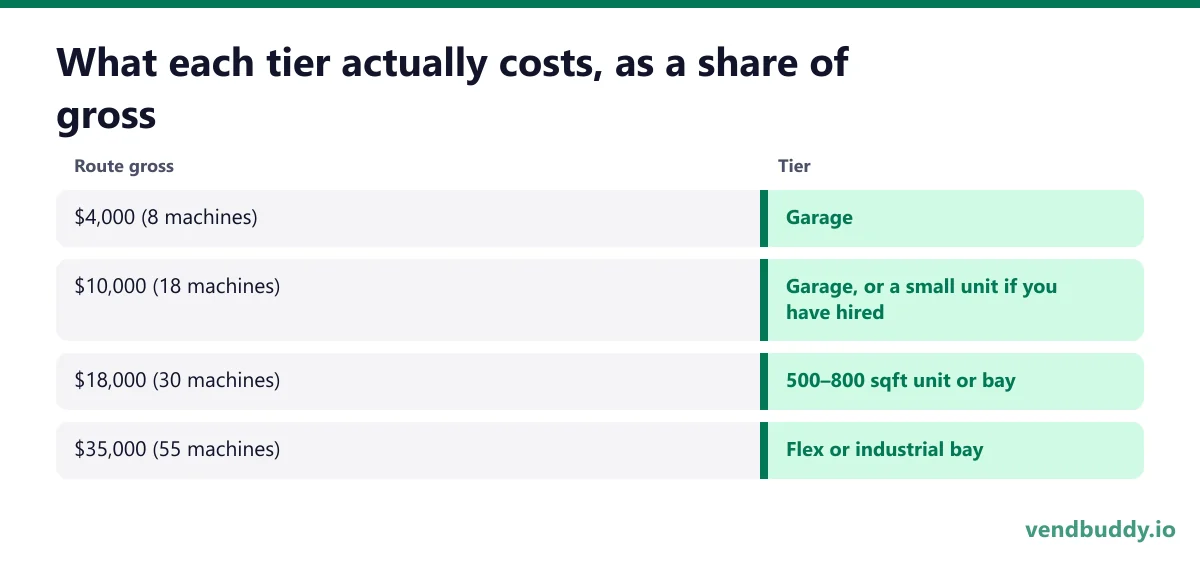
What each tier actually costs, as a share of gross
| Route gross | Tier | Monthly space cost | Share of gross |
|---|---|---|---|
| $4,000 (8 machines) | Garage | $0 | 0% |
| $10,000 (18 machines) | Garage, or a small unit if you have hired | $0–$200 | 0–2% |
| $18,000 (30 machines) | 500–800 sqft unit or bay | $150–$400 | 0.8–2.2% |
| $35,000 (55 machines) | Flex or industrial bay | $600–$850 | Under 2.5% |
If your space cost is running above about three percent of gross, you moved too early or you rented too much. That is a fixable mistake — storage leases are usually short — but it is worth catching before it becomes a year of it. Keep the number in the same monthly review as your route bookkeeping, not in your head.
Once the answer is yes
Then it becomes a build-out problem: what shelving, what layout, what a pick-and-pack workflow looks like, what to spend and what to skip. That is a bill of materials rather than a decision, and it is written out in full in the vending warehouse setup checklist, which does the whole thing for under $1,500 plus the unit.
You can build all of this yourself in a spreadsheet over a weekend. If you would rather not, the operator kits package the same checklists and templates as a one-time download starting at $27.
Two things to settle before you sign anything. Confirm the access hours are genuinely 24/7 if a stocker will use it, because plenty of self-storage sites are gated outside business hours and that single detail can invalidate the entire reason you rented. And confirm the drive-up or dock arrangement will take a pallet delivery, because the moment you are buying at pallet pricing the loading dock is worth more than the square footage.
A warehouse decision is downstream of a placement pipeline. VendBuddy scores real businesses in your ZIP by headcount, category and captivity, hands you the best contact on file for each, and tracks the pipeline — so you are adding machines inside a cluster you already drive rather than adding rent. Free to start, no card.
Frequently Asked Questions
When do you need a warehouse for a vending machine business?
Later than most people think and earlier than most people do it. A garage handles roughly twenty machines. A 500 to 800 square foot storage unit or small bay covers twenty to fifty. Flex or industrial space starts making sense past fifty. But the honest trigger is an event rather than a machine count: you are carrying $2,000 to $3,000 of inventory and losing track of it, you need to stage more than one route load at a time, or somebody who is not you needs to pick and pack without you present.
How much does vending machine storage cost?
A 500 to 800 square foot storage unit or small bay runs $150 to $400 a month in most markets. Flex or industrial space with a receiving area and pallet racking is more, but on a route grossing $35,000 a month a bay like that runs under two and a half percent of gross. A garage costs nothing, which is why the answer for a route under twenty machines is almost always the garage plus $200 of shelving.
How many cases of product does a vending route hold?
Rule of thumb: budget one to one and a half cases of inventory per machine per service cycle, plus a buffer of roughly a third. Ten machines on a ten-day cycle is therefore in the region of 13 to 20 cases in stock at any moment, which is two or three heavy-duty wire shelving units. Thirty machines is 40 to 60 cases, which is a room. The step from shelves to a room is the step that needs rent.
Can I run a vending business out of my garage?
Yes, up to about twenty machines, and most operators should. Four things make a garage work: wire shelving categorized one section per product type with the shelves labeled rather than the boxes, a hand truck, a written count rather than a remembered one, and date rotation every single time. That is $200 to $350 of kit total. The failure mode is not space, it is that nobody else can work in it.
What is the real reason to rent vending storage?
Almost always the third person. A part-time stocker cannot work from your garage at seven in the morning while you are asleep upstairs, and the moment somebody who is not you needs to pick and pack a route load, an attached residential garage stops being a warehouse and starts being your house. Inventory volume and staging space are the reasons people give. Access is the reason it actually happens.
Related reading: the vending warehouse setup checklist, when to hire your first route driver, vending route vehicle math, restocking efficiently, scaling from 5 to 50 machines, and multi-route logistics.
What is selling, which buildings say yes, and the numbers before you buy a machine. Free, confirm from your inbox, unsubscribe in one click. Refer one friend and get 25 VendBuddy credits.
General information, not legal, tax or financial advice. Rules change, so check the official source. Revenue and income figures are examples, not promises. See our terms.