- Price your own hour first. Monthly net profit divided by hours actually worked. Without that number every hiring argument is a feeling.
- The trigger is not tiredness. It is the week you turned down a location because you had no time.
- Under 15 machines, hire part-time. Fifteen to twenty-five is where a dedicated driver starts clearing their own cost.
- A $22/hr driver at 30 hours costs about $3,100 a month all in and can carry a route grossing $28,000 to $35,000.
- Automate before you delegate, and buy the freed hour for something specific, in writing, before you spend the money.
There is a moment in this business that announces itself as a very specific and unwelcome thought: I do not own a business, I own a job that came with machines. It is usually correct. And the decision that fixes it — paying somebody else to touch your machines — gets made on feelings far more often than on arithmetic, which is why so many operators either hire two years too late or hire at eight machines and quietly lose money on it for a year.
This post is the decision, not the process. When the hire pays, what it costs, what the freed hours have to earn to justify it, and the accountability setup that has to exist on day one. When you have decided it is time, hiring your first route driver covers the job description, the interview questions, the W-2 setup and the three-week ride-along.
Price your own hour first
You cannot make a sensible decision about delegating, hiring, buying a van or renting space without this number, and almost nobody has it.
Operator hourly rate = monthly net profit ÷ hours you actually worked that month.
Net, after product, commission, card fees, fuel, repairs and software. If you cannot produce that figure in four minutes, that is its own finding. Say six machines netting $1,650 a month, and twenty-two hours spent, which is what a route looks like before telemetry and pre-kitting compress it. That is about $75 an hour. Now hold it against what the hours actually went to.
| What the hour went to | What that hour is worth | Who should do it |
|---|---|---|
| Driving to a machine that turned out to be three-quarters full | $0 | Nobody. Delete it with telemetry. |
| Restocking, counting, cleaning | $16–$25/hr | A part-time stocker |
| Fixing a validator you have fixed nine times | $95–$150/hr | You, until you can price a quote. Then a tech. |
| Walking into a building and signing a location | The entire future value of that machine | You. This is the job. |
| Renegotiating a commission down two points | Hundreds a year, in ten minutes | You, and it is criminally under-done |
That table is the whole strategy. Every hour you spend on work worth less than your operator rate is an hour you are paying yourself below market to avoid making a decision.
The trigger to hire is not tiredness. It is the week you declined a location because you had no time — that is an appreciating asset traded for an afternoon.
One caveat almost everybody ignores. The arbitrage is only real if the freed hour goes somewhere. Hand off eight hours of restocking a month and let those hours dissolve into ordinary life and you have bought leisure at twenty dollars an hour and made your business less profitable. Decide what the hour is for, in writing, before you buy it back. For most operators at this stage the honest answer is doors — see the 100-door math for what fifteen a week actually buys.
Delegate in this order
The sequence matters more than the timing, and operators who go out of order almost always do it because they hate one specific task.
Before any of it: automate before you delegate. Paying a person to perform a task you could have deleted converts a fixable inefficiency into a permanent line item. Delete the stops telemetry makes unnecessary before you hire someone to drive them.
Picture the machines paying you while you sleep
That’s the real promise of vending — income that doesn’t cost you your time, and a life on your own terms. VendBuddy turns this guide into a step-by-step plan so you actually build it instead of just reading about it. Start free today.
Start building free →The trigger, stated precisely
Two conditions have to be true at the same time.
- Your hours are the constraint on growth — not capital, not demand, not your list. If you could place two more machines this quarter and the only reason you will not is the servicing time, that is the condition.
- You know your operator hourly rate, from real numbers rather than an estimate.
Most operators arrive at both between fifteen and twenty-five machines. And the leading indicator is not tiredness. It is that you declined a location because you had no time. That is the week the hire became overdue, because you just traded an appreciating asset for an afternoon.
What a driver costs and what a driver carries
| Line | Number |
|---|---|
| Wage, 30 hours a week at $22 | ~$2,860/month |
| Employer payroll taxes and mileage | 20–30% on top |
| Payroll software | ~$40/month |
| Workers compensation, one driver | $80–$180/month |
| All-in cost | ~$3,100/month |
| Machines one driver can carry on a designed route | ~25 |
| Gross those 25 machines support | $28,000–$35,000/month |
| Margin after 45% product and 6% commissions | $13,600–$17,100/month |
| Net after the driver | $10,500–$14,000/month |
Two things fall straight out of that table. Under about fifteen machines the full-time version does not work — there is not enough route to fill thirty hours and the fixed costs land on too little gross, so a part-timer is the correct shape. And above about twenty-five the constraint moves from can I afford a driver to is my route dense enough to be worth driving, which is a different problem entirely and is covered in route density versus machine count.
The part-time versus full-time decision at the boundary is its own question with its own answer: part-time versus full-time vending stockers works through the hours, the reliability trade and what changes at the threshold.
The accountability setup, which is not optional
This person handles cash and holds keys to your accounts. The goal is not surveillance theatre — that produces a driver who feels policed and an operator who still cannot tell what happened. The goal is a system where the numbers speak so neither of you has to.
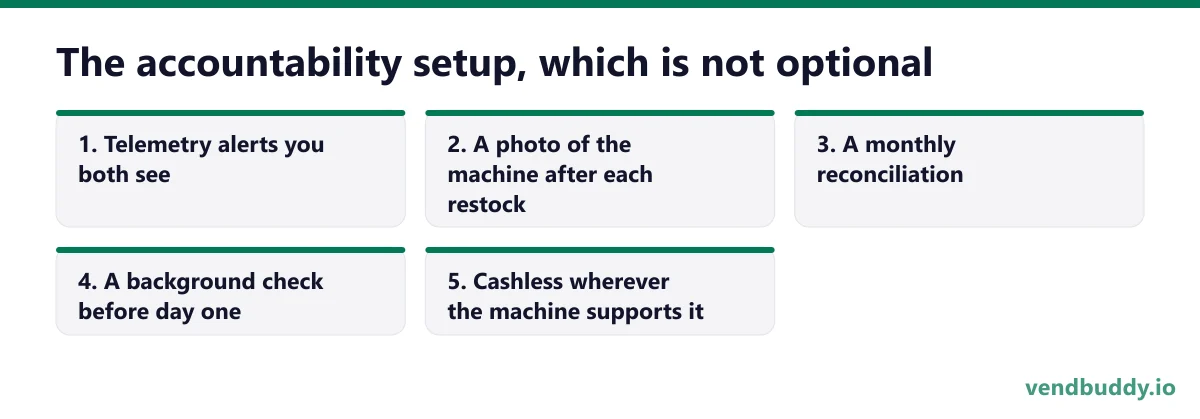
- Telemetry alerts you both see. Shared visibility means you are watching the business rather than the person, and it removes the single most corrosive dynamic in a two-person route: you knowing something they do not.
- A photo of the machine after each restock. Takes four seconds, settles every argument about whether a slot was actually filled, and doubles as your merchandising record.
- A monthly reconciliation of product checked out against product sold. Three to five percent variance is normal — that is stales, spills, miscounts and the occasional free vend. A consistent ten percent is a conversation, not an accusation.
- A background check before day one. Cheap, standard, and the one control you cannot retrofit.
- Cashless wherever the machine supports it. No cash box means nothing to reconcile and nothing worth taking. This is the quiet reason the theft problem is shrinking on its own for operators who let their fleet turn over.
Shared alerts and machine-level sales data are what turn a driver from a trust exercise into a process, and they are the same feed that deletes the drive to a machine that turned out to be three-quarters full. Nayax is the card reader and telemetry stack most multi-machine operators standardize on, and it is the one we point operators at when the route is about to have a second person on it.
When the answer is not yet
Three situations where hiring is the expensive option and something cheaper fixes the same symptom.
- Your route is spread out rather than large. If driving is 50 percent of your time and you have eleven machines across a metro, you do not have a staffing problem, you have a geography problem. Compressing the route is free and hiring is $3,100 a month.
- You are servicing on a calendar rather than on data. An operator with telemetry, par levels and pre-kitted totes spends five to eight hours a week on eight to ten machines. The same eight machines serviced blind take twelve to sixteen. That gap is a hire you do not need to make yet — see restocking efficiently.
- You have not decided what the freed hours are for. If the honest answer is rest, take the rest — but take it by servicing less often, not by paying somebody $3,100 a month to hand you an unallocated Saturday.
The whole case for hiring is that your time moves from restocking to placement. VendBuddy is the placement half: it scores real businesses in your ZIP by headcount, category and captivity, hands you the best contact on file for each, and tracks the pipeline so the freed hours turn into signed agreements instead of errands. Free to start, no card.
Frequently Asked Questions
When should a vending operator hire a route driver?
When two things are true at once: your hours have become the constraint on growth rather than capital or demand, and you know your own operator hourly rate. Most operators arrive at both between fifteen and twenty-five machines. The leading indicator is not tiredness — it is the week you declined a location because you had no time, which means you traded an appreciating asset for an afternoon.
How many vending machines before you hire an employee?
Under about fifteen machines the full-time math does not work and a part-timer is the right shape. Fifteen to twenty-five is where a dedicated driver starts paying for themselves. A driver servicing twenty-five machines on a well-designed route supports roughly $28,000 to $35,000 a month gross, which at 45 percent product cost and 6 percent commissions leaves $13,600 to $17,100 of margin before their pay.
If the spend is going on plastic anyway, the card choice is worth ten minutes. Most operators we talk to land on the Bilt card, not for what it pays on pallets but because the rent payment earns too. Referral link, and the honest caveat is that a carried balance beats what any of these points are worth. Affiliate link, so we may earn a commission at no extra cost to you.
What does a vending route driver cost?
Around $3,100 a month all in for thirty hours a week at $22 an hour, once the employer share of payroll taxes is counted. Pay runs $18 to $20 for entry-level and $21 to $24 for someone out of beverage, food service or parcel delivery, plus the IRS mileage rate if they use their own vehicle. Add payroll software at roughly $40 a month and workers compensation at $80 to $180 a month for one driver.
Should a vending route driver be W-2 or 1099?
W-2. A driver who follows your schedule, drives routes you designed and services your accounts exclusively fails the independent contractor test on every dimension, and calling them a contractor does not change the classification. If you are audited you owe the employer share of payroll tax for the whole relationship plus penalties. This is not a gray area and it is not worth the saving.
How do you stop a vending route driver from stealing?
Design it in rather than police it. Telemetry alerts that you both see, so you are watching the business rather than the person. A photo of the machine after each restock. A monthly reconciliation of product checked out against product sold, where three to five percent variance is normal and a consistent ten percent is a conversation. And a background check before day one, because this person handles cash and holds keys to your accounts. Machines that have gone cashless remove most of the temptation entirely.
What should I delegate before hiring a driver?
Automate before you delegate. Paying a person to perform a task you could have deleted converts a fixable inefficiency into a permanent line item, so kill the unnecessary stops with telemetry first. Then the order is restocking, machine moves, repairs, bookkeeping, and location outreach dead last — because location selection determines what every machine you own is worth, and handing it to somebody paid per placement rather than per good placement outsources growth and quality control in one transaction.
Related reading: hiring your first route driver (the process), part-time versus full-time stockers, when you need a warehouse, when the sedan stops working, how many machines one person can service, and scaling from 5 to 50 machines.
What is selling, which buildings say yes, and the numbers before you buy a machine. Free, confirm from your inbox, unsubscribe in one click. Refer one friend and get 25 VendBuddy credits.
Every operator we talk to wants fewer cold calls. The ones who get there have a Google Business Profile and a simple site a manager can check before replying. AI builders make that an evening job now. Wix is the mature site builder; Base44 also builds working tools like a quote form. Start with the AI website walkthrough or Wix vs Base44.
General information, not legal, tax or financial advice. Rules change, so check the official source. Revenue and income figures are examples, not promises. See our terms.