- The trigger is the second trip, not the machine count. Machine count is just a proxy, and a loose one.
- Sedan to ~6 machines, SUV or minivan to ~12–15, cargo van past 18–25. Pre-kitting moves every one of those numbers up.
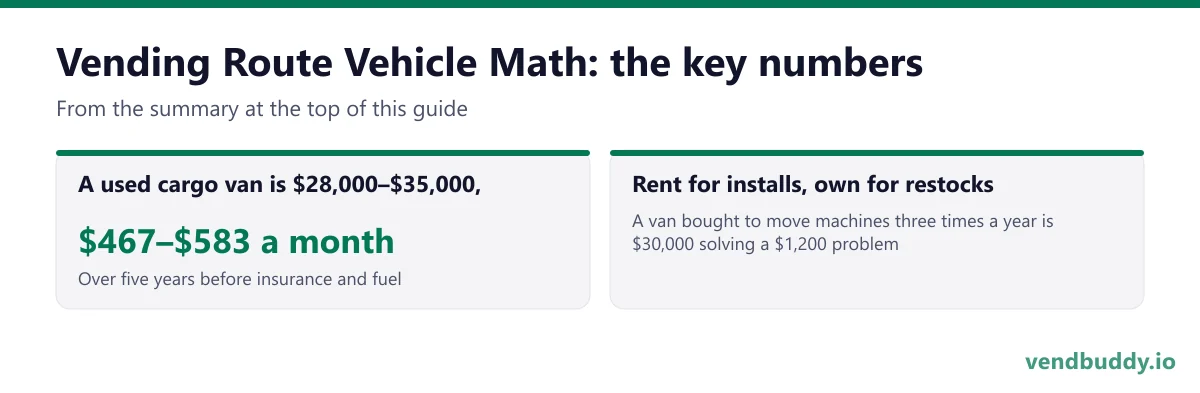
- A used cargo van is $28,000–$35,000, or $467–$583 a month over five years before insurance and fuel.
- Rounding error at $20,000/month gross. A mistake at $5,000. Run it as a percentage of gross, not as a feeling.
- Rent for installs, own for restocks. A van bought to move machines three times a year is $30,000 solving a $1,200 problem.
The vehicle question gets answered emotionally more often than almost anything else in this business, because a van looks like the moment the hobby becomes a company. It is not. It is a fixed monthly cost attached to an asset that does not earn anything by itself, and the only honest way to decide is to work out what the vehicle actually buys you in hours and compare that to what it costs.

Here is that arithmetic, plus the specific event that tells you the sedan is finished.
The capacity ladder
| Vehicle | Machines it realistically supports | What breaks first |
|---|---|---|
| Sedan | ~6, if you are disciplined about pre-kitting | Volume, then your back. Cases go in the trunk and on the back seat, and a full restock of two high-turn machines fills it. |
| Large SUV or minivan | 12 to 15 | Height. You can carry the cases but you cannot stage them, so loading becomes a Tetris problem that adds twenty minutes to every route day. |
| Used full-size cargo van | 18 to 25+ | Nothing, for a long while. This is the standard answer at scale and the point at which shelving inside the vehicle starts paying for itself. |
Treat those numbers as soft. A route of six high-volume plants can outgrow a sedan faster than a route of twelve small offices, because what fills a vehicle is cases per trip and not machines on a list. And pre-kitting — picking each machine’s exact load into a labeled tote at home instead of carrying general stock and deciding at the machine — moves every row in that table up by a machine or three, for the price of some totes.
The actual trigger: the second trip
Forget the machine count for a second. The event that says the vehicle is finished is this one: you started making a second trip because the first load did not fit.
That is the trigger because it is the only one that converts directly into money. A second trip is not an inconvenience, it is your route length plus the drive home plus the drive back out, on a schedule that repeats every service cycle for as long as you own those machines.
The trigger is not the machine count. It is the day you start making a second trip because the first load did not fit.
So price it. Say the second trip costs you 75 minutes door to door and happens twice a month. That is 2.5 hours a month, 30 hours a year. If your operator hourly rate is $75, the second trip is costing you roughly $2,250 a year in time before you count the fuel. That is the number the van has to beat.
Picture the machines paying you while you sleep
That’s the real promise of vending — income that doesn’t cost you your time, and a life on your own terms. VendBuddy turns this guide into a step-by-step plan so you actually build it instead of just reading about it. Start free today.
Start building free →The worked comparison
Two routes, same operator, same van quote. The van is a good decision in one of them and a bad one in the other, and nothing about the vehicle changed.
| Route A: 9 machines, $5,000/mo gross | Route B: 22 machines, $20,000/mo gross | |
|---|---|---|
| Trips per service cycle | 1, with room to spare | 2, every cycle, without fail |
| Hours the van saves per month | ~0 | ~5 |
| Value of those hours at $75/hr | $0 | $375 |
| Van amortization (5 yr on $30k) | $500 | $500 |
| Commercial insurance | $120–$300 | $120–$300 |
| Fuel delta versus current vehicle | +$60–$140 | +$60–$140 |
| All-in monthly cost | ~$680–$940 | ~$680–$940 |
| Cost as a share of gross | 14–19% | 3.4–4.7% |
| Verdict | No. This is a mistake dressed as an upgrade. | Yes, and it was probably due two machines ago. |
The share-of-gross line is the one to internalise. A vehicle running at 14 percent of gross is competing with your product cost for the top of the P&L. At 3 to 4 percent it disappears into the noise, and the five hours it hands back go into doors instead of driving. That, not the badge on the side, is the whole argument.
Rent for installs, own for restocks
The most common bad reason to buy a van is machine moves. Do not let a rare, heavy task drive a permanent monthly cost.
- Machine moves are rare. You will do perhaps three a year at a small route size, and the move itself is the one job where doing it yourself risks your back, the machine, and somebody’s doorframe.
- Liftgate freight with inside delivery runs $150 to $400 per move. Three of those a year is $450 to $1,200, against $8,000 to $11,000 a year of van ownership.
- Renting a box truck for an install day costs $80 to $150, and a rental with a ramp and a load rating beats your own van for exactly this task anyway.
- Do not move a full-size machine in a cargo van without the right gear regardless. A machine that shifts in transit is a destroyed cabinet and a hospital visit — moving a machine solo covers the actual mechanics.
Own the vehicle for the thing that happens every week. Rent for the thing that happens three times a year.
The step nobody talks about: the in-between years
Between the sedan and the van there is a stretch of eighteen months or so where the honest answer is neither. Three moves that buy you that time for close to nothing:
If you have decided to buy
- Used, not new. A vending route does not need a warranty on a vehicle that will spend its life at 30 mph between industrial estates. The depreciation on new is the single most expensive line item you can volunteer for.
- Cargo, not passenger. Windows and rear seats are weight and glass you will never use, and a cargo shell takes shelving without a fight.
- Shelve it immediately. An unshelved van is a bigger version of the trunk problem: everything slides, nothing is findable, and you lose the loading time you bought the vehicle to save.
- Insure it commercially. A personal policy on a vehicle used for business is a claim waiting to be denied, and once anyone else drives it you are into hired and non-owned auto liability territory — which is one of the costs that lands alongside your first driver.
- Do not finance it on the same instrument you are financing machines with. A machine pays for itself out of a location. A van does not pay for itself out of anything — it saves time — so it should never be competing for the credit line your next placement needs. Financing options compared covers which instrument fits which purchase.
Most vehicle problems are geography problems wearing a disguise: machines scattered across a metro fill a van with driving rather than product. VendBuddy scores real businesses in your ZIP so the next placement lands inside the cluster you already drive, with the best contact on file attached. Free to start, no card.
Frequently Asked Questions
What is the best vehicle for a vending machine business?
Whatever you already own, for as long as it fits the load. A sedan works to about six machines if you are disciplined about pre-kitting. A large SUV or minivan gets you to twelve or fifteen. Past eighteen to twenty-five machines a used full-size cargo van is standard. The correct upgrade is the cheapest vehicle that ends second trips, not the most professional-looking one.
When should a vending operator buy a cargo van?
The trigger is an event, not a machine count: the day you start making a second trip because the first load did not fit. Machine count is a proxy for that event and it is a loose one, because a route of six high-volume plants can outgrow a sedan faster than a route of twelve small offices. If you are making one trip and finishing with room in the back, the van is a purchase looking for a justification.
How much does a cargo van cost for a vending route?
A used full-size cargo van runs roughly $28,000 to $35,000, which amortized over five years is $467 to $583 a month before insurance, fuel and maintenance. Commercial insurance typically adds $120 to $300 a month. Against a route grossing $20,000 a month that is a rounding error. Against $5,000 a month it is a mistake dressed as an upgrade.
Do you need a van to move a vending machine?
No, and you should not buy one for that reason. Machine moves are rare, heavy, and the one task where doing it yourself risks your back, your machine and a doorframe. Liftgate freight with inside delivery runs $150 to $400 per move and you will do it perhaps three times a year. Renting a box truck for an install day costs $80 to $150. Buying $30,000 of vehicle to avoid a $400 charge three times a year is not a saving.
Is a vending business vehicle tax deductible?
A vehicle used for the business is generally deductible, either through actual expenses or the standard mileage rate, and the rules around first-year expensing of a qualifying vehicle change regularly. That is a conversation for your own accountant rather than a blog post, and the deduction should never be the reason for the purchase — a deduction returns a fraction of the money, so buying something you did not need to save tax still costs you most of it.
Related reading: when you need a warehouse, when to hire your first route driver, route density versus machine count, restocking efficiently, multi-route logistics, and moving a vending machine solo.
What is selling, which buildings say yes, and the numbers before you buy a machine. Free, confirm from your inbox, unsubscribe in one click. Refer one friend and get 25 VendBuddy credits.
Every operator we talk to wants fewer cold calls. The ones who get there have a Google Business Profile and a simple site a manager can check before replying. AI builders make that an evening job now. Wix is the mature site builder; Base44 also builds working tools like a quote form. Start with the AI website walkthrough or Wix vs Base44.
General information, not legal, tax or financial advice. Rules change, so check the official source. Revenue and income figures are examples, not promises. See our terms.