- Every dollar of vending revenue is downstream of a conversation. Which building you got into, what commission you agreed to, what the location let you add, whether they renewed — all of it was settled by talking, not by the machine.
- The machine is the commodity. The conversation is not. Two operators buy identical equipment at identical prices and end up with routes that look nothing alike.
- Four levers, all verbal: location quality, commission terms, in-location upsells, and renewals. None of them are equipment decisions.
- Sales skill costs a few hundred conversations and nothing else. A second machine costs thousands and does not improve the first one.
- The scenario below is illustrative arithmetic, not a forecast. Your numbers depend on your buildings, your prices and your market.
Two operators start the same month. Both buy five machines. Both pay roughly the same for equipment, freight, and the first product fill. Eighteen months later one of them is running a route that comfortably covers a car payment and the other is quietly listing machines on Facebook Marketplace.
- Every dollar is downstream of a conversation
- The same five machines, two operators
- Lever 1 — you close better buildings, not more buildings
- Lever 2 — commission is a conversation, not a market rate
- Lever 3 — the upsell nobody makes
- The fastest revenue lift: add a card reader
- Lever 4 — renewals are cheaper than anything else you will ever do
- The reluctance tax
Part of our complete guide: how to find vending machine locations.
The difference is almost never the machines. It is not the software, the planogram, the wrap, or the city. It is that one of them got good at the four conversations this business is actually made of, and the other treated those conversations as an unpleasant toll on the way to owning equipment.
Here is the uncomfortable framing: sales skill is the cheapest piece of equipment you can add to a vending route. A second machine costs thousands of dollars, needs a location you do not have yet, and does nothing at all for the machines you already own. Getting materially better at asking for things costs a few hundred conversations and improves every placement you will ever make, including the ones already installed.
Every dollar is downstream of a conversation
Trace any line of vending revenue backwards and it terminates in something somebody said out loud.
- The machine earns what it earns because of which building it is in — decided in a placement conversation.
- You keep a given share of that gross because of the commission you agreed to — decided in a negotiation.
- The machine holds what it holds because of what the location let you put in it, and whether they let you add cashless, a second machine, or a requested product line — decided in a follow-up conversation months after install.
- The location is still yours in year three because somebody stayed in touch — decided in a dozen thirty-second conversations nobody logged.
Not one of those four is an equipment decision. They are all sales, and three of the four happen after the machine is already plugged in, which is the part most operators never internalize. The pitch is not the job. The pitch is the first quarter of the job.
Most people working on the pitch start by pulling the list rather than driving the map. The ranks the businesses around your ZIP by type and headcount, and the first five contact reveals are free.
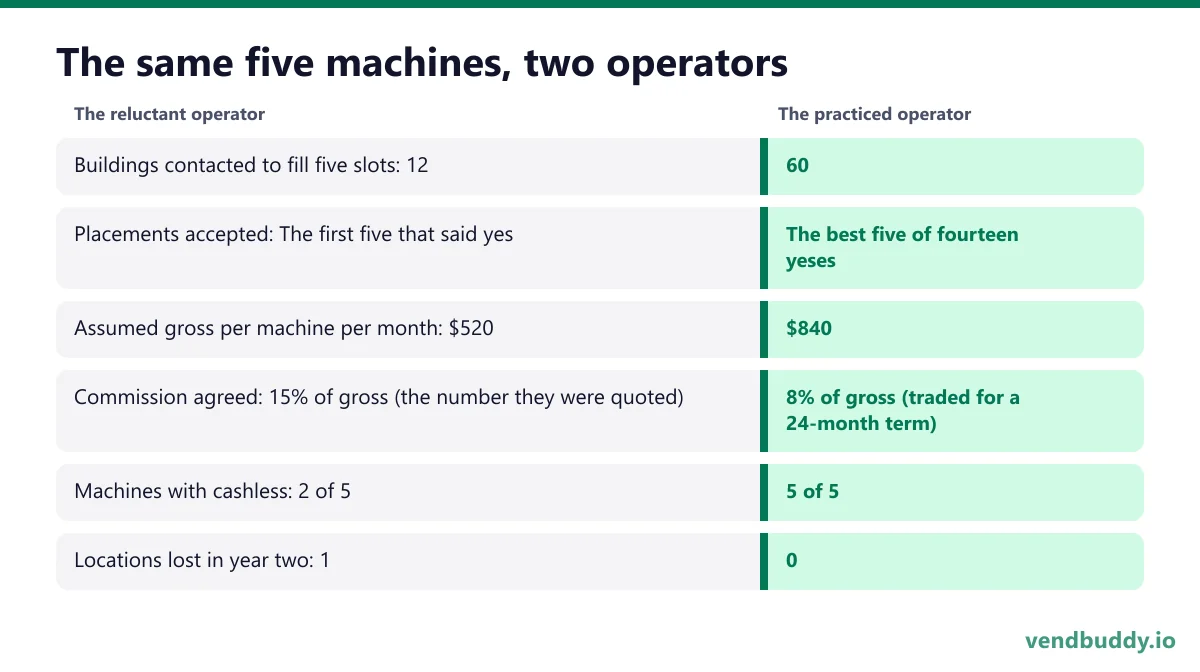
The same five machines, two operators
What follows is an illustrative scenario built from stated assumptions, not a projection and not a promise of results. It exists to show where the gap between two operators actually opens up, not to tell you what you will earn. Both operators own five machines. Both bought the same equipment.
| The reluctant operator | The practiced operator | |
|---|---|---|
| Buildings contacted to fill five slots | 12 | 60 |
| Placements accepted | The first five that said yes | The best five of fourteen yeses |
| Assumed gross per machine per month | $520 | $840 |
| Commission agreed | 15% of gross (the number they were quoted) | 8% of gross (traded for a 24-month term) |
| Machines with cashless | 2 of 5 | 5 of 5 |
| Locations lost in year two | 1 | 0 |
Run it at a 45% cost of goods, which is a common planning figure and not a law of nature:
| Monthly | Reluctant | Practiced |
|---|---|---|
| Gross across five machines | $2,600 | $4,200 |
| Cost of goods at 45% | −$1,170 | −$1,890 |
| Location commission | −$390 | −$336 |
| Left before fuel, fees and time | ~$1,040 | ~$1,974 |
Same capital. Same machines. Roughly double the money left over, and none of the difference came from equipment. It came from walking into sixty buildings instead of twelve so there was something to choose between, from asking about the commission number instead of accepting it, and from finishing the cashless rollout instead of getting to two machines and losing momentum.
Two honest caveats, because this is arithmetic and not a forecast. First, the practiced operator did roughly five times the outreach work to fill the same five slots — the skill did not remove the labour, it made the labour worth more. Second, both gross figures are assumptions. Your buildings will produce what your buildings produce, and no article can tell you what that is.
Sales skill is the cheapest piece of equipment you can add to a vending route. A second machine costs thousands and does nothing for the machines you already own.
Picture the machines paying you while you sleep
That’s the real promise of vending — income that doesn’t cost you your time, and a life on your own terms. VendBuddy turns this guide into a step-by-step plan so you actually build it instead of just reading about it. Start free today.
Start building free →Lever 1 — you close better buildings, not more buildings
The most expensive sentence in vending is “well, they said yes.”
An operator who can only convert a handful of conversations has no ability to be fussy. Every yes is precious, so every yes gets accepted, including the twenty-employee office with a coffee shop next door and the apartment building whose residents all drive past a supermarket on the way home. That machine will underperform for its entire life and the operator will conclude that vending does not work.
An operator who is comfortable in the conversation generates more yeses than they have machines for, which converts placement into a selection problem instead of a survival problem. That is the actual mechanism. Sales skill does not make a bad building good. It gives you enough options that you never have to install into a bad building in the first place.
What that looks like in practice is unglamorous: a bigger top of funnel, run at a steady weekly rate. The arithmetic of how many buildings you have to walk into for one placement is laid out in the 100-door math, and the checklist for grading a building before you say yes is the location scoring checklist. If you are starting from zero, the whole sequence sits inside how to start a vending machine business.
Lever 2 — commission is a conversation, not a market rate
Ask ten operators what a vending commission “should” be and you will get a range wide enough to drive a truck through, because there is no rate. There is only what was agreed.
The reluctant operator hears “the last vendor gave us fifteen” and pays fifteen. The practiced operator hears the same sentence as an opening position and starts trading, because commission is one variable in a placement and never the only one. Things a location frequently values more than points:
- Term length. A property manager who wants to stop thinking about this will often take two points less for a longer commitment.
- Restock frequency and response time. The previous vendor let it sit empty. A written service standard is worth real money to a facilities person whose complaints inbox is the actual problem.
- Product requests. Stocking the three items the staff keep asking for costs you almost nothing and reads as partnership.
- Who pays the electric. Frequently assumed rather than discussed, and frequently negotiable in both directions.
- Exclusivity. If you are giving it, charge for it in points.
The full version of that trade, including which concessions to give away first and which to refuse, is in the vending placement negotiation playbook, and the range of what operators actually agree to is in vending machine commission rates. The point for this article is narrower: a few points of commission across a five-machine route is real money every month, forever, and it is decided in about ninety seconds of conversation by whichever party is more comfortable being slightly awkward.
Lever 3 — the upsell nobody makes
Here is a revenue line that almost no new operator touches: selling more to a location you already have. It is the cheapest sales you will ever do, because the hard part — getting a stranger to trust you with their lobby — is already finished.
Three upsells that live inside an existing placement:
- A second machine or a second machine type. A snack machine that performs earns you the right to ask about a drink machine. Most operators never ask.
- Product-mix changes the location asks for. Every facilities manager has a list of what staff complain about. Getting that list is one question, and acting on it is the cheapest goodwill in this business.
- Cashless payment. Which is a revenue conversation with the location as much as a hardware decision — the site benefits too, because a machine that only takes cash generates complaints that land on their desk, not yours.
That last one deserves its own paragraph, because it is the upsell with the clearest mechanism. A cash-only machine is functionally invisible to a large share of anyone under thirty, and the person who walks away from it does not tell you — they tell nobody, and the sale simply never happens. Framed to the location as “your staff have been asking to tap, I would like to fix that,” it is not a sales pitch at all. It is a service improvement you happen to profit from.
The fastest revenue lift: add a card reader
Across operator surveys and our own route data, adding cashless lifts per-machine revenue 30–50% within 60 days — cash-only machines are functionally invisible to most customers under 30. Nayax is the reader most multi-machine operators standardize on: reliable hardware, strong telemetry, and wide machine compatibility — it is also the one live reader integration inside VendBuddy. Our full breakdown of what the monthly fee buys, and when to skip it, is in the Nayax review for operators.
Lever 4 — renewals are cheaper than anything else you will ever do
The cheapest location you will ever land is the one you already have. Keeping a placement costs a few short conversations a year. Replacing one costs sixty-five building contacts, several weeks, and an install day.
Operators lose locations for boring, preventable reasons: a machine that sat empty over a holiday, a price rise that arrived without warning, a new facilities manager who never met the vendor and treats an unfamiliar machine as clutter, a competitor who walked in with a proposal while you had not been seen since install.
Every one of those is a communication failure rather than an operational one. The fix is a fifteen-minute habit: introduce yourself to whoever is new, tell the site before you raise a price rather than after, drop a short note when you have changed the mix at their request, and be a face rather than an unmarked machine. Operators who do this keep locations for years. Operators who do not rebuild a fifth of their route annually and call it the cost of doing business.
When it does go wrong, it is usually recoverable — the recovery playbook for when a property manager says no covers the version where you get the conversation back, and taking over an existing vendor contract is the same skill pointed at somebody else’s neglected placement.
The reluctance tax
Add up what the reluctant operator paid for not wanting to have these conversations, and the bill is itemizable:
- They installed into buildings they should have walked away from, because they had no alternatives.
- They paid the first commission number they were quoted, on every machine, every month.
- They never asked for the second machine at the location that would have said yes.
- They finished cashless on two machines out of five and left the rest cash-only.
- They lost a location to inattention and spent six weeks replacing it.
None of those are equipment failures and none of them are fixed by buying anything. They are all the same failure wearing five different costumes: an unwillingness to be slightly uncomfortable for ninety seconds.
Which is good news, because it makes this the one input in the business you can improve for free. You cannot talk your way to cheaper machines or better cost of goods. You can absolutely talk your way to better buildings, better terms, and locations that renew.
Worth noting on the cost of goods: the route spend is the smaller half of this. The bigger line is the rent or mortgage payment, which normally earns nothing. Per its card page the Bilt card earns up to 1.25X on that payment with no transaction fee, and the no-fee Blue tier earns 1X on everything else. Referral link, and it only works if you clear the balance every month. Affiliate link, so we may earn a commission at no extra cost to you.
What this is not
Two things this article is deliberately not claiming.
It is not claiming that sales skill produces a specific income. Nothing here is an earnings projection. The tables above are arithmetic run on stated assumptions to isolate one variable, and your results will depend on your market, your buildings, your pricing, your costs and a good deal of ordinary business risk.
It is also not claiming that being pushy works. Nearly everything above is about asking a second question, not about pressure. The operators who do best in this business are usually the ones who are easy to deal with and impossible to forget, which is a very different personality than the one people picture when they hear the word sales. If you have been assuming this business is closed to you because you dislike selling, can an introvert run a vending business is the direct answer, and it is yes.
Where to start
If the argument lands, the next two pages are the practical half of it. The 30-day practice plan is how you actually get better — daily quotas, the objection pattern, recording yourself, and the follow-up cadence that wins locations on touch three to five. The seven no’s every operator hears decodes what each rejection actually means and gives you the response for each one.
For the words themselves, the cold pitch script that works covers the walk-in and cold email scripts for vending contracts covers the buildings that will not let you through the door. The full pre-pitch checklist — what to have ready before you walk in — is the essentials to land vending locations.
Sixty building contacts is the work. Building a list of sixty buildings actually worth contacting is the part that quietly does not get done. VendBuddy scores real businesses in your ZIP by headcount, category and captivity, then hands you the best contact on file for each one, so the prep is ten minutes instead of an evening with a notebook. Free to start, no card.
Frequently Asked Questions
Do you need sales skills to run a vending machine business?
You need them more than you need any other skill in this business, because every other input is bought at roughly the same price by everyone. Machines cost what they cost. Product costs what it costs. The two things that vary enormously between operators with identical equipment are which buildings they managed to get into and what terms they agreed to once inside, and both of those are settled in conversations. An operator who is comfortable asking for things ends up with a different route than one who is not, using the same capital.
How much does a better location actually change vending revenue?
The spread between a quiet placement and a busy one is commonly several fold rather than a few percent, which is why placement quality dominates almost everything else you can optimize. The same machine, the same planogram and the same prices produce very different monthly gross depending on how many people walk past it and whether they have another option within a two-minute walk. That gap is created before the machine is installed, in the decision about which building to pursue and whether you were persuasive enough to get in.
Are vending commission rates negotiable?
Almost always, and the number you are quoted is usually an opening position rather than a policy. Commission is one of several levers in a placement conversation, alongside term length, exclusivity, who pays for electricity, restock frequency and product requests. Operators who treat the first number as fixed tend to pay it. Operators who treat it as one variable among several often trade something the location values more, such as a longer commitment or a specific product line, for points back.
Can an introvert be good at vending sales?
Yes, and often better than the natural talker, because this job rewards preparation and follow-through rather than charisma. The conversations are short, repetitive and largely scriptable, the same eight or so objections come up over and over, and the operator who wins a location is usually the one who followed up on schedule rather than the one who was most charming in the doorway. What an introvert has to build deliberately is the habit of initiating, not the ability to converse.
What is the highest-leverage sales skill for a vending operator?
Asking a second question after the first no. Most placement conversations end at the first soft objection because the operator hears a decision where the location gave a reflex. The single behaviour that changes route economics more than any script is staying in the conversation long enough to find out what the no actually meant, then answering that rather than the words that were said.
Related reading: the 30-day sales practice plan, the seven no’s and what they mean, negotiating vending placements, the 100-door math, how to find vending machine locations, and why most operators fail in year one.
What is selling, which buildings say yes, and the numbers before you buy a machine. Free, confirm from your inbox, unsubscribe in one click. Refer one friend and get 25 VendBuddy credits.
Walk-ins and cold emails find locations. A small site with your own machine photos and a request-a-machine form lets the next one find you. Around machine three to five, an AI builder drafts it in an evening. Wix is the mature site builder; Base44 also builds working tools like a quote form. Start with the AI website walkthrough or Wix vs Base44.
General information, not legal, tax or financial advice. Rules change, so check the official source. Revenue and income figures are examples, not promises. See our terms.