- Sales is a motor skill, not a personality. It responds to rep count the way a golf swing does, and almost nobody reading this has enough reps for their conclusions about themselves to mean anything.
- Four numbers, tracked for 30 days: contacts made, conversations reached, follow-ups sent, placements agreed. Everything else is noise.
- One objection pattern, used every time: acknowledge → empathize → bridge. Learn it once, use it on all seven common no’s.
- Record yourself in week 3. It is the single most unpleasant and most effective hour in the plan.
- Most placements close on touch 3 to 5 — which is exactly where most operators have already stopped following up.
Nobody is born able to walk into a building they have never been in, find a stranger, and ask for floor space. That is a learned skill with a rep count, and the reason most operators believe they are bad at it is that they have done it eleven times.
Part of our complete guide: how to find vending machine locations.
Eleven reps is not a verdict on your ability. It is not even a warm-up. This page is a thirty-day plan for getting past that — a specific weekly volume, one objection pattern to drill, a recording exercise, and the follow-up cadence that turns conversations into placements. It assumes nothing about your personality and it does not ask you to become someone else.
Start here: it is a motor skill
Watch what happens to a new operator at door six versus door sixty. At door six the opening is memorized and stiff, the objection lands like a slap, and the exit is fast. At door sixty the opening is conversational because it has stopped being a performance, the objection is recognized as one of a small set, and the exit is a scheduled follow-up rather than an escape.
Nothing about the person changed. The pathway got worn in. That is what practice does, and it is why the plan below is organized around volume first, quality second. You cannot refine a pitch you have not delivered enough times to hear yourself giving.
Most people working on the pitch start by pulling the list rather than driving the map. The ranks the businesses around your ZIP by type and headcount, and the first five contact reveals are free.
The four numbers
Track these and nothing else. On paper, on an index card, on your phone — the medium is irrelevant, the daily entry is not.
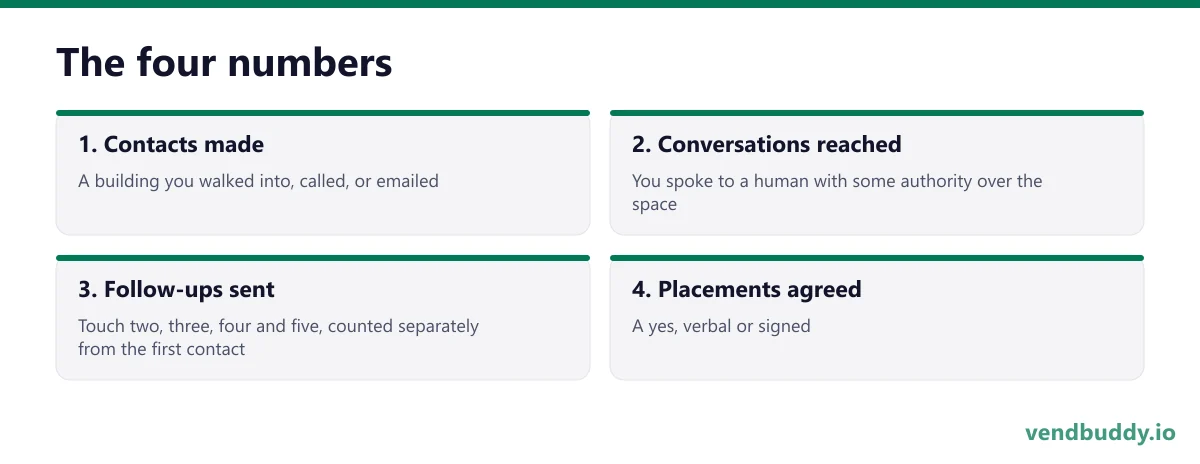
- Contacts made. A building you walked into, called, or emailed. Not a building you drove past and considered.
- Conversations reached. You spoke to a human with some authority over the space.
- Follow-ups sent. Touch two, three, four and five, counted separately from the first contact.
- Placements agreed. A yes, verbal or signed.
The ratios between those four tell you which part of your process is broken, and they are the only diagnostic that does. A low conversations-to-contacts ratio is a list or timing problem, not a pitch problem. A healthy conversations number with no placements is a pitch or follow-up problem. Diagnosing without the numbers is how operators spend three months rewriting a script that was fine and never fix the list. The full leak-reading table lives in the 100-door math.
Picture the machines paying you while you sleep
That’s the real promise of vending — income that doesn’t cost you your time, and a life on your own terms. VendBuddy turns this guide into a step-by-step plan so you actually build it instead of just reading about it. Start free today.
Start building free →Week 1 — volume, with nothing at stake
Target: 15 building contacts. Zero of them should be a building you actually want.
This is the week that fixes the nerves, and it works precisely because the outcome does not matter. Independent shops, laundromats, barbershops, tyre places, small single-site gyms, family restaurants. A no from any of them costs you a building you were never going to install in.
Rules for week one:
- Same opening every time. Two sentences, memorized, delivered identically at all fifteen. You are testing one thing, so you only get to change one thing.
- Ask for the decision-maker by role, not by name. “Who handles the break room?” travels further than “is the owner in?”. Who that person is by venue type is mapped in the decision-maker map.
- Write down the exact objection words before you get back in the car. Not your summary of them — their words. By Friday you will have fifteen of them and you will notice they are the same four sentences.
- Do not pitch a machine. Ask a question about their space. The pitch comes later; week one is about staying in the room.
By day five, most people discover that the thing they were afraid of — being thrown out, being laughed at — does not happen. The realistic worst case is a distracted person saying “no thanks” while looking at a screen. That is it. That is the monster.
Week 2 — acknowledge, empathize, bridge
Target: 15 contacts, and one pattern used on every objection.
This is the core skill of the whole business and it has three steps in a fixed order. Learn it once; it works on all seven of the common no’s.
- Acknowledge. Repeat what they said back, plainly, so they know you heard it and are not winding up to argue. “You already have a machine — got it.”
- Empathize. Name the reason underneath the objection out loud. It is nearly always a past bad experience or a fear of new work. “Honestly, most of the buildings I walk into have one that half works and nobody wants to be the person who has to sort it out.”
- Bridge. Offer a smaller, lower-risk version of what you want. Not the same ask, louder. A different, cheaper ask. “I am not asking you to swap anything today. Can I leave you what our service standard looks like, and check back in six weeks in case that one is still doing what it is doing?”
The reason this works is mechanical. Most objections are reflexes, not decisions — they are what a busy person says to make a stranger leave. A reflex survives being argued with, because arguing confirms you are the thing to be got rid of. It usually does not survive being agreed with and then narrowed to something small enough not to be worth refusing.
What each of the seven common objections is actually signalling, and the bridge for each, is decoded one by one in the seven no’s every vending operator hears. Drill two of them a day this week, out loud, in the car, before you walk in.
Most objections are reflexes, not decisions. A reflex survives being argued with. It rarely survives being agreed with and then narrowed to something easy to say yes to.
Week 3 — record yourself
Target: 15 contacts, plus one hour you will hate.
Sit in the car and record your opening on your phone as if the door had just opened. Do it three times. Then play it back.
It will be worse than you think, and that is the entire value of the exercise. What operators reliably hear on the first playback:
- An apology at the front. “Sorry to bother you” frames the whole conversation as an imposition and invites the answer that ends it.
- Speed. Nerves compress everything. The pitch that felt calm runs at about 1.4x and lands as a script.
- The ask buried in the middle, with the sentence trailing off rather than landing on a question.
- Talking about the machine instead of about their building, their staff and their complaints.
- No specific next step. The conversation ends on “let me know”, which is not a next step and never has been.
Fix one of those a day for the rest of the week and re-record on Friday. This single hour moves more numbers than any amount of reading, because it is the only feedback loop in the plan that shows you what the other person is actually receiving. If you want the polished version to compare against, the cold pitch script that works is the words themselves, and the essentials to land vending locations is what you should be carrying when you walk in.
Week 4 — the cadence that closes
Target: 15 contacts, and every warm conversation from weeks 1 to 3 on a schedule.
Here is the fact that reorganizes most operators’ effort: the majority of placements that close do so on the third to fifth contact, and the majority of operators stop after the first. That is not a small inefficiency. It means a large share of the work already done is being thrown away one touch short of the finish.
A cadence that works and takes about twenty minutes a week:
- Touch 1 — the visit or call. End on a specific date, out loud: “I will check back the week of the fourteenth.”
- Touch 2 — day 3. A short email or text with one useful thing attached, not a nudge. What you would install, what it costs them (nothing), what the service standard is.
- Touch 3 — day 10. Back in person if it is walkable. This is the touch where a surprising number of no’s become “actually, let me ask.”
- Touch 4 — day 24. New information, not a repeat. A product line their staff type of building tends to ask for, a placement you just did nearby.
- Touch 5 — day 45. The permission-to-close-the-file message. “Sounds like the timing is not right — should I check back after the new year, or leave it?” This one converts more often than any of the others, because it is the only one that costs them something to ignore.
Run it on a calendar, not on feel. The written versions of touches two, four and five are in cold email scripts for vending contracts. Every conversation gets the same cadence regardless of how it went, because your read on how it went is the least reliable data you have.
Most first agreements are two pages, not twenty. The contracts walkthrough lays out the clauses that actually matter for the contract, including the termination language operators forget about until they need it.
Everything above is free to read and free to do. The operator packs are the same material in fill-in-the-blank form — the 50-state distributor list, the LLC and permit checklist in unblocking order, the word-for-word walk-in script, and the placement agreement you hand a property manager. One-time purchase from $27, nothing renews.
See what is inside →Day 31 and after
Do not stop and evaluate. Look at the four numbers, change exactly one thing, and run another thirty days.
- Conversations under about one in five contacts? That is a list and timing problem. Fix who you are contacting and when, not what you are saying — start with how to find vending machine locations.
- Good conversations, no placements? The ask is too big or too vague. Shrink the bridge.
- Placements agreed but never installed? That is a paperwork and momentum problem — vending machine contracts 101 closes the gap between a verbal yes and a machine on the floor.
- Everything working but slowly? Nothing is wrong. Add three contacts a week and leave the rest alone.
The three practice mistakes
Changing the pitch every day. If you change the opening at door four, you have four samples of nothing. Hold it for a full week, then change one sentence.
Practising on the buildings you actually want. The forty-unit office with the captive lunch crowd is not the place to find out that your opening is an apology. Spend it in week four, not week one.
Confusing activity with contacts. Driving around scouting is not a contact. Building a spreadsheet is not a contact. A contact is a conversation attempt with a human being, and the four numbers only count the real ones. Why that distinction ends most operators’ first year is covered in why most vending operators fail in year one.
Why this is worth thirty days
Because the return does not stop. A better pitch improves every placement you make for the rest of the route’s life, and it also improves the commission you agree to, the upsells you ask for, and the locations that renew because you were easy to deal with. The full argument for why the conversation is the highest-leverage input in this business is sales skills are the cheapest vending machine you will ever buy. If you are earlier than that and still deciding whether to start at all, begin with how to start a vending machine business.
The reps are the easy half. Finding fifteen buildings a week that are genuinely worth walking into — right headcount, right category, no cafe next door, and a named decision-maker — is the part that quietly stops happening in week two. VendBuddy scores real businesses in your ZIP and hands you the contact, so Sunday prep is ten minutes. Free to start, no card.
Frequently Asked Questions
How do you get better at sales for a vending business?
By treating it as a motor skill with a rep count rather than a personality trait you either have or do not. The plan that works for most operators is a fixed weekly number of building contacts, a single repeatable objection pattern practised until it is automatic, a recording of your own pitch reviewed once a week, and a follow-up cadence you run on a calendar rather than on how the last conversation felt. Thirty days of that is enough to change your conversion rate noticeably, because most people are starting from almost no reps at all.
How many locations should a vending operator contact per week?
Fifteen building contacts a week is the number that most operators can sustain alongside a job, and it works out to roughly six or seven hours including drive time, scouting and follow-up. Ten a week still compounds. Five is enough to keep a pipeline warm but not enough to learn quickly, because the feedback arrives too slowly to connect a change in your pitch to a change in the response. The number matters less than whether it is fixed in advance and survives a bad week.
What is the acknowledge, empathize, bridge pattern?
It is a three-step response to any objection. Acknowledge what they said so they know you heard it and are not about to argue. Empathize with the reason underneath it, which is almost always a past bad experience or a fear of extra work. Then bridge to a smaller, lower-risk version of the thing you want. It works because most objections are reflexes rather than decisions, and a reflex only survives being argued with. It rarely survives being agreed with and then narrowed.
How many follow-ups does it take to land a vending location?
Most placements that close do so somewhere between the third and fifth contact rather than on the first, which is exactly where the majority of operators have already stopped. The practical consequence is that follow-up discipline is worth more than pitch quality for most people, because a mediocre pitch delivered five times beats an excellent pitch delivered once. Run the cadence on a calendar so it does not depend on how the previous conversation felt.
Should I practise my vending pitch on real locations?
Yes, but start on venues where a bad outcome costs you nothing. Independent shops, laundromats, barbershops, small gyms and single-site businesses give you a real human, a real objection and a real reflex to manage, and losing one costs you a building you were never going to install in anyway. Save the ten high-value buildings on your list for week three or four, once the first thirty conversations have burned the nerves out of the opening.
Related reading: the seven no’s and what each one means, why sales skill is the cheapest machine you can buy, the cold pitch script, cold email scripts for vending contracts, the decision-maker map, and how long it takes to land your first location.
What is selling, which buildings say yes, and the numbers before you buy a machine. Free, confirm from your inbox, unsubscribe in one click. Refer one friend and get 25 VendBuddy credits.
Walk-ins and cold emails find locations. A small site with your own machine photos and a request-a-machine form lets the next one find you. Around machine three to five, an AI builder drafts it in an evening. Wix is the mature site builder; Base44 also builds working tools like a quote form. Start with the AI website walkthrough or Wix vs Base44.
General information, not legal, tax or financial advice. Rules change, so check the official source. Revenue and income figures are examples, not promises. See our terms.