- Four things: a target list, a script, a contract, proof of insurance. That is the whole list.
- Website? No — with one narrow one-page exception for hesitant managers who need something to forward.
- Business cards? Rarely. Flyers? Only for buildings you cannot physically get into.
- Contract? Yes, unambiguously — it protects the placement, which is the actual asset.
- LLC before you start? Not required to place a machine. Useful around machine two or three.
There is a version of week one that feels enormously productive and produces nothing: designing a logo, buying a domain, comparing LLC filing services, ordering shirts, building a website nobody will visit. It is not laziness. It is the entirely human preference for tasks with a clear finish line over tasks that involve being told no by a stranger.
So this page is written to shorten your list rather than lengthen it. Below, each of the things beginners buy first, with an honest verdict on whether it moves a property manager — and then the four things that genuinely do.
Do you need a website for a vending business in 2026?
No. Not to land locations.
Think about the actual decision from the other side of the desk. A building manager is being offered a free amenity: a machine appears, their team stops walking to the gas station, and it costs the building nothing. The questions in their head are whether the building has room, whether people will use it, whether their boss cares, and whether you will disappear after two months and leave a broken machine in the hallway. Not one of those is answered by a website, and virtually none of them will open a browser before saying yes.
The exception, and it is narrow. Sometimes the person you are talking to is interested but is not the decider. They need to hand something upward. In that moment a single page — business name, phone number, one photo of a clean stocked machine, one line about service response time, one line about insurance — is genuinely useful, because it survives the walk to somebody else’s desk in a way a spoken conversation does not.
That is a one-page site built in an afternoon. It is not a website project, it does not need a blog, and it should not delay a single walk-in. If you want the version that actually generates inbound rather than just existing, a Google Business Profile does more for a local operator than a website does, and it is free.
Do you need business cards?
Rarely. This is the purchase that feels most like starting a business and has the least effect on whether you have one.
The honest use case exists but it is small: the interested-but-not-deciding manager who needs to pass your details on. A card does that job. So does a text message with your name and number, which is more likely to still exist in a week than a card in a drawer.
If you want them, get a hundred, spend twenty minutes, and move on. The failure mode is not the money. It is that designing them becomes the reason week one contains zero conversations, and week one containing zero conversations is how most vending businesses actually die.
Picture the machines paying you while you sleep
That’s the real promise of vending — income that doesn’t cost you your time, and a life on your own terms. VendBuddy turns this guide into a step-by-step plan so you actually build it instead of just reading about it. Start free today.
Start building free →Do you need flyers?
Sometimes — for one specific obstacle. Not as marketing.
The obstacle is buildings you cannot get into. Multi-tenant office parks with a locked lobby, industrial units with a gate, anywhere reception is trained to keep salespeople away from the person you need. In those buildings a printed one-pager left with a receptionist does something a conversation cannot: it stays there until the right person walks past it.
What belongs on it is short. Who you are, that the machine costs the building nothing, that you handle stocking and service, a response-time promise, a phone number, and a photograph of a clean machine. Photographs do a disproportionate amount of work here, because the fear on the other side is a grubby machine, not a bad deal.
For buildings you can walk into, a flyer is strictly worse than talking. The flyer-and-elevator play has its own page, and so does direct mail, which is the version of this that works at scale once you know which building types convert.
Do you need contracts? Yes. This one is not optional
Here is where the answers stop being “probably not”.
The thing you are investing in is not the machine. A machine is a movable object you could sell next month. The asset is the right to have that machine in that building, which took you twenty walk-ins and six weeks to acquire, and which is worth several hundred dollars a month for as long as it lasts. A written placement agreement is what makes that right survive the events that would otherwise end it.
Most first agreements are two pages, not twenty. The contracts walkthrough lays out the clauses that actually matter for the placement agreement, including the termination language operators forget about until they need it.
The events are ordinary, not dramatic. The manager who said yes leaves and their replacement has no idea who you are. A competitor walks in offering a higher commission and finds nothing standing in their way. The building changes hands. A dispute arises over who pays for the electricity or who is liable if someone is injured. None of these are hypothetical, and all of them are cheap to handle in advance and expensive to handle afterwards.
A workable agreement is short. Five things carry almost all the weight:
- Term and renewal — how long, and what happens at the end.
- Exclusivity — whether another vendor can put a machine ten feet away.
- Commission — the percentage or flat amount, and when it is paid.
- Service standard — how fast you respond to a fault, which is the promise the building actually cares about.
- Termination — notice period, and who removes the machine.
The full breakdown of what belongs in a placement agreement is here, and commission rates by location type are here so you know what you are agreeing to before you agree to it. If the building wants a revenue share that scales, tiered structures are covered separately.
Do you need insurance?
Practically, yes — and it is the item most likely to stall a deal that has already been agreed.
Larger buildings, property management companies, hospitals, schools and anything with a facilities department will ask for a certificate of general liability insurance, frequently naming them as additional insured, before a machine crosses the threshold. Smaller owner-operated buildings often will not ask at all. The problem is that you cannot tell in advance which building will ask, and the request usually arrives at the exact moment the manager has said yes and you are trying to keep momentum.
Being able to produce the certificate the same day is worth more than the coverage costs. What a small route needs, what it costs, and how the additional-insured request works is here.
Do you need an LLC before you start?
Not to place a machine. A sole proprietorship is a business as far as a placement agreement, a wholesale account and most bank applications are concerned.
An LLC is worth forming — liability separation is a real thing and bookkeeping is cleaner — and most operators do it somewhere around machine two or three, once there is revenue to justify the annual cost and the filings. Treating it as step one is one of the most common ways a first month disappears into paperwork. Some insurers and some larger properties will want to see an entity, which is a perfectly good reason to form one when it actually comes up. The LLC and deduction side is covered here, and the licence and permit layer, which is separate and genuinely required, is here.
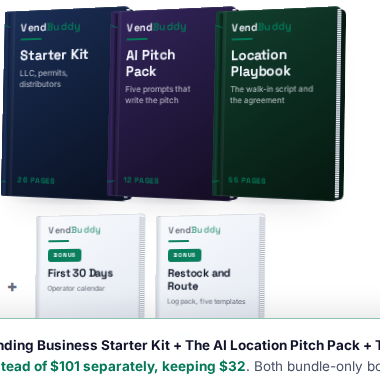
If you get to the end of this and the answer is yes, the kits are the shortcut past the blank page: a 26-page starter kit for the paperwork, a 55-page Location Playbook for the walk-in script and the agreement, and a 12-page AI Pitch Pack. Bought once, from $27, and you keep the files.
Look inside the kits →What you actually need: the four-item list
Everything above was subtraction. Here is the addition, and it is short.
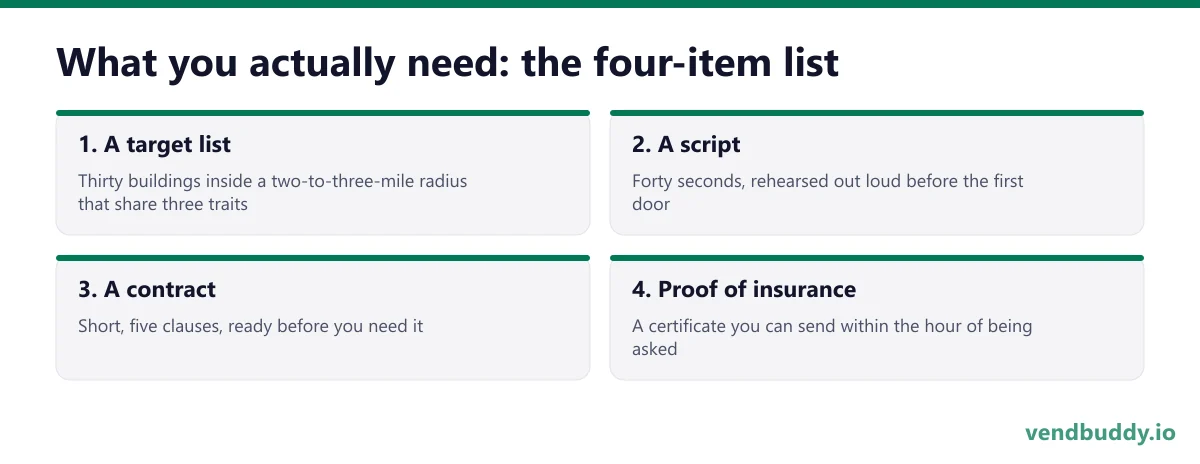
1. A target list
Thirty buildings inside a two-to-three-mile radius that share three traits: 50 or more people on site, no convenient food alternative, and a decision-maker who works in the building. That third filter is the one that saves months, because a building whose facilities decisions are made in another state is a six-month sales cycle and a building where the owner is in the office is a ten-minute conversation.
This is the single highest-leverage item on the list, and it is the reason the same pitch produces wildly different results for different people. The scoring checklist is here, the headcount thresholds are here, and the decision-maker map by building type is here.
2. A script
Forty seconds, rehearsed out loud before the first door. Lead with their benefit, name the cost as zero, and end on a question with an easy answer. The full version, with the twelve objections that actually come back, is in the cold pitch script that works. If walking in is not your method, the email version is here and it is a legitimate path rather than an inferior one.
3. A contract
Short, five clauses, ready before you need it. The worst time to be writing a placement agreement is the afternoon somebody says yes.
4. Proof of insurance
A certificate you can send within the hour of being asked.
That is it. Notice what is not on it: a brand, a logo, a website, a van, a uniform, a machine. Especially a machine — buying equipment before you have a location is the single most common expensive mistake in this business, because an unplaced machine sitting in a garage quietly pressures you into accepting the first building that says yes regardless of whether it is any good. That argument in full is here.
A target list of the right thirty buildings is worth more than every other item on this page combined, and it is the part that takes longest to build by hand. VendBuddy scores real venues near you by traffic, headcount and category, gives you the best contact on file for each, and models what a machine would net there before you drive anywhere. Five free credits, no card required.
The bottom line
Most of what beginners buy in week one is a way of feeling like the business has started without doing the part that starts it. That is understandable, and the fix is not more discipline — it is knowing that the list is genuinely four items long, so there is nothing left to prepare.
A target list, a script, a contract, and a certificate of insurance. Then twenty doors, spread across as many weeks as your life allows. The logo can wait until there is something to put it on.
Related reading: vending machine contracts 101, cold email scripts for vending contracts, the walk-in script that works, the location scoring checklist, the insurance guide, and your first $100 in vending.
Frequently Asked Questions
What do you need to land vending machine locations?
Four things, and only four. A target list of buildings that meet the headcount and decision-maker criteria, a short spoken script you have rehearsed, a written placement agreement, and proof of liability insurance. That is the complete list. Everything else people buy first - a website, business cards, a logo, branded shirts, flyers, an LLC before there is any revenue - is optional and none of it changes whether a property manager says yes. The single largest determinant is which buildings you walk into, not how you present.
Worth knowing for your website: the operators who stop cold-calling are the ones property managers can find. A simple site built with Wix or Base44, plus the basics in our vending website SEO guide, is how that starts. Affiliate link, so we may earn a commission at no extra cost to you.
Do you need a website for a vending business in 2026?
No, not to land locations. Property managers decide based on whether the building needs a machine and whether you seem like you will actually service it, and almost none of them will look you up before saying yes to a free amenity. There is one worthwhile exception: a single page with your business name, a phone number, a photo of a clean machine and a line about service response gives a hesitant manager something to forward to an owner or a boss. That is a one-page site you can build in an afternoon, not a website project.
Do you need business cards for a vending business?
Rarely, and they are the classic first purchase that feels like progress and produces none. The realistic use case is narrow: a manager who is interested but not the decision-maker needs to hand something to the person who is. A card solves that, and so does a text message with your details, which is more likely to survive. If you buy them, buy a hundred, not a thousand, and do not let designing them become the reason week one has no walk-ins in it.
Do you need flyers for a vending business?
Sometimes, for a specific job: buildings you cannot get into. Multi-tenant office parks, gated industrial units and buildings where reception will not let you past are where a printed one-pager left with a receptionist actually does work a conversation cannot, because it survives until the decision-maker walks past it. For buildings you can walk into, a flyer is worse than talking. Treat it as a tool for a particular obstacle rather than as marketing.
Do you need a contract for a vending machine location?
Yes. This is the one item on the list where the answer is unambiguous. A written placement agreement protects the thing you are actually investing in, which is not the machine but the right to keep it in that building. Without one, a new facilities manager can ask you to remove a machine that took two months to place, and a competitor can offer the same building a higher commission with nothing to displace. The document does not need to be long - term, exclusivity, commission, service response, and how either side ends it.
Do you need insurance to place a vending machine?
Practically, yes. A large share of commercial properties will ask for a certificate of general liability insurance naming them as additional insured before a machine goes in, and property managers at larger buildings treat it as non-negotiable. Coverage for a small route is typically an inexpensive monthly cost relative to the deals it unlocks, and being able to produce the certificate the same day a manager asks for it is frequently the difference between a yes that closes and one that goes quiet.
Do you need an LLC to start placing vending machines?
Not to place a machine. A sole proprietorship is a business for the purposes of a placement agreement, a bank account application and a wholesale account. Forming an LLC is worth doing for liability separation and bookkeeping, and many operators do it around machine two or three, but treating it as a prerequisite is one of the most common ways a first month gets spent on paperwork instead of on buildings. Some locations and some insurers will ask for an entity, which is a good reason to form one when it comes up rather than before.
What should I say when I walk into a business about a vending machine?
Keep it to about forty seconds and lead with their benefit. Ask for whoever handles the building or the break room, then say that you run vending locally, that it costs the building nothing, that you handle stocking and servicing, and that their team gets drinks and snacks without leaving the building - then ask whether that is something they would consider and who you should talk to. Short, their-benefit-first, zero cost named explicitly, and ending on an easy question. Rehearse it out loud before the first door, because the first three are always the worst.
What is selling, which buildings say yes, and the numbers before you buy a machine. Free, confirm from your inbox, unsubscribe in one click. Refer one friend and get 25 VendBuddy credits.
General information, not legal, tax or financial advice. Rules change, so check the official source. Revenue and income figures are examples, not promises. See our terms.