- Getting vending machines into auto repair shops is the highest-close-rate cold walk-in in the business. The owner is on the floor and there is no process.
- Place for the technicians, not the waiting room. Eight people for nine hours beats twelve people for forty minutes, every time.
- Drinks are 60–70% of dollar volume. Energy, sports drinks and large-format water. A candy-forward planogram melts and dies here.
- Nobody wants commission. They want a case of water a week for the crew. Offer that before anybody says a percentage out loud.
- $250–$600 a month at a typical independent, up to $1,200 at a big tyre or fleet shop. Cluster them on a commercial strip.
If you have never placed a machine and you want to find out whether you can actually do the conversation, go to an independent repair shop. Not because they are the biggest accounts — they are not — but because everything that makes location acquisition hard elsewhere is simply absent here. No receptionist, no property manager, no committee, no corporate vendor list. A man with a rag in his back pocket who owns the building and decides things in thirty seconds.
Part of our complete guide: how to find vending machine locations.
They are also genuinely good little accounts: steady six days a week, no seasonality, no vandalism, and a customer base that drinks a remarkable volume of cold liquid. Here is the version of this pitch that works and the two mistakes that make it fail.
The buyer is the technician
Most operators walk into a repair shop and look at the waiting room. Vinyl chairs, a coffee pot, a television on mute, and four or five people at any given time. It feels like the obvious spot and it is the wrong one.
Run the arithmetic. A busy six-bay independent might have twelve to fifteen customers wait on site across a day, averaging maybe forty minutes each, and a good share of them buy nothing because they are staring at a phone. Meanwhile the shop has eight to twelve technicians, a service writer, a parts runner and the owner, and every one of them is in that building from seven-thirty in the morning until six at night, doing physical work, in a space that is not air conditioned from May through September.
A technician drinks two to four cold beverages across a shift. That is not a preference, it is thermoregulation. Multiply eight technicians by two and a half drinks by six days, and you are at a hundred and twenty transactions a week before a single customer touches the machine. That is the account. The waiting room is a bonus.
The same split shows up at dealership service departments, at a larger scale and with a longer approval chain — the dealership version of this post covers that structure.
Who to ask for, by shop type
- Independent general repair, 3–10 bays. The owner. He is in the shop, usually under a car or at the service counter, and the answer arrives in the same conversation. This is the target.
- Independent tyre shop or fleet garage, 12–30 bays. The owner or a shop manager. Bigger crews, longer hours, sometimes two shifts. Best revenue in the category and still a one-conversation decision at most independents.
- Franchise or national chain store. A store manager who cannot approve a vendor and a district manager who can. Frequently there is a national arrangement that makes the answer no regardless. Get the district manager’s name and treat it as a separate multi-site pitch, not a walk-in.
- Truck, diesel and equipment repair. Underrated and worth going out of your way for. Bigger buildings, longer shifts, drivers waiting on repairs, and almost nothing within walking distance because these shops sit in industrial zones. Ask for the shop foreman.
- Collision and body shops. Separate buildings from mechanical repair even when they share an owner, and they need their own machine. Paint and body techs do not walk to the mechanical shop.
Picture the machines paying you while you sleep
That’s the real promise of vending — income that doesn’t cost you your time, and a life on your own terms. VendBuddy turns this guide into a step-by-step plan so you actually build it instead of just reading about it. Start free today.
Start building free →What they actually produce
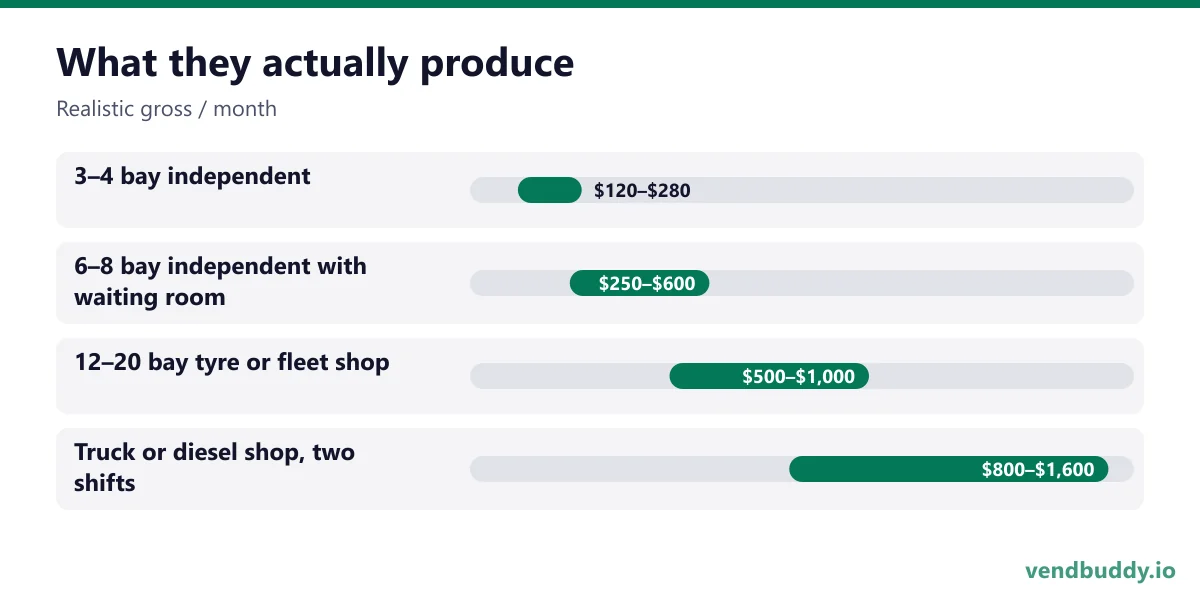
| Shop | People on site all day | Realistic gross / month |
|---|---|---|
| 3–4 bay independent | 4–6 | $120–$280 |
| 6–8 bay independent with waiting room | 8–12 | $250–$600 |
| 12–20 bay tyre or fleet shop | 15–25 | $500–$1,000 |
| Truck or diesel shop, two shifts | 20–40 | $800–$1,600 |
The mix is drink-dominant and it stays that way year-round. Energy drinks, sports drinks and large-format water carry the machine; the snack side runs savoury — chips, jerky, nuts, crackers — because a bay in August will ruin chocolate in a week and the buyers were never candy customers to begin with. Where to buy the energy category at a price that works is covered in sourcing Celsius, Alani and the energy shelf.
Seasonality is mild and predictable: summer is the peak because the bays are hot, winter dips maybe fifteen percent. Compared with schools, resorts or anything student-driven, this is one of the flattest venue types on a route. Profit by location type shows where that sits against the rest of the map.
The walk-in, and why the timing matters
Go at seven-thirty in the morning. Shops open early, the owner is there before the first car is on a lift, and nobody is under pressure yet. By ten the day has gone sideways and you are an interruption.
“Morning — you the owner? I run a small vending route around here. Quick one: how many guys do you have in the back? Because every one of them is walking to the gas station two or three times a day in this heat, and I would rather they did not have to. I put a cold drink machine on your wall, I stock it, I service it, it costs you nothing, and your crew drinks free. Where is your break area?”
The last question is doing the work. “Where is your break area” is not a decision, it is a walk, and a shop owner will show you a break area out of pure reflex. Once you are standing in it, looking at a wall and an outlet, the conversation has already moved from whether to where — which is a completely different conversation and a much easier one.
Bring something. A cold case of Gatorade left on the parts counter at seven-thirty in the morning costs you fifteen dollars and buys a level of goodwill that no script generates. Nobody in this category will hold it against you.
At a repair shop the waiting room holds twelve people for forty minutes and the shop floor holds ten people for nine hours. Place for the technicians. Everything else is a bonus.
The objections you will hear
“The guys bring their own / there is a fridge back there.”
The most common one, and the answer is to go look at the fridge. Shop refrigerators are small, shared, and empty by ten in the morning, and whoever restocked it last is quietly annoyed about it. Ask the owner who buys what is in there. If the honest answer is “I do,” you have just found the pitch: you are removing a purchase and an errand he is currently doing himself.
The fastest way to test this in your own ZIP is the . Search once, see which businesses sit within a few miles, and reveal five contacts for nothing. It will not tell you who says yes, but it saves the afternoon you would spend building the list by hand.
“We are too small.”
Sometimes true. Under about five people on site all day, a full-size drink machine will not clear a service stop unless the shop is on a corridor you already drive. Say so honestly and ask if he knows the shop down the street — owners in this trade all know each other, and a referral from one is worth four cold walk-ins.
“Nobody carries cash.”
Correct, and it is a solved problem. Tap-to-pay reader, and say it in the first minute rather than waiting for the objection. A technician in nitrile gloves is not smoothing a dollar bill for a validator, and any machine you place here without a modern reader will underperform by a third.
“Somebody already came by about this.”
Ask when, and ask whether anything actually happened. In this category the answer is usually that a locator company called once, or a vendor installed a machine and stopped servicing it. Both of those are opportunities, and the second one is covered in how to take over an existing vending account.
The seven-thirty walk-in above is one of a dozen in the Location Playbook — the opener annotated line by line, variants for offices, gyms, apartments, warehouses and salons, twelve objections answered including the break-room-fridge one, and a one-page placement agreement a shop owner will actually sign at the counter.
See what is inside →Equipment, and what the environment does to it
A repair shop is a hard place for a machine and operators learn this the expensive way. Bay doors open in July mean the unit is fighting a hundred-degree ambient. Brake dust, tyre rubber and grinding particulate load a condenser coil faster than any office ever will. And the floor is concrete that gets hosed.
What that means in practice:
- Bottle-drop or stack drink machines over glass-front coolers. Sealed, tougher, and far less sensitive to a warm ambient. A glass-front looks better and will cost you a compressor.
- Clean the condenser every visit, not every quarter. This single habit is the difference between a machine that lasts eight years in a shop and one that dies in three. The general maintenance picture is in the troubleshooting guide.
- Put the snack unit in the break room, not on the shop floor. Snacks on an open bay wall pick up dust and the packaging degrades.
- Confirm the circuit before install day. Shops have plenty of power but the outlets near the break area are frequently on a circuit shared with a compressor or a welder, and a machine that trips every time the lift runs is a machine the owner will ask you to remove.
The deal: product, not percentage
Do not open a commission conversation at a repair shop. A three-hundred-dollar-a-month machine paying fifteen percent is forty-five dollars, and the owner has no process for receiving it, no interest in tracking it, and a mild suspicion that anything involving a monthly cheque is more complicated than it is worth.
Offer product. The standard trade is free drinks for the crew, either as a case a week left on the counter or a fixed monthly allowance keyed into the machine. It costs you fifteen to thirty dollars of product, it makes the technicians glad the machine is there, and the technicians are the ones who decide whether the machine gets used or ignored. Commission rates by venue type shows how far below the norm this venue sits and why that is not a problem.
Worth reading before you sign anything: the contract walkthrough covers which terms get pushed back on and which ones you can safely give away. Commission is rarely the clause that hurts you later.
Get one page signed anyway. Term, service interval, who owns the machine, thirty-day out either way. Shops sell, owners retire, and the paper is the thing that survives the handover. Vending machine contracts 101 covers what belongs on it.
Why this category rewards density
Repair shops cluster on light-industrial and commercial corridors, usually within a few blocks of each other and alongside the tyre shops, parts stores, laundromats and barbershops that make good fill-in stops. Working one corridor and landing five shops on it turns a category of small accounts into a service loop worth two thousand a month with twenty minutes of driving between the first and last stop.
They also refer, hard. Independent shop owners in a market know each other, use the same parts suppliers, and talk. One owner who likes his vendor will tell three others, which is the closest thing to free lead generation this business has. The city guides for Houston and Columbus both show where the light-industrial corridors sit in a large market.
Repair shops are worth having because they cluster. VendBuddy scores real businesses in your ZIP by category, headcount and captivity and gives you the best contact on file for each, so you can work one light-industrial corridor properly instead of driving between single stops. Free to start, no card.
Frequently Asked Questions
How do you get vending machines into auto repair shops?
Walk in before eight in the morning and ask for the owner. Independent repair shops have the shortest decision chain of any venue in vending: the person who can say yes is standing in the shop, has no procurement process, and is used to making equipment decisions on the spot. Lead with the technicians rather than the waiting room, because the waiting room is a handful of people a day and the technicians are eight people who are there for nine hours.
How much does a vending machine make in an auto repair shop?
Two hundred and fifty to six hundred dollars a month gross at a six-to-eight-bay independent with eight or ten technicians and a waiting room, and six hundred to twelve hundred at a large tyre or fleet shop with twenty-plus bays. The drink side carries it: cold beverages and energy drinks are commonly sixty to seventy percent of dollar volume in a shop, and the snack side is savoury rather than sweet because chocolate does not survive a bay in summer.
Do auto repair shops pay commission on vending machines?
Almost never. An independent shop owner grossing a few hundred a month from a machine has no interest in a cheque and no accounting process to receive one, and the thing he actually wants is free product for his crew. A case of water a week or a fixed monthly allowance for the technicians is the standard trade, and it closes faster and costs less than any percentage would.
What vending machine works best in a repair shop?
A rugged drink machine rated for a warm ambient, ideally a bottle-drop or stack unit rather than a glass-front cooler. Shop bays run hot, carry brake dust and rubber particulate, and have doors open most of the day, all of which loads a condenser fast and shortens the life of residential-grade equipment. Add a snack unit only if there is a real break room to put it in, and fit a tap-to-pay reader because technicians in gloves are not feeding bills into a validator.
Should you pitch a repair shop chain or an independent?
Independents first, because the owner is on the floor and the decision takes one conversation. National chains such as the large tyre and quick-service brands run through a district or regional manager and frequently have a national vendor arrangement, which makes a walk-in at a chain store almost useless. If you want the chain, get the district manager name from the store manager and treat it as a separate multi-site pitch rather than a location call.
Is the waiting room or the shop floor the better vending placement?
The shop floor, by a wide margin. A waiting room at a busy independent might hold six to fifteen people over a day, most of whom are there under an hour. The shop floor holds the same eight to twenty technicians for nine hours a day, six days a week, and they buy two or three times each. Place for the technicians and treat any waiting-room sales as a bonus rather than as the business case.
Related reading: how to find vending machine locations, car dealerships, laundromats, salons and barbershops, the cold pitch script that works, and profit by location type.
What is selling, which buildings say yes, and the numbers before you buy a machine. Free, confirm from your inbox, unsubscribe in one click. Refer one friend and get 25 VendBuddy credits.
Want the free 38-page Ultimate Vending Guide too? Get the guide
Every operator we talk to wants fewer cold calls. The ones who get there have a Google Business Profile and a simple site a manager can check before replying. AI builders make that an evening job now. Wix is the mature site builder; Base44 also builds working tools like a quote form. Start with the AI website walkthrough or Wix vs Base44.
General information, not legal, tax or financial advice. Rules change, so check the official source. Revenue and income figures are examples, not promises. See our terms.