- Getting vending machines into car dealerships means pitching the shop, not the lounge. The lounge is complimentary by brand standard at most stores and will never be a paid placement.
- The buyer is the technician, not the customer. Twenty to sixty people who are paid flat rate, cannot leave, and drink energy drinks all day.
- The general manager approves it, the service manager places it. You need both, and you need them in that order.
- Energy and sports drinks are 40–55% of dollar volume. A candy-forward planogram will underperform badly here.
- Nobody wants commission. They want free water for the lounge. That trade is cheaper than a percentage and closes faster.
Almost every operator who has walked into a dealership has walked into the wrong room. The customer lounge is the obvious spot — comfortable chairs, a coffee machine, people stuck for two hours — and it is the one placement in the building you will almost never get, for a reason that has nothing to do with you.
Part of our complete guide: how to find vending machine locations.
The money is through the door marked Service. Behind it are twenty to sixty people who are physically in that building from seven in the morning until six at night, who are paid by the job rather than by the hour, and who currently walk to the gas station across the road four times a day. That is the account. Here is how to get it.
A dealership is two buildings with one address
The front of the house — showroom, lounge, sales floor — runs on customer experience. The back of the house — service bays, parts counter, detail, body shop — runs on throughput. They have different budgets, different managers, and completely different answers to the same question.
In the front, refreshments are a cost of doing business. Several manufacturers write complimentary beverages into the facility standard for the customer lounge, and every dealer is measured on a satisfaction index that a customer fills out after a service visit. A general manager who is having a bad quarter on that index is not going to start charging people two dollars for water while they wait on a warranty job. That is not stubbornness, it is arithmetic on a metric that affects his allocation from the factory.
In the back, nobody is being surveyed. A flat-rate technician who bills eight hours in a nine-hour day loses money every time he walks off the property, and he does it anyway because he is thirsty. Twelve minutes of a flat-rate day, four times, is real money to him and real throughput to the service manager. That is a problem, and you happen to sell the fix.
Who signs and who places it
Two people, and you want them in order:
- General manager. Runs the store. Approves vendors, signs the placement agreement, and is the person the Call Practice roleplay below is built around. Reachable by phone, generally between the morning sales meeting and lunch, and used to being sold to — which means a bad opener gets a shorter hearing here than almost anywhere else.
- Fixed operations director or service manager. Runs the back of the house. Does not usually approve a new vendor on his own but absolutely can kill it, and he is the one who tells you which wall has a spare twenty-amp circuit and where the machine will not be in the way of a transmission jack. Talk to him second, and talk to him like a tradesman rather than a salesperson.
If the store belongs to a large dealer group — Lithia, Group 1, AutoNation, Penske, or a regional twelve-rooftop group — a new vendor may need a group-level nod. Ask the general manager directly whether it is his call or the group’s, and if it is the group’s, ask for the name and permission to say this store sent you. A named referral into a dealer group is worth more than five cold calls to the other rooftops.
Roleplay a property manager and get scored. Pick who you are calling — office property manager, apartment community manager, gym owner, warehouse ops lead, school administrator, hospital facilities director, dealership GM — then pick how hard they are, up to Gatekeeper mode where a receptionist screens you and you have to earn the transfer. Talk it through out loud. At the end you get a score out of 100, whether the meeting was actually booked, three things that worked, three that cost you, and three better questions written word for word for the next real call. In the VendBuddy app for paid subscribers.
Picture the machines paying you while you sleep
That’s the real promise of vending — income that doesn’t cost you your time, and a life on your own terms. VendBuddy turns this guide into a step-by-step plan so you actually build it instead of just reading about it. Start free today.
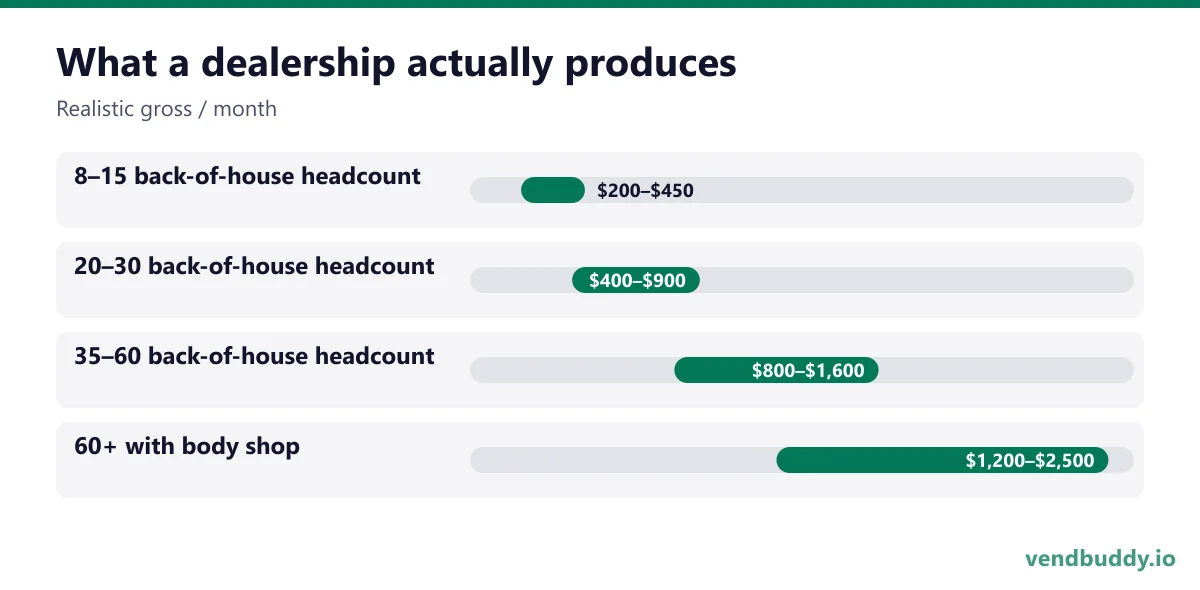
Start building free →What a dealership actually produces
| Back-of-house headcount | Typical store | Realistic gross / month |
|---|---|---|
| 8–15 | Small single-line import store | $200–$450 |
| 20–30 | Mid-size domestic or import dealer | $400–$900 |
| 35–60 | Large volume store, two shifts in service | $800–$1,600 |
| 60+ with body shop | Dealer group flagship or truck centre | $1,200–$2,500 |
Count technicians, parts counter staff, porters, detail and the body shop if there is one. Do not count sales, because sales staff are in and out of the building all day and buy nothing. Do not count the lounge, because you are not getting the lounge.
The mix is the part that catches new operators out. In a shop, energy drinks and sports drinks are commonly forty to fifty-five percent of dollar volume, water is another fifteen to twenty, and the snack side is smaller and skews savoury and heavy rather than candy. Monster, Celsius, Red Bull, Gatorade, Body Armor and large-format water are the machine. Chocolate is close to worthless from May to September in an unconditioned bay, and you will find that out the expensive way if you plan a standard planogram. Where to source Celsius and the energy category matters more at this venue type than at any other.
Volume is also flatter here than almost anywhere else on a route. Dealership service departments run six days a week, do not have a summer, and do not empty out at Christmas. That predictability is worth something when you are planning a service loop.
The pitch, in the words that land
Do not open with a machine. Open with the flat-rate math, because it is the one argument in this building that a general manager has never heard from a vendor.
“Quick question about the back of the house rather than the lounge — I know the lounge is complimentary and I am not asking about that. How many techs do you have back there? Because every one of them is walking to the Shell across the road two or three times a day, and at flat rate that is ten or twelve minutes off their day each trip. I put a cold drink machine on the shop wall, I stock it, I service it, it costs you nothing, and your guys stop leaving the property. Can I look at the wall by the parts door?”
What that does: it disqualifies the lounge before he has to, which buys you credibility instantly. It reframes the machine as a throughput tool rather than an amenity. And it ends with a physical request — look at a wall — which is a much smaller yes than a meeting.
If the general manager is not available, the fallback is to ask for the service manager and use the same opener with one change: technicians respond to “your guys keep asking you for a machine, right?” because they usually have. The full structure of a cold walk-in like this is in the cold pitch script that works.
Every dealership operator pitches the customer lounge and loses. The money is behind the door marked Service, where forty flat-rate techs walk to the gas station four times a day.
The objections, and what each one means
“We give drinks away free in the lounge.”
Correct, and you should say so before he does. Then move to the shop. This objection is almost never a no, it is a mishearing of what you asked for.
“The guys bring their own / there is a fridge in the break room.”
A shared fridge in a dealership break room is a small unit that runs out by ten in the morning and belongs to whoever got there first. Ask the service manager how that fridge is doing. The honest answer is usually a story.
“We already have a machine.”
Look at it. Dealership machines are frequently ancient units left over from a vendor who stopped coming, still coin-only, and half empty. That is not a competitor, it is an opening — and the pitch for it is the takeover conversation, not a fresh one. How to take over an existing vending account covers the exact framing.
“Talk to my group.”
Take the name, ask permission to reference this store, and ask one more question before you leave: whether the group has an actual vending agreement or just a preference. Those are very different obstacles and only one of them is real.
The walk-in above is one of a dozen. The Location Playbook is the whole conversation written down — the opener annotated line by line, variants for offices, gyms, apartments, warehouses and salons, twelve objections answered including the ones on this page, and a plain-English placement agreement to leave with the GM.
See what is inside →The deal structure that closes
Dealerships rarely want a commission cheque. A four-hundred-dollar-a-month machine paying fifteen percent is sixty dollars, which is a rounding error against a store doing seven figures a month, and it creates a vendor payment their accounting office now has to process. Offer something operational instead:
- Free-vend for the lounge. A small counter cooler or a set number of free vends a month, stocked with water and diet soda, that the lounge can hand to waiting customers. It solves the general manager’s satisfaction-score problem and it costs you product rather than cash.
- A monthly staff allowance. Fifty or seventy-five dollars of free product a month for the service team, handed out by the service manager. This makes the service manager your ally, which matters more on install day and every day after than the general manager’s signature does.
- Nothing. A meaningful number of independent and small-town stores take zero, because the machine is a thing their techs asked for and the owner would rather it just exist.
Get the term, the service interval and a thirty-day out on one page regardless. General managers move stores every couple of years and the paper is what survives it. Commission rates by venue type has the wider comparison if you want to see where dealerships sit.
Worth reading before you sign anything: the contract walkthrough covers which terms get pushed back on and which ones you can safely give away. Commission is rarely the clause that hurts you later.
Equipment and placement
Where: the shop wall nearest the parts counter or the tech break area, not the bay itself. You want it out of the swing path of a lift and near an existing circuit. If there is a body shop, that is frequently a second machine rather than a shared one, because body techs do not walk to the main shop.
What: a rugged bottle-drop or stack drink machine rated for a warm ambient. Glass-front coolers look better and die faster in this environment — brake dust and rubber particulate load the condenser, and open bay doors in August mean the unit is fighting a hundred-degree ambient all day. Clean the condenser on every visit here, not every quarter. If you want a snack unit too, put it inside the break area rather than on the shop floor. The equipment trade-offs are compared in how to choose the right vending machine.
Payment: tap-to-pay card reader, non-negotiable. A technician in nitrile gloves with no wallet on him is not feeding dollar bills into a validator.
Why dealerships are worth building a route around
They cluster. Almost every metro has an auto row — a two-mile stretch with fifteen or twenty rooftops on it — which means a single service loop can hit six accounts without a highway between them. The city guides for Dallas and Phoenix both map where those corridors sit, and the same pattern holds in nearly every market.
They also refer. Service managers move between stores constantly, general managers know each other, and a dealership that likes its vendor will say so to the store down the road. Landing one rooftop on an auto row is frequently how operators end up with four.
Dealerships cluster, which is what makes them worth a route. VendBuddy scores real businesses in your area by category, headcount and captivity and gives you the decision-maker title for each, so you can pull every rooftop on your auto row into one list before you make the first call. Free to start, no card.
Frequently Asked Questions
How do you get vending machines into car dealerships?
Ask for the general manager and pitch the service department rather than the customer lounge. The lounge is almost always complimentary refreshment, which the dealer pays for out of the customer satisfaction budget and will not convert to a paid machine. The shop is different: twenty to sixty technicians, parts staff and porters who are on the property all day, are paid flat rate, and currently walk to the gas station. That is the placement, and the general manager is the person who can approve it in one conversation.
How much does a vending machine make in a car dealership?
A service department with twenty to thirty technicians and parts staff realistically grosses four hundred to nine hundred dollars a month from one drink machine, and a large dealer group service operation with sixty or more people in the back runs twelve hundred to twenty-five hundred. The mix is unusual: energy drinks and sports drinks are typically forty to fifty-five percent of dollar volume, well ahead of snacks, because the buyer is a technician working a physical job in an unconditioned bay.
Do car dealerships pay vending commission?
Usually not, and asking for a percentage conversation is often the wrong opening. Dealerships are high-revenue businesses where a few hundred dollars a month of commission is noise, so what they want instead is something operational: free product for the customer lounge, a monthly allowance for the service team, or a machine stocked with water at cost for waiting customers. Trading free-vend for the lounge in exchange for a paid machine in the shop is the deal that closes most often.
Why will a dealership not put a paid vending machine in the customer lounge?
Because the lounge is scored. Manufacturers measure dealers on a customer satisfaction index, and several luxury brands require complimentary refreshments in the waiting area as a facility standard. Charging a customer two dollars for a bottle of water while they wait three hours for a warranty repair is the kind of thing that shows up in a survey, so a general manager who is protecting a score will refuse the lounge and may still say yes to the shop in the same breath.
What kind of vending machine works in a service department?
A rugged bottle-drop or stack drink machine rather than a glass-front cooler. Service bays run hot in summer, carry brake dust and tire rubber in the air, and the doors are open most of the day, all of which shortens the life of a residential-grade unit and fouls the condenser fast. Whatever you place needs a card reader, because technicians do not carry cash, and it needs a compressor rated for a warm ambient rather than an office one.
On card readers specifically, Nayax is the default for a dull reason: it is the one most machine suppliers pre-wire for. Price the monthly against your slowest machine, not your best one. Affiliate link, so we may earn a commission at no extra cost to you.
Who is the decision maker at a car dealership for vending?
The general manager for the store as a whole, and the fixed operations director or service manager for anything that lives in the shop. The dealer principal owns the business but is rarely involved in a decision this size. The practical route is to get the general manager to bless it and the service manager to tell you where the outlet is, because the service manager is the person whose team uses it and whose cooperation you need on install day.
Related reading: how to find vending machine locations, independent auto repair shops, hotels and motels, senior living communities, the decision-maker map, and the property-side version at vending machines for auto dealerships.
What is selling, which buildings say yes, and the numbers before you buy a machine. Free, confirm from your inbox, unsubscribe in one click. Refer one friend and get 25 VendBuddy credits.
Want the free 38-page Ultimate Vending Guide too? Get the guide
Every operator we talk to wants fewer cold calls. The ones who get there have a Google Business Profile and a simple site a manager can check before replying. AI builders make that an evening job now. Wix is the mature site builder; Base44 also builds working tools like a quote form. Start with the AI website walkthrough or Wix vs Base44.
General information, not legal, tax or financial advice. Rules change, so check the official source. Revenue and income figures are examples, not promises. See our terms.