- You are selling the meeting, not the machine. Nobody buys vending on a cold call. They agree to fifteen minutes, and the fifteen minutes is where everything happens.
- The opener is three parts: who you are, why this building specifically, and permission for thirty seconds. Anything else is a pitch and gets treated like one.
- Ask more than you tell. Four questions about their building beat four sentences about your equipment, every time.
- Close on a day and a time. “Can I send you some information” is how a live call quietly dies.
- Twenty-five dials a week is roughly eight conversations, two or three meetings, and a placement every few weeks. Count the dials, not the yeses.
Cold calling is the part of this business that most operators skip, which is exactly why it works. You are not competing with a hundred other vending calls that week. You are competing with the property manager’s inbox, and you will win that fight in about twenty seconds or not at all.
- What you are actually selling
- Before you dial: three facts and a name
- The 20-second opener, word for word
- The four questions that do the selling
- The objections, and the line that answers each
- The ask: a day and a time, not “some information”
- The voicemail that actually gets returned
- The cadence: five touches, not one
Part of our complete guide: how to find vending machine locations.
The mistake almost everyone makes on call one is treating the call like a sales presentation. It is not. It is a booking call. Everything below is built around one rule that changes the numbers more than any script tweak ever will: the only thing you are selling on the phone is a short meeting. The machine, the commission split, the product mix, the service schedule — all of that is meeting material, and every second you spend on it during the call is a second spent talking someone out of the meeting.
What you are actually selling
Picture the person answering. A property manager for a three-building office park is somewhere between a tenant complaint about the HVAC and a lease renewal she has not read yet. She is not anti-vending. She has simply never once in her life thought “what I need today is a call about a snack machine.”
So there are two things she can say yes to. She can say yes to a project — equipment, contracts, liability, a thing to manage — which is expensive to think about and easy to defer. Or she can say yes to fifteen minutes on Thursday, which costs her nothing and defers the actual decision to a version of herself who has more information.
Every good cold call in this business is the second one. And the honest reason it works is not psychology, it is arithmetic: the meeting has a conversion rate several times higher than the call, because in a meeting you can walk the space, count the door, ask about the break room and hand over something physical. Your job on the phone is to get to that room. Nothing else.
Before you dial: three facts and a name
Ten minutes of prep is the difference between a call that sounds like a template and a call that sounds like you drove past. Before the first dial of the session, get these for every building on the list:
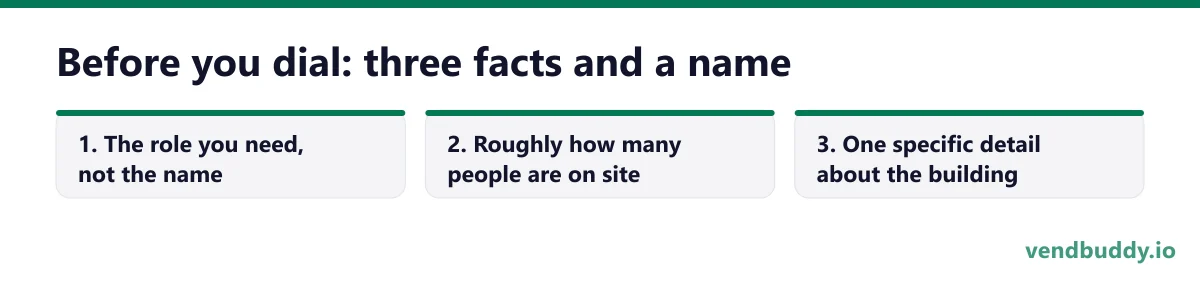
- The role you need, not the name. Offices and apartment communities: property manager or community manager. Warehouses: operations manager or plant manager. Gyms and studios: the owner. Hospitals: director of facilities or environmental services. Schools: the operations or nutrition administrator. If you have an actual name, use it — if you do not, the role gets you further than “whoever handles vending,” which is a sentence that gets you a voicemail box. The decision-maker map has the right title for every property type.
- Roughly how many people are on site. You do not need to be right, you need to be close enough that your number does not sound invented. Headcount is also your own qualifier — the headcount thresholds tell you whether the building is worth a dial at all.
- One specific detail about the building. The number of buildings on the campus. The fact that they run two shifts. That the gym is open 24 hours. This is the fact that proves you are not a call centre, and it goes in your first sentence.
Then block the time. Twenty-five dials takes about ninety minutes with notes, and it does not survive being done “when you get a chance”. Put it on the calendar as a recurring block the way you would a shift.
Picture the machines paying you while you sleep
That’s the real promise of vending — income that doesn’t cost you your time, and a life on your own terms. VendBuddy turns this guide into a step-by-step plan so you actually build it instead of just reading about it. Start free today.
Start building free →The 20-second opener, word for word
Three moves: who, why this building, permission. Then stop talking.
“Hi — this is Dana? My name’s Chris, I run a small vending route here in the north end. I’m calling because you’ve got three buildings on that campus and a few hundred people on site, and buildings that size usually have a break room problem nobody owns. Have you got thirty seconds, or should I catch you later in the week?”
Four things are doing work in there, and each one is deliberate.
- “I run a small vending route” — not a company name they have never heard. Small and local is an advantage on this call, not something to hide.
- “You’ve got three buildings on that campus” — the specific fact. This is the sentence that stops the reflex hang-up, because a template does not know how many buildings she has.
- “A break room problem nobody owns” — a problem, not a product. You have said nothing about a machine yet, and you should not.
- “Or should I catch you later in the week?” — the escape hatch. Offering to go away is what makes people stay, and it converts “I’m busy” from a hang-up into a scheduling question.
Do not extend it. Every extra sentence in the opener costs you a measurable share of the calls, because the longer you talk without asking anything, the more you sound like the four other cold callers she got this week.
The four questions that do the selling
If she gives you the thirty seconds, do not use them to describe your equipment. Use them to ask. These four, in this order, and you listen to the whole answer before you say anything:
- “What do people do there now when they want a drink or something to eat?” — the whole call turns on this answer. Either they leave the building, which is a productivity problem you did not have to invent, or there is already a machine, which tells you who the incumbent is and how they are doing.
- “Is there anything in there now, or was there at some point?” — “we tried one before” is the best news you can get on a cold call. It means the space works and somebody else already paid to prove it. What failed was almost always service, not demand.
- “Roughly how many people are on site on a normal day?” — you already estimated it; asking confirms it and quietly signals that headcount is how you decide, which makes you sound like an operator rather than a salesperson.
- “Who else would need to be in the room on something like this?” — asked early, this saves you a month. Ask it late and you get an approval chain you did not know about, on the day you thought you were signing.
Four questions, roughly ninety seconds, and you now know more about the building than most operators know when they walk in. The full walk-in version of this discovery sequence is in the cold pitch script that works.
Roleplay a property manager and get scored. Pick who you are calling — office property manager, apartment community manager, gym owner, warehouse ops lead, school administrator, hospital facilities director, dealership GM — then pick how hard they are, up to Gatekeeper mode where a receptionist screens you and you have to earn the transfer. Talk it through out loud. At the end you get a score out of 100, whether the meeting was actually booked, three things that worked, three that cost you, and three better questions written word for word for the next real call. In the VendBuddy app for paid subscribers.
The objections, and the line that answers each
You will hear five sentences for the rest of your career. The pattern for all five is the same and it is the house pattern on this site: acknowledge → empathize → bridge to something smaller. You never argue, because arguing confirms you are the thing to be got rid of.
“We already have a machine.”
“Makes sense — most buildings that size do. Honestly half the ones I walk past are half empty and nobody wants to be the person chasing the vendor about it. I’m not asking you to swap anything. Can I send you what our restock schedule and response time look like, and check back in about six weeks? If yours is running fine, bin it.”
“Corporate handles that.”
“Understood, a lot of the multi-site places I deal with are set up that way. Two quick things and I’ll get out of your way — who’s the right person over there, and would you mind if I said this site sent me?”
That second half is the whole play. A named person plus a named building turns a cold corporate approach into a warm referral, and it costs the person on the phone nothing to give you.
“Send me some information.”
“Happy to. What’s the best address? I’ll keep it to one page — what I’d put in, what it costs you, which is nothing — and I’ll check back the week of the fourteenth.”
This is a polite exit that hands you permission to follow up, which is worth more than the conversation you just lost. Three rules for what you send: one page, it names their building, and it ends with a date you will actually honour. The written versions live in cold email scripts for vending contracts.
“What does it cost us?”
“Nothing. I buy the machine, I stock it, I carry the insurance, and I service it. If you want a commission on sales we can talk about that when I see the space, but plenty of buildings this size just want the amenity.”
Answer this one instantly and plainly. Hesitating here reads as a catch, and a catch ends the call. What the commission conversation looks like later is in the negotiation playbook.
“I’m in the middle of something.”
“Course — that’s my fault for calling cold. Is tomorrow morning better, or is later in the week easier? I’ll ring you then rather than leaving you a message.”
Then call at exactly the time you named. Doing that once puts you ahead of nearly everyone who ever called them.
The full decoder for what each of these sentences actually signals — including the three that genuinely are a no — is the seven no’s every vending operator hears.
Nobody buys a vending machine on a cold call. They buy fifteen minutes on Thursday. Sell the meeting and your close rate stops being a personality problem.
The ask: a day and a time, not “some information”
This is where most calls quietly die. The operator has had a good conversation, senses it going well, and closes with something soft: “can I send you over some details?” That is not a close. That is asking permission to be ignored.
The ask has to be a specific slot, and it has to be small:
“Here’s what I’d suggest. I’m out that way Thursday morning anyway — can I put my head in for ten minutes, look at where it would go, and tell you honestly if it’s worth doing? If the space doesn’t work I’ll say so and stop bothering you. Does ten o’clock work, or is after lunch better?”
Two options, both of them yes. Ten minutes, not a meeting. And an explicit offer to disqualify yourself, which is disarming precisely because no salesperson does it. If they hedge, shrink the ask rather than repeating it: “then let me just drop the one-pager at the front desk Thursday and I’ll call you the week after.”
The voicemail that actually gets returned
Most of your dials will go to voicemail. Twenty seconds, number twice, one specific fact, and an intention rather than a request:
“Hi Dana, Chris here, 555-0148. I run a small vending route in the north end and I’m calling about the office park on Ridgeway — specifically the break room in Building B. Nothing urgent and nothing to sign; I’d just like ten minutes to look at the space. I’ll try you again Thursday morning. 555-0148. Thanks.”
“I’ll try you again Thursday morning” is the load-bearing sentence. It removes the obligation to call you back, which is the thing that makes people delete the message, and it puts you back on their radar on a named day. Then actually call Thursday morning.
The number you leave twice should be a business number, not your personal cell. It is the number the property manager saves, and later the one on your machine sticker. A free Google Voice number works when you are starting out. If a helper will answer calls and texts with you, Quo gives you a shared business line with voicemail transcripts on the phone you already carry. VendBuddy may earn a commission if you sign up through that link. The setup and ten copy-paste texts are in business phone setup for vending operators.
Every script above, plus the ones this post did not have room for: the walk-in opener annotated line by line, variants for offices, gyms, apartments, warehouses and salons, twelve objections answered, and the plain-English placement agreement you put in front of them once the meeting goes well.
See what is inside →The cadence: five touches, not one
One call is not an attempt, it is a coin flip. The operators who place machines are running a sequence, and most placements close somewhere in touches three to five — well past the point where the average person has decided the building is not interested.
| Touch | When | What it is |
|---|---|---|
| 1 | Day 0 | The call. If voicemail, the twenty-second message above. |
| 2 | Day 2 | The one-pager, emailed or dropped at the desk, naming their building and ending with your check-back date. |
| 3 | Day 7 | The call you promised on the voicemail, at the time you named. |
| 4 | Day 21 | Something useful and not about you: what a comparable building nearby put in, or a note about their peak hours. |
| 5 | Day 45 | The permission-to-close line: “should I check back after the new year, or should I leave this one alone?” |
That last one is the highest-converting message in the sequence, and the reason is simple: it is easy to ignore a request and oddly hard to ignore somebody politely offering to stop contacting you. A meaningful share of the yeses in this business arrive in response to that exact sentence, weeks after the operator had privately written the building off.
Touch 4 is a good place to use paper instead of another email. A short handwritten card that mentions something specific from the call lands on the desk instead of in the inbox. If you are running this cadence on dozens of buildings at once, Handwrytten writes your typed message in real pen with a handwriting robot and mails it, stamp included. VendBuddy may earn a commission if you sign up through that link.
What to track (four numbers, on paper if you like)
You cannot fix a call you did not measure, and you cannot stay motivated on a scoreboard that only counts wins. Track these four per session:
- Dials. The only number fully inside your control, and therefore the only one worth setting a target on.
- Conversations. A live human who spoke to you. Expect roughly a third of dials.
- Meetings booked. A named day and time. Expect two or three per twenty-five dials once your opener stops being new to you.
- Reason for the no. One or two words. After forty calls this column tells you whether your list is wrong or your script is, and those are completely different repairs.
The full conversion arithmetic from dials to live machines is in the 100-door math, and the weekly practice structure that turns this from a burst into a habit is the 30-day sales practice plan.
Your first ten calls will be bad
They are supposed to be. The opener will come out backwards, you will describe the machine because your brain reaches for something concrete under pressure, and someone will hang up mid-sentence. That is the cost of entry and it is paid in about a week.
What you can do is stop paying it on live prospects. Rehearse the opener out loud in the car until it stops sounding like reading. Then burn your worst-fit buildings first — the ones you would not be sad to lose — and keep the best twenty for once the words are automatic. And if talking to strangers is genuinely the thing standing between you and a route, that skill is the cheapest machine you will ever buy: it is the multiplier on every other dollar in this business.
Half the calls that go nowhere were never going to go anywhere — wrong headcount, wrong category, nobody captive. VendBuddy scores real businesses in your ZIP by headcount, category and captivity and gives you the decision-maker title for each, so your dial list starts with buildings that have a reason to say yes. Free to start, no card.
Frequently Asked Questions
How do you cold call a vending machine location?
Call the main line, ask for the person by role rather than by name if you do not have one, and open with who you are, why you are calling this specific building, and a request for a moment of their time. Then ask questions instead of describing machines. The entire goal of the call is a short meeting on a named day, not a decision, and framing it that way is what keeps the call alive past the first ten seconds. Most operators lose the call by pitching the machine, because a machine is a project and a meeting is not.
The fastest way to test this in your own ZIP is the . Search once, see which businesses sit within a few miles, and reveal five contacts for nothing. It will not tell you who says yes, but it saves the afternoon you would spend building the list by hand.
What is the best time to cold call a property manager?
Mid-morning and mid-afternoon on Tuesday, Wednesday and Thursday, avoiding the first and last hour of the day. Monday mornings are triage and Friday afternoons are already gone. For warehouses and 24-hour sites, call around shift change, because the ops manager is on the floor and reachable rather than sitting in a meeting. If a person tells you they are busy, the correct move is to ask what time tomorrow is better and then call at exactly that time.
How many cold calls does it take to place a vending machine?
The working arithmetic most operators land on is roughly a hundred real conversations for one to two placements, and calls are only part of that mix. A useful weekly target for someone doing this around a job is twenty-five dials, which produces roughly eight to ten conversations, two or three meetings, and one signed placement every few weeks. Counting dials rather than yeses is what keeps the habit alive in week six.
Should you cold call or walk in to vending locations?
Both, for different building types. Calls scale better and are the only way into hospitals, school districts and multi-site corporate properties where you would never get past a lobby. Walk-ins beat calls at gyms, independent restaurants, small offices and anywhere the owner is physically on the floor most days. The practical answer is to call the ones with a switchboard and walk into the ones without one.
What do you say when they ask what it costs them?
Answer it plainly and immediately, because it is the question underneath every other objection. In most placements the building pays nothing: you own the machine, you pay for the product, you carry the insurance, and you either pay a commission on sales or you do not, depending on the site. Say the number or say zero, then move straight back to the meeting. Operators who get vague here lose the call, because vagueness on price reads as a catch.
How do you leave a voicemail that gets called back?
Keep it under twenty seconds, say your name and number twice, name their building once, and ask for a specific tiny next step rather than a callback in general. The line that outperforms everything else is a stated intention to try again at a named time, because it removes the obligation to call you back while still putting you back on their calendar. Do not describe the machine on a voicemail.
Related reading: sell the meeting, not the machine, getting past the gatekeeper, the cold pitch script that works, the seven no’s and what each one means, cold email scripts for vending contracts, the decision-maker map, and the 100-door math.
What is selling, which buildings say yes, and the numbers before you buy a machine. Free, confirm from your inbox, unsubscribe in one click. Refer one friend and get 25 VendBuddy credits.
Every operator we talk to wants fewer cold calls. The ones who get there have a Google Business Profile and a simple site a manager can check before replying. AI builders make that an evening job now. Wix is the mature site builder; Base44 also builds working tools like a quote form. Start with the AI website walkthrough or Wix vs Base44.
General information, not legal, tax or financial advice. Rules change, so check the official source. Revenue and income figures are examples, not promises. See our terms.