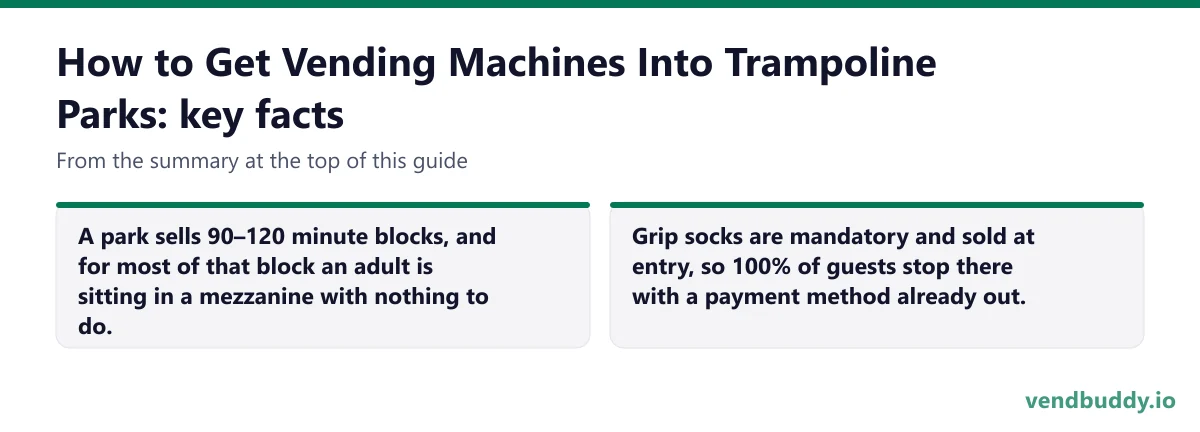
- The customer is the parent, not the jumper. A park sells 90–120 minute blocks, and for most of that block an adult is sitting in a mezzanine with nothing to do.
- Ask for the sock counter wall. Grip socks are mandatory and sold at entry, so 100% of guests stop there with a payment method already out. Waiver kiosks are the second-best wall.
- Franchise or independent decides who you call. Sky Zone, Urban Air, Altitude, Launch and Big Air are franchised — the franchisee signs, the GM scouts, and there may be an approved-vendor list.
- Never ask for the court edge. Food near the jump surface is a settled risk decision. Asking marks you as someone who does not understand the building.
- Better than commission: offer a drink token inside the birthday-party package. That package is the highest-margin thing the park sells.
A trampoline park is the closest thing in the venue series to a purpose-built vending location that nobody has taken. Two hours of forced dwell time. A hundred percent of guests funnelled past a single counter. A predictable party calendar. Adults who are bored, standing, and already holding a card because they just paid for socks.
Part of our complete guide: how to find vending machine locations.
And most operators never work them, because the category reads as a children's venue and children are not the customer here. The parent is. Once you have that straight, the pitch writes itself — but the person you deliver it to depends entirely on whether the sign over the door is a franchise.
Franchise or independent, and why it matters first
This is the qualifying question and it takes one look at the name.
- Franchised parks — Sky Zone, Urban Air, Altitude, Launch, Big Air and the rest — are owned by a local franchisee, frequently someone who owns two or three units and is not in the building. The GM on the floor cannot sign and will not pretend to. Your job in the first visit is to get the franchisee's name and whether the franchise agreement carries an approved-vendor list or a mandated cafe programme. Some do. Find out in week one, not week five.
- Independent parks — the local adventure park, the ninja-warrior gym, the indoor playground with a court — are the owner, who is usually reachable and usually on site. Faster yes, smaller building.
The tell that saves you a wasted month: ask the GM “is this something you can approve, or does it go to the owner?” in the first two minutes. That single question is the thing wave one of this series kept coming back to, and it is mapped out for every property type in the decision-maker map.
What a park operator actually cares about
- Liability, above everything. The business runs on waivers, court monitors and an insurance policy that is the second-biggest line on the P&L. Anything you propose gets filtered through that first. Lead with where the machine will not be.
- Throughput at the front. Session changeovers are every ninety minutes and the entire building turns over at once. Waiver kiosks jam, the sock counter jams, and the GM watches it. You are not solving that, but you should know it is what he is looking at while you talk.
- Party attach rate. Open jump barely works as a business. Birthday parties are the product. Anything that makes a party package look richer without costing the park anything is genuinely interesting to an owner in a way a commission cheque is not.
- The cafe, if there is one. Most franchise parks have one and most of them are thin: a pizza warmer, a slush machine, one staff member who also runs the register at peak, and hours that do not cover the full day. It is not the fortified snack bar a bowling centre runs, but it is not nothing either.
Picture the machines paying you while you sleep
That’s the real promise of vending — income that doesn’t cost you your time, and a life on your own terms. VendBuddy turns this guide into a step-by-step plan so you actually build it instead of just reading about it. Start free today.
Start building free →The three walls worth asking for
| Placement | Why it works | Machine |
|---|---|---|
| Sock counter adjacency | Grip socks are mandatory and sold here, so every guest stops with a card out | Drinks-led combo |
| Waiver kiosk queue | 5–15 minutes of standing still at every session changeover | Drinks only |
| Spectator mezzanine | Bored adults, 90–120 minutes, line of sight to the courts | Combo, coffee-adjacent mix |
The sock counter is the one to fight for. It is the single highest-transaction point in the building and the psychological work is already done: the guest has been told there is something they must buy before they go in, they have accepted it, and their wallet is open. A drink at that moment is a two-second decision.
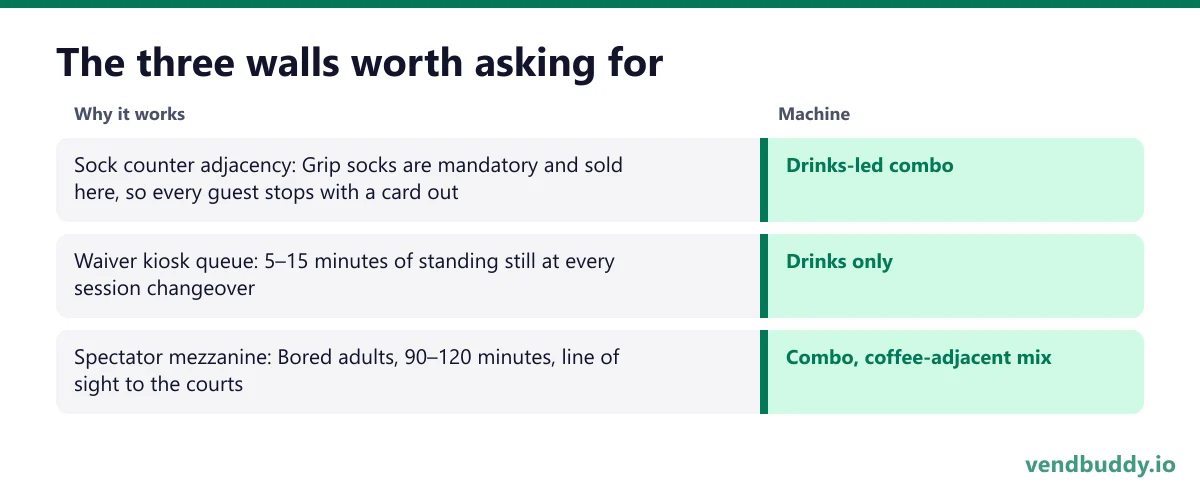
The mezzanine is the one you will more often actually get, because it is out of the way and the owner does not have to think about it. It is a good placement, not a great one — parents drift there rather than queue there, so model a lower capture. That same parent-as-customer pattern is what makes the pitch for how to get vending machines into daycares work, with far shorter dwell time but a repeat visit every weekday.
The revenue math, honestly
Parks count jumpers, by session, and the number is in the point-of-sale. Ask for a monthly figure and then ask what share is parties, because parties bring a higher adult-to-child ratio than open jump does.
A park at 6,000 jumpers a month brings a broadly similar number of accompanying adults through the door across the month. A sock-counter machine at a 5–10% capture on a $2.50 ticket models to roughly $600–$1,500 gross a month. A mezzanine placement at the same park models lower, call it half. Both of those are arithmetic on the park's own numbers, not a benchmark, and the capture rate is the assumption you should be testing rather than believing — which is what the 90-day location test is for.
Seasonality inverts the bowling pattern and that is useful if you run both. Trampoline parks peak in summer, on school holidays, and on every rainy Saturday in the calendar. January and February are slow. A weather-driven venue is unusually spiky week to week, so telemetry earns its keep here faster than at a steady office account.
On telemetry specifically, Nayax is the default for a dull reason: it is the one most machine suppliers pre-wire for. Price the monthly against your slowest machine, not your best one. Affiliate link, so we may earn a commission at no extra cost to you.
At a trampoline park the customer is the parent, not the jumper. Two hours of forced dwell time, and every guest walks past the sock counter with a card already out.
The pitch, and the party-package trade
Go on a weekday morning. Parks are empty before school lets out and the GM is doing inventory.
“I would not go anywhere near the courts or the cafe — I know that is a whole conversation and it is not the one I want. What I am asking about is the wall by the sock counter. Everybody who comes in stops there anyway, and right now that is a thirty-second stop where the only thing you sell is socks. Costs you nothing, I own it, I service it, and if it does not earn the wall in three months I take it back out.”
Then make the offer that separates you from every other vendor who has walked in: a drink token in the birthday-party package. You supply the tokens at your cost, the park folds a free drink for every party guest into the package it already sells, and the package gets richer without the park spending anything. What you get back is a machine that is written into the park's highest-margin product and a redemption stream that pulls families to your unit rather than the cafe. This is frequently worth more to a park owner than five points of commission, and it costs you less.
The objections you will hear
“We have a cafe.”
Ask what time it closes and who runs it during a party rush. At most parks the answer is one person, and at peak that person is making pizzas. Then be specific: “I am not asking for food. I am asking for cold drinks on the other side of the building, for the parents who are not going to leave the mezzanine to queue behind eleven kids.” If the park runs a franchisor-mandated cafe programme, check whether it covers packaged beverages, because plenty of them cover prepared food only.
“It is a safety thing.”
Take the win. This objection means the owner is picturing the machine near the court, and you were never asking for that. Say so, name the spectator side, and mention that you anchor to the wall and run cashless so there is no coin box and nothing to tip. You have now had a safety conversation and come out looking like someone who has been in a park before.
“Corporate has to approve vendors.”
Sometimes true, and unlike the hotel version of this objection it is worth pursuing rather than walking away from, because a franchise system with an approved-vendor list is a list you can get on once and sell against for years. Ask the franchisee for the process and offer to do the paperwork. Most operators will not, which is exactly why the slot stays open.
You can build all of this yourself in a spreadsheet over a weekend. If you would rather not, the operator kits package the same checklists and templates as a one-time download starting at $27.
“Kids will wreck it.”
Less true here than at an arcade, because a trampoline park is one of the most heavily supervised rooms a child can be in — court monitors are everywhere and cameras cover the floor. Say that back to him. Then anchor the machine anyway and skip the coin mech.
The walk-in above, written out end to end — the opener, the twelve objections operators actually hear, how to structure a value trade instead of a commission percentage, and the plain-English placement agreement to leave with the GM when it goes well.
See what is inside →What to put in
Machine: a glass-front drink unit at the sock counter or the kiosks, a combo on the mezzanine. Cashless-first is not optional at a venue where the guest already tapped twice on the way in and half of them are teenagers with a phone and no wallet. Anchor everything.
Product: water in volume, sports drinks, and coffee-adjacent for the mezzanine adults, which is the SKU set most operators forget because they are thinking about the children. Skip anything that melts and skip glass entirely. The general logic lives in best products to stock.
If you have looked at the automated dessert category, this is one of the few venue types where it genuinely fits — families, dwell time and a party calendar — and the honest economics of that are in the dessert kiosk post. Do not lead with it. Land the drink machine first and ask about the second unit in month four.
Service reality
Weekly, and service Tuesday or Wednesday morning. Trying to restock a sock-counter machine at 11am on a Saturday means standing in a queue of forty people with a hand truck. Expect volume to swing hard with weather and school calendars, which is the case for telemetry rather than a fixed route slot.
When to walk
Say no to: parks under roughly 3,000 jumpers a month, a park whose only offered wall is a back corridor guests do not use, a franchisee who wants a percentage and also wants you to fund the party tokens, and any park where the cafe is a full staffed food operation with its own drink cooler at the register. The last one is a bowling alley with a bounce floor, and the four-placement logic from the bowling and FEC guide is the version of this pitch you want instead.
Trampoline parks, adventure parks and indoor playgrounds do not show up on any prospecting list, and franchise units and independents need different calls. VendBuddy scores real venues near you by category and size and hands you the best contact on file for each one, so you know which door you are knocking on before you leave the house. Free to start, no card.
Frequently Asked Questions
How do you get vending machines into a trampoline park?
Find out first whether the park is franchised or independent, because it changes who you are calling. Sky Zone, Urban Air, Altitude, Launch and Big Air are franchise systems, so the person who can sign is the franchisee rather than the general manager on the floor, and there may be an approved-vendor list to clear. An independent park is the owner and a single conversation. Either way, pitch the spectator side of the building rather than the jump court, and pitch the parent rather than the jumper.
If you are not sure where to start, most people pull a free list of the businesses near them in the before they do anything else. Five contact reveals are free and there is no card, so it costs you a search and about ten minutes.
Do trampoline parks make good vending locations?
The good ones do, and the reason is dwell time on the adults. A park sells jump time in ninety or one hundred and twenty minute blocks, and for most of those blocks a parent is sitting in a mezzanine with nothing to do. That is a captive adult with a wallet, held in one room, for two hours, on a schedule you can predict from the party calendar. The weak parks are the ones with a full cafe that stays staffed all day, and the small ones that only fill on Saturday.
Where should a vending machine go in a trampoline park?
Next to the sock counter or the waiver kiosks if the owner will give you that wall, and in the spectator seating area if he will not. Every single guest passes the sock counter, because grip socks are mandatory and sold there, and a queue forms at the waiver kiosks at every session changeover. Those are the two places in the building where a person is standing still with a payment method already out. The party-room hallway is the third. Never the jump court edge, which is a safety conversation you will lose.
What commission do trampoline parks expect on vending?
Fifteen to twenty percent of gross is the normal band, and franchise parks tend to be more structured about it than independents because they are used to vendor paperwork. There is a better trade available at this venue than a percentage: offer to fold a drink token into the park birthday-party package. The party package is the highest-margin thing the park sells, and an operator who makes that package look richer at no cost to the park is worth more to the owner than a monthly cheque.
How much can a vending machine make at a trampoline park?
Work from jumper counts, which the park tracks by session and will usually tell you. A park doing six thousand jumpers a month brings roughly the same number of accompanying adults through the door across parties and open jump, and a machine at the sock counter with a five to ten percent capture at a two-fifty ticket models to somewhere around six hundred to fifteen hundred dollars gross a month. That is arithmetic on figures the park gave you rather than an industry figure, and the capture rate is the assumption to test rather than trust.
Will a trampoline park let you put a vending machine near the courts?
Almost certainly not, and you should not ask. Park operators run on waivers and insurance, and food or drink anywhere near the jump surface is a category of risk they have already decided against, partly for the obvious mess reasons after a child has been jumping for an hour. Ask for the spectator side instead. Framing your request as the safe side of the building is a small signal that you understand their business, and at a venue this liability-conscious that signal is worth more than it should be.
Related reading: how to find vending machine locations, bowling alleys and family entertainment centres, the experiential venue playbook, colleges and universities, churches, sell the meeting, not the machine, and how to negotiate a placement.
What is selling, which buildings say yes, and the numbers before you buy a machine. Free, confirm from your inbox, unsubscribe in one click. Refer one friend and get 25 VendBuddy credits.
Want the free 38-page Ultimate Vending Guide too? Get the guide
Every operator we talk to wants fewer cold calls. The ones who get there have a Google Business Profile and a simple site a manager can check before replying. AI builders make that an evening job now. Wix is the mature site builder; Base44 also builds working tools like a quote form. Start with the AI website walkthrough or Wix vs Base44.
General information, not legal, tax or financial advice. Rules change, so check the official source. Revenue and income figures are examples, not promises. See our terms.