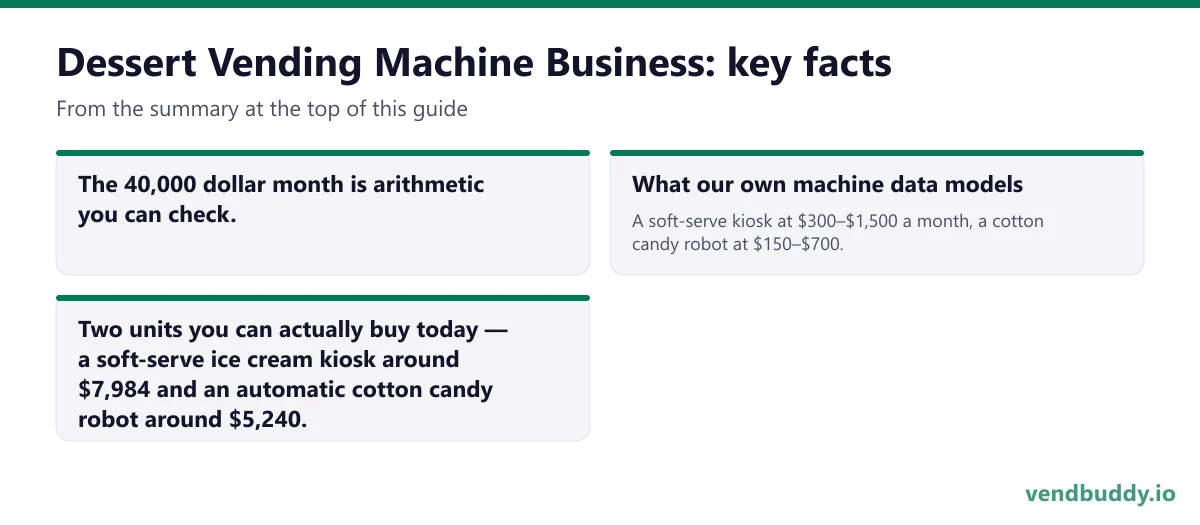
- The 40,000 dollar month is arithmetic you can check. At a $6 ticket that is 222 servings a day with no closed days. The machine can do it. Almost no venue can.
- What our own machine data models: a soft-serve kiosk at $300–$1,500 a month, a cotton candy robot at $150–$700. Good money on the right site, nothing on the wrong one.
- Two units you can actually buy today — a soft-serve ice cream kiosk around $7,984 and an automatic cotton candy robot around $5,240. Everything past that, verify parts and service before you send a deposit.
- This is a venue business wearing a machine costume. Families plus dwell time, or it does not work. Offices, gyms and warehouses are the wrong room entirely.
- Wrong choice for machine #1. Perishable stock, sanitation cycles, food permitting and a steep winter drop. Right as machine four or five for an operator who already has a route and a relationship at a family venue.
The automated dessert kiosk is having its moment: a robot arm spinning cotton candy, a touchscreen soft-serve unit assembling a cone in twenty seconds, and a number attached to it — forty thousand dollars a month — that gets repeated far more often than it gets checked. So let us check it, then talk about what the category actually is, because there is a real business in here and it is not the one being sold.
What 40,000 dollars a month actually requires
Take the claim at face value and work backwards. Forty thousand a month is about $1,333 a day. A soft-serve cone with sauce and a topping is a $5–$7 ticket, so call it $6. That is 222 servings a day. Over a twelve-hour operating window that is one sale every three minutes and twelve seconds, sustained, with nobody closing the venue, nobody emptying the hopper, and nothing needing a clean.
The machine is not the constraint. A soft-serve kiosk dispenses in roughly twenty seconds, so it could theoretically serve well over a thousand people a day. The constraint is the room. At a 3–5% capture rate — generous for a dessert impulse buy at a premium price — 222 servings a day needs somewhere between four and seven thousand people walking past that machine, every single day, in a mood to buy dessert. That is a theme park midway, a top-tier mall concourse in December, or a stadium on a game night. It is not a lobby, and it is not a location anybody is handing a solo operator on a handshake.
For contrast, here is what our own Machine Finder models for these units on realistic placements, and we would rather publish the unflattering number than the exciting one:
| Machine | Price | Modelled gross / month |
|---|---|---|
| Soft-serve ice cream vending kiosk | $7,984 | $300–$1,500 |
| Automatic cotton candy vending robot | $5,240 | $150–$700 |
The gap between $1,500 and $40,000 is not a rounding error, and it is not pessimism either. It is the difference between one unattended machine at a good family venue and whatever the forty-thousand figure is actually describing — most often a full location, a multi-unit fleet, or a franchise gross before cost of goods, rent and labour. When you see the number, the only useful question is: how many machines, at what venue, over what months? If the answer is not offered, treat the number as marketing rather than data.
If the spend is going on plastic anyway, the card choice is worth ten minutes. Most operators we talk to land on the Bilt card, not for what it pays on pallets but because the rent payment earns too. Referral link, and the honest caveat is that a carried balance beats what any of these points are worth. Affiliate link, so we may earn a commission at no extra cost to you.
At a $6 ticket, $40,000 a month is 222 dessert servings a day with no closed days. The machine can do it in 20 seconds a cone. The venue is the constraint, and nobody hands a solo operator that venue.
The machines that actually exist to buy today
Two units are genuinely orderable, priced, and in our catalog because operators have bought them:
- Soft-serve ice cream vending kiosk — about $7,984. Touchscreen, assembles a cone or cup in roughly twenty seconds, handles sauce and topping add-ons, and reports remotely. The real draw is that it is a spectacle a child will pull a parent toward. The real caution is in our own catalog note: strongly seasonal and family-traffic dependent, with a steep winter drop.
- Automatic cotton candy vending robot — about $5,240. A robot arm spins fresh candy in about thirty seconds across a dozen flavours, cashless built in. It sells itself in malls, family entertainment centres and parks, and it is effectively dead in offices, gyms or adult-only venues. Detail on that one is in the cotton candy vending machine business breakdown.
Past those two, be careful. Frozen yogurt and gelato kiosks exist and are largely the same overseas OEM platforms rebadged by different importers, which matters less for build quality than for who answers the phone when a compressor fails in July. Açaí and smoothie-bowl robots, and the hot-dessert units — churro, waffle, mini-donut and cookie robots — we could not verify to our own standard at the time of writing: no US distributor with published pricing, confirmed parts availability and a service map we could check. That is not a claim they do not exist. Several clearly do, and some are impressive. It is a reason to ask three questions before any deposit moves.
- Who stocks parts in the US, and what is the lead time on a compressor, a board and a dispense motor? A dessert machine down for three weeks in August has lost its season, not a week.
- Who services it, and what does a call-out cost? If the answer is a video call with an overseas engineer, you are the technician. Price your own time into the model.
- What does my county health department call this machine? Ask before you buy. See below — this is the one that catches people.
Picture the machines paying you while you sleep
That’s the real promise of vending — income that doesn’t cost you your time, and a life on your own terms. VendBuddy turns this guide into a step-by-step plan so you actually build it instead of just reading about it. Start free today.
Start building free →The costs a dessert kiosk carries that a snack machine does not
This is where the category stops resembling vending. A snack machine is a shelf with a coil. A dessert kiosk is a small unmanned kitchen, and it is priced accordingly on the operating side even when the purchase price looks comparable.
- Perishable stock and cold chain. Dairy mix has a shelf life and a temperature it must never leave. Slow weeks do not just cost you sales, they cost you product. A snack machine that sells nothing for a month has lost nothing but time.
- Sanitation cycles. Soft-serve heads need regular sanitising. Heat-treat units automate a chunk of that; teardown-clean units do not, and a teardown clean is a service visit on a schedule you do not control. Ask which one you are buying, because it changes your route time per machine more than anything else on this list.
- Permitting. Many jurisdictions treat a machine that assembles a dairy product to order as food service rather than vending. That can mean a different permit, a plan review, and a certified food-protection manager attached to the account. It is entirely survivable and it is not something to discover after the freight arrives.
- Downtime asymmetry. A jammed coil costs you one sale. A failed compressor costs you the whole hopper plus the sales plus the callout, and it always happens on the hottest weekend.
- Seasonality you cannot merchandise around. Our catalog note on the soft-serve unit says it plainly: summers and family venues carry it, and winter drops steeply. If your model needs twelve even months, this is the wrong category.
The venues that actually fit
Every dessert kiosk decision is really a venue decision. The filter is short: children, dwell time, and a host willing to take a food machine. Miss any one of the three and the machine underperforms regardless of how good it is.
| Venue | Why it works | The catch |
|---|---|---|
| Family entertainment centres, trampoline parks, bowling | Families parked for two hours with money already out | They may want a commission or already run their own snack bar |
| Water parks, pools, campgrounds | Heat plus children plus captive time | Ferociously seasonal; a four-month earning window |
| Mall concourse and food courts | The traffic volume the math actually needs | This is a kiosk lease, not a free placement — price it as rent |
| Cinema lobbies | Dessert is already the reason people are in the lobby | Direct competition with the concession stand that pays their bills |
| Campus student unions | Late-night demand, high dwell, card-native buyers | Academic-year dip and a procurement process |
| Zoos, minor-league stadiums, seasonal attractions | Peak-day volumes that flatter a whole month | Event calendars, not steady weeks |
The anti-list is just as useful: offices, gyms, warehouses, laundromats, auto repair shops and medical waiting rooms. No children, wrong daypart, wrong mood. Those are excellent snack and drink locations and they are terrible dessert locations, and operators lose real money learning that with a $7,984 machine instead of a $1,500 one. If you are working out which venues near you carry that kind of family traffic at all, that is what the location-finding process and the experiential venue playbook are for.
Why the timing matters more than the machine
The reason to look at this category now is not that the machines have got better. It is that in most US markets nobody has placed one yet, and that produces two advantages that both expire.
The first is novelty pricing. A robot that spins cotton candy in front of a seven-year-old is not competing with a candy bar, it is competing with the gift shop. That supports a ticket a snack machine could never hold. The second identical machine in the same mall is not a spectacle, it is a vending machine, and the ticket falls to what the product is worth. Novelty is a real asset with a short half-life, and it is spent per venue rather than per market.
The second is that the first operator through the door gets the exclusive. A family entertainment centre that has never been pitched a dessert robot will sign a three-year exclusive without thinking hard about it. The same venue, after three operators have called, will run it as a bid and take a commission. Machines are orderable any month of any year. A signed multi-year exclusive at the busiest trampoline park in your county is not, and that contract is the actual asset here — the machine is just what you put in the space. Get the term and the exclusivity written down properly; commission rates by venue type covers what the number should be.
The honest other half: pre-saturation also means unproven. There are no local comparables to sanity-check your projection against, the used market is thin if you want out in year two, and parts supply is exactly as good as the importer you bought from. You are being paid for taking that risk, and it is a real risk rather than a rhetorical one.
This category is decided by the room, not the robot. VendBuddy scores real properties near you by category, size and traffic, and hands you the best contact on file to call — so you can find out whether your county actually has the family venues this needs before you spend $8,000 finding out.
The honest verdict
A dessert kiosk is a bad first machine and a genuinely interesting fourth or fifth one. It is wrong for anyone who needs predictable monthly cash, wrong for a cold-climate route with no indoor family venue, and wrong for an operator who has not yet proved they can close a location, because this category asks you to close a harder one than usual.
It is right for an operator with an existing snack and drink route, a working relationship at a family venue, enough cash to shrug at a slow January, and the patience to verify parts and permitting before buying rather than after. On that profile, a soft-serve kiosk at a busy trampoline park is one of the better placement opportunities in vending right now, precisely because the number circulating around it is wrong in a way that keeps sensible people away.
If you want the broader field before committing to this one, alternative vending businesses ranked puts every niche side by side on capital and return, the most unusual machines operating today covers what else is out there, and the vending machine prices guide has the full price sheet by machine type.
Frequently Asked Questions
Is a dessert vending machine business profitable?
It can be, in a narrow set of venues, and it is not profitable the way the marketing implies. Our own machine data models a soft-serve kiosk at 300 to 1,500 dollars a month gross and a cotton candy robot at 150 to 700, which is a real second income on a good placement and nothing at all on a bad one. Profit depends far more on whether the venue delivers families with dwell time than on which machine you buy.
How much does an automated dessert kiosk cost?
A touchscreen soft-serve ice cream kiosk runs about 7,984 dollars and an automatic cotton candy vending robot about 5,240 dollars. Add roughly 700 to 1,000 dollars for the card reader, opening product and freight, and budget for a cold-chain and sanitation routine that a snack machine does not need.
Can a dessert vending machine really make 40,000 dollars a month?
Run the arithmetic before you believe it. At a 6 dollar average ticket, 40,000 dollars a month is about 222 servings a day, every day, with no closed days and no downtime. The machine can physically do that in 20 second cycles. The venue almost never can. A figure that size is usually a whole location, a fleet of machines, or a franchise gross rather than one unattended kiosk.
Do you need a food permit for an ice cream vending machine?
Usually yes, and it is often not the same permit as a snack machine. Many health departments treat a unit that assembles a dairy product to order as food service rather than vending, which can mean a separate permit, a plan review, and a named food-protection manager on the account. Ask your county health department what category the specific machine falls into before you place a deposit, not after.
What is the best location for a dessert vending machine?
Somewhere families already spend hours. Family entertainment centres, trampoline parks, bowling alleys, water parks, campus student unions, cinema lobbies, zoos and minor-league stadiums. The filter is children plus dwell time plus a host who will accept a food machine. Offices, gyms, warehouses and auto shops are the wrong daypart and the wrong mood no matter how good the machine is.
Is the dessert vending niche saturated?
Not yet in most US markets, which is the honest case for looking at it now. It is also unproven, which is the honest case against. Pre-saturation means no local comparables, a thin used market if you want out, and parts supply you have to verify yourself. The thing worth locking early is not the machine but a multi-year exclusive at the venue with the traffic.
Related reading: the cotton candy vending machine business, vending at experiential venues, profit by location type, and how to place machines for maximum revenue.
What is selling, which buildings say yes, and the numbers before you buy a machine. Free, confirm from your inbox, unsubscribe in one click. Refer one friend and get 25 VendBuddy credits.
Want the free 38-page Ultimate Vending Guide too? Get the guide
General information, not legal, tax or financial advice. Rules change, so check the official source. Revenue and income figures are examples, not promises. See our terms.