- This is a permission question, not a zoning question. Every machine sits on ground somebody controls, and the whole job is getting that person to say yes in writing — which is what how to find vending machine locations is about.
- Private property: written owner consent first, permits second. In that order, every time.
- Public property is not unowned property. Parks, transit, libraries and municipal buildings place vending through concession agreements and competitive bids. You apply; you do not arrive.
- Pavements and the right-of-way belong to the city, and most cities will not permit a machine there because of accessibility clearance. Assume no.
- Your own front yard is a traffic problem before it is a legal one — and it is also a zoning, HOA and code-enforcement problem.
- General principles only below. Rules vary by city, county and state, so verify anything specific with your local clerk, planning office and health department.
Search this and you will find a lot of pages talking about zoning, as though the question were whether the ground is coded correctly. That is not the constraint that stops people. The constraint is that every square metre of floor in the world belongs to somebody, and putting a revenue-generating box on it requires that somebody's agreement. Once you see it as a permission problem, the confusing cases stop being confusing. Here is how it works for each type of place people ask about.
The one-sentence answer
You can put a vending machine anywhere the person who controls that space has agreed in writing to let you, and where the local authority does not separately require a permit you do not have.
Notice the order. Permission comes first because without it nothing else matters — a perfectly permitted machine with no owner consent is still trespassing. Permits come second because they are administrative: they are forms and fees, they vary wildly by city and county, and they are solvable once you know the address. Almost every beginner researches them in the opposite order and concludes the business is more complicated than it is.
What follows is general information about how placement works, not legal advice. Requirements differ by city, county and state, and the only authoritative answer for your machine at your address comes from your local clerk, planning department and health department.
Where can I put my vending machine? The short list
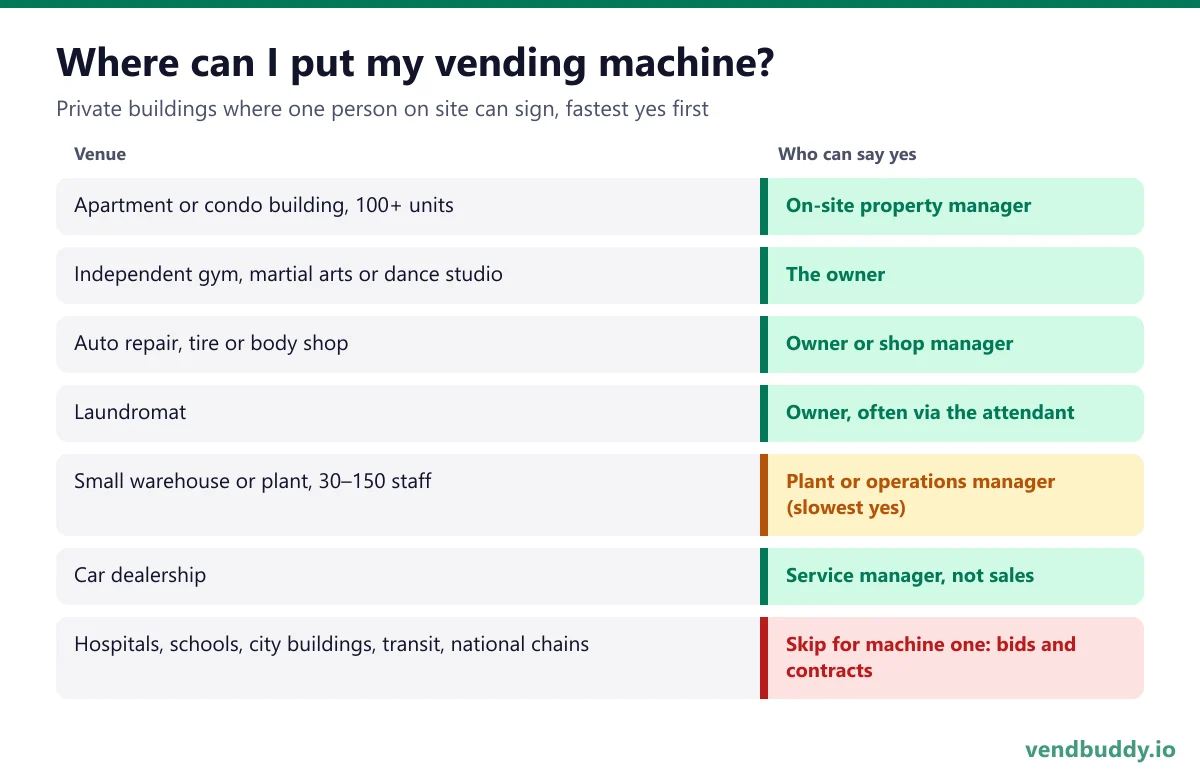
For a first machine, the realistic answer is a privately owned building where one person on site can sign for it. That rules out almost everything with a procurement department and leaves a short list, ranked here by how quickly you can get a yes that is worth having:
| Venue | Who can actually say yes | Why it is on the list |
|---|---|---|
| Apartment or condo building, 100+ units | On-site property manager, sometimes the regional manager | Evening and weekend traffic, no competing shop in the building, and the manager can usually sign without escalating |
| Independent gym, martial arts or dance studio | The owner, who is normally on the floor | One conversation, no committee, and drinks carry the best margin in the machine |
| Auto repair shop, tire shop or body shop | The owner or shop manager | Customers wait 40 minutes with nothing to do, and the decision takes about a minute |
| Laundromat | Owner, often reachable through the attendant | Long dwell time and existing power. Check the machine has a dry corner away from the dryers |
| Small warehouse or plant, 30–150 staff | Plant manager, operations manager, sometimes HR | The slowest yes on this list and usually the highest revenue. Worth the wait once you have one reference site |
| Car dealership | Service manager, not sales | Service waiting rooms run all day and dealerships rarely have their own vending |
| Barbershop or salon | The owner | Easy yes, modest volume. Take it only with no commission and a machine you already own |
What to skip for machine number one: hospitals, schools, city buildings, transit stations, and any national chain. Not because they are bad placements, they are often the best ones, but because they buy vending through bids and contracts and that process takes months you do not have yet. Go back for them at machine eight, with a reference site and a certificate of insurance in hand.
The permission path is the same in every row above. Find out who controls the floor, ask them in person rather than by email, and turn the yes into a short written placement agreement before you move any equipment. The full method for working through a list like this, including how to identify the decision-maker at each venue type, is how to find vending machine locations. If you want the version of this table for your own ZIP code, with the actual businesses and a contact for each, run a search in the Lead Finder.
Picture the machines paying you while you sleep
That’s the real promise of vending — income that doesn’t cost you your time, and a life on your own terms. VendBuddy turns this guide into a step-by-step plan so you actually build it instead of just reading about it. Start free today.
Start building free →Private property: the permission model
This is where the overwhelming majority of machines live, and it is the simplest case. An office, a gym, a factory, an apartment building, a laundromat, a car dealership. Somebody controls that floor space. You find out who, you ask, and if they say yes you write it down.
Two things make this harder than it sounds, and neither is legal. The first is identifying the actual decision-maker, which is rarely the front desk and often not the manager either — for apartments it is usually the property or regional manager, for offices it can be facilities or HR, for a franchise it may be the owner rather than the store. That mapping is the whole of the vending decision-maker map. The second is that the person who says yes is frequently not the person who owns the building: a tenant can usually authorise something inside their leased space, but their lease may restrict it and the landlord may already have an exclusive with another vendor. Ask.
What you want out of the conversation is not a handshake. It is a short written placement agreement covering term, commission, who pays for power, access hours, responsibility for damage, and how either side ends it — what it should contain is in vending machine contracts 101.
Public property, parks and government buildings
The single most common misconception in this whole topic is that public means unowned, and therefore free to use. It does not. Public means owned by a government body — a city, a county, a school district, a transit authority, a parks department — and those bodies typically control commercial access to their property more formally than private landlords do, not less.
In practice that means a concession agreement, a licence, or a competitive procurement. Anything with real volume usually goes out as a bid or an RFP: the authority publishes what it wants, operators submit proposals with a commission offer and proof of insurance, and one wins for a fixed term. Smaller placements might be a simple licence from the department that manages the building.
None of this makes public sites off-limits. They are frequently excellent placements, precisely because the process filters out everyone hoping to just show up. It does mean the route in is an application. Find the department that manages the specific site — parks, facilities, transit, the school district business office — and ask how they award vending concessions and whether anything is out for bid. Expect to be asked for liability insurance and, for schools or healthcare, to meet product rules on what may be sold. Those institutional cases are covered in school and campus vending contracts and hospital and healthcare vending.
Sidewalks, kerbs and the public right-of-way
The strip of pavement outside a building is usually not part of that building's property, even though it looks like it. It is public right-of-way controlled by the municipality, and placing a permanent object on it is generally treated as an encroachment.
Where cities allow it at all, it typically requires an encroachment or sidewalk-use permit, sometimes an annual fee, and insurance naming the city. Many cities will not issue one for a vending machine at all, because pavements have minimum accessible-width requirements and a machine plus the person standing at it eats a lot of that clearance. Rules differ more between neighbouring cities here than on almost any other topic in this business, so there is no useful national answer — call your city's public works, planning or streets department and ask about a fixed vending unit on the right-of-way. Until a named person there says otherwise in writing, treat the pavement as a no. If a shopfront placement is what you want, put the machine inside the premises or on private ground behind the property line, with the owner's consent.
Your own front yard, driveway or garage
This comes up constantly, usually as some version of "hear me out — what if I just put one in my front yard?" The answer has two halves.
The legal half: owning the land is the first permission, not the only one. Residential zoning in most places limits commercial activity in residential areas, and a machine serving the public is commercial activity. If you are in an HOA, the covenants very often prohibit it outright, and that is a contract you already signed. A machine visible from the street is also the kind of thing neighbours report, which brings code enforcement whether or not anything is technically wrong. Ask your city or county planning department; the answer genuinely varies.
Most first agreements are two pages, not twenty. The contracts walkthrough lays out the clauses that actually matter for the contract, including the termination language operators forget about until they need it.
The practical half matters more: a front yard has no captive traffic. Vending revenue comes from people who are already somewhere for another reason and cannot easily leave — a shift worker, a gym member between sets, a resident at 11pm. A residential street has passers-by, not captives. Add no overnight supervision, weather exposure, and your home address becoming a business address, and the traffic problem sinks it before zoning is even reached. The productive version of that instinct is untapped vending locations beyond apartments.
In front of, or inside, your own business
The easiest placement in vending, and worth naming because people over-think it. If you own or lease the premises and the machine is inside, you are mostly dealing with yourself. Two checks remain. If you rent, read the lease — some restrict installations or anything placed outside the unit. And if the machine ends up past your property line onto the pavement, you are back in right-of-way territory and the city decides, not you.
What you vend can also change the rules. Food and drink typically bring health-department requirements, and some categories — anything age-restricted in particular — carry their own licensing regardless of whose building it is in.
Permits: real, secondary, and wildly variable
Once you have permission, the administrative layer is straightforward and it is genuinely local. Depending on where you are, some combination of these may apply: a general business licence, a vending machine or amusement device licence, a food establishment permit or food handler card, a health department registration or inspection, a sales tax permit, and in some jurisdictions a physical decal on each machine.
Some places want almost none of that. Others want most of it. Two calls resolve it for a specific address: your city or county clerk, and your local health department. The general shape of what to expect is in vending machine licence and permit requirements, with a state-level comparison in permit requirements by state — but treat both as orientation, not as the answer for your city.
The practical answer
Stop asking whether a machine is allowed somewhere and start asking who controls that floor and how you get a yes from them in writing. That reframing does two useful things. It removes the paralysis, because "who do I ask" is a solvable problem where "is this legal" feels like it needs a lawyer. And it points you straight at the work that actually builds the business: identifying venues worth pursuing, finding the decision-maker, and pitching.
If you want to see which venues near you are worth asking, the Lead Finder scores them from your ZIP and tells you who to contact. The full method is how to find vending machine locations, the words to use are in the cold pitch script, and the paperwork that follows a yes is contracts 101.
Frequently Asked Questions
Can you put a vending machine anywhere?
No. A vending machine has to sit on land or inside a building that somebody owns or controls, and that somebody has to agree in writing to let it be there. That is true of a break room, a car park, a shop frontage, a park, and your own driveway. Permits are a separate and secondary question that only matters once permission exists. The practical test is not "is this legal" but "who controls this square metre of floor, and have they said yes in writing". If you cannot name that person, you do not have a location.
Where can I put my vending machine?
For a first machine, a privately owned building where one person on site can sign for it. The shortest paths to a yes are apartment buildings of 100 units or more, independent gyms, auto repair shops, laundromats, small warehouses of 30 to 150 staff, dealership service departments, and barbershops. Skip hospitals, schools, city buildings and national chains until you have a reference site, because those buy vending through bids and contracts that take months. In every case the permission comes from whoever controls the floor, and it should end up as a short written placement agreement before you move the machine.
Can you put a vending machine on public property?
Not by simply putting one there. Public does not mean unowned - it means owned by a government body, and those bodies control access to their property at least as tightly as a private landlord does. Parks, transit stations, libraries, courthouses, municipal pools and government offices generally place vending through a concession agreement, a licence, or a competitive bid or RFP process run by the relevant department. Those contracts exist and operators do win them, but they are applied for rather than assumed. Contact the department that manages the specific site and ask how they award vending concessions.
Can I put a vending machine in my front yard?
Owning the land is only the first of several permissions you need, and often the easiest one. Residential zoning in most places restricts commercial activity in a residential area, homeowner association rules may prohibit it outright, and a machine visible from the street can attract code-enforcement attention regardless of who owns the dirt. There are also practical problems that outrank the legal ones: no captive foot traffic, no lighting or supervision overnight, exposure to weather, and your home address becoming a business address. Check with your city or county planning department before assuming, and treat the traffic problem as the real one.
Can you put a vending machine in front of your own business?
Usually yes if the machine is inside your premises or on ground you own or lease, and this is the simplest placement in the whole industry. Two things still need checking. If you rent, your lease may restrict what you install or place outside, so read it or ask the landlord. And if the machine sits on the pavement or anywhere past your property line, you are on the public right-of-way and that is the local authority decision, not yours. Health and food-handling rules may also apply depending on what you vend.
Can you put a vending machine on a sidewalk?
Almost never without an explicit permission from the local authority. Pavements and the strip between the kerb and a building are usually public right-of-way, and placing a permanent object on them typically requires an encroachment permit, a sidewalk-use permit, or a licence with an annual fee - and many cities simply will not issue one for a vending machine because of accessibility clearance requirements. Rules differ enormously from city to city, so the only reliable answer comes from your own municipality. Assume no until they tell you otherwise in writing.
If the spend is going on plastic anyway, the card choice is worth ten minutes. Most operators we talk to land on the Bilt card, not for what it pays on pallets but because the rent payment earns too. Referral link, and the honest caveat is that a carried balance beats what any of these points are worth. Affiliate link, so we may earn a commission at no extra cost to you.
Do you need a permit to put a vending machine somewhere?
Often, and it varies more than almost anything else in this business. Depending on where you are you may need a general business licence, a vending or amusement device licence, a food-establishment or food-handler permit if you vend food, a health department registration, a sales tax permit, and in some places a per-machine sticker or decal. Some places require almost nothing. The correct move is to call your city or county clerk and your local health department and ask what a vending machine at a specific address requires. Do that after you have permission from the property, not before.
What happens if you put a vending machine somewhere without an agreement?
Best case, the property owner asks you to remove it and you lose the cost of moving it twice. Worse cases are real: the machine gets moved or disposed of without you, the site keeps the cash inside it, or you discover you have no standing to argue because nothing was ever written down. Handshake placements also fail quietly - the manager who agreed leaves, the new one has no record of any arrangement, and your machine is suddenly an unexplained object in their building. A one-page written agreement is what turns a machine sitting in a building you do not own into a location you actually hold.
Related: finding locations, licences and permits, placement contracts, who to ask at each venue type, and which venue types are worth pursuing.
What is selling, which buildings say yes, and the numbers before you buy a machine. Free, confirm from your inbox, unsubscribe in one click. Refer one friend and get 25 VendBuddy credits.
Every operator we talk to wants fewer cold calls. The ones who get there have a Google Business Profile and a simple site a manager can check before replying. AI builders make that an evening job now. Wix is the mature site builder; Base44 also builds working tools like a quote form. Start with the AI website walkthrough or Wix vs Base44.
General information, not legal, tax or financial advice. Rules change, so check the official source. Revenue and income figures are examples, not promises. See our terms.