- A severance package is somebody else deciding your runway. A fixed number of weeks, granted at their discretion, on their timing, usually conditional on signing a release.
- Income you own has none of those properties. It exists before the announcement, it does not expire, and nobody has to approve it.
- The reframe that makes it concrete: on a planning scenario, each machine is roughly another two to three weeks of take-home pay a year — renewed annually, and never revoked.
- Build it while employed, one machine at a time. A paycheck is what lets you wait for a good building instead of taking a bad one.
- Honest limit: this is a 12 to 24 month build, not a parachute. If the layoff already happened, you want the 30-day plan instead.
Everybody understands severance as a number of weeks. Almost nobody notices the strange thing about it, which is that the most important variable in your financial life — how long you can go without a paycheck — is currently set by a committee you are not in, using a formula you did not see, at a time you will not choose.
That is not a criticism of employers. It is just the arrangement. And once you notice it, an obvious question follows: what would it take to grant myself the same thing, in advance, in a form nobody can revoke?
This page is the answer for people who are still employed and paying attention. If the announcement already happened, this is the wrong page and the 30-day plan for after a layoff is here — same asset, much tighter timeline, different rules. This one is for the two years before.
The 2026 AI-layoff wave changed the math
When this page was first written, the argument for building a cushion early was a probability argument: layoffs happen, you cannot time them, so arrange the runway in advance. In 2026 it stopped being probabilistic. Visa cut roughly 2,600 roles and said out loud that it was accelerating its AI adoption at the same time. ServiceNow — a company that sells AI to other companies — trimmed its San Diego offices while posting growth. Neither of those is a company in trouble. That is the part worth sitting with.
A downturn layoff has a shape you can plan around: the market softens, headcount comes out, the market recovers, the roles come back. What is happening now does not have that shape. When a profitable company reduces white-collar headcount and cites AI as the reason, it is not waiting to rehire those seats — the work has been re-specified so that fewer people do it, permanently. The old advice, keep your skills current and you will land somewhere, assumed the somewhere still existed at the same headcount. Increasingly the honest answer is that it exists at seventy percent of the headcount, and nobody will tell you in advance whether you are in the seventy.
That does not change what this page recommends. It changes the deadline. If displacement is structural rather than cyclical, then the runway you build is not insurance against a bad quarter, it is the thing that lets you take twelve months to find the right next role instead of eight weeks to take the first one that answers. And a cushion has to be built before you need it, which means the only bad time to start is the month after the meeting. If the meeting has already happened, the ninety-day plan for what to do after being laid off by AI picks up exactly where this leaves off.
The severance math, and why the units are wrong
Severance packages vary enormously and there is no legal entitlement to one in most private US employment, which is itself worth sitting with. Where a package exists, the common shapes are some number of weeks per year of service, often with a cap, and mid-career employees frequently land somewhere in the range of eight to sixteen weeks. Some people get more. Plenty of people get nothing at all, particularly in smaller companies and particularly when the layoff is disorderly.
So here is the comparison, framed as a planning scenario using illustrative numbers rather than a projection of what you will earn. Put your own figures in; the shape is the point, not the digits.
| A severance package | Income you own | |
|---|---|---|
| Who decides it exists | Your employer | You |
| When it arrives | On their timing, after the decision is made | Every month, starting long before |
| Conditions | Usually a signed release, sometimes a non-disparagement clause | None |
| Duration | A fixed number of weeks, then zero | Continues while the asset exists |
| Can be reduced or withdrawn | Policies change, and packages shrink in bad years | No |
| Exists if you resign | Almost never | Yes |
| Survives the next job | No | Yes — and it comes with you |
The row that changes behaviour is the last one. A package is a one-time bridge that ends. An asset is a floor that stays under you across every job you have after this one.
The per-machine reframe
Now the arithmetic, in the unit that makes it feel real. Again: illustrative planning scenario, not a promise, and the ranges are wide because the buildings are.
Take a $70,000 salary. Depending on your state, your withholding and your deductions, take-home might land somewhere around $4,400 a month, which is roughly $1,000 a week.
Now take a single vending machine in an ordinary building. After product cost, commission to the property and card processing, a common net range is $120 to $350 a month, with strong locations well above that. Call the middle of the ordinary range $250 a month, which is $3,000 a year.
On those illustrative figures, one machine is about three weeks of take-home pay, every year, permanently.
Which means the sentence that reframes this entire category:
Every machine you place is roughly another two to three weeks of severance — renewed every year, granted by nobody, and impossible to revoke.
Four machines, on the same illustrative scenario, is somewhere in the region of a twelve-week package. That is not a small thing to have arranged before anyone calls a meeting. And unlike a package, it is still there in year three, and in the next job, and after that.
Do not adopt my numbers. Run yours: the Income Reality Calculator takes your target monthly income, your deadline and the hours you actually have, and returns the activity and the timeline that implies across ten business models. It is deliberately unflattering and it will tell you plainly when a goal does not fit the time available, which is exactly what you want from a planning tool rather than from a sales page.
Picture the machines paying you while you sleep
That’s the real promise of vending — income that doesn’t cost you your time, and a life on your own terms. VendBuddy turns this guide into a step-by-step plan so you actually build it instead of just reading about it. Start free today.
Start building free →Why this particular asset, and where it genuinely falls short
Any income stream you own does this job. The reason vending shows up in this conversation so often is a set of properties that suit the build-while-employed case specifically:
- It is asynchronous, not passive. Nobody is waiting on your reply. A machine does not care whether you restock it at 6am Sunday or 8pm Tuesday, which is the property that lets it coexist with a demanding job. The word passive is used constantly in this category and it is false; asynchronous is the accurate and more useful description. The honest hours breakdown is here.
- The entry cost is small and the asset is real. $2,000 to $5,000 all in for a first placed used machine, and at the end of it you own equipment rather than a marketing spend. The line-item budget is here.
- It is uncorrelated with your employer and with the market. The break room at a 24-hour warehouse does not care what happened to your sector.
- It is sellable. Routes change hands, commonly somewhere around 12 to 24 times monthly net depending on contracts and equipment. A cushion you can convert to a lump sum is a genuinely different thing from one you cannot. What routes sell for is here.
And the honest shortfalls, because a page arguing for a cushion should not oversell the cushion. It takes one to two years to build to a figure that matters. A bad building earns very little, and the gap between a good site and a bad one is larger than the gap between working hard and working normally. It involves a car, a cart and a Tuesday. And it is not a substitute for cash savings, which remain the only thing that works next month. Savings first, then this alongside. The honest fit assessment, including the cases where the answer is no, is here.

Five free guides cover the ground below in more detail than a blog post can — a 90-day launch plan, the location scouting checklist, the B2B pitch script with the twelve objections answered, tax deductions, and pricing. No card, delivered to your inbox in a couple of minutes.
Get the free guides →The build-while-employed plan, one machine at a time
The whole design rule is: never buy a machine before a building has signed, and never add the next one until the last one has proved it works. That sequencing is what keeps this from becoming an expensive hobby, and it matters more when you are employed than when you are not, because a paycheck removes all the urgency that normally makes people accept a bad location.
| Months | What happens | Weekly hours | Cumulative, as a planning scenario |
|---|---|---|---|
| 0–2 | Target list, script, walk-ins, first location signed. Then buy machine one. | 5–8 | Roughly 3 weeks of pay a year |
| 3–5 | Learn the machine. Fix the product mix. Do nothing else. This is the month most people skip and regret. | 2 | Same |
| 6–8 | Second location, inside the same 15-minute cluster. Funded by machine one plus payroll. | 4–6 | Roughly 6 weeks a year |
| 9–14 | Third location. By now the pitch is automatic and the conversion rate has improved. | 4–5 | Roughly 9 weeks a year |
| 15–24 | Fourth and possibly fifth. Decision point: is this a cushion or a route you are actually building? | 5–8 | Roughly 12–15 weeks a year |
Two things about that table that matter more than the numbers in it.
The months 3 to 5 row is the one everybody wants to skip. One machine running for a full quarter tells you your real net, your real service time, your real product mix and whether you actually like this. Buying machine two before that data exists is how people end up with three machines that each earn less than they should. What the first machine actually teaches you is here.
Everything stays inside one cluster. Fifteen minutes from home or from a road you already drive. Four machines in a cluster is one morning a week; four machines across a metro is four separate outings and it is the reason employed operators quit. Density versus machine count is the whole argument.
By schedule, because the constraint is different for everybody
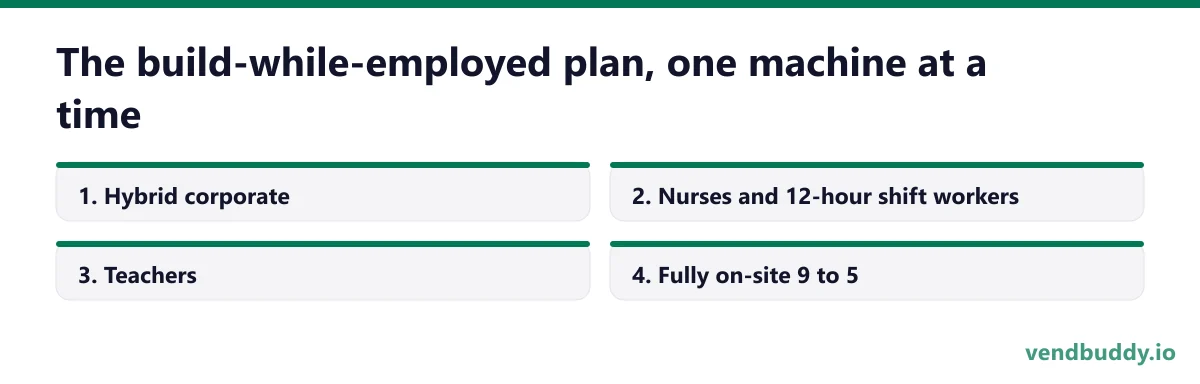
The one part of this that needs weekday daytime is the location hunt, and how you produce those hours depends entirely on what your week looks like. The full job-by-job breakdown is here; the short version:
- Hybrid corporate: a long lunch on a work-from-home day is three walk-ins. Two of those a month runs the entire hunt without a single PTO day. Check your employment agreement for an outside-employment or disclosure clause first.
- Nurses and 12-hour shift workers: four non-shift days a week, most of them weekdays. This is the best schedule in the country for the location hunt and almost nobody realises it.
- Teachers: hunt in summer, service during term. A teacher who starts the hunt in June is placed by September; one who starts in October stalls until the following summer.
- Fully on-site 9 to 5: the hardest case, and the answer is two half-days of PTO used deliberately for walk-ins, plus written outreach to the professionalised properties in the evenings. The cold email scripts are here.
The part nobody prices: what the cushion does to you at work
This is the actual return on the first two years, and it arrives long before the money is meaningful.
There is a specific, recognisable posture that people adopt when their entire income depends on one relationship they cannot control. It is not cowardice and it is not weakness; it is rational. It looks like this: you do not say the true thing in the meeting. You take the doomed project because refusing it costs political capital you cannot afford. You accept the reorg that moves you sideways. You do not ask for the number you are worth, because asking creates a data point about you and you already feel replaceable. You laugh at the thing.
What changes when there is an independent income underneath you is not that you become bold. It is that the cost of being honest drops. Six hundred dollars a month is not freedom. It is not a salary and it does not let you resign. But it moves your internal floor from “if this ends I am in trouble immediately” to “if this ends I have a base and a few months,” and it turns out that most of the behaviour people dislike in themselves at work lives in exactly that gap.
The reported effects from operators who built a cushion while employed are consistently ordinary rather than dramatic: they negotiated a raise they would previously have accepted quietly. They said no to a project with a bad brief. They stopped rehearsing conversations at 2am. And when a package did eventually appear, they read it slowly instead of signing it in the meeting, because the calendar was not making the decision for them.
Two honest caveats, because this section could easily become a fantasy.
The first is that a cushion can make you complacent as easily as it makes you brave. Some people use the floor to stop trying, and disengagement is visible and is itself a layoff risk. The cushion is supposed to lower the cost of being honest, not lower your standards.
The second is that if you decide you are leaving, decide properly rather than drifting. A half-committed employee with a side business is a worse version of both roles. The readiness question has its own page, and the real replacement number is here — it is roughly 28 percent higher than your salary once the employer health contribution, the retirement match and self-employment tax are counted, which is the calculation that stops most people from leaving too early.
Every week of self-granted severance starts with one signed location, and the difference between a good building and a bad one is most of the return. VendBuddy scores real venues near you by traffic, headcount and category, gives you the best contact on file for each, and models the monthly net before you spend anything on equipment. Five free credits, no card required.
When this is the wrong page for you
- If the layoff already happened. This is a 12 to 24 month build. It is not a parachute you can pull the week the rumours start, and it would be dishonest to imply otherwise. Go here instead — the 30-day plan is designed for exactly that situation and costs under $200.
- If the rumours started last month and you are hoping this covers it. Same answer. Build savings first, aggressively, and start the location hunt in parallel because the hunt is free. The machine can wait for the outcome.
- If you have no emergency savings at all. Cash first. Three months of fixed expenses in an account beats one machine, every time, because the machine cannot be spent on rent in March.
- If your employment agreement genuinely prohibits it and you have not read it. Check before you form an entity, not after. Most corporate agreements restrict competing work and work on company time rather than unrelated businesses, but a minority require written disclosure, and disclosing an unrelated route is a far smaller conversation than the one that happens if it surfaces later.
- If what you actually want is to leave now. Then the honest project is a replacement income and a resignation plan, not a cushion. The businesses filtered for actually leaving are ranked here.
The bottom line
The odd thing about severance is not that it is unfair. It is that most people accept, without ever examining it, that the length of their runway is a number somebody else writes down. You can write a version of that number yourself. It takes longer, it starts smaller, and it has the useful property that no meeting can change it.
On a planning scenario, each machine is another two to three weeks of pay a year, granted by nobody, renewed automatically, and still there in the next job. Four of them is a package the size of one a company might have offered — except that it arrived before the announcement, it does not require you to sign a release, and it does not run out in the twelfth week.
Start with one building. The first $100 sequence is here, and it is the same first step whether this ends up being a cushion or a career.
Not sure whether to start anything at all? The readiness quiz scores you on capital, protected hours, risk tolerance and deadline in about two minutes, and it is willing to tell you not yet.
Related reading: what to do after a layoff has already happened, should you start a business in 2026, passive income to quit your job, what replacing your income actually costs, starting a business while working full time, and nine signs you should be your own boss.
Frequently Asked Questions
What does it mean to build your own severance?
It means creating recurring income you own outright, before you need it, so that your runway is not a decision somebody else makes about you. A severance package is a fixed number of weeks of pay, granted at an employer discretion, on their timing, usually conditional on signing a release. Income from an asset you own has none of those properties: it exists before any announcement, it does not expire, nobody can decline to award it, and it keeps arriving after the weeks of a package would have run out. The practical version for most people is a small cash-flowing asset built alongside a job over one to two years rather than a lump sum negotiated in a single meeting.
What should I do before I get laid off?
Three things, in order of how much they matter and how little they cost. Know your real runway - fixed monthly expenses divided into cash on hand, which is a number most people carry a vaguely optimistic version of. Reduce the number of decisions other people make about your income, which usually means starting one income stream you own, however small. And keep your professional network warm while you still have something to offer it, because a network is far more responsive before an announcement than after one. Notice that none of those require you to leave, and all of them are more comfortable to do while employed.
How much of an income cushion should I have before a layoff?
The conventional emergency-fund guidance is three to six months of fixed expenses, and it is reasonable as far as it goes. What it misses is that a cushion made of savings is consumed and a cushion made of recurring income is not, and the second kind changes your position rather than just delaying it. A useful way to think about the target is in terms of your monthly gap: any recurring income you own reduces the amount of savings a given number of months requires. Both kinds of cushion are worth having and they do different jobs, so the honest answer is savings first, then recurring income built alongside.
How many vending machines equal a month of salary?
It depends entirely on the buildings, which is why any single number is misleading. As a planning scenario rather than a projection: a machine in an ordinary location commonly nets somewhere between $120 and $350 a month after product cost, commission and card fees, and a strong location can net $500 to $1,000. Take-home pay for a $70,000 salary is roughly $4,400 a month in a lot of situations. On those illustrative figures, a month of take-home is a fairly large route rather than a handful of machines. The more useful framing is not months of salary but weeks of severance, because that is the number a small route reaches quickly.
Is a vending route a good hedge against layoffs?
It hedges the specific thing a layoff does to you, which is remove your only income source on somebody else timing, and it does not hedge everything. Route income is uncorrelated with your employer, does not require you to be employable, and does not stop when you are between jobs. It is also not passive, it takes one to two years to build to a meaningful monthly figure, and a bad location earns very little. If you want a hedge you can deploy next month, this is not it - savings are. If you want a hedge that still exists in five years and pays you the entire time, this is the shape of it.
Can I build a business while employed without my company finding out?
Business registrations are public records in most states, so an entity filing is findable by anyone who looks, though very few people look. The more relevant questions are whether your employment agreement contains an outside-employment, conflict-of-interest or disclosure clause, and whether the business can be run without employer time, equipment or contacts. Most corporate agreements restrict competing work and work performed on company time rather than unrelated businesses, and where disclosure is required, disclosing an unrelated vending route is generally a small conversation. It is a much smaller conversation than the one that happens if it surfaces later.
Should I start a business now or wait until after the layoff?
Now is materially easier if you have the choice, for one reason that has nothing to do with motivation: a paycheck is what lets you wait for a good location instead of accepting a bad one, and location quality is the single biggest determinant of what a machine earns. Building while employed also means the equipment is funded by income rather than by severance or debt, and it means the first year of learning happens when a mistake is inconvenient rather than serious. The version people usually regret is the one started at maximum urgency with a lump sum they could not afford to lose.
What is selling, which buildings say yes, and the numbers before you buy a machine. Free, confirm from your inbox, unsubscribe in one click. Refer one friend and get 25 VendBuddy credits.
Every operator we talk to wants fewer cold calls. The ones who get there have a Google Business Profile and a simple site a manager can check before replying. AI builders make that an evening job now. Wix is the mature site builder; Base44 also builds working tools like a quote form. Start with the AI website walkthrough or Wix vs Base44.
General information, not legal, tax or financial advice. Rules change, so check the official source. Revenue and income figures are examples, not promises. See our terms.